





How Irrigation Solutions Affect Apex Locator Accuracy

Electronic apex locators (EALs) are essential for determining the working length during root canal treatments, but their accuracy can vary depending on the irrigation solutions used. Sodium hypochlorite (NaOCl), EDTA, saline, and chlorhexidine all influence EAL readings differently due to their electrical conductivity. Here’s what you need to know:
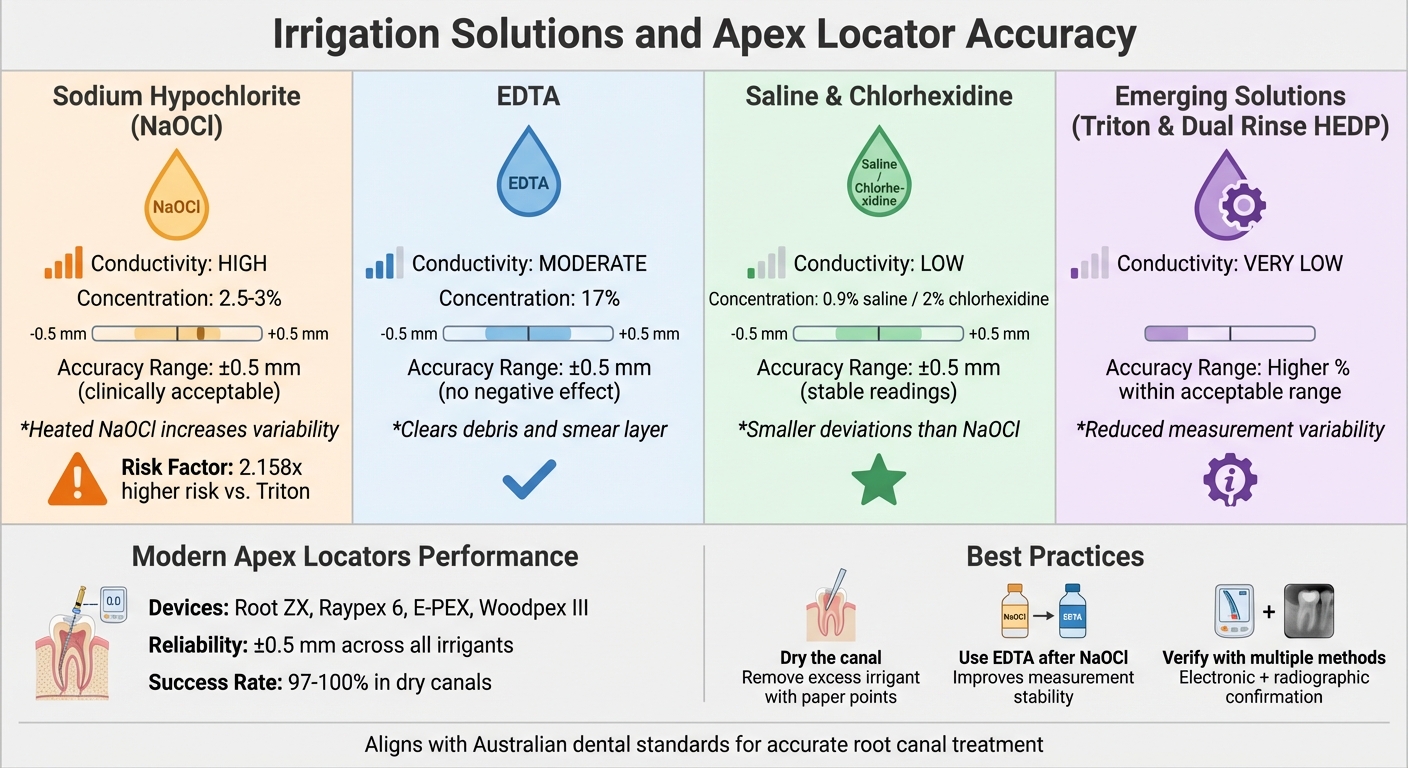
- NaOCl (Sodium Hypochlorite): High conductivity can cause slight measurement deviations but typically stays within ±0.5 mm of accuracy. Heated NaOCl increases variability.
- EDTA (Ethylenediaminetetraacetic Acid): Clears debris and smear layers without affecting accuracy.
- Saline and Chlorhexidine: Provide stable readings due to lower conductivity.
- Emerging Solutions: Low-conductivity irrigants like Triton and Dual Rinse HEDP reduce measurement variability.
Key Takeaways:
- Modern apex locators like Root ZX and Raypex 6 remain reliable across irrigants, with measurements usually within ±0.5 mm.
- Drying the canal, managing excess irrigants, and using EDTA after NaOCl improve accuracy.
- Verifying readings with multiple methods ensures precise working length determination.
These practices align with Australian dental standards, ensuring accurate and effective root canal treatments.
How Different Irrigation Solutions Affect Apex Locator Accuracy in Root Canal Treatment
How Different Irrigation Solutions Affect Apex Locator Accuracy
Sodium Hypochlorite and High Conductivity Issues
Sodium hypochlorite (NaOCl) is known for its high electrical conductivity, which can influence apex locator readings. A comparative study using the Root ZX device revealed that 2.5% NaOCl caused significantly larger differences in working length measurements compared to 0.2% chlorhexidine or 0.9% saline (p = 0.024). However, all readings still fell within the clinically acceptable range of ±0.5 mm [4]. Another study comparing the E-PEX and Root ZX II devices found that even with 3% NaOCl, measurements remained within 0.5 mm of the true length in all cases. This suggests that modern multi-frequency apex locators can adjust for the challenges posed by high-conductivity solutions [1][4].
That said, higher concentrations of NaOCl, combined with elevated temperatures that further increase conductivity, can lead to greater variability in measurements. This underlines the importance of carefully managing NaOCl use to minimise potential inconsistencies.
Comparing Different Irrigation Solutions
Irrigants like EDTA, chlorhexidine, and saline tend to provide more stable readings compared to sodium hypochlorite. Certain devices, such as the Raypex 6, have shown consistently high accuracy across various irrigant conditions [2]. The Root ZX Mini, for instance, demonstrated strong agreement between electronic and actual lengths in both dry and saline-irrigated canals, with no significant differences observed (p > 0.05) [2].
Emerging low-conductivity solutions are showing promise as alternatives to traditional irrigants. In a 2025 study, devices like the Woodpex III Gold Plus, EndoRadar Pro, and X-Smart Pro+ were tested, revealing that NaOCl posed a 2.158 times higher risk of producing readings outside the acceptable range compared to Triton (p = 0.036) [3]. Continuous chelation irrigants, such as Dual Rinse HEDP, and low-conductivity solutions like Triton were associated with a higher percentage of measurements within the acceptable range when compared to NaOCl [3]. Still, factors like canal anatomy and moisture levels also play a significant role in measurement accuracy.
How Canal Anatomy and Moisture Affect Readings
Beyond the conductivity of the irrigant, canal anatomy and moisture levels introduce additional complexities. Features like curved canals or wide apical openings can amplify the effects of irrigants, particularly when excess moisture from solutions such as NaOCl or saline is present. This often leads to inconsistent electronic length measurements (p < 0.05) [2]. For example, while the Root ZX Mini generally performs reliably in dry or saline-irrigated canals, it tends to show more variability in curved or wet canals. On the other hand, devices like the Raypex 6 and Apex ID maintain stable readings even in curved canals irrigated with NaOCl or EDTA [2].
Excess moisture can increase conductance throughout the canal system, resulting in unstable or shorter readings [1][2]. Despite this, modern apex locators such as the E-PEX and Root ZX II have demonstrated accuracy within 0.5 mm even under wet conditions [1]. Dry canals remain the gold standard for reliable measurements, with success rates ranging from 97% to 100%. While wetter conditions may introduce some variability, the measurements still typically stay within clinically acceptable limits [2].
Practical Solutions to Improve Apex Locator Accuracy
Adjusting Sodium Hypochlorite Use
The concentration of sodium hypochlorite (NaOCl) used during root canal procedures can significantly impact the accuracy of an apex locator. Studies suggest that concentrations between 2.5% and 3% provide reliable results, even though they may show slight deviations compared to saline or 2% chlorhexidine solutions [4]. To maintain accuracy, it’s crucial not to overfill the canal during measurement. Thorough irrigation followed by the removal of excess solution with paper points ensures the canal walls remain moist but not overly saturated [2].
Temperature also plays a part. Heated NaOCl increases conductivity, which can lead to more variability in measurements [4]. To avoid this, stick to room‑temperature NaOCl. If inconsistencies arise, remove any extra irrigant, dry the canal with paper points, and remeasure, ensuring the file maintains firm contact with the canal walls. These steps create a solid foundation for further refinements in measurement accuracy.
Using EDTA After Sodium Hypochlorite
Once NaOCl has been managed effectively, following it up with a 17% EDTA solution can improve conditions for accurate readings. EDTA helps clear the smear layer and inorganic debris, which might otherwise interfere with electrical measurements. Research shows that EDTA does not negatively affect apex locator accuracy, with most readings staying within ±0.5 mm of the actual working length when using modern devices [1]. Apply EDTA for 1–2 minutes, then aspirate the solution, leaving the canal moist but free of pooling. This process ensures a clean environment that supports stable and reliable impedance detection.
Selecting Low-Conductivity Solutions for Confirmation
If adjustments to NaOCl and the use of EDTA still don’t yield consistent results, switching to a low-conductivity solution like 0.9% saline or 2% chlorhexidine can help. Studies involving the Root ZX device have shown that these solutions produce smaller deviations compared to NaOCl [4]. To use them effectively, irrigate with the chosen solution, remove any excess, and ensure the file is immersed in a thin film of liquid rather than a pooled area to prevent short-circuiting.
Emerging low-conductivity systems, such as Triton and Dual Rinse HEDP, are also showing promise in providing stable readings. For example, NaOCl has been found to increase deviation risks by a factor of 2.158 compared to Triton (p = 0.036) [3]. Regardless of the irrigant used for confirmation, always validate electronic measurements with a working-length radiograph, especially in cases involving apical resorption, open apices, or irregular canal anatomy [4][5]. These practices align well with contemporary Australian endodontic standards, promoting both accuracy and adherence to professional guidelines.
Technique Adjustments for Better Accuracy
Preparing the Canal Environment
To optimise the use of an apex locator, start by pre-flaring the coronal and mid-root segments. This creates a consistent canal shape, reducing interference. Begin by achieving patency with a small stainless-steel K-file (typically size 8–10) to the estimated working length. Then, use orifice openers or nickel-titanium rotary files to widen the coronal third of the canal [4][6]. Establishing a smooth glide path with a K-file up to size 15–20 can minimise file binding and improve electrical contact. This step is effective regardless of whether the canal contains sodium hypochlorite, EDTA, chlorhexidine, or saline [3][4][7]. Research consistently shows that pre-flaring improves the accuracy of electronic working length measurements, often achieving values within ±0.5 mm of the actual length [3][4].
After irrigation, carefully manage excess solution. The goal is to keep the canal moist without flooding it. Use a side-vented needle to suction 1–2 mm short of the working length, and blot the canal walls with paper points to remove pooling while maintaining moisture [4][7]. Both over-drying and excessive flooding can lead to unstable readings [3][4][7][6]. Modern devices like Root ZX, Root ZX II, iPex, and Woodpex III are designed to deliver accurate readings (within ±0.5 mm) when moisture is balanced [3][4][7]. These adjustments complement earlier irrigation steps, collectively improving the reliability of measurements.
Proper File Selection and Insertion
For initial electronic working length determination, use small to medium stainless-steel K-files, typically sizes 10–15. These are well-suited for navigating narrow canals and reaching the apical region without creating ledges [3][4][7]. In wider canals, a slightly larger file (size 20–25) that fits loosely in the apical third can help maintain stable contact with dentine and irrigant without binding at the foramen [3][4].
When advancing the file, proceed slowly using a watch-winding motion, keeping an eye on the apex locator display. As the indicator nears the apical area, pause and withdraw slightly to stabilise the reading [4][6]. Avoid aggressive advancement, as this can push the file beyond the foramen, particularly in cases with immature or resorbed apices. Such errors may trigger transient "over-apex" signals, leading to inaccurate length estimates [4]. Studies comparing manual hand-file techniques with "auto-stop" modes in endomotors show similar accuracy when files are advanced gradually until the device signals the apical limit [3][6]. After inserting the file, it’s wise to confirm measurements through multiple methods for added precision.
Verifying Measurements with Multiple Methods
To ensure consistent accuracy, it’s best to verify working length measurements using multiple methods. Start by taking electronic measurements in your primary working irrigant (commonly sodium hypochlorite), record the value, and then irrigate with EDTA or a neutral solution like saline. Blot the canal to a moist state and repeat the measurement [3][2][4]. If all readings fall within ±0.5 mm of each other, use the mean or the shortest value as the working length. Sodium hypochlorite often yields slightly longer readings due to its higher conductivity [3][4]. Although different irrigants may cause minor variations, modern apex locators generally provide clinically acceptable results (within ±0.5 mm) [2][4][7].
Evidence supports using the apex locator as the primary tool for determining working length, with periapical radiographs and tactile feedback serving as confirmatory methods [4][5]. A typical clinical workflow might look like this: estimate the working length from a pre-operative radiograph → perform access, pre-flaring, and irrigation → determine the electronic working length in a moist canal → take a radiograph with the file positioned at the electronic working length → adjust the length if the radiograph or tactile feedback (such as apical "tug-back" during cone fitting) suggests minor corrections [4][5]. For Australian clinicians, modern apex locators are as reliable as radiographs for determining working length. However, radiographs remain essential for evaluating canal anatomy, curvature, and proximity to vital structures [4][5].
sbb-itb-2be92ed
How to Use J Morita ZX Apex Locator
Applying These Methods in Australian Dental Practices
Incorporating these approaches into Australian dental practices ensures that the benefits of precise irrigant management and refined techniques are effectively integrated into everyday clinical work.
Following Australian Clinical Standards
Australian dentists operate under the guidance of the Dental Board of Australia‘s Code of Conduct and must comply with AHPRA standards when determining working length electronically. This includes adhering to evidence-based protocols and maintaining detailed clinical records. These records should include key information such as the apex locator reading, file size, irrigant used, reference point, and radiographic confirmation.
Additionally, practitioners must follow state radiation safety regulations and ARPANSA guidelines to minimise exposure. Modern apex locators are compatible with commonly used irrigants like sodium hypochlorite, chlorhexidine, saline, and EDTA, making them both versatile and safe for routine use [4].
These standards provide a solid framework for integrating advanced endodontic systems into clinical practice.
Using Modern Endodontic Equipment
Building on these clinical standards, modern endodontic systems bring an extra layer of consistency to procedures. Many Australian dental practices now utilise advanced endodontic motors with built-in apex locators. Devices such as Root ZX, X-Smart Pro+, EndoRadar Pro, and iPex have become staples in these settings. Research supports the reliability of integrated apex locator systems, showing they can determine working lengths with a precision of ±0.5 mm, regardless of the irrigant used [3][6].
Clinics like Complete Smiles Bella Vista (https://completesmilesbv.com.au), which prioritise cutting-edge technology and techniques, can incorporate these protocols seamlessly into their endodontic routines. Standardising the sequence of irrigants – using sodium hypochlorite during instrumentation, EDTA for removing the smear layer, and finishing with a low-conductivity rinse – ensures consistent and accurate measurements. Furthermore, training staff in proper clip placement, selecting the right file, and recognising unstable signals (often caused by bubbles, debris, or excessive irrigant) enhances both treatment precision and patient safety. This approach aligns with Australian regulatory standards for evidence-based, modern endodontic care [1][3][7].
Conclusion
Determining the precise working length during endodontic procedures hinges on understanding how irrigants affect the accuracy of electronic apex locators. Studies consistently show that modern devices like Root ZX, E-PEX, and Woodpex III deliver reliable measurements within ±0.5 mm, even when using irrigants such as sodium hypochlorite, EDTA, chlorhexidine, or saline. Although high-conductivity irrigants can introduce slight variations, the readings generally remain dependable for clinical applications [3] [4].
To achieve the best results, adopting evidence-based practices is essential. For instance, using EDTA after sodium hypochlorite helps minimise residual conductivity, while choosing low-conductivity solutions for final measurements enhances precision. Additionally, cross-verifying working length through multiple methods further ensures accuracy. These refined techniques not only improve outcomes but also align with local clinical standards, reinforcing the importance of precision in endodontic care.
FAQs
Does sodium hypochlorite impact the accuracy of apex locators?
Yes, sodium hypochlorite can impact the accuracy of apex locators. Since it’s a conductive solution, it can disrupt the electronic signals used to determine root canal length, potentially leading to an overestimation of the canal’s measurement.
To reduce errors, make sure your apex locator is calibrated regularly and follow proper protocols during root canal procedures. Being aware of how irrigation solutions like sodium hypochlorite interact with these devices can help achieve more accurate results in endodontic treatments.
Why should EDTA be used after sodium hypochlorite during root canal treatment?
Using EDTA following sodium hypochlorite during root canal treatment plays a key role in clearing the inorganic smear layer left behind after cleaning. This process not only boosts the disinfection by helping irrigants reach deeper into the canal system but also improves the canal’s sealing, contributing to more reliable long-term results.
How do low-conductivity solutions like Triton improve the accuracy of apex locators in root canal treatments?
Low-conductivity solutions like Triton play a key role in reducing electrical interference during root canal treatments. This reduction is crucial as it allows electronic apex locators to provide more precise measurements of the root canal’s length. Accurate measurements are vital for achieving effective treatment and reliable results. By incorporating these solutions, dentists can perform endodontic procedures with greater precision, leading to better outcomes and improved patient care.
Related Blog Posts
- Real-Time Feedback in Ultrasonic Endodontics
- How Ultrasonic Devices Manage Heat in Endodontics
- How Apex Locators Measure Root Canal Length
- Passive Ultrasonic Irrigation: Faster Root Canal Cleaning
Important Notice: Any surgical or invasive procedure carries risks. Before proceeding, you should seek a second opinion from an appropriately qualified health practitioner.
Individual results may vary. The information provided in this article is for educational purposes only and does not constitute medical advice.
Checkout Related Blogs




Get in touch with us
For more information, call us now to start feeling better. Or fill the form below to make appointment
The Latest News from Complete Smiles
How to Clean Clear Plastic Retainers
Checklist for Choosing Wearable Dental Devices
Checklist for Choosing Cloud AI Platforms in Dentistry
Complete Smiles Bella VistaAccepts All Major Health Funds, Including





