





What Is Piezoelectric Surgery?
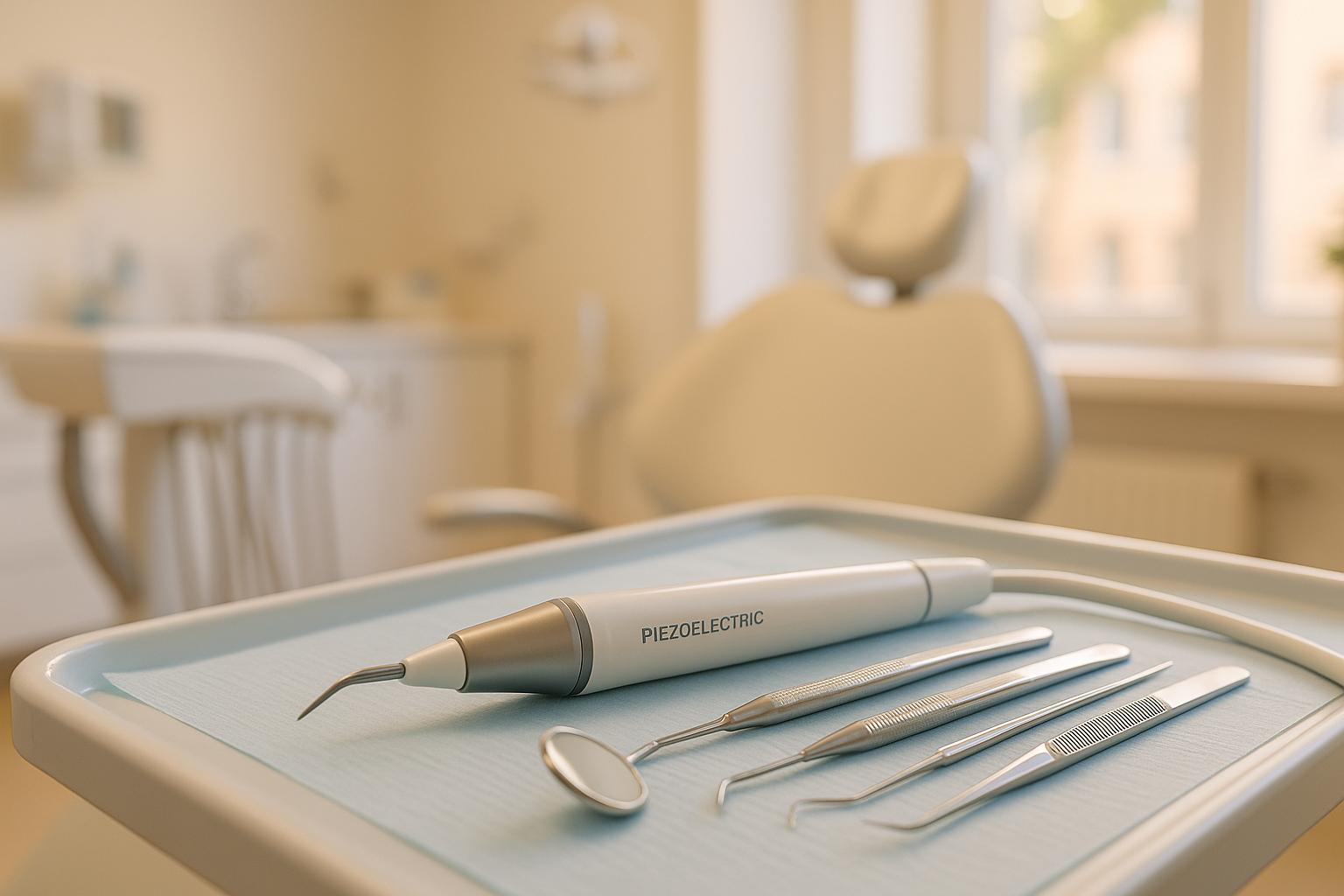
Piezoelectric surgery is a modern dental technique that uses ultrasonic vibrations to cut bone with high precision while protecting soft tissues. It’s especially useful for procedures like dental implants, sinus lifts, and tooth extractions. Unlike traditional tools, it offers improved safety, reduced bleeding, and faster recovery for patients. Here’s what you need to know:
- How it works: Ultrasonic vibrations (25–29 kHz) selectively cut bone but leave soft tissues unharmed, thanks to a unique tissue-selectivity mechanism.
- Key benefits: Reduced nerve damage (67% lower risk), less bleeding (25–30% less), and improved healing.
- Applications: Dental implants, sinus lifts, bone grafting, and complex extractions.
- Limitations: Procedures take longer, equipment is costly, and practitioners need specialised training.
This technology is reshaping dental care by offering safer and more precise alternatives to traditional methods.
How Piezoelectric Surgery Works
The Technology Behind Piezoelectric Surgery
Piezoelectric surgery operates by converting electrical energy into precise ultrasonic vibrations using specially designed transducers. These transducers generate ultrasonic waves in the range of 25–29 kHz, creating micromovements of 60–210 μm [1][4]. When electrical current flows through piezoelectric ceramics in the handpiece, these ceramics deform to produce controlled micro-movements, allowing for highly accurate bone cutting.
This technology also employs a cavitation effect, where tiny collapsing micro-bubbles help maintain a clear surgical field. Additionally, a continuous irrigation system cools the surgical site and removes debris, reducing the risk of thermal damage. Together, these mechanisms ensure a safer and more precise surgical process.
Safety Through Tissue Selectivity
One of the standout benefits of piezoelectric surgery is its ability to selectively cut mineralised tissues, like bone, while sparing soft tissues. This is possible because soft tissues require much higher frequencies – above 50 kHz – to be cut, which is outside the operating range of piezoelectric devices [4][7]. This precise targeting significantly enhances surgical safety. Research suggests that using this method can reduce blood loss by 25–30% and lower the risk of membrane perforation by more than 80% [4][7].
Equipment Features in Australian Practices
Piezoelectric devices used in Australian dental practices are designed with advanced features to maximise safety and efficiency. For instance, the NSK VarioSurg3 offers 50% more power compared to earlier models, enabling greater precision and shorter procedure times [6]. These tools come with ergonomic handpieces and auto-tuning feedback systems that adjust vibration frequencies based on the density of the tissue being worked on. The irrigation systems are fine-tuned to provide effective cooling and debris removal while maintaining excellent visibility.
Moreover, a wide variety of engineered tip designs allows dental professionals to choose the ideal tool for specific tasks, such as implant site preparation or complex extractions. These innovations make piezoelectric surgery less invasive, while the cavitation effect helps create a "bloodless field", improving visibility during procedures and enabling more precise surgical techniques.
PiezoElectric Surgery made easy with Piezosurgery white by Mectron
Applications of Piezoelectric Surgery in Dentistry
Piezoelectric surgery has transformed dental procedures by offering precise bone cutting while safeguarding soft tissues, enhancing both safety and outcomes.
Dental Implant Site Preparation
When preparing implant sites, piezoelectric surgery offers a significant advantage. Ultrasonic osteotomies promote better healing and improve implant stability. A study by da Silva Neto and colleagues, involving 30 patients, revealed higher implant-stability quotient values for sites prepared with piezoelectric tips compared to conventional drilling methods [5]. This technique preserves bone vascularity and minimises thermal damage, ensuring successful osseointegration.
Stefan Stübinger from the University of Basel’s Hightech Research Centre of Cranio-maxillofacial Surgery highlighted its potential:
"With respect to current and future innovative surgical concepts, piezoelectric surgery offers a wide range of new possibilities to perform customised and minimally invasive osteotomies." [5]
This precision extends to procedures like sinus lifts and bone grafting, where accuracy is critical.
Sinus Lifts and Bone Grafting
Sinus lift procedures have seen remarkable improvements with piezoelectric surgery. Traditional rotary techniques carry a 30% risk of Schneiderian membrane perforation, while piezoelectric methods reduce this risk to just 5–7% [10]. Clinical studies show that piezoelectric tools can cut mineralised tissue without harming the membrane, making separation far easier [10].
In bone grafting, piezoelectric surgery allows the collection of well-sized bone particles with minimal heat generation. This reduces the risk of thermal necrosis, ensuring healthier graft sites.
Tooth Extractions and Other Procedures
Complex extractions near sensitive structures have become safer with piezoelectric surgery. For example, Ueki and colleagues performed Le Fort I osteotomies on 14 patients using ultrasonic bone curettes, avoiding damage to critical areas like the descending palatine artery and nearby nerves [4].
Additional applications include:
- Nerve decompression: A study involving 10 lateralisation surgeries demonstrated safe nerve transposition with restored sensory function [10].
- Alveolar bone crest expansion: The controlled, gradual bone expansion reduces the risk of fractures.
- Crown lengthening: Precise bone contouring supports better healing and predictable tissue responses.
In another study, Gonzalez-Garcia and colleagues examined 17 vertical alveolar distractions in the posterior mandible. They found piezoelectric osteotomy made the procedure easier for surgeons and reduced intraoperative complications compared to conventional methods [10].
These advancements showcase the versatility of piezoelectric surgery in modern dentistry, making complex procedures more efficient and predictable.
sbb-itb-2be92ed
Benefits and Limitations of Piezoelectric Surgery
Knowing the pros and cons of piezoelectric surgery can help patients make better decisions about their dental care. While this technology offers some impressive advantages, it also comes with challenges that are worth discussing with a dental professional.
Key Benefits
Piezoelectric surgery stands out for its precision. It selectively targets hardened tissues, leaving soft tissues unharmed. Studies have shown it leads to significantly reduced pain, swelling, and fewer neurosensory issues – 4.7% compared to 61.6% with traditional methods [9][12][13].
Its gentle approach not only promotes faster recovery but also enhances the quality of bone in extraction sites. Additionally, the continuous irrigation and microstreaming reduce the risk of infection [9][11][12].
Surgical visibility is another strong point. The cavitation effect of the irrigation solution keeps the operative field clear, giving clinicians better control during procedures [4].
However, these benefits come with some trade-offs that should be considered.
Potential Limitations
One of the main drawbacks is the time factor – procedures take about 25.83% longer compared to conventional methods [3].
The equipment itself is costly, requiring a substantial initial investment. For dental practices, this can make piezoelectric devices less economical than traditional tools [4][14].
Practitioners also need specialised training to operate the equipment effectively. The learning curve may limit the availability of this technology in some locations [4][14].
From a technical standpoint, there’s a risk of thermal damage and cavitation artefacts if recommended protocols aren’t followed carefully [4].
Comparison Table
| Aspect | Piezoelectric Surgery | Conventional Methods |
|---|---|---|
| Precision | Selectively cuts mineralised tissue | Less selective; higher risk to soft tissues |
| Neurosensory Issues | 4.7% of patients [13] | 61.6% of patients [13] |
| Procedure Time | About 25.83% longer [3] | Generally faster |
| Equipment Cost | Higher initial investment [4][14] | Lower equipment costs |
| Training | Requires specialised skills [4][14] | Standard dental training |
| Patient Comfort | Less pain, swelling, and bleeding [9] | More post-operative discomfort |
| Bone Healing | Enhanced quality and quantity [12] | Standard healing outcomes |
| Surgical Visibility | Clearer field due to reduced bleeding [4] | Reduced visibility due to blood |
This table provides a clear comparison of the clinical benefits and practical challenges of piezoelectric surgery versus conventional methods.
Choosing the right approach depends on weighing these advantages against the limitations, considering both the patient’s needs and the specifics of the procedure.
Safety and Clinical Considerations in Australia
In Australia, piezoelectric surgery is governed by a robust regulatory framework designed to ensure patient safety and effective treatment outcomes. These guidelines help patients make well-informed decisions about their dental care while maintaining the high standards of modern Australian dentistry.
Professional Training and Expertise
Dentists performing piezoelectric surgery undergo specialised training that builds on their foundational qualifications. This training focuses on mastering ultrasonic vibrations, tissue selectivity, and the proper use of advanced equipment. The Dental Board of Australia requires all registered practitioners to adhere to its standards, codes, and guidelines [15]. Staying current with advanced surgical techniques and evolving technologies is a key part of maintaining professional competency.
Piezoelectric surgery involves a steep learning curve. Practitioners must understand how ultrasonic vibrations interact with tissues [20] and refine their techniques in pressure application and angulation. Many dental practices in Australia mandate comprehensive training before allowing practitioners to perform these procedures. For instance, a clinical study highlighted a 95% success rate in osteotomy procedures using piezoelectric surgery, underscoring the importance of expertise in achieving positive outcomes [20].
Regulatory Standards in Australia
The Therapeutic Goods Administration (TGA) oversees all medical devices used in Australian dental practices, including piezoelectric surgical tools. This regulatory body ensures that equipment meets international safety standards before it is approved for patient use, contributing to high clinical success rates.
The TGA aligns with standards set by the International Organisation for Standardisation (ISO) [16]. Whether manufactured locally or imported, all piezoelectric devices must comply with TGA regulations. Device sponsors, such as importers or manufacturers, are responsible for registering their equipment in the Australian Register of Therapeutic Goods (ARTG) before it can be legally supplied [15]. This process involves thorough safety testing and documentation.
For dental practitioners, this regulatory framework simplifies the process of selecting equipment. Devices already registered in the ARTG require no additional registration by the practitioner [15]. However, practitioners must stay informed about current legal requirements for medical device use [16]. The system also accommodates custom applications. For example, if a practitioner uses ARTG-approved materials to create surgical guides, these guides may not need separate registration, provided the base materials are compliant [15].
Patient Selection Criteria
Beyond equipment regulations, careful patient evaluation is essential for achieving the best outcomes. Bone quality and quantity are key considerations, as piezoelectric surgery excels in performing precise osteotomies while minimising bone loss [18]. This makes it particularly effective for patients with limited bone volume or those requiring implants in areas where aesthetics are a priority.
Soft tissue characteristics also play a role. The technology’s ability to protect soft tissues is especially beneficial for patients with thin gingival phenotypes or limited keratinised tissue. This precision ensures that the procedure is minimally invasive and tailored to the needs of the individual [17].
A patient’s medical history is another critical factor. Those with compromised healing or on medications affecting bone metabolism may benefit from the gentler, less traumatic approach of piezoelectric surgery. Additionally, complex cases requiring highly accurate cuts and precise bone reshaping are particularly suited to this technology [17].
A structured risk assessment, similar to those used in immediate implant placement, can guide patient selection. Factors like gingival margin position, facial bone wall thickness, and infection status can help determine whether piezoelectric surgery is the most suitable option [19]. This thorough evaluation ensures that the procedure delivers tailored, optimal results for each patient.
Conclusion
Piezoelectric surgery is reshaping dental care by enabling safer and more precise bone cutting. Using ultrasonic vibrations (24–29 kHz), this technology achieves accurate bone removal while safeguarding surrounding soft tissues [3].
Key Takeaways
Piezoelectric surgery offers more than just precision. Patients benefit from less swelling, reduced pain, and quicker recovery times compared to traditional drilling methods [8]. Its ability to selectively cut hard tissues while sparing soft tissues enhances safety during procedures [22].
These measurable benefits highlight the technology’s practical impact.
"The great advantage of piezo surgery in dentistry is that it is selectively effective for hard substances such as bone and teeth: while the surrounding soft tissue absorbs the vibration of the predominantly metallic instruments and ‘vibrates along’, calcified tissue is selectively ablated for specific preparation of bone."
- Christian Kurz [21]
The clinical advantages are clear. For example, in sinus lift procedures, the risk of Schneiderian membrane perforation drops significantly – from 30% to just 7% – when piezoelectric techniques are used [2].
In Australia, the Therapeutic Goods Administration (TGA) ensures piezoelectric devices meet stringent international safety standards. This regulatory oversight, combined with specialised practitioner training, supports the high success rates reported in clinical studies. The technology is especially useful in cases requiring micrometric precision, such as patients with limited bone volume or specific aesthetic needs.
A Step Towards Modern Dentistry
Piezoelectric surgery represents a significant leap forward in dental practice. It addresses many limitations of traditional tools, offering greater control and safety in delicate anatomical areas [2]. Its versatility spans a range of applications, from preparing implant sites to performing sinus lifts and extractions, making it an essential tool in modern dentistry.
The bloodless surgical field provided by this technology enhances visibility during procedures, while reduced trauma promotes faster healing and a quicker return to daily life [8]. As more dental practices in Australia adopt piezoelectric technology, patients can look forward to more comfortable treatments and better outcomes.
This advancement underscores dentistry’s dedication to patient-focused, evidence-based care. Piezoelectric surgery exemplifies the progress of modern medicine, achieving superior results with less invasive methods.
FAQs
How does piezoelectric surgery improve patient recovery and comfort compared to traditional dental surgery?
Piezoelectric surgery is known for offering a gentler alternative to traditional dental surgery, often leading to reduced post-operative pain, swelling, and jaw stiffness. While the procedure might take a bit more time, the benefits in recovery often outweigh this.
This technique focuses on being as minimally invasive as possible, which can support quicker healing and a smoother recovery process. Many patients report feeling more at ease and satisfied with their experience, making it an appealing option for specific dental treatments.
What training do dentists need to perform piezoelectric surgery?
Dentists need specialised training to use piezoelectric surgery effectively. This training often involves hands-on courses, workshops, or continuing education programs designed to help them master the technique, ensure patient safety, and understand its various applications.
Key topics covered in these programs include precise bone cutting, preservation of soft tissue, and specific procedures like sinus lifts and periodontal surgeries. These courses are typically short, lasting one to three days, but provide dentists with the essential skills to confidently integrate piezoelectric technology into their clinical practice.
What are the potential risks or complications of piezoelectric surgery in dentistry?
While piezoelectric surgery is known for its precision and safety, it’s not entirely without risks. Some patients may experience temporary neurosensory disturbances, which are relatively common. There’s also the possibility of haemorrhage or, in certain cases, the formation of oroantral communications – an opening between the mouth and sinus.
The technique itself requires a high level of skill, and less experienced practitioners might unintentionally cause soft tissue damage, such as harm to nerves or blood vessels. Another factor to consider is the longer operation time that’s often associated with this method, which could slightly raise the risk of complications.
If you’re feeling unsure or have specific concerns, don’t hesitate to speak with your dentist or oral surgeon. They can offer personalised guidance and help you understand how this procedure aligns with your needs.
Related Blog Posts
- What Is Minimally Invasive Cavity Preparation?
- Flapless Implant Surgery: Benefits and Process
- Advances in Gum Grafting Materials and Techniques
- Minimally Invasive Tooth Extraction Techniques
Important Notice: Any surgical or invasive procedure carries risks. Before proceeding, you should seek a second opinion from an appropriately qualified health practitioner.
Individual results may vary. The information provided in this article is for educational purposes only and does not constitute medical advice.
Checkout Related Blogs




Get in touch with us
For more information, call us now to start feeling better. Or fill the form below to make appointment
The Latest News from Complete Smiles
How to Clean Clear Plastic Retainers
Checklist for Choosing Wearable Dental Devices
Checklist for Choosing Cloud AI Platforms in Dentistry

Complete Smiles Bella VistaAccepts All Major Health Funds, Including





