





Ultimate Guide to Ergonomics for Dental Hygienists
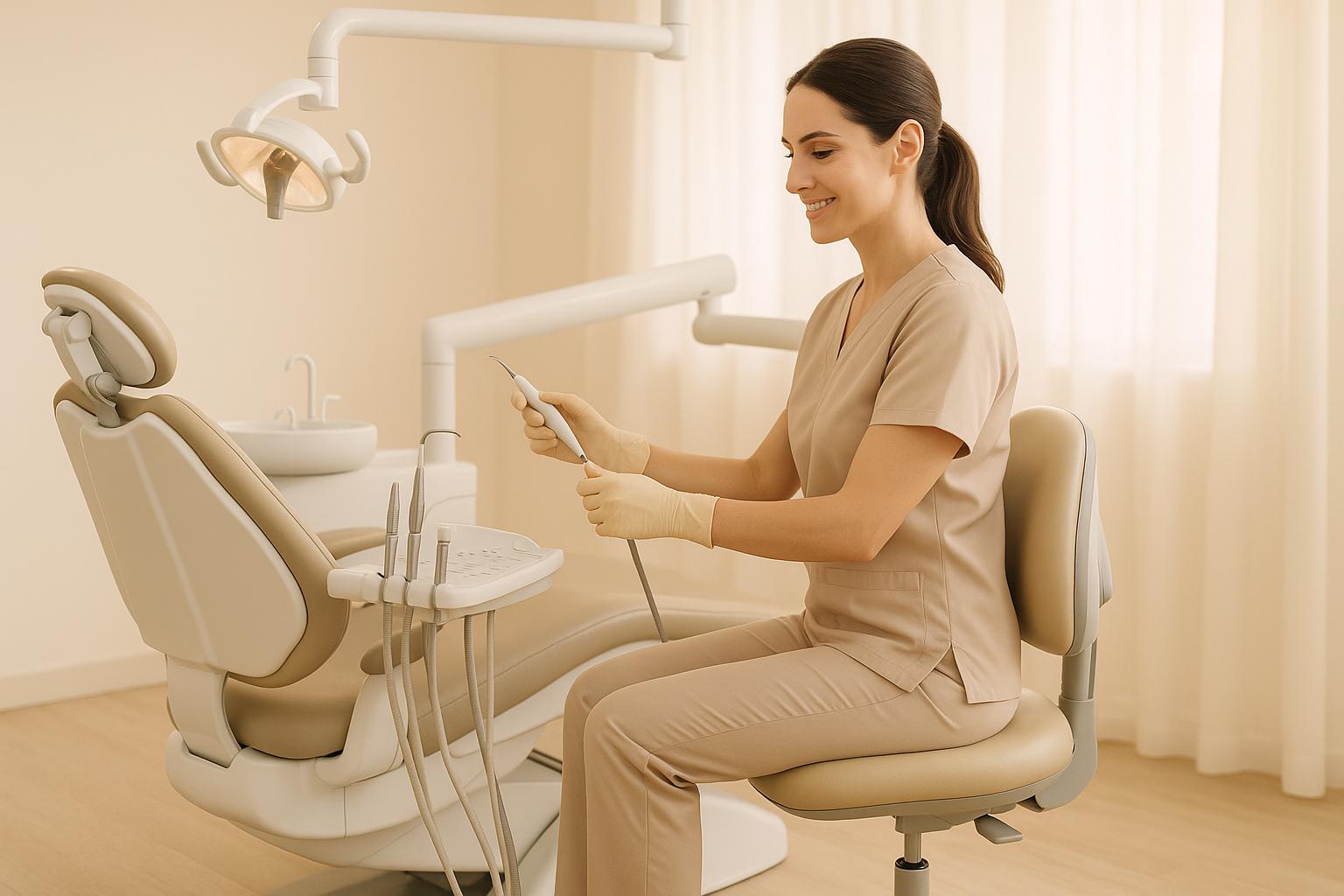
Ergonomics is vital for dental hygienists to prevent musculoskeletal pain and injuries caused by static postures, repetitive movements, and awkward angles. Proper posture, effective workspace setup, and regular breaks can help maintain physical health and career longevity. Here’s what you need to know:
- Posture Matters: Keep your spine straight, shoulders relaxed, and wrists aligned. Adjust your chair and patient’s position to reduce bending or twisting.
- Workspace Setup: Arrange tools, trays, and lighting to minimise reaching or straining. Use ergonomic seating like saddle stools for better support.
- Take Breaks: Short 20–30 second breaks every 20 minutes can ease muscle tension and improve focus.
- Use the Right Tools: Lightweight instruments with wide, textured handles reduce hand fatigue and strain.
- Patient Positioning: Adjust the patient’s chair for easy access without compromising your posture.
- Teamwork: Work efficiently with assistants to reduce physical demands and improve workflow.
Musculoskeletal disorders are common in the field, but following these ergonomic principles can lower the risk by up to 50%. Simple adjustments to your workspace and habits can safeguard your health and extend your career.
Hygienist Ergonomics: New Research & Strategies to Maintain Healthy Hands, Elbows & Shoulders
Basic Principles of Ergonomics in Dental Hygiene
The principles of ergonomics are essential for building a long-lasting and healthy career in dental hygiene. These guidelines focus on maintaining body positions that minimise strain while enabling you to carry out clinical tasks efficiently. They form the foundation for workplace adjustments and injury prevention strategies that will be explored further.
Neutral Body Posture
Neutral body posture is all about keeping your body aligned during clinical work. Think of it as your baseline position for reducing strain and improving control. Start with an upright spine, a slightly forward-tilted head, relaxed shoulders at an even level, and elbows bent close to 90°. This setup helps prevent unnecessary stress on your body.
Pay attention to your wrists – keep them straight and aligned with your forearms to avoid repetitive strain injuries. When seated, position your hips slightly higher than your knees, with your feet flat on the floor. This not only supports your spine but also reduces lower back pressure.
Your chair and the patient’s position play a big role in maintaining this alignment. Adjust your chair to tilt slightly downward, encouraging an upright posture. Similarly, position the patient’s chair and headrest so the work area comes to you, not the other way around. Avoid bending or twisting unnecessarily.
Sticking to a neutral posture isn’t just about feeling comfortable in the moment. Studies show that dental hygienists who consistently use these principles experience far fewer musculoskeletal problems over their careers. Even small, repeated deviations from this posture can lead to chronic pain and injuries over time.
Taking Micro-Breaks and Moving Regularly
Micro-breaks are a simple yet effective way to combat fatigue and prevent strain on your muscles. These short pauses in your routine can restore blood flow, ease muscle tension, and stop strain from building up to the point of injury.
Research recommends taking 20–30 second micro-breaks every 20 minutes during clinical tasks [1]. These breaks can be easily woven into your workflow – whether you’re switching arches, waiting for anaesthetic to take effect, or simply transitioning between tasks. The key is consistency. Frequent, short breaks are more effective than occasional, longer pauses.
During these breaks, try simple movements like neck rolls, shoulder shrugs, or standing stretches. These quick exercises improve circulation and relieve tension. Timing matters, too. Stretching before work preps your muscles for the day, micro-breaks during procedures keep tension at bay, and post-work stretches help your body recover from the physical demands of the job.
Some dental practices have even started incorporating guided stretching routines into daily schedules, recognising that staff wellbeing directly impacts both job satisfaction and patient care. This shift reflects a growing awareness of how ergonomic habits benefit the entire team.
Beyond physical health, regular movement also sharpens mental focus. A quick micro-break can refresh your concentration during long procedures, improving both your comfort and your performance. If you notice tension creeping in, take it as a signal to pause, reset your posture, and return to work with renewed energy.
Ergonomic Workplace and Equipment Setup
Applying ergonomic principles to your workspace and equipment setup is a practical way to reduce physical strain and support your overall health. A thoughtfully designed operatory can help prevent chronic musculoskeletal pain by aligning with your body’s natural movements.
Setting Up Your Operatory Layout
Ergonomics begins with the arrangement of your dental chair, stool, trays, and lighting. Each element should minimise movements like reaching, bending, or twisting, which can build up into physical stress over time.
For instance, maintaining a clearance of 50–56 cm between the headrest and counter when the chair is supine allows you to move comfortably around the patient without awkward positioning[3]. Patient positioning also plays a critical role. For maxillary treatments, position the patient fully supine, tilt the headrest back, and ensure the chin is up. This setup keeps your elbows at a 90° angle and the occlusal plane tilted 10–20° behind vertical[1][3]. For mandibular work, adjust the chair to a semi-supine position, tilt the headrest forward, and position the mandibular plane about 30° above horizontal[1][3].
Instrument placement is equally important. Keep frequently used tools – like suction, air/water syringes, and ultrasonic scalers – within arm’s reach to avoid unnecessary stretching or twisting[1][3]. Mobile or swing-arm trays offer added flexibility, enabling you to adjust your workspace instead of straining to adapt to fixed equipment[3].
Lighting also needs careful consideration. Position the dental light above and slightly in front of the patient’s mouth to maintain an upright posture. The light intensity should balance with the room lighting at a ratio no greater than 3:1.6 to avoid eye strain[2]. Adjustable LED lights, designed to eliminate shadows, provide the clarity needed for efficient and comfortable work.
These adjustments create a workspace that naturally supports the ergonomic practices discussed earlier.
Choosing Ergonomic Seating
Your choice of operator stool can significantly impact your comfort and long-term health. An ergonomic stool helps maintain a neutral posture, reduces strain on your spine and legs, and allows you to move freely around the operatory.
Saddle stools have become increasingly popular among Australian dental professionals. Their design promotes a neutral spine position and an open hip angle, reducing lower back strain[7][4]. They also encourage an upright posture and allow your thighs to move easily beneath the dental chair, making them particularly useful for lengthy procedures.
Traditional stools remain a solid option when properly configured. Look for stools with adjustable height, lumbar and thoracic support, and a seat that encourages an upright posture[2][5]. Features like a slightly downward-tilted seat, adjustable backrests, and arm supports can enhance comfort and stability.
Regardless of the stool type, ensure your feet rest flat on the floor or a foot ring, with hips slightly higher than knees to maintain spinal alignment. The stool should also allow smooth movement around the operatory without requiring you to stretch or strain.
| Seating Type | Key Features | Primary Benefits |
|---|---|---|
| Saddle Stool | Upright posture design, back support | Reduces leg and back strain, supports spine[7][4] |
| Traditional Stool | Adjustable height, lumbar support | Familiar design, customisable support[7] |
Selecting Comfortable Tools and Instruments
The tools you use daily can greatly affect hand and wrist fatigue. Lightweight, ergonomic instruments are essential for reducing repetitive strain.
Choose tools with large-diameter, textured handles to minimise pinch force and hand fatigue[3][8]. A wider grip spreads pressure across your hand, while textured surfaces improve control without requiring excessive grip strength.
Handpieces also deserve attention. Opt for low-vibration models that fit comfortably in your hand[3][8]. Balanced weight distribution and a good fit can reduce strain and prevent long-term issues like nerve or circulation problems.
Instruments with colour coding or tactile markers can streamline your workflow by helping you quickly identify the right tool, reducing the time spent in awkward positions[3][8]. Additionally, properly fitted gloves are crucial. Tight gloves can restrict circulation and increase fatigue, while loose gloves may hinder dexterity. The right fit supports natural hand movement and provides the tactile feedback necessary for precise work[3].
Even minor choices, like slightly heavier instruments, can have a cumulative impact over time. Investing in ergonomic tools is a step toward sustaining your career and improving daily comfort.
At Complete Smiles Bella Vista, practitioners benefit from adjustable dental chairs, ergonomic stools, and lightweight instruments. Their commitment to staff training ensures that ergonomic principles are ingrained in everyday practice, enhancing both practitioner wellbeing and patient care.
sbb-itb-2be92ed
Proper Positioning Techniques
Building on the basics of workstation setup and maintaining a neutral posture, proper positioning techniques are essential for ergonomic dental hygiene. How you position yourself and your patient can significantly affect your comfort, work quality, and long-term career health. Let’s explore how refining both patient and operator positioning can help minimise strain.
Patient Positioning Techniques
Adjusting the patient’s position based on the treatment area is crucial for both their comfort and your ability to maintain a neutral posture. These adjustments also help reduce the risk of musculoskeletal strain.
- For maxillary treatments: Position the patient fully supine with the headrest tilted so their chin is raised. The occlusal plane should angle 10–20° behind vertical[1].
- For mandibular treatments: Set the patient at a 20–30° semi-supine angle, tilting the headrest forward slightly to bring the chin forward. The mandibular occlusal plane should elevate about 30° from horizontal[1].
Ensure the patient’s mouth aligns with your elbows to maintain a 90° bend in your arms[1]. Clear verbal instructions, like "turn your head slightly to the right" or "tilt your chin up a bit", can help achieve the ideal positioning while reducing unnecessary reaching or twisting[9].
Clock Positions for Operators
Using proper clock positioning is key to avoiding torso twisting and ensuring efficient access to all areas of the mouth.
- Right-handed practitioners: Work between the 9 and 12 o’clock positions. Use 12 o’clock for anterior access and 9 to 11 o’clock for posterior areas.
- Left-handed practitioners: Mirror these positions, typically operating between 4 and 11 o’clock[5].
Regardless of your dominant hand, always adjust your position to maintain an upright, neutral posture. Avoid stretching or twisting to reach challenging areas. Keep your feet flat on the floor or a foot ring, and allow your thighs to move freely under the patient chair for better lower back support[5].
Working as a Team for Better Ergonomics
Ergonomics isn’t just about individual positioning – it’s about teamwork too. A four-handed dentistry approach can reduce physical strain and improve workflow efficiency. Partnering effectively with a dental assistant enhances precision while easing physical demands.
For optimal teamwork:
- The assistant should sit about 15–20 cm higher than the operator, with proper foot support for stability[5]. This height difference allows for smooth instrument transfers and effective suction management while helping the operator maintain good posture.
- Typically, the assistant works from the 2 to 4 o’clock position for right-handed operators, ensuring clear sight lines and seamless collaboration.
When both team members follow proper positioning protocols, tasks like instrument transfers become smoother, reducing repetitive movements. Effective suction management by the assistant also minimises hand and wrist fatigue for the operator. Additionally, the assistant can help stabilise the patient by gently supporting their head or retracting soft tissues, improving access and visibility during procedures[5].
Clear communication and standardised positioning practices between the operator and assistant are essential for maintaining ergonomic efficiency throughout treatment.
| Team Member | Optimal Position | Primary Responsibilities | Ergonomic Benefits |
|---|---|---|---|
| Operator | 9–12 o’clock (right-handed) | Direct treatment | Neutral posture, reduced strain |
| Assistant | 2–4 o’clock, 15–20 cm higher | Instrument transfer, suction | Reduced reaching, improved flow |
In clinics like Complete Smiles Bella Vista, teamwork is a central focus of ergonomic practices. This collaborative approach not only supports long-term career health for practitioners and assistants but also enhances the quality of care provided to patients.
Preventing and Managing Work-Related Injuries
Work-related injuries are a major challenge for dental hygienists, who are particularly prone to musculoskeletal disorders [1]. Taking proactive steps to address these risks is key to ensuring long careers and maintaining high-quality patient care.
Common Risk Factors for Musculoskeletal Disorders
Dental hygienists often face risks linked to prolonged static postures, repetitive hand movements, and awkward body positions. These factors significantly increase the likelihood of developing chronic musculoskeletal disorders [1][6]. Poorly designed seating and disorganised instrument layouts can force practitioners into unnatural positions, leading to muscle fatigue and persistent pain [1]. According to global research, as many as 64% of dental hygienists report experiencing work-related musculoskeletal pain or injuries during their careers [6].
Prevention Strategies
Reducing these risks starts with targeted prevention strategies. Ergonomic training is a cornerstone, helping practitioners adopt proper positioning techniques and recognise early signs of strain [1]. Simple chairside stretches – like shoulder rolls, neck tilts, and wrist flexion – are easy to incorporate between patient appointments and can make a big difference.
To minimise strain, practitioners should focus on using wrist-forearm motion instead of excessive finger movements during instrumentation [1]. Scheduling strategies, such as alternating between demanding procedures and less intensive recare appointments, can also help manage operator fatigue [1]. Even glove selection matters – ill-fitting gloves can either compromise instrument control or restrict circulation, so choosing the right fit is essential [1].
Ergonomic tools and equipment are equally important. For example, prism loupes allow hygienists to maintain a neutral neck position while working, reducing strain on the neck and lower back [4]. Adjustable chairs with proper lumbar support and a well-organised workspace further help practitioners maintain good posture and avoid unnecessary physical stress.
Managing Existing Injuries
When injuries do occur, early intervention is critical. Physiotherapy, which may include targeted exercises and manual therapy, is often recommended to address specific musculoskeletal issues [1]. Physiotherapists can design personalised treatment plans to manage symptoms and correct the movement patterns that contribute to injuries.
Workplace ergonomic assessments by occupational health professionals can identify and mitigate risk factors in the work environment [1]. Adjustments to patient scheduling, more frequent breaks, or temporary changes in treatment techniques may be necessary during recovery. Rest and specific exercises are essential for managing injuries, and consulting occupational health experts early can prevent minor issues from becoming major problems [6].
Ergonomic modifications to equipment and workflow can also support the healing process and help prevent re-injury [1]. Australian workplace health and safety standards emphasise the importance of ergonomic interventions in reducing the risks of musculoskeletal disorders [10]. Employers have a responsibility to provide safe working environments, which includes offering ergonomic equipment and regular training. Dental clinics, such as Complete Smiles Bella Vista, can play a key role in promoting staff well-being by integrating ergonomic practices into their operations [1].
Key Takeaways
Ergonomics plays a crucial role in protecting both your health and career by reducing work-related musculoskeletal pain. Adopting proper ergonomic practices is key to maintaining long-term success in dental hygiene.
The cornerstone of effective ergonomics is maintaining a neutral posture. Aligning your spine, neck, and wrists can significantly lower the risk of injury. Even small adjustments can lead to noticeable improvements. For example, arranging instruments and equipment within easy reach helps you avoid unnecessary stretching or twisting. Opt for ergonomic seating, like saddle chairs or high-backed seats, to support proper posture and reduce strain on your legs and back. Additionally, using well-fitted gloves and loupes with adjustable declination angles can minimise physical stress. These strategies align with national safety standards and are designed to support your career health over the long term.
Incorporating regular 20–30 second micro-breaks into your routine and ensuring optimal patient positioning can further help you maintain a neutral posture and reduce physical strain.
Research shows that ergonomic interventions in dental settings can cut the risk of musculoskeletal disorders by up to 50% [10]. Not only do these practices prevent pain, but they also contribute to a sustainable and fulfilling career in dental hygiene.
Rather than adapting to poor working conditions, focus on making necessary adjustments to your workspace. In Australia, workplace health and safety standards require both employers and employees to identify and address ergonomic hazards. Dental practices have a responsibility to provide adjustable equipment, promote safe work habits, and ensure staff are trained in ergonomics.
FAQs
What are the common musculoskeletal issues dental hygienists experience, and how can ergonomic practices help prevent them?
Musculoskeletal problems like neck pain, shoulder strain, lower back issues, and carpal tunnel syndrome are common among dental hygienists. These challenges often stem from repetitive movements and staying in static postures for extended periods.
Here are some ways to help avoid these issues:
- Focus on posture: Keep your spine straight and avoid slouching to maintain proper alignment.
- Adjust your workspace: Set up dental chairs and equipment to minimise awkward movements like reaching or twisting.
- Choose ergonomic tools: Use instruments designed to ease the strain on your hands and wrists.
- Take breaks: Regularly stretch, move around, and shift your position to reduce stiffness and tension.
By weaving these ergonomic practices into your daily routine, you can lower the chances of discomfort or injury and support your physical health throughout your career.
What are some practical ways dental hygienists can take micro-breaks to reduce muscle strain during their workday?
Incorporating short breaks into your day is a simple yet powerful way to avoid muscle strain and support better posture. Try stepping away for 20–30 seconds every 20–30 minutes. Use this time to stretch areas like your neck, shoulders, and wrists, or stand up and give your arms and legs a gentle shake to ease any built-up tension.
Switching between sitting and standing positions during the day is another great habit to adopt, if your setup allows. Make sure your workspace is adjusted to reduce strain – this might include using tools like magnification loupes to avoid hunching forward. These small tweaks can have a noticeable impact on your comfort and overall well-being.
What should dental hygienists look for in ergonomic tools and chairs to stay comfortable and healthy?
When selecting ergonomic tools and seating, dental hygienists should focus on features that encourage proper posture and minimise strain during lengthy procedures. Opt for lightweight instruments with balanced designs and textured grips to help reduce hand fatigue. For seating, adjustable chairs with lumbar support and the ability to tilt or swivel are key to maintaining a neutral spine and alleviating back discomfort.
It’s also worth considering tools and chairs that can be customised to fit your unique needs and workspace. Choosing ergonomic equipment doesn’t just protect your physical health over time – it also improves comfort and efficiency in your daily practice.
Related Blog Posts
- Scope of Practice for Dental Hygienists in Australia
- How Wearables Help Prevent Dental Issues
- Orthodontic Sterilization Tools: Guide
- Ergonomic Handle Design: Benefits for Dental Practitioners
Important Notice: Any surgical or invasive procedure carries risks. Before proceeding, you should seek a second opinion from an appropriately qualified health practitioner.
Individual results may vary. The information provided in this article is for educational purposes only and does not constitute medical advice.
Checkout Related Blogs




Get in touch with us
For more information, call us now to start feeling better. Or fill the form below to make appointment
The Latest News from Complete Smiles
How to Clean Clear Plastic Retainers
Checklist for Choosing Wearable Dental Devices
Checklist for Choosing Cloud AI Platforms in Dentistry

Complete Smiles Bella VistaAccepts All Major Health Funds, Including





