





Titanium Implant Coatings: Nano vs. Micro Scale

When it comes to titanium dental implants, surface coatings are a game-changer. They transform inert titanium into bioactive surfaces that encourage faster bone growth and improve implant stability. Two main types of coatings dominate the conversation: nano-scale (1–100 nm) and micro-scale (1–10 µm). Here’s what you need to know:
- Nano-scale coatings work at a molecular level, improving protein interactions, promoting bone integration, and offering antibacterial properties. They can also deliver drugs like antibiotics directly to the implant site.
- Micro-scale coatings create rough textures for mechanical stability and strong bone interlocking. They’re the gold standard in clinical practice with proven long-term success rates exceeding 95%.
Key differences include:
- Size: Nano (<100 nm) vs. Micro (1–10 µm)
- Mechanism: Nano focuses on cellular bioactivity, while Micro relies on mechanical interlocking.
- Applications: Nano is promising for complex cases (e.g., diabetes), while Micro is reliable for routine use.
- Limitations: Nano coatings can delaminate and are costlier; Micro coatings are less effective in patients with systemic health issues.
Both approaches have their strengths. Micro-scale coatings remain the go-to for most patients, while nano-scale technology is emerging as a solution for more challenging cases. Together, they pave the way for hybrid designs that combine the best of both worlds.
Nano-Scale Coatings: Features and Benefits
What Are Nano-Scale Coatings?
Nano-scale coatings operate at dimensions below 100 nanometres, with surface roughness less than one micrometre [1][7]. These tiny structures are designed to mimic the intricate patterns found in natural bone tissue and cell membrane receptors [1][3]. This biomimicry allows them to interact directly with proteins and integrins, creating an ideal environment for cell attachment.
How Nano-Scale Coatings Are Prepared
The most common technique for creating nano-scale coatings is electrochemical anodisation. This method is used to form self-ordered titania nanotubes (TNTs) or nanopores [3][5]. During the process, a titanium implant acts as the anode, immersed in a fluoride-based electrolyte alongside a counter electrode. When a specific voltage is applied, well-ordered nanotube structures are formed.
Other methods include DC sputtering, magnetron sputtering, sol-gel techniques, and ion implantation. DC and magnetron sputtering deposit thin, uniform metallic films, such as silver, onto titanium surfaces, creating coatings with thicknesses ranging from 100 nm to over 500 nm [8]. Sol-gel techniques rely on chemical solutions to produce thin nanofilms or bioactive ceramic coatings, such as calcium phosphate [5][6]. Meanwhile, ion implantation embeds ions or nanoparticles – like silver or zinc – directly into the titanium, offering antibacterial and bone-growth properties [5][8].
Several companies are leading the way in nano-scale coating technology:
- Straumann (Basel, Switzerland) manufactures the SLActive implant, featuring a nanostructured surface to speed up osseointegration [2].
- Promimic (Gothenburg, Sweden) developed the HAnane Surface, which uses nanohydroxyapatite to stimulate bone-forming cells [2].
- Dentsply Sirona offers the Osseospeed surface, incorporating fluoride-treated nano-scale modifications [4].
- Nobel Biocare‘s TiUnite surface employs anodic oxidation to create micropores with nano-scale stabilisation for enhanced implant performance [4].
Benefits of Nano-Scale Coatings for Dental Implants
Nano-scale coatings provide a dramatic increase in surface area, which encourages faster and stronger bone integration [4][7]. For example, research indicates that TiO₂ nanotubes with a 15 nm diameter elicit an optimal response from osteoblasts and osteoclasts [4]. These coatings also improve surface wettability and energy. A titanium implant with a 530 nm silver nano coat (Ti-Ag5), for instance, reduces the water contact angle by 15% and boosts surface energy by 22% compared to uncoated titanium [8].
In addition to promoting integration, certain nano-structures – like spikes or high-aspect-ratio nanopillars – offer antibacterial properties. Through mechanobactericidal action, these structures physically disrupt bacterial cell membranes. For instance, nanopillars have been shown to achieve bactericidal rates of up to 87% against Pseudomonas aeruginosa and 72.5% against Staphylococcus aureus within 24 hours [3][7]. Similarly, nano-scale silver coatings demonstrate approximately 64.6% antibacterial activity against S. aureus without harming nearby cells [8]. This is crucial, as peri-implantitis affects over 20% of patients within 5–10 years of implant placement [5].
TiO₂ nanotubes further enhance functionality by enabling controlled local drug delivery. Antibiotics like gentamicin or vancomycin, anti-inflammatory agents such as ibuprofen, and growth factors like BMP-2 can be released directly into the peri-implant tissue [4][5]. These advanced capabilities highlight the unique advantages of nano-scale coatings, setting the stage for a comparison with micro-scale alternatives.
Micro-Scale Coatings: Features and Benefits
What Are Micro-Scale Coatings?
Micro-scale coatings work alongside nano-scale techniques to improve how implants mechanically interlock with bone. These coatings create surface textures with roughness levels between 1 and 10 µm, mimicking the natural structure of bone lacunae. Unlike nano-scale coatings, which operate on a much smaller scale (below 100 nm), micro-scale features form larger irregularities that encourage bone integration through well-understood biological processes [1][5].
In clinical implant dentistry, micro-scale coatings are often considered the "gold standard" because of their proven ability to support bone growth effectively.
"The roughness value in the micro-scale condition ranges between 1 and 10 µm; this roughness range represents the best interlocking reaction between mineralized bone and implants." – Wang et al. [1]
This mechanical interlocking plays a critical role in securing implants and ensuring their stability.
How Micro-Scale Coatings Are Prepared
The most common approach to creating micro-scale coatings is the Sandblasted, Large-grit, Acid-etched (SLA) method. This involves blasting the titanium surface with large-grit particles (250–500 µm) and then treating it with hydrochloric or sulphuric acid. The result is a rough, multi-level surface with distinct dips and micropits that improve bone attachment [4].
Another technique, anodic oxidation, creates micro-scale features like volcano-shaped micropores (~1–1.5 µm) [4]. Other methods include grit blasting with ceramic particles such as Al₂O₃, TiO₂, or ZrO₂, and titanium plasma-spraying, which can produce surface roughness levels exceeding 2 µm [1][6]. Research suggests that the optimal surface roughness for promoting bone attachment falls between 3.62 and 3.90 µm [3].
Each of these methods is designed to create implant surfaces that enhance stability and long-term success.
Benefits of Micro-Scale Coatings for Dental Implants
The textured surfaces created by micro-scale coatings have been shown to significantly improve clinical outcomes. For instance, micro-roughened titanium implants boast a 10-year survival rate of over 95%. A retrospective study of more than 500 SLA implants reported success rates of 97% or higher [4]. Similarly, anodised micro-scale implants have demonstrated a failure rate as low as 1.3%, with peri-implantitis rates of just 1–2% [5].
These results stem from the coatings’ ability to support direct bone growth on the implant surface while also encouraging bone to grow toward the implant. This two-way bone formation speeds up healing and enhances integration. The increased surface area distributes interfacial stress more effectively and promotes osteoblast differentiation, which helps minimise bone resorption [1][3]. Additionally, the scratch-resistant surfaces created by dual acid etching can withstand the high friction forces of surgical implantation without damage [6]. Over five years or more, vertical bone loss around micro-modified implants typically remains under 0.5–1 mm, highlighting their durability in the oral environment [4].
While nano-scale coatings focus on molecular-level interactions, micro-scale coatings achieve improved osseointegration through increased surface roughness and strong mechanical interlocking. Together, these features make micro-scale coatings a reliable choice for long-term dental implant success.
Nano vs. Micro Coatings: Direct Comparison
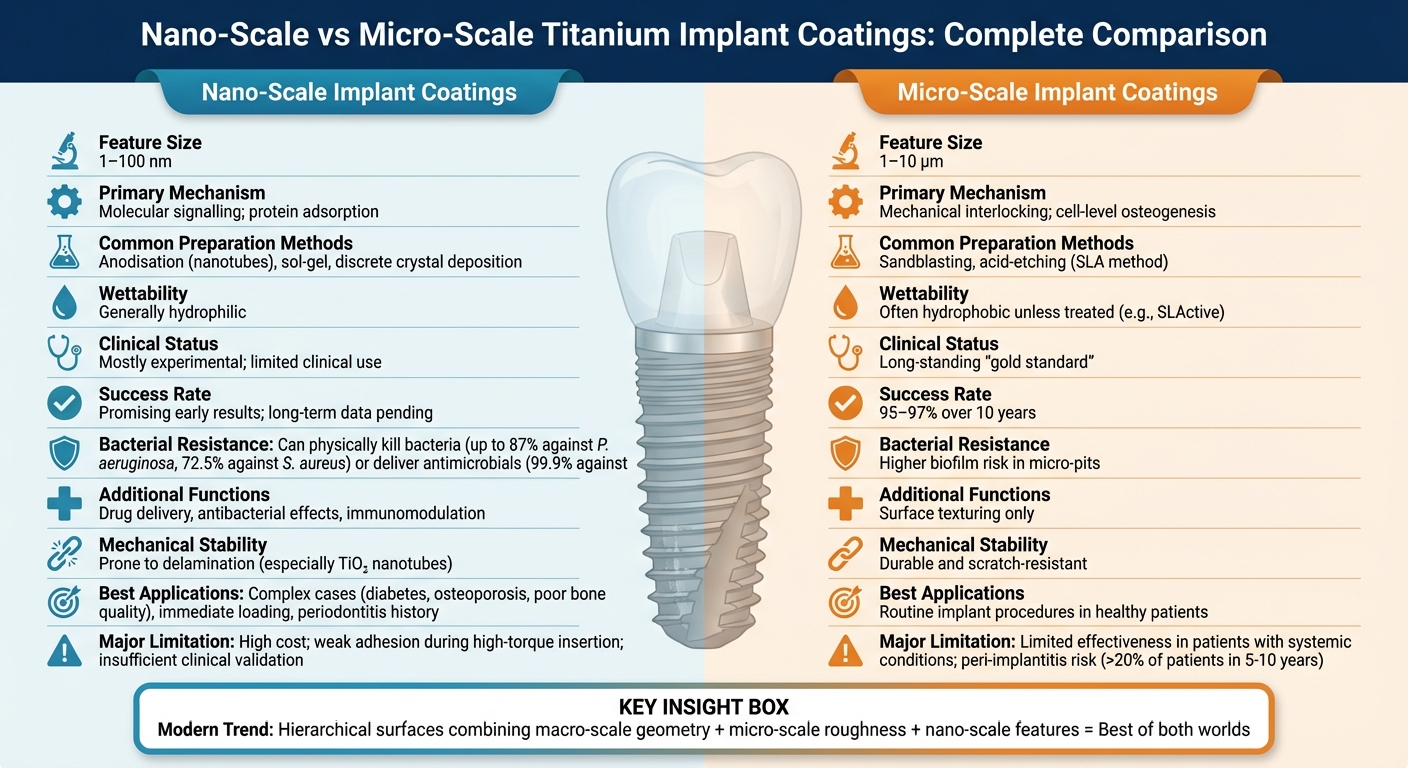
Nano-Scale vs Micro-Scale Titanium Implant Coatings Comparison
Key Factors for Comparing Coating Types
When comparing nano- and micro-scale coatings, several factors stand out: surface roughness, wettability, osseointegration rates, and mechanical stability. Let’s start with surface roughness – micro-scale coatings typically feature modifications between 1 and 10 µm, while nano-scale coatings operate on a much smaller scale, ranging from 1 to 100 nm [4]. Another major difference is wettability, or how well a surface attracts water and proteins. Nano-scale surfaces tend to be more hydrophilic, making them better at drawing in these essential elements [3][7].
Other considerations include the complexity and cost of preparation, as well as how each coating type impacts bacterial adhesion. This is especially important in dental applications, where bacterial biofilms are linked to about 65% of dental diseases [2]. These differences set the stage for a closer comparison in the table below.
Side-by-Side Analysis of Nano and Micro Coatings
| Feature | Micro-Scale Coatings | Nano-Scale Coatings |
|---|---|---|
| Feature Size | 1–10 µm [4] | 1–100 nm [4] |
| Primary Mechanism | Mechanical interlocking; cell-level osteogenesis [4][3] | Molecular signalling; protein adsorption [3][2] |
| Common Methods | Sandblasting, acid-etching [4][5] | Anodisation (nanotubes), sol-gel, discrete crystal deposition [5][7] |
| Wettability | Often hydrophobic unless treated (e.g., SLActive) [4] | Generally hydrophilic [3][7] |
| Clinical Status | Long-standing "gold standard" [5] | Mostly experimental; limited clinical use [4][5] |
| Bacterial Resistance | Higher biofilm risk in micro-pits [7][9] | Can physically kill bacteria or deliver antimicrobials [7][3] |
| Additional Functions | Surface texturing only [4] | Drug delivery, antibacterial effects, immunomodulation [5] |
| Mechanical Stability | Durable and scratch-resistant [4] | Prone to delamination (e.g., TiO₂ nanotubes) [4][5] |
This comparison highlights the trade-offs: micro-scale coatings provide well-established mechanical durability, while nano-scale coatings excel in bioactivity and multifunctionality. For example, certain nano-scale coatings loaded with antimicrobial peptides can achieve up to a 99.9% bactericidal effect against MRSA [5]. However, these nano-coatings often face challenges with mechanical stability.
Zhang and Gulati point out that while micro-roughness remains the benchmark for implant-bone integration, nano-scale engineering offers exciting potential to boost bioactivity [5]. Interestingly, modern trends in implant dentistry are moving toward hierarchical surfaces. These designs combine macro-scale geometry, micro-scale roughness for mechanical strength, and nano-scale features to enhance cellular interactions [1][9]. By blending these scales, researchers aim to achieve the best of both worlds: the reliability of micro-coatings and the biological benefits of nano-coatings.
sbb-itb-2be92ed
Biocompatibility and Osseointegration Results
How Coating Scale Affects Biocompatibility
The scale of an implant’s coating significantly influences how it interacts with surrounding tissues. Micro-scale coatings enhance biocompatibility by creating mechanical interlocks. These micro-irregularities act as anchors for osteogenic cells, encouraging bone matrix deposition and initiating contact osteogenesis – where bone begins forming directly on the implant surface [4].
Nano-scale coatings, on the other hand, operate at a molecular level, closely imitating natural bone. They influence protein adsorption, integrin signalling, and interactions with cell membrane receptors, which in turn shape cell behaviour and immune responses [3][5][10]. For instance, research shows that titania nanotubes with a 15 nm diameter can elicit strong responses from both osteoblasts and osteoclasts [3][4].
"The nano-scale surface modification of Ti implants offers enhanced bioactivity, outperforming the clinical micro-roughness."
– Yifan Zhang, Department of Oral Implantology, Peking University [5]
When nano-scale textures are layered over micro-rough surfaces, they amplify protein adsorption, speed up osteogenic cell migration, and increase the density of surface hydroxyl groups. This combination accelerates hydroxyapatite precipitation, a key factor in bone bonding [1][6]. While micro-scale coatings set the foundation for tissue interaction, nano-scale adjustments refine and elevate these molecular processes.
Osseointegration Rates: Comparing the Evidence
Clinical studies highlight the importance of coating scale in achieving long-term osseointegration. Micro-scale coatings, created through methods like sandblasting, large-grit, and acid-etching (SLA), have set a high benchmark. These surfaces boast survival and success rates exceeding 97% over 10 years. Meanwhile, anodised implants that combine micro- and nano-scale porosity report failure rates as low as 1.3% [4][5].
Nano-scale surfaces are showing promising results in experimental settings. A January 2015 study in Acta Biomaterialia compared three types of titanium alloy implants – machined, standard alumina grit-blasted/acid-etched (MICRO), and nanostructured (NANO) – in New Zealand White rabbits. The NANO surfaces, featuring titanium oxide nanotubes with a diameter of 37 ± 11 nm, exhibited higher pull-out force values and greater bone-to-implant contact (BIC) after just four weeks. These results were achieved despite the NANO surface’s lower roughness (Ra 0.5 µm) compared to the MICRO surface (Ra 1.5 µm) [11].
Hydrophilicity also plays an essential role in osseointegration. For example, hydrophilic SLA surfaces achieved a BIC of 81.91% compared to 66.57% for conventional SLA surfaces within four weeks of implantation in miniature pigs [1]. While nano-scale modifications accelerate early-stage osseointegration, micro-scale coatings continue to dominate as the standard for long-term clinical reliability [4][5].
Clinical Use and Limitations in Dental Implants
Current Use in Dental Implantology
In Australian dental practices, micro-scale coatings are the go-to choice for implant procedures. Surfaces prepared using SLA (sandblasted, large-grit, acid-etched) techniques consistently deliver excellent results, with survival rates ranging from 95% to 97% over a decade [5]. Straumann’s SLActive® implants, which combine micro-roughness with hydrophilic nano-features, are a standout example, backed by extensive clinical studies demonstrating their reliability [5].
Nano-scale modifications, on the other hand, are finding their place in more complex and challenging cases. Researchers at the University of Queensland are developing anodised nano-engineered titanium implants tailored for patients with compromised healing abilities, such as those with diabetes, osteoporosis, or heavy smoking habits [12][13]. These nano-coatings also double as platforms for localised drug delivery, releasing antibiotics, anti-inflammatory agents, and growth factors directly at the surgical site [5]. Among the commercial options, Promimic’s HAnane Surface® stands out, using nanohydroxyapatite to promote bone growth [2]. These advancements highlight the growing role of nano-scale modifications in addressing intricate clinical scenarios.
Challenges and Limitations of Each Coating Type
While micro-scale coatings have proven to be reliable over the long term, each coating type comes with its own set of challenges that clinicians must weigh carefully.
Nano-scale coatings, despite their biological advantages, face mechanical stability issues. Titania nanotubes, for instance, are prone to delamination during high-torque implant insertion due to their weak adhesion to the titanium substrate. As In-Sung Luke Yeo from Seoul National University explains:
"The mechanical strength between the TiO2 nanotubes and the base Ti surface is too weak for this surface to be applied to a dental implant" [4].
Additionally, the high cost of nano-scale coatings limits their widespread use [8], and there is a noticeable lack of long-term clinical trials under real-world loading conditions [12].
Micro-scale surfaces, while mechanically stable, have other limitations. They show reduced bioactivity in patients with systemic health issues, making them less effective in such cases [5]. There’s also the risk of peri-implantitis, which affects over 20% of patients and 10% of implants within 5 to 10 years of placement [5]. High-roughness surfaces can exacerbate this by increasing ion leakage, potentially triggering inflammation [1]. Moreover, nano-engineered implants require optimised cleaning, sterilisation, and packaging protocols – standards that are not yet universally implemented across the industry [12].
| Coating Scale | Primary Clinical Application | Success Rate | Major Limitation |
|---|---|---|---|
| Micro-scale | Routine implant procedures in healthy patients | 95–97% over 10 years | Limited effectiveness in patients with systemic conditions; peri-implantitis risk |
| Nano-scale | Complex cases (e.g., diabetes, osteoporosis); drug delivery | Promising early results; long-term data pending | Prone to delamination; high cost; insufficient clinical validation |
Choosing the Right Coating for Dental Implants
When it comes to routine dental implant procedures in healthy individuals, micro-scale coatings are the go-to choice. Techniques like sandblasted, large-grit, acid-etched (SLA) surfaces and anodised treatments provide the mechanical strength needed during implant placement. These coatings have a strong track record of long-term clinical success, making them a reliable option. This established performance often serves as the benchmark when comparing them to newer nano-scale alternatives.
Nano-scale coatings, on the other hand, play a more specialised role. They are particularly useful for patients facing challenges like osteoporosis, diabetes, or poor bone quality. These surfaces, engineered with bioactive properties, can speed up osseointegration and improve early healing responses [4][5][14]. Additionally, they may be advantageous for patients needing immediate loading or those with a history of periodontitis, as their antibacterial properties can help mitigate infection risks [8].
Choosing between these options involves weighing the robust mechanical stability of micro-scale coatings against the enhanced bioactivity offered by nano-scale surfaces. While micro-rough surfaces remain the standard for implant-bone bonding, nano-engineered coatings are gaining traction for their potential to boost healing in specific scenarios [5]. However, there are limitations. For instance, coatings like titania nanotubes may delaminate under high-torque conditions during insertion into dense bone [4][6], making them less suitable for routine use. For patients with normal bone quality and no systemic health issues, the tried-and-tested performance of micro-scale coatings usually outweighs the potential advantages of nano-scale modifications.
Ultimately, the choice of coating should be guided by a thorough evaluation of the patient’s overall health, bone density, healing ability, and infection risk. In straightforward cases, sticking with proven technologies is often the best approach, while nano-scale advancements can offer meaningful benefits in more complex situations.
FAQs
What are the key benefits of nano-scale coatings compared to micro-scale coatings for titanium dental implants?
Nano-scale coatings bring a host of benefits to titanium dental implants, making them a game-changer in the field. One of their standout features is the ability to improve osseointegration. By encouraging stronger cellular attachment to the implant surface, these coatings support faster healing and ensure the implant remains stable over time.
They also enhance the implant’s surface hydrophilicity, which plays a crucial role in creating an environment that supports better bone integration. This means the implant can bond more effectively with the surrounding bone tissue, boosting its overall performance.
Another key advantage lies in their antibacterial properties. These coatings help minimise bacterial adhesion, significantly lowering the risk of post-surgery infections. By reducing infection rates, they contribute to the long-term success of implants and improve patient satisfaction. Nano-scale coatings are undoubtedly pushing dental implant technology to new heights.
How do nano-scale coatings improve dental implants for patients with diabetes?
Nano-scale coatings work wonders on titanium surfaces by refining them at a microscopic level, creating an ideal setting for bone to integrate more quickly and effectively. These coatings boost surface energy and hydrophilicity, which helps with clot formation and encourages the rapid attachment of osteoblasts (the cells responsible for forming bone). This is especially helpful for patients with diabetes, where the healing process tends to take longer.
Another standout feature of nano-coatings is their antimicrobial properties. They help lower the risk of infection by preventing bacteria from sticking to the surface and forming biofilms. This combination of enhanced bone integration and infection prevention makes nano-scale coatings a game-changer for handling complex implant cases, including those in patients with systemic conditions like diabetes. Dental clinics, such as Complete Smiles Bella Vista, rely on these advanced, evidence-based implant technologies to ensure safer and more predictable outcomes for their patients.
What are the risks or challenges of using nano-scale coatings on dental implants?
Nano-scale coatings on titanium implants bring several advantages, such as increased surface area and better integration with bone (osseointegration). However, they are not without their challenges and potential risks. One concern is the possibility of allergic reactions or inflammation. This can happen if nanoparticles, like titanium-oxide or silver, are released into nearby tissues or enter the bloodstream. These particles might also carry risks of being toxic to cells (cytotoxic) or causing genetic damage (genotoxic), though more long-term research is needed to fully grasp their effects.
Another issue lies in the nano-textured surface itself. While it promotes bone growth, it can also create small spaces where bacteria might thrive. If the coating’s antimicrobial properties aren’t strong enough, this could lead to peri-implantitis – a serious infection around the implant. Finally, because there isn’t enough long-term clinical data yet, more thorough safety studies are essential before these nano-scale coatings can become a standard in dental implants.
Related Blog Posts
- Micro vs. Nano Surface Modifications for Implants
- How Hybrid Coatings Improve Osseointegration
- Titanium Implant Surface Modifications for Osseointegration
- How Nanostructured Coatings Improve Osseointegration
Important Notice: Any surgical or invasive procedure carries risks. Before proceeding, you should seek a second opinion from an appropriately qualified health practitioner.
Individual results may vary. The information provided in this article is for educational purposes only and does not constitute medical advice.
Checkout Related Blogs




Get in touch with us
For more information, call us now to start feeling better. Or fill the form below to make appointment
The Latest News from Complete Smiles
How to Clean Clear Plastic Retainers
Checklist for Choosing Wearable Dental Devices
Checklist for Choosing Cloud AI Platforms in Dentistry

Complete Smiles Bella VistaAccepts All Major Health Funds, Including





