





Teeth Diagram Posters: What Kids Learn

Teeth diagram posters help kids understand dental anatomy by turning complex concepts into clear visuals. These posters break down the structure of teeth, show how different types of teeth function, and explain inner layers like enamel, pulp, and roots. They’re widely used in classrooms and dental practices to teach topics like tooth types, oral hygiene, and the effects of diet on teeth. Studies show that visual aids like these improve learning outcomes compared to text-based methods. They also make it easier for kids to adopt proper brushing and flossing habits by providing step-by-step guidance. For parents and educators, these posters are an effective way to simplify oral health education.
Tooth Structure | #aumsum #kids #science #education #children
Why Children Struggle to Learn About Teeth
Understanding dental anatomy can be tricky for children because much of what makes teeth work is hidden from view. While kids can see the white crowns of their teeth when they smile, the roots, inner layers, and microscopic details remain out of sight unless diagrams are used. Terms like incisors, premolars, and cementum [1] can feel like a foreign language without clear images to explain them. Visual aids play a key role in making these abstract concepts tangible, turning unfamiliar words into identifiable parts. This is why clear, visual explanations are so important for teaching children about teeth.
Identifying Different Types of Teeth
Visual tools make it easier to distinguish between different types of teeth by highlighting their unique features. Simply looking in a mirror isn’t enough to notice the subtle differences between, say, central and lateral incisors or premolars and molars [4]. Each type of tooth has a specific shape and position in the jaw, details that are hard to grasp without proper guidance.
The functions of teeth – like incisors cutting, canines tearing, premolars crushing, and molars grinding [1] – become much clearer when paired with visuals. For example, seeing the sharp edges of incisors or the broad, flat surfaces of molars helps children understand how these shapes enable specific tasks. This connection between form and function reinforces their learning.
The shift from baby teeth to adult teeth adds another layer of complexity. Adult mouths introduce eight premolars that replace primary molars [4]. Without diagrams showing how new teeth emerge or replace old ones, this natural development can be confusing for young learners.
Understanding What’s Inside a Tooth
The inner structures of teeth – like enamel, dentine, pulp, and cementum – are another challenge to grasp without visual support [4][5]. For instance, enamel, which is 96% mineral content [5], serves as an incredibly hard but irreplaceable protective layer. Beneath it, dentine and pulp [5][6] are living tissues that require nourishment, but these layers remain hidden from sight.
Adding to the complexity, some structures operate on a microscopic level. Dentine is filled with tiny tubes that connect to the pulp, transmitting nerve signals [4][5]. Similarly, blood vessels and nerves enter the tooth through the apical foramen at the root tip, travelling through root canals to the pulp chamber. These intricate spatial details are difficult to imagine without diagrams to bring them to life [6].
What Children Learn from Teeth Diagram Posters
Teeth diagram posters simplify the often tricky task of teaching children about oral anatomy. By turning complex dental concepts into easy-to-follow visuals, these posters help kids grasp and remember essential details about their mouths. They highlight important features, such as the 32 adult teeth and surrounding structures like the hard palate, soft palate, and uvula [1][7]. Through clear labelling and organisation, these posters make it easier for children to identify parts of the mouth they might otherwise overlook. For instance, they visually map out the 32 adult teeth, numbered from 1 (upper right back) to 32 (lower right back) [7]. This visual approach lays the groundwork for understanding how each tooth functions.
Learning About Each Tooth’s Purpose
Teeth posters break down the different types of teeth – incisors, canines, premolars, and molars – and explain their specific roles. Incisors are for biting, canines for tearing, premolars for crushing, and molars for grinding [1]. They also highlight that humans typically have 8 incisors, 4 canines, 8 premolars, and 8 molars [1]. This functional explanation helps children see why their front teeth are sharper and their back teeth are flatter.
Seeing Inside a Tooth
Cross-sectional diagrams take learning a step further by showing the inner structure of a tooth. These diagrams reveal the layers – enamel, pulp, cementum, and roots – and explain how each part works together. For example, the crown, which is the visible portion above the gum line, connects to roots that anchor the tooth securely.
Some modern posters go even further by incorporating interactive features, like QR codes that link to videos and other digital resources [8]. This combination of visuals and interactive content appeals to different learning styles, helping children expand their dental vocabulary with terms like "cementum" and "pulp."
sbb-itb-2be92ed
Using Teeth Diagrams to Teach Hygiene Habits
Teeth diagram posters play a vital role in helping children adopt daily oral care routines. By breaking down complex hygiene instructions into simple, easy-to-follow steps, these visual tools help kids build habits that protect their teeth from decay and disease.
Showing Proper Brushing and Flossing Methods
Posters with visual sequences make it easier for children to understand and remember proper brushing techniques. They highlight critical areas to focus on, such as the gum line and the chewing surfaces of molars. These diagrams also demonstrate specific motions for cleaning different types of teeth – like incisors, molars, and canines – ensuring kids learn the right approach for each [1].
Specialised visuals go a step further by showing how to use tools like floss and interdental brushes effectively [3]. This is particularly helpful for teaching aspects of oral hygiene that aren’t obvious when looking in a mirror, like the correct placement of floss. By providing clear guidance, these posters not only teach technique but also help children understand how their daily choices impact their oral health.
Teaching How Food Affects Teeth
Comparison posters are a great way to show how dietary choices affect oral health. They often include visuals that highlight the sugar and acid levels in common drinks, alongside images of tooth decay [2][3]. For instance, "Sugar Maths" exercises use relatable comparisons, like showing the sugar content of a soft drink in terms of sugar cubes, to make the impact of excessive sugar consumption more tangible [2][9].
Additionally, diagrams that display the warning signs of tooth decay help children spot the early effects of poor nutrition on their teeth [3]. Cross-sections of healthy and decayed teeth further reinforce the link between food choices and the condition of enamel, pulp, and roots. These visuals encourage healthier snacking habits by making the consequences of dietary decisions clear [9].
Comparing Learning Outcomes with and without Posters
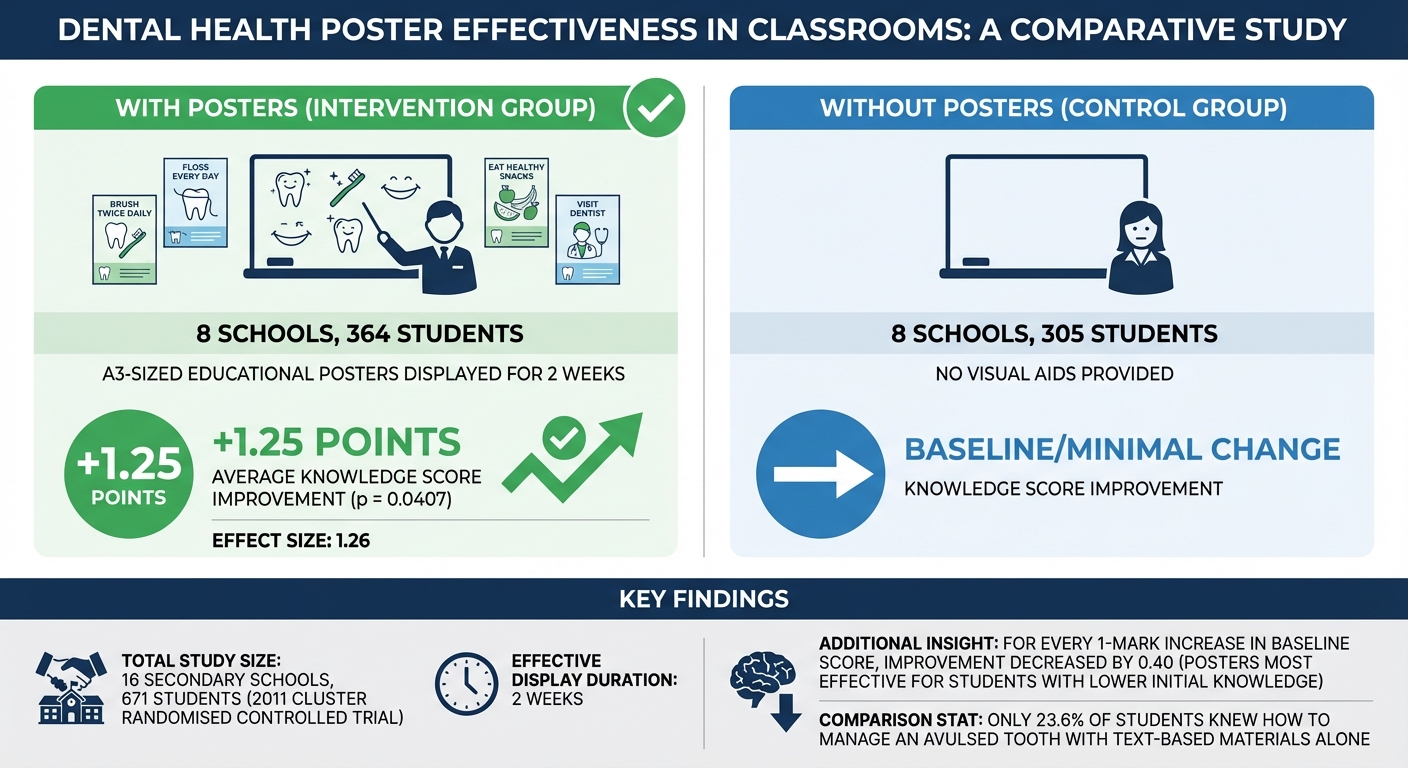
Learning Outcomes: Dental Education With vs Without Visual Posters
Studies have consistently shown that visual aids can significantly enhance learning, particularly in dental health education. Among these, posters stand out as a tool that not only improves knowledge retention but also aids in practical application. The following data highlights the impact of posters compared to traditional lecture-based methods.
Data on Learning Effectiveness
A 2011 cluster randomised controlled trial conducted in 16 secondary schools with 671 students compared the effectiveness of classrooms equipped with A3-sized educational posters to those without. In the intervention group – comprising 8 schools and 364 students – colourful educational posters were displayed for two weeks. Meanwhile, the control group of 8 schools with 305 students had no visual aids. Results showed that students exposed to posters achieved an average knowledge score improvement of 1.25 points (p = 0.0407), while the control group exhibited minimal change [10]. This underscores the value of visual aids in improving children’s dental health education.
One of the key benefits of posters is their ability to provide continuous exposure, enabling students to review the material as often as needed. Interestingly, the data also revealed that baseline knowledge plays a role in how much a student benefits from posters. For every 1-mark increase in a student’s initial score, the improvement after viewing a poster decreased by 0.40. This suggests that posters are especially effective for students starting with lower levels of knowledge [10].
| Learning Metric | With Posters | Without Posters |
|---|---|---|
| Average Knowledge Score Improvement | +1.25 points [10] | Baseline/Minimal change [10] |
| Effect Size | 1.26 [10] | N/A |
| Effective Display Duration | 2 weeks [10] | N/A |
These findings highlight the measurable advantages of incorporating visual aids like posters into educational settings. By comparison, text-heavy resources often fall short. For instance, only 23.6% of students knew how to manage an avulsed tooth when relying solely on text-based materials [10]. This further emphasises the effectiveness of visually engaging posters, which students encounter daily, in reinforcing critical knowledge.
Conclusion
Teeth diagram posters make learning about oral health easier for children by turning complex dental ideas into simple, engaging visuals. Instead of relying solely on abstract descriptions, kids can see how their teeth function and explore the internal structure of a tooth, making it easier to understand and remember dental anatomy.
Research supports the effectiveness of these visuals. A study by Al-Quds University and An-Najah National University involved 536 students over two months, using posters, charts, and dental models. The results were clear: students exposed to these visual aids showed noticeable improvements in plaque reduction, while the control group saw no significant changes [12].
These posters go beyond just teaching anatomy. They act as ongoing reminders of proper oral hygiene. Feedback from SickKids revealed that many individuals not only noticed these posters but also picked up new tips for maintaining good dental health in children [11]. This constant reinforcement has been linked to better daily oral care routines.
For parents and educators aiming to enhance dental education, teeth diagram posters provide a simple yet effective tool backed by evidence. When combined with hands-on activities and practical demonstrations, these visuals can make a real difference in improving children’s understanding of oral health and their daily habits.
FAQs
How do teeth diagram posters help children learn about dental anatomy and oral health?
Teeth diagram posters are a great way to teach kids about dental anatomy and oral health. With their clear and visual explanations, they simplify tricky concepts like the structure and role of teeth, making them easier for children to grasp.
These posters can also inspire curiosity, showing kids why brushing and flossing matter. By turning learning into something visual and engaging, they help children connect with the topic and take more interest in caring for their teeth.
What do teeth diagram posters teach about the different types of teeth and their roles?
Teeth diagram posters are an excellent tool for teaching kids about the four main types of teeth and their specific roles in maintaining oral health. These include:
- Incisors: The sharp, flat teeth at the front of the mouth, ideal for cutting food into smaller pieces.
- Canines: Pointed teeth located next to the incisors, great for tearing food.
- Premolars: Found just behind the canines, these teeth handle crushing and grinding food.
- Molars: The largest teeth at the back of the mouth, built for heavy-duty chewing and grinding.
By presenting this information visually, these posters make it simpler for children to understand the basics of oral anatomy and how each type of tooth plays a role in eating and dental health.
How do teeth diagram posters help children learn about oral hygiene?
Teeth diagram posters are a fun and effective tool for teaching kids about oral hygiene. By breaking down the structure of the mouth and teeth into simple visuals, these posters make it easier for children to grasp where their teeth are and how to look after them.
Many of these posters also feature step-by-step guides for brushing and flossing, helping kids learn the right techniques to keep their teeth clean and healthy. With colourful designs and easy-to-follow instructions, these visual aids turn oral care into an engaging activity, encouraging children to build habits that support strong dental health for years to come.
Related Blog Posts
- Toothbrushing Tips for Kids by Age
- How to Teach Teens Good Oral Health Habits
- Checklist for Baby Teeth Care: Ages 0-5
- How to Teach Kids Proper Brushing Techniques
Important Notice: Any surgical or invasive procedure carries risks. Before proceeding, you should seek a second opinion from an appropriately qualified health practitioner.
Individual results may vary. The information provided in this article is for educational purposes only and does not constitute medical advice.
Checkout Related Blogs




Get in touch with us
For more information, call us now to start feeling better. Or fill the form below to make appointment
The Latest News from Complete Smiles
How to Clean Clear Plastic Retainers
Checklist for Choosing Wearable Dental Devices
Checklist for Choosing Cloud AI Platforms in Dentistry

Complete Smiles Bella VistaAccepts All Major Health Funds, Including





