





Top Questions to Ask Before Dental Procedures

When planning for a dental procedure, asking the right questions is crucial to understanding the process, reducing anxiety, and making informed decisions. Here’s what you need to know:
- Understand Your Oral Health: Ask about the current state of your teeth and gums, potential risk factors from your lifestyle or medical history, and why a specific treatment is recommended.
- Explore Treatment Options: Discuss alternatives, costs, expected results, and the durability of materials like zirconia or gold for restorative work.
- Know the Risks: Understand potential complications like dry socket, nerve irritation, or sensitivity, along with safety protocols and pain management options (local, sedation, or general anaesthesia).
- Prepare for Recovery: Learn about recovery times, aftercare (like avoiding straws and smoking), and how to handle complications like infections or prolonged pain.
- Check Dentist Qualifications: Confirm your dentist’s credentials, experience, and success rates for your chosen procedure.
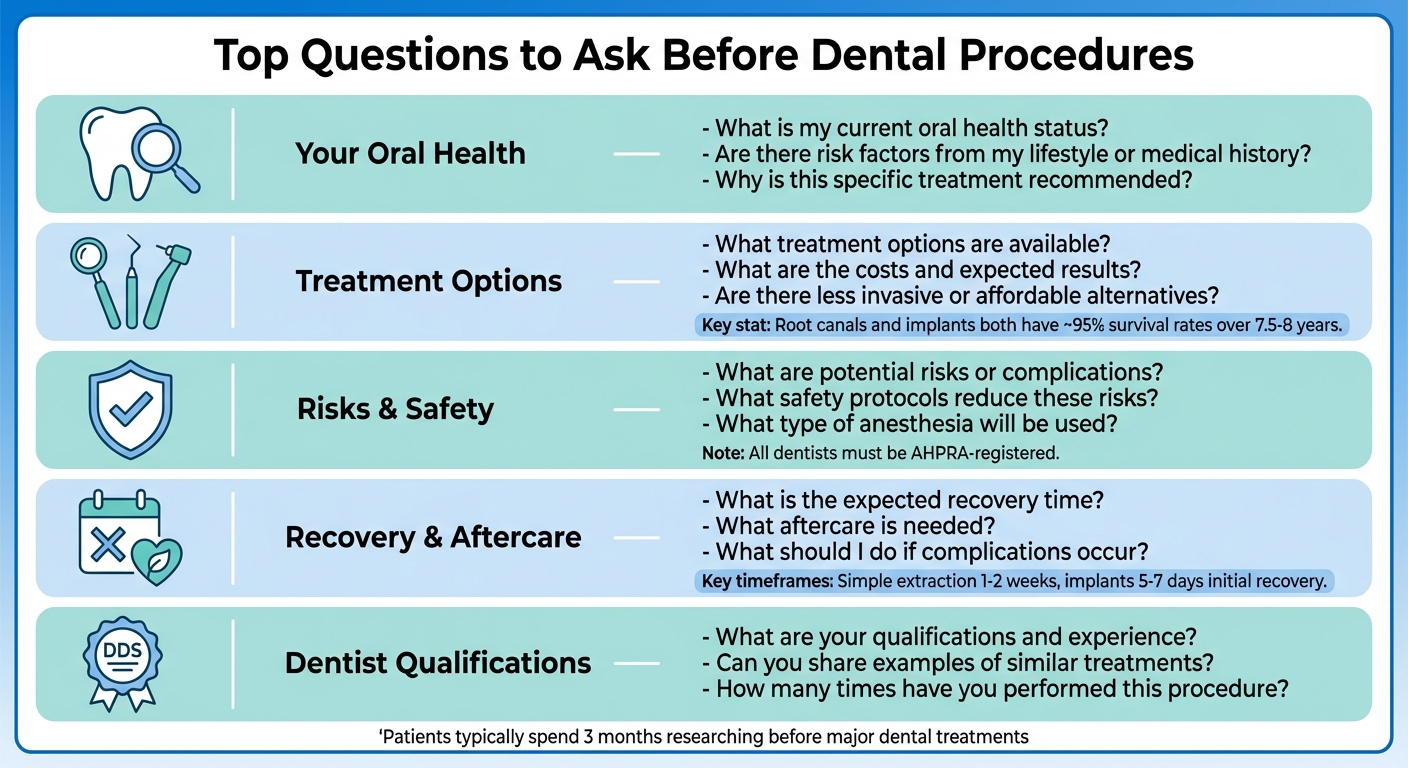
Essential Questions to Ask Before Any Dental Procedure
Top 5 Questions To Ask Your Dentist About Dental Implants
sbb-itb-2be92ed
Questions About Your Current Oral Health
Before moving forward with any dental treatment, it’s crucial to get a solid understanding of your current oral health. This usually involves a detailed examination, X-rays, and diagnostic scans to spot issues like cavities, gum disease, or impacted teeth [1][2]. Having this baseline not only helps you understand why a treatment is recommended but also whether it’s genuinely necessary. Here are some key questions to ask to get a clear picture of your oral health.
What is the current state of my oral health?
Start by asking your dentist for a breakdown of your teeth and gum health. Are there any immediate concerns that need addressing? Common issues that might require attention include significant decay, infections, overcrowding, or damage that can’t be fixed with simpler treatments [4]. For instance, impacted wisdom teeth often need removal to avoid complications down the road [4].
It’s also worth discussing how your oral health ties into your overall facial structure and appearance [3]. If you have cosmetic concerns, share them with your dentist to understand how treatments may affect both function and aesthetics.
Are there any risk factors related to my lifestyle or medical history?
Your daily habits and medical history play a big role in how successful your treatments will be. Things like smoking, diet, and oral hygiene can directly impact the durability of procedures like dental implants [2]. For example, quitting smoking might be necessary to maximise the success of certain treatments [2].
"Every patient is different. Ask your dentist what challenges they foresee that relate specifically to you." – Dr. Luke, Lead Implant Dentist, Keppel Dental [2]
Medical conditions and medications can also influence your oral health. For example, some medications lead to dry mouth, which raises the risk of cavities and enamel erosion. Diets high in sugar or acid can contribute to tooth decay, while habits like teeth grinding (bruxism) can wear down enamel over time. Make sure to share these details with your dentist so they can customise your treatment plan to suit your needs.
Questions About Treatment Options
Once you’ve assessed your oral health, the next step is to evaluate treatments that address your specific needs. Dentists typically offer a variety of solutions, each with distinct benefits, costs, and outcomes. Taking the time to understand these options ensures your decision fits both your health priorities and budget.
What treatment options are available for my condition?
Discuss all possible solutions with your dentist – not just the most common one. For instance, if you have a damaged tooth, ask whether a root canal could save it or if extraction followed by an implant is necessary. Research shows that both nonsurgical root canal treatments and single-tooth implants have similar survival rates of around 95% over 7.5 to 8 years [5][6].
"Implants are supposed to replace missing teeth; they are not supposed to replace savable teeth." – Pjetursson et al. [5]
If saving the tooth is an option, it’s often the better choice for maintaining long-term oral health. Reviewing all potential treatments ensures your decision aligns with your goals.
For restorative work like crowns or fillings, you’ll likely need to choose between materials such as amalgam, composite resin, gold, porcelain-fused-to-metal, or ceramics like zirconia or lithium disilicate (eMax). Each material has its own strengths and aesthetic appeal. For example, a study conducted between 2013 and 2024 by clinician Sorin Gheorghe Mihali tracked 1,143 zirconium oxide restorations in 393 patients. Over five years, monolithic zirconia restorations had a 100% survival rate, while layered restorations had a 95.8% survival rate, with most failures due to chipping of the ceramic layer [8]. For back teeth, which endure heavy chewing, materials like monolithic zirconia or gold may be recommended for their durability.
What are the costs and expected results for each option?
Understanding the financial aspect is critical before starting any treatment. Ask for a detailed breakdown of costs, including the procedure itself, anaesthesia, follow-ups, and materials [1]. Request specific dental item numbers so you can check with your private health insurer for potential rebates [10]. Typically, private health extras cover a percentage (e.g., 60%) or provide a fixed rebate per item [9].
Costs and longevity vary by material and procedure. For example, gold crowns have a 96% survival rate over 10 years and 87% over 20 years [7], while composite resin fillings are more affordable and visually appealing but may not last as long under heavy pressure. Single-tooth implants, which include multiple appointments and medications, are generally more expensive than nonsurgical root canals [5]. Additionally, replacing failed restorations accounts for about 60% of all dental procedures, with annual costs estimated at US$5 billion [7]. Opting for a durable solution upfront can save money over time.
Many dental clinics offer interest-free payment plans or financing options to make high-cost treatments, such as implants or cosmetic procedures, more manageable [1][3]. If upfront expenses are a concern, don’t hesitate to ask about these options.
Are there less invasive or more affordable alternatives?
It’s also worth exploring simpler or less invasive options. For example, early-stage tooth decay might be treated with fluoride to reverse the damage, avoiding the need for a filling [1]. Similarly, if you’re dealing with mild teeth grinding, a custom night guard could prevent further wear without requiring crowns or veneers.
For missing teeth, alternatives like dental bridges or removable dentures may offer a solution. Bridges don’t involve surgery but may require altering nearby teeth, while dentures are a more affordable yet less stable option. Each approach has trade-offs in terms of durability, effectiveness, recovery time, and potential complications. Ask your dentist to compare the pros and cons of each alternative, including their longevity and recovery requirements, so you can make an informed choice [1].
Questions About Risks and Safety
Every dental procedure comes with some level of risk, ranging from minor discomfort to rare, serious complications. Knowing these risks upfront allows you to weigh the benefits against potential downsides, helping you make an informed and comfortable decision. These considerations highlight the importance of strict safety measures during any dental treatment.
What are the potential risks or complications?
Most dental treatments carry common short-term effects like sensitivity, swelling, bruising, or a slight risk of infection [12][13]. The specific risks depend on the type of procedure:
- Cosmetic treatments such as teeth whitening and veneers often lead to temporary tooth sensitivity, which usually subsides quickly [11][12]. Veneers involve removing enamel permanently, and they can chip if you bite hard objects. Revision cases may increase the chance of needing root canal therapy [11].
- Dental implants carry surgical risks, like the implant not fusing with the bone or, in the upper jaw, sinus complications [12][13]. In rare cases, nerve involvement in the lower jaw can cause temporary or, occasionally, lasting altered sensation in the lip, chin, or tongue [12].
- Tooth extractions can lead to "dry socket", where the protective blood clot dislodges, causing severe pain that needs immediate care [14].
- Invisalign and orthodontics may result in tooth tenderness with each new aligner, temporary changes in speech, root resorption, or decay if oral hygiene isn’t maintained [11][12].
- Root canal treatments have risks like reinfection if bacteria remain, structural weakening of the tooth, or incomplete cleaning due to complex canal anatomy [12].
"Every dental procedure carries risks and benefits. Before starting any treatment, we recommend seeking independent advice from an AHPRA-registered health practitioner and considering a second opinion." – The Dental Room [11]
Your medical history and medications play a crucial role. Conditions like diabetes or heart disease, or the use of blood thinners, can affect healing and treatment success [11][13]. If you experience severe, ongoing pain after an extraction, contact your dentist immediately, as it could be a sign of dry socket symptoms [14].
What safety protocols are used to reduce risks?
To minimise risks, dentists follow strict safety protocols. All instruments are sterilised to prevent cross-contamination and infection [1][14]. A rubber dam is often used to isolate the treatment area, keeping saliva and blood away from the site [14].
"The main benefit of the rubber dam is to create a bacteria-free and dry treatment area by keeping away saliva and blood." – Australian Dental Association (ADA) [14]
Before any procedure, your dentist will review your medical history, current medications, and dental X-rays to identify potential risks [1][14]. Additionally, all dental professionals in Australia must be registered with the Australian Health Practitioner Regulation Agency (AHPRA), ensuring they meet national competency and safety standards [10]. Advanced tools, like digital imaging and laser equipment, also help improve precision and reduce invasiveness during treatments [1][2].
What type of anaesthesia or pain management will be used?
The type of anaesthesia depends on the complexity of the procedure and your comfort level:
- Local anaesthesia: Numbs the treatment area while you remain awake and pain-free [15][17].
- Sedation (twilight anaesthesia): Administered intravenously, it makes you relaxed and drowsy. You may remember parts of the procedure but won’t feel pain. Fasting for six hours beforehand and having someone accompany you post-treatment are necessary [15][17].
- General anaesthesia: Puts you in a controlled state of unconsciousness, requiring a breathing tube and constant monitoring by an anaesthetist [15][17].
Side effects like drowsiness, nausea, and fatigue are common [15][16]. Serious complications, such as allergic reactions or cardiovascular issues, are extremely rare. Australia is considered among the safest countries for anaesthesia [15][16]. However, there is a small risk of damage to existing teeth, crowns, veneers, or bridges from instruments or breathing tubes used during the procedure [16].
If you’re undergoing sedation or general anaesthesia, arrange for an adult to stay with you for 24 hours afterward, and avoid driving, alcohol, or operating machinery during this time [15][16]. Be sure to provide a complete list of medications and disclose any history of smoking or recreational drug use [15][16]. Lastly, agree on a hand signal with your dentist to indicate discomfort or the need for a break during the procedure [2].
Questions About Recovery and Aftercare
Once you’ve understood the potential risks and safety measures of your procedure, the next step is to focus on recovery and aftercare. Knowing what to expect post-treatment helps you plan your time, arrange any necessary support, and ensure a smooth healing process. Since recovery timelines and aftercare needs differ depending on the procedure, getting clear answers in advance can make all the difference.
What is the expected recovery time?
Recovery times depend on the complexity of the procedure. For instance, a simple tooth extraction typically takes about 1–2 weeks for initial healing, though full bone regeneration can take months [20]. More complex surgeries, like impacted wisdom tooth removal, may require 3–4 weeks for a full return to normal [21]. Dental implant patients often feel back to normal within 5–7 days, but complete osseointegration – when the implant fuses with the bone – can take three months or longer [2]. On the other hand, recovery from a root canal is usually quicker, with only a few days of mild discomfort [22].
"The hours and days following your tooth extraction (or oral surgery) set the tone for how well your mouth heals." – Odontologie Dental Care [20]
To help your recovery, avoid strenuous activities like heavy lifting or running for at least 48–72 hours. Physical exertion can raise blood pressure and increase the risk of bleeding [20]. During the first 24 hours, avoid rinsing, spitting forcefully, or using straws, as the suction could dislodge the protective blood clot [18]. Smoking or vaping should also be avoided for at least 72 hours to lower the risk of dry socket – a painful condition that affects 2–5% of routine extractions but up to 30% of complex wisdom tooth removals [20].
What aftercare is needed to maintain results?
Aftercare starts immediately after your procedure. Protect the blood clot by avoiding any activities that create suction in your mouth during the first 24 hours. If bleeding continues, bite firmly on a gauze pad for 30–60 minutes, or try a dampened black tea bag – the tannins can help constrict blood vessels [20].
To reduce swelling, apply ice packs in 15–20 minute intervals during the first 24 hours. After 48 hours, switch to warm compresses to ease any jaw stiffness [18][19]. Stick to soft, cool foods like yoghurt, mashed potatoes, or smoothies (eaten with a spoon) for the first two days, and steer clear of spicy, crunchy, or acidic foods that could irritate the area [19]. Avoid brushing the surgical site for the first 24 hours. Instead, rinse gently with warm salt water (½ teaspoon of salt in a glass of water) after meals to keep the area clean [20]. Take prescribed pain relief before the anaesthetic wears off, and avoid aspirin in the early stages, as it can increase bleeding [20]. Rest with your head elevated during the first 24 hours and drink water slowly from a glass rather than a straw [19].
For dental implants, long-term care is similar to looking after natural teeth. This includes regular brushing, flossing, and professional check-ups. With proper maintenance, implants can last 10–20 years [2].
These steps help ensure your recovery stays on track and prevent unnecessary complications.
What should I do if complications occur?
If you experience severe pain beyond the third day or pain that doesn’t improve with medication, contact your dentist immediately – this could indicate dry socket or an infection [20]. Signs of infection include a fever over 38°C, chills, pus (yellow or green discharge), or a persistent foul taste or smell [20]. While light oozing is common in the first 24 hours, heavy bleeding that doesn’t stop with firm pressure needs prompt attention [18].
Be alert for swelling that worsens after the third day or spreads toward your neck or eye [21]. Persistent tingling or numbness in your lip, tongue, or chin for more than 24 hours could indicate nerve irritation [23]. Additionally, difficulty breathing or swallowing requires immediate medical care [23].
For urgent advice in Australia, you can call the Healthdirect helpline (1800 022 222) to speak with a registered nurse 24/7. Your dentist should also provide clear instructions on who to contact for emergencies outside regular hours and help you differentiate between urgent issues and those that can wait until the next business day.
Questions About Your Dentist’s Qualifications
Knowing your dentist’s credentials and experience can give you peace of mind about the quality of care you’ll be receiving. In Australia, all dental practitioners must be registered with the Dental Board of Australia [25][26]. This registration ensures they meet baseline education and training standards. However, it’s still a good idea to ask specific questions about their qualifications and experience to make informed decisions about your treatment.
What are your qualifications and experience with this procedure?
To confirm your dentist’s credentials, you can use AHPRA’s "Look up a practitioner" tool [24][26]. This free resource verifies their current registration and lists any specialist qualifications. For more complex treatments, like root canals or dental implants, ask whether your dentist is a registered specialist or a general dentist with additional training in that area [25][1].
Specialist registration in Australia requires at least two years of general dental practice followed by an accredited specialist qualification [25]. Specialists are listed in one of seven recognised fields, such as Endodontics for root canals, Prosthodontics for implants and restorations, or Orthodontics for teeth alignment [25].
"The expertise and experience of your dentist can significantly impact the success of your procedure." – Dental Aspects [1]
Ask how many times they’ve performed the procedure you’re considering. Dentists with more experience are generally better prepared to handle complications and deliver the best results [1][2]. For surgical treatments, it’s also worth asking if they track post-operative infection rates as a measure of quality [27]. Keep in mind that all registered practitioners are required to complete Continuing Professional Development to stay current in their field, so feel free to ask about their latest training or certifications [26].
Can you share examples of similar treatments you’ve performed?
Although AHPRA guidelines restrict dentists from using before-and-after images in advertising, you can ask them to describe similar cases they’ve handled. Discuss their approach, typical outcomes, and how they manage less-than-ideal results [28]. For example, if you’re considering dental implants, ask about their success rates and any factors that might influence your specific case [2].
If your treatment requires specialised skills, ensure your dentist holds the necessary certifications, memberships in professional organisations, or even hospital privileges if applicable [27][28]. While "cosmetic dentistry" isn’t a registered specialty in Australia, additional certifications from reputable institutions can indicate advanced training in this area [28]. These discussions not only help you assess their technical expertise but also their openness and willingness to discuss their experience. This extra step can give you greater confidence in choosing the right dentist and treatment plan.
Conclusion
Asking thoughtful questions puts you in charge of your oral health journey. By understanding the details of your treatment – like the process, potential risks, and recovery – you’re better equipped to make choices that suit your needs, budget, and lifestyle. This proactive approach not only eases anxiety but also helps set realistic expectations for the results.
Having open conversations with your dentist builds trust and ensures clarity. Whether it’s a straightforward filling or a more involved procedure like dental implants, discussing your concerns and exploring all options ensures you’re fully informed. Interestingly, many patients spend around 3 months researching before committing to major dental treatments [2].
"You should go into this treatment comfortable and confident with your decisions and know about the outcomes." – Dr. Luke, Lead Implant Dentist, Keppel Dental [2]
Taking the time to review your oral health, treatment choices, safety protocols, and your dentist’s expertise is key to achieving better results. Use the insights shared here to create a personalised list of questions about your treatment, recovery, and safety measures. With this preparation, you can approach your procedure with confidence and make well-informed decisions for your dental care.
FAQs
Do I really need this treatment right now?
It’s a good idea to ask your dentist whether the treatment needs to happen right away or if it can wait without causing issues. Your dentist can evaluate your oral health and suggest the most suitable timing based on your situation. Knowing how urgent the treatment is allows you to make a well-informed choice while keeping your dental health on track.
What will the total cost be, including follow-ups?
The overall cost, including any follow-up appointments, will vary based on the treatment and care you need. It’s a good idea to request a detailed treatment plan and cost breakdown from your dentist before proceeding. This way, you’ll have a clear understanding of all potential expenses involved.
What should prompt me to call you after the procedure?
If you’re dealing with severe pain, excessive bleeding, increasing swelling, signs of infection, or anything out of the ordinary that worries you, it’s time to contact your dentist. These symptoms could suggest complications that need urgent attention. When in doubt, prioritise your well-being and get professional advice.
Related Blog Posts
- Dental Implants: Your Top 8 Questions Answered
- Guide to Choosing the Right Cosmetic Dental Treatment
- How Local Anaesthesia Reduces Pain During Extractions
- Smile Makeover Consultation: Step-by-Step Guide
Important Notice: Any surgical or invasive procedure carries risks. Before proceeding, you should seek a second opinion from an appropriately qualified health practitioner.
Individual results may vary. The information provided in this article is for educational purposes only and does not constitute medical advice.
Checkout Related Blogs




Get in touch with us
For more information, call us now to start feeling better. Or fill the form below to make appointment
The Latest News from Complete Smiles
How to Clean Clear Plastic Retainers
Checklist for Choosing Wearable Dental Devices
Checklist for Choosing Cloud AI Platforms in Dentistry

Complete Smiles Bella VistaAccepts All Major Health Funds, Including





