





Multidisciplinary Orthodontic Care: Benefits
Multidisciplinary orthodontic care brings together dental specialists like orthodontists, oral surgeons, periodontists, and prosthodontists to solve complex dental issues. This team approach is especially helpful for adults with challenges such as severe bite problems, missing teeth, gum disease, or jaw misalignment. By addressing alignment, function, and aesthetics in a coordinated way, patients experience faster results, improved oral health, and better long-term outcomes.
Key Takeaways:
- Severe bite issues often require a mix of orthodontics and jaw surgery.
- Missing teeth or gum disease complicate treatment, needing stabilisation before orthodontics.
- TMJ disorders and tooth wear may require restorative work before braces.
- Collaboration between specialists ensures efficient treatment and reduces relapse risks.
This approach is ideal for cases where single-specialty care falls short. If you’re facing complex dental problems, consult a practice offering multidisciplinary care for a tailored plan.
Orthodontic Problems That Need Multiple Specialists
Severe Bite Problems and Jaw Misalignment
Some bite issues go beyond simple tooth alignment. For example, severe Class II malocclusions (where the upper jaw is too far forward) or Class III malocclusions (where the lower jaw sticks out) often stem from skeletal problems. If the Wits appraisal exceeds –5 mm, orthodontic camouflage (adjusting tooth positions to mask the issue) won’t suffice [9]. These cases typically require orthognathic surgery to reposition the jaw bones.
A narrow upper jaw in adults presents another hurdle. Since mature bone cannot be widened with orthodontics alone, treatment often involves combining orthodontic appliances with surgery – like a Le Fort I osteotomy – to align the upper and lower jaws. In September 2024, a case study featured a 38-year-old man with moderate obstructive sleep apnoea and severe mandibular retrognathia. His treatment included a two-piece Le Fort I osteotomy for 6 mm of maxillary expansion and a bilateral sagittal split osteotomy for 10 mm of mandibular advancement. This reduced his apnoea score from 15 to 4 and improved his facial profile significantly [7].
These cases highlight the importance of teamwork among specialists to address both structural and functional challenges.
Missing Teeth and Gum Disease Complications
Tooth loss can create a chain reaction of problems. Nearby teeth may tilt into the gap, and opposing teeth can over-erupt, leading to a collapsed bite. When periodontal disease is also present, the situation becomes even more complicated. Periodontitis weakens the bone and ligaments supporting the teeth, making them more likely to tip, flare, or migrate abnormally.
Treatment timing is crucial here. Orthodontic work only begins after periodontal disease is stabilised, often requiring a waiting period of several months [10][11]. For instance, a 42-year-old man with a Class III malocclusion, a missing upper lateral incisor, and moderate-to-severe tooth wear underwent a comprehensive treatment plan. This included orthognathic maxillary advancement surgery, orthodontic alignment to create space, surgical crown lengthening, and a 3.3-mm dental implant restored with a zirconia crown [8].
Similarly, occlusal problems tied to TMJ disorders also demand coordinated care.
Bite Problems and TMJ Disorders
Deep bites and severe tooth wear frequently accompany temporomandibular joint (TMJ) disorders, creating challenges that no single specialist can tackle alone. When teeth wear down below 2 mm, the occlusal vertical dimension collapses, making it tricky to bond orthodontic brackets [8]. In such cases, restorative dentists often perform composite build-ups to restore bite height before orthodontic treatment can proceed [6].
One example involved a 54-year-old man with severe wear on his mandibular incisors. Mid-treatment composite build-ups helped increase his vertical dimension, stabilising the bite and allowing the orthodontist to complete alignment [6]. For patients with bruxism (teeth grinding), protective measures are essential. A 25-year-old woman with constricted dental arches, nocturnal bruxism, and severe dental wear underwent orthodontic levelling, surgical crown lengthening, and received ceramic veneers. To protect her restorations, she was provided with a custom maxillary Kois occlusal splint for night-time use [7].
AO Spotlight: Facilitating interdisciplinary orthodontic therapy
How Different Specialists Work Together
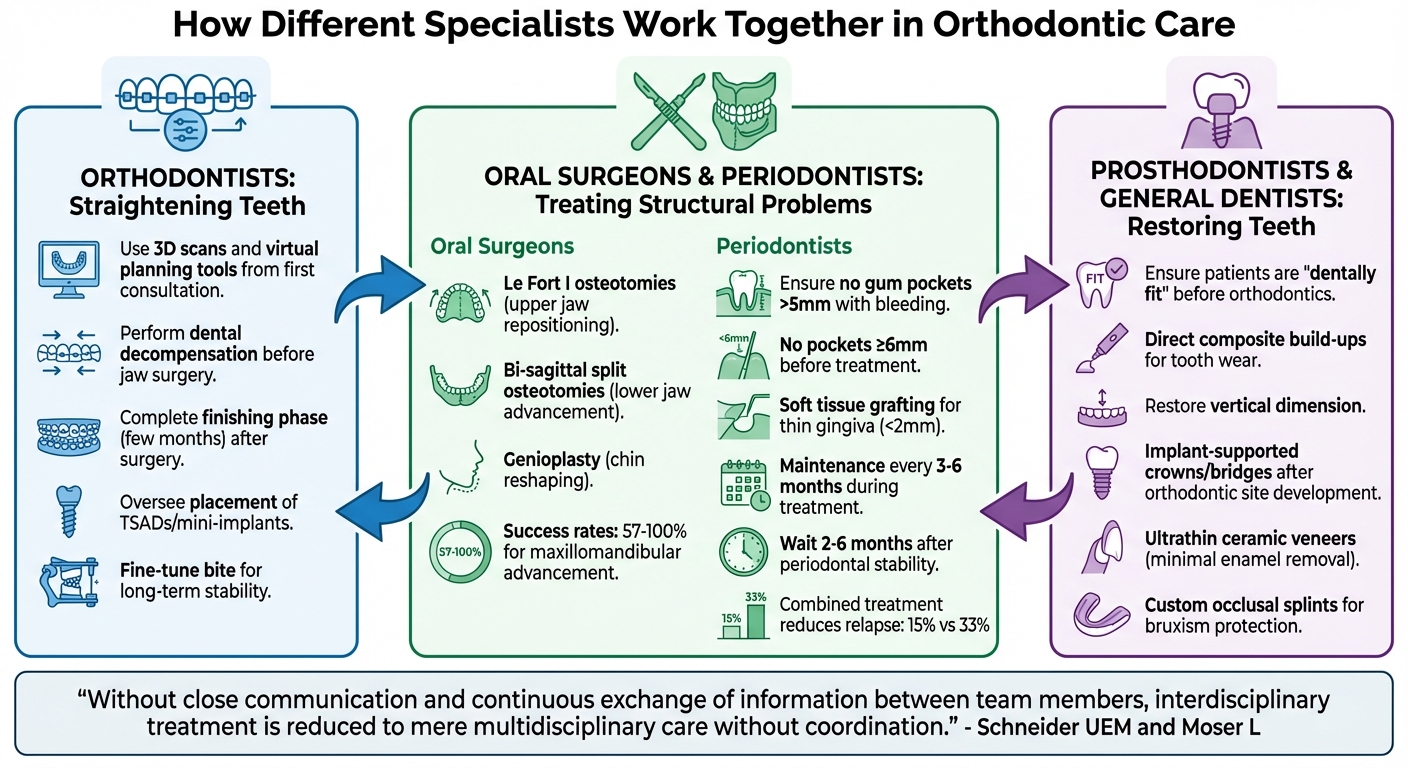
How Dental Specialists Collaborate in Multidisciplinary Orthodontic Care
Orthodontists: Straightening Teeth
Orthodontists collaborate closely with other specialists, utilising 3D scans and virtual planning tools to map out treatments right from the first consultation [7][2]. This teamwork ensures everyone involved is aligned with the ultimate goal before any procedures begin.
For cases requiring jaw surgery, orthodontists perform a process called dental decompensation. Essentially, this means aligning the teeth within their respective arches before surgery so that, once the oral surgeon adjusts the jaws, the teeth fit together as they should [7]. After the surgery, orthodontists enter a finishing phase, which typically lasts a few months, to fine-tune the bite and ensure it remains stable over time [7]. They also oversee the placement of Temporary Skeletal Anchorage Devices (TSADs) or mini-implants, which oral surgeons install to provide secure anchor points for more complex tooth movements [7][4].
"Without close communication and continuous exchange of information between the team members interdisciplinary treatment is reduced to mere multidisciplinary care without coordination of the single procedures." – Schneider UEM and Moser L [7]
This coordinated effort flows seamlessly into the surgical work handled by oral surgeons and periodontists.
Oral Surgeons and Periodontists: Treating Structural Problems
Oral surgeons focus on structural corrections that go beyond what orthodontics alone can achieve. They perform procedures like Le Fort I osteotomies (upper jaw repositioning), bi-sagittal split osteotomies (lower jaw advancement), and genioplasty (chin reshaping) to correct jaw relationships [7]. These surgeries are particularly crucial for patients with severe skeletal issues or conditions like obstructive sleep apnoea. For example, maxillomandibular advancement surgery has reported success rates ranging from 57% to 100% [7].
Periodontists, on the other hand, ensure the gums and bone are healthy enough to support tooth movement. Before orthodontic treatment begins, they aim for specific benchmarks: no gum pockets deeper than 5 mm with bleeding, and no pockets of 6 mm or more [13][10]. In areas with thin gingiva (less than 2 mm), they may perform soft tissue grafting or bone augmentation to prevent gum recession during treatment [12][13][10]. During orthodontic care, periodontists provide tailored maintenance plans every three to six months to manage the increased risk of plaque build-up associated with braces [11][10]. They may also perform specialised procedures like fiberotomy, which involves severing fibres around rotated teeth to reduce the risk of relapse [13][10].
Clinical guidelines suggest waiting two to six months after achieving periodontal stability before starting orthodontic treatment [11]. When periodontal and orthodontic treatments are combined, relapse rates drop to 15%, compared to 33% when only periodontal therapy is used [10].
Once the structural corrections are complete, restorative specialists take over to finish the process.
Prosthodontists and General Dentists: Restoring Teeth
Restorative specialists step in to complete the transformation by focusing on tooth function and aesthetics. General dentists ensure patients are "dentally fit" – free from active decay or gum disease – before orthodontic treatment begins [11]. For patients with significant tooth wear, they use direct composite build-ups to restore the teeth’s shape and re-establish the correct vertical dimension, which is essential for proper function and appearance [7][6].
If severely worn teeth pose challenges to orthodontic plans, the treatment sequence may be adjusted. For example, composite build-ups can be used to increase the vertical dimension, allowing orthodontic work to proceed smoothly before final restorations and permanent retainers are placed [6].
Prosthodontists handle tooth replacements with implant-supported crowns or bridges, often after orthodontic "site development", where teeth are moved to optimise bone and soft tissue for implants [7][3]. They work with orthodontists to determine ideal tooth positions, enabling minimally invasive options like ultrathin ceramic veneers that require minimal enamel removal [7]. For patients prone to grinding their teeth (bruxism), prosthodontists provide custom-made occlusal splints to protect restorations over the long term [7].
"Collaboration with other disciplines, timely coordination of treatment plans and regular intermediate consultations ensured that a true win–win situation was achieved in this complex case." – Bas Loomans, Professor of Oral Function and Restorative Dentistry [6]
sbb-itb-2be92ed
Benefits of Team-Based Orthodontic Care
Better Bite and Jaw Function
When specialists work together from the beginning, they can address structural issues that impact how your jaw moves and how your teeth align. For instance, oral surgeons often perform maxillomandibular advancement surgery to correct severe skeletal problems. This procedure has reported success rates ranging from 57% to 100% and can also help treat conditions like obstructive sleep apnoea by repositioning the jaws to open up the airways [7].
By planning collaboratively, orthodontists can align teeth in a way that supports less invasive treatments, ensuring long-term stability of your bite and reducing the likelihood of issues like TMJ disorders [4][7]. Not only does this improve functionality, but it also enhances appearance while promoting lasting oral health.
Better Appearance and Long-Term Oral Health
Team-based care doesn’t just give you a better smile – it also supports the health of your gums and bone structure. When orthodontists and periodontists join forces, they can address mucogingival defects and ensure there’s enough bone support before moving teeth [7].
This coordination also plays a key role in procedures like ridge preservation and implant placement. By planning these steps together, specialists can maintain or rebuild hard and soft tissues, reducing the need for extensive grafting later on [1][7]. The result? A more stable and visually pleasing outcome.
Faster, More Coordinated Treatment
In addition to better function and aesthetics, coordinated care speeds up the overall treatment process. Joint clinics and advanced digital tools allow multiple specialists to assess your case at the same time, often finalising a treatment plan during your very first visit [5]. This eliminates the back-and-forth of separate appointments, making the process much more efficient.
Digital tools like 3D scans also make it easier for specialists to share information instantly, avoiding delays in scheduling [7][2]. Take the example of The Campbell Clinic in Nottingham: in March 2025, a team including Andrew Legg (Restorative), Andrew Flett (Orthodontist), and Colin Campbell (Oral Surgeon) treated a 28-year-old patient with a failing central incisor. By coordinating orthodontic alignment, ridge preservation, and implant reconstruction from the outset, they achieved a stable, symmetrical result that would have taken much longer with separate care [1].
"A coordinated multidisciplinary approach is paramount in achieving success in the most challenging dental scenarios." – Andrew Legg, Dental Surgeon [1]
Another advantage of team-based care is its flexibility. When unexpected problems crop up – like brackets not adhering properly to worn teeth – restorative dentists can step in with solutions like composite build-ups, allowing orthodontic treatment to continue without significant delays [6].
Conclusion
Why Team-Based Orthodontic Care Works
When specialists collaborate, they can tackle complex dental issues far more effectively than working alone. A unified approach, built on constant communication, ensures that treatment plans are cohesive and well-coordinated [7]. This teamwork not only streamlines procedures but also delivers noticeable improvements in bite function and overall aesthetics.
The key to success lies in specialists joining forces to create a single, well-rounded treatment plan. As Professor Bas Loomans and Assistant Professor Johanna Maertens put it:
"Collaboratively managing a clinical case is significantly more effective and fulfilling than working in isolation" [6].
Such collaboration also allows the team to adapt quickly to unexpected challenges, keeping treatments on track without compromising the end result. This level of coordination ensures you receive care that is both thorough and effective.
Taking Action for Your Dental Health
The benefits of coordinated care are clear. If you’re dealing with severe bite problems, missing teeth, or jaw pain, it’s essential to consult a multidisciplinary team early. Before starting treatment, check whether your provider collaborates with specialists and ask for a detailed overview of your treatment plan. You might also request a digital simulation of the expected outcome, as advanced tools like 3D scans can help specialists align their efforts and visualise results.
Complete Smiles Bella Vista (https://completesmilesbv.com.au) offers a range of dental care services, including orthodontics and specialist treatments. Consult their team of experienced professionals to design a personalised plan tailored to your needs.
FAQs
What are the benefits of a multidisciplinary approach to orthodontic care?
Combining the expertise of various dental specialists, a multidisciplinary approach to orthodontic care provides customised solutions for complex dental challenges. This teamwork-driven method is particularly effective for addressing issues like severe malocclusions, missing teeth, gum disease, TMJ disorders, and even sleep apnoea.
By collaborating, specialists can craft treatment plans that cater to both functional and aesthetic needs, ensuring improved long-term oral health. This approach not only enhances communication among the team but also streamlines care and integrates advanced technologies for more precise and effective treatments. The result? Patients receive a well-rounded, personalised experience that focuses on their individual needs and goals.
What is multidisciplinary orthodontic care, and how do specialists work together?
Multidisciplinary orthodontic care brings together a team of dental specialists to manage complex dental problems. Orthodontists, restorative dentists, periodontists, and other professionals collaborate to design treatment plans tailored to each patient’s specific needs.
This teamwork ensures smooth communication and coordination, allowing specialists to address issues like severe malocclusions, missing teeth, or gum disease. By combining their skills and using advanced technology, the team focuses on precise planning and effective results, balancing oral health and aesthetics for lasting success.
When is a multidisciplinary approach needed for orthodontic treatment?
Orthodontic treatment can sometimes involve more than just straightening teeth, especially when dealing with complex dental issues. Conditions like severe bite problems, missing teeth, dental trauma, gum disease, temporomandibular joint disorders, or even sleep apnoea often require expertise beyond orthodontics.
In these situations, a team effort is key. Orthodontists work alongside specialists like oral surgeons, periodontists, and prosthodontists to develop a customised treatment plan. This collaborative approach ensures every aspect of dental health – alignment, functionality, and appearance – is carefully considered.
This kind of care is particularly important for adults with intricate dental needs. By addressing these challenges from multiple angles, the team can deliver results that are not only effective but also long-lasting.
Related Blog Posts
- Complex Dental Cases: Role of Multidisciplinary Teams
- Principles of Digital Smile Design
- Role of Medical History in Orthodontic Diagnosis
- Speech Disorders and Dental Health: Research Insights
Important Notice: Any surgical or invasive procedure carries risks. Before proceeding, you should seek a second opinion from an appropriately qualified health practitioner.
Individual results may vary. The information provided in this article is for educational purposes only and does not constitute medical advice.
Checkout Related Blogs




Get in touch with us
For more information, call us now to start feeling better. Or fill the form below to make appointment
The Latest News from Complete Smiles
How to Clean Clear Plastic Retainers
Checklist for Choosing Wearable Dental Devices
Checklist for Choosing Cloud AI Platforms in Dentistry

Complete Smiles Bella VistaAccepts All Major Health Funds, Including





