




What Are Interceptive Orthodontic Appliances?

Interceptive orthodontic appliances are devices used during childhood (ages 6–10) to guide jaw growth and teeth alignment. Unlike braces, they work with natural growth to address issues early, reducing the need for complex treatments later. Examples include space maintainers for preserving gaps for permanent teeth, palatal expanders to widen the upper jaw, and habit-breaking devices to stop thumb-sucking or tongue-thrusting. Early intervention can prevent overcrowding, misaligned bites, and dental injuries, while also setting the stage for better oral health as adult teeth emerge. However, only about 10% of children are ideal candidates for this type of treatment, making timely orthodontics and Invisalign evaluations essential.
What Is Interceptive Orthodontic Treatment?
sbb-itb-2be92ed
Types of Interceptive Orthodontic Appliances
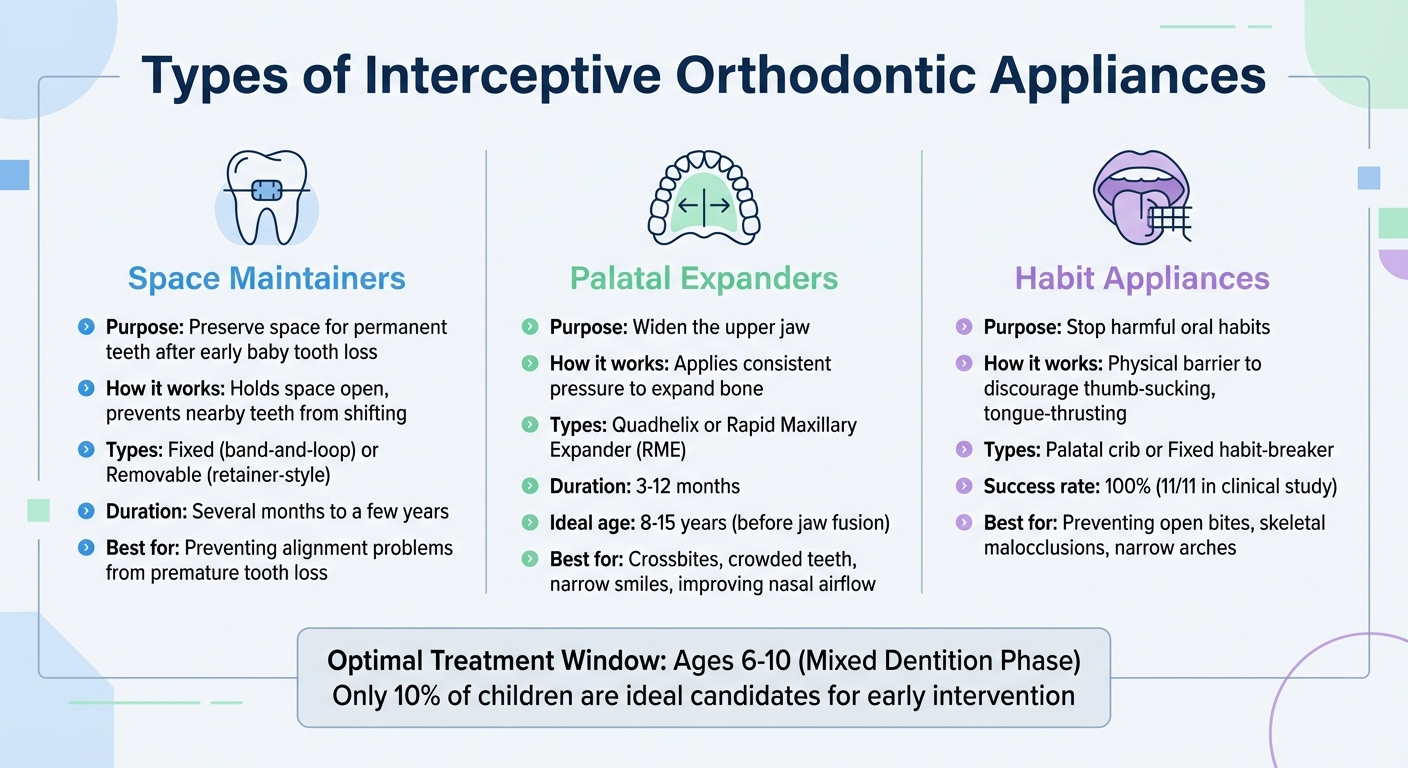
Types of Interceptive Orthodontic Appliances: Functions and Treatment Duration
Interceptive orthodontic appliances are designed to address specific developmental issues in children, helping guide proper dental and jaw growth during critical stages.
Space Maintainers
When a baby tooth is lost too early – whether from decay or injury – nearby teeth can start shifting into the empty space, potentially causing alignment problems. Space maintainers are used to keep this space open for the permanent tooth to emerge correctly. These devices don’t actively move teeth; they simply hold the space in place[9].
"A space maintainer does exactly what it sounds like – it maintains the amount of space available in the mouth and prevents unwanted drift of surrounding teeth." – Orthodontics Australia[9]
There are two main types: fixed and removable. Fixed space maintainers, such as the band-and-loop design, are cemented to adjacent teeth and are ideal for younger children who may struggle with removable options. Removable maintainers, which resemble Hawley retainers, are better suited for older kids who can manage their oral hygiene independently. Depending on how soon the permanent tooth is expected to erupt, these appliances may need to stay in place for several months to a few years[9].
Next, let’s look at appliances that actively reshape jaw development.
Palatal Expanders
Also known as maxillary expanders, these devices are used to gently widen the upper jaw by applying consistent pressure to the bone. Common fixed options include the Quadhelix and the Rapid Maxillary Expander (RME), which are effective for treating issues like posterior crossbites, crowded teeth, and narrow smiles. An added benefit of these expanders is that they can broaden the nasal cavity floor, potentially improving airflow through the nose[10][4].
Treatment typically lasts between 3 and 12 months[10], with the ideal age for expansion being between 8 and 15 – before the upper jaw’s bone junctions fully harden and fuse[10]. During treatment, parents might notice a temporary gap forming between the front teeth, which is a normal and expected sign that the jaw is expanding. This gap usually closes on its own as treatment progresses.
Now, let’s explore how certain appliances address behavioural habits that impact dental development.
Habit Appliances
Habits like thumb-sucking, finger-sucking, or tongue-thrusting can lead to dental problems such as anterior open bites, skeletal malocclusions, or narrow arches if not corrected early[1][11]. Habit appliances, such as the palatal crib or the fixed habit-breaker, are designed to act as physical barriers, discouraging these behaviours.
In one clinical study, all participants (11 out of 11) who were treated with a fixed habit-breaker successfully stopped their thumb-sucking habit[2].
"A fixed habit-breaker is the most effective treatment option for stopping persistent thumb-sucking habits where behaviour management techniques have been unsuccessful." – Felicity R Borrie and David R Bearn[2]
These devices are typically recommended when other methods, like positive reinforcement or aversive taste treatments, have failed. By breaking these harmful habits during the mixed dentition phase, habit appliances can help prevent more severe bite and alignment issues from developing later on.
When and Why Are Interceptive Appliances Used?
Understanding when to use interceptive appliances and recognising the signs for early intervention can make a significant difference in a child’s orthodontic journey.
Signs Your Child May Need Treatment
There are several signs that may indicate your child could benefit from an early orthodontic evaluation. These include issues like crowding or spacing of teeth, bite misalignments (such as crossbites, deep overbites, underbites, or open bites), protruding front teeth, irregularities in jaw development, persistent oral habits beyond the age of five, and the premature loss of baby teeth [1][3].
Protruding front teeth are particularly concerning, as studies show that children with a pronounced overjet are more than twice as likely to suffer dental injuries [2]. Research also highlights that between 26% and 39% of children present with malocclusions that could require treatment [2]. However, only about 10% of pre-adolescent patients truly benefit from early orthodontic intervention [3]. The Australian Society of Orthodontists recommends an initial screening around the age of 8, which aligns with the mixed dentition phase, the optimal period for such evaluations [3].
The Mixed Dentition Phase: Ages 6–10
The mixed dentition phase, typically between the ages of 6 and 10, is considered the best time for interceptive treatment. During this period, a child’s jaw and facial bones are still developing, making it easier to guide growth and address emerging issues [1][5]. As permanent teeth begin to erupt – usually starting around age 6 or 7 – orthodontists can detect crowding or alignment problems early and work to guide teeth into more favourable positions [1][5][7].
This stage is especially important for treating conditions like narrow maxillary arches. Palatal expanders, for instance, are most effective during this time, as the palatal suture is still developing and has not yet fused [5][12]. By expanding the dental arch early, orthodontists can create more room for adult teeth, potentially reducing the need for permanent tooth extractions or invasive jaw surgeries later in life [1][7]. Early treatment can also help address harmful habits and reduce the risk of trauma to protruding front teeth before they worsen [1][5][12].
Besides improving dental development, early intervention can lower the complexity and cost of future treatments. Interceptive treatments range in cost, from approximately $2,000 for simpler appliances to over $10,000 for more complex functional treatments. These early measures can often prevent the need for more extensive procedures down the line [4].
Benefits and Considerations of Interceptive Orthodontic Appliances
Benefits of Early Orthodontic Treatment
Interceptive orthodontic appliances can make a big difference for children in their mixed dentition phase (usually between ages 6–10). By addressing dental issues early, these treatments can create room for erupting teeth, which often makes later orthodontic work much easier and reduces the likelihood of needing extractions [6][7]. They also help protect kids with protruding front teeth, who are more than twice as likely to experience dental injuries compared to their peers [2][7].
Beyond the physical benefits, early treatment can have a positive impact on a child’s confidence. By tackling dental concerns before they become noticeable, children can feel more at ease with their appearance [13][2]. Plus, interceptive appliances can improve essential functions like breathing, speech, and chewing [6]. Another key advantage? Early intervention can often save families from expensive and complicated procedures down the track [13].
These benefits highlight why it’s worth considering early orthodontic treatment. But readiness plays a crucial role, which brings us to the next point.
What Families Should Consider
While the advantages are compelling, families need to think carefully about whether their child is ready for interceptive treatment. It’s important to note that this is often just the first step. Once all permanent teeth have emerged, additional treatment – like braces or clear aligners – may still be needed [4][5]. Interestingly, only about 10% of pre-adolescent patients are ideal candidates for early orthodontic intervention, so consulting a specialist orthodontist is essential to determine if your child will benefit [3].
Another key factor is compliance. Children must be able to maintain good oral hygiene and take care of removable appliances [14]. As Orthodontics Australia points out:
"There is no point trying to rush into orthodontic treatment if your child is not dentally and/or emotionally ready" [14].
Parents should assess whether their child has the maturity and responsibility to manage an appliance properly. Financial considerations are also important. Treatment costs can vary widely, from around $2,000 for simpler appliances to over $10,000 for more complex functional treatments [4]. Discussing payment plans with your provider can help make the process more manageable.
Conclusion
Key Takeaways
Interceptive orthodontic appliances play an important role in addressing dental issues in children while their jaws are still developing. Typically used during the mixed dentition phase (ages 6–10), these appliances help guide jaw growth, create space for permanent teeth, and reduce the risk of future dental complications [6][8]. As Felicity R. Borrie, Clinical Lecturer in Orthodontics, points out:
"If intercepted and correctly managed during the mixed dentition, many malocclusions can be eliminated or reduced in severity" [2].
The benefits of early intervention go beyond just straighter teeth. It can lower the risk of dental injuries, improve essential functions like breathing and speech, and even enhance a child’s confidence [2][5]. For families, early treatment often means shorter, less invasive procedures later on and may help avoid the need for tooth extractions [6][8].
That said, not every child requires early treatment. While the American Association of Orthodontists advises an orthodontic evaluation by age 7, only around 10% of pre-adolescent children actually need immediate care [3][5]. Consulting with a qualified specialist orthodontist ensures that treatment is tailored to your child’s specific needs.
If you’re considering interceptive orthodontics, scheduling an early evaluation is a good first step. With proper timing and expert guidance, you can set your child on the path to long-term oral health.
FAQs
Will my child still need braces later?
Early orthodontic treatments can play a big role in shaping your child’s dental development, potentially reducing the need for braces later on. These treatments, like interceptive appliances, help guide the growth of teeth and jaws, tackling issues such as crowding or bite problems before they become more serious. However, for more complex alignment concerns, braces or aligners might still be necessary as your child grows. The best way to stay ahead is through regular orthodontic check-ups, ensuring any issues are addressed promptly.
How do I know if my child is ready for an appliance?
Children are typically assessed for interceptive orthodontic appliances between the ages of 6 and 8, during the phase when baby teeth and permanent teeth are both present. At this stage, an orthodontist evaluates factors like jaw growth, tooth alignment, and behaviours such as thumb-sucking or mouth breathing. While early treatment may not always be required, having an evaluation by age 8 can spot potential problems early and help plan any necessary steps to promote proper dental development.
Are palatal expanders painful or hard to use?
Palatal expanders are crafted to be both comfortable and simple to use. While it’s common to experience slight pressure or mild discomfort when first adjusting to the appliance, this feeling usually fades as you become accustomed to wearing it. If the discomfort continues, it’s a good idea to reach out to your orthodontist for advice.
Related Blog Posts
- 5 Differences Between Retainers for Kids and Adults
- How to Prevent Malocclusion in Children
- 5 Factors Affecting Orthodontic Treatment Feasibility
- Orthodontic Planning: Setting Realistic Goals
Important Notice: Any surgical or invasive procedure carries risks. Before proceeding, you should seek a second opinion from an appropriately qualified health practitioner.
Individual results may vary. The information provided in this article is for educational purposes only and does not constitute medical advice.
Checkout Related Blogs



Get in touch with us
For more information, call us now to start feeling better. Or fill the form below to make appointment
The Latest News from Complete Smiles
How to Clean Clear Plastic Retainers
Checklist for Choosing Wearable Dental Devices
Checklist for Choosing Cloud AI Platforms in Dentistry
Complete Smiles Bella VistaAccepts All Major Health Funds, Including