



How Patient Portals Improve Dental Care
Patient portals are transforming dental care by giving patients direct, secure access to their oral health information and streamlining communication with dental teams. These online platforms allow patients to manage appointments, access records, and receive tailored treatment plans – all while improving efficiency for dental practices. Here’s why they matter:
- 24/7 Access: View dental records, X-rays, and treatment plans anytime.
- Better Communication: Use secure messaging to ask questions or clarify instructions without waiting for a call back.
- Appointment Management: Schedule appointments and receive reminders at your convenience.
- Educational Resources: Access personalised information to understand your oral health better.
- Administrative Efficiency: Reduce paperwork with digital forms and online payments.
For dental practices, these tools enhance patient satisfaction, reduce administrative workloads, and ensure compliance with privacy laws like the Privacy Act 1988. Whether you’re coordinating complex treatments or simply booking a check-up, patient portals make dental care more accessible and effective.
Better Communication Between Patients and Dental Teams
Secure Messaging for Easy Communication
Patient portals are changing the game for communication between patients and dental teams by offering encrypted messaging systems that work 24/7. Unlike traditional phone calls restricted to business hours, these platforms let patients send messages whenever it suits them.
For Australian dental practices, security is a top priority. These systems use two-factor authentication and encryption, ensuring compliance with the Privacy Act 1988 and Australian Privacy Principles. This means patients can discuss sensitive health matters without worrying about privacy breaches.
The benefits are clear. Patients can send messages about post-treatment care, request prescription refills, or clarify instructions without the hassle of waiting for a call back. For instance, someone recovering from dental implant surgery can check in with their dentist about their progress and get advice without needing an emergency appointment.
This system also lightens the load for dental practices. With fewer routine phone calls to manage, front desk staff can focus on more complex tasks, while dental teams can reply to messages during set times. This efficiency is especially valuable given the staffing shortages many Australian practices have faced in recent years.
Another advantage? Every message sent through the portal is automatically documented. This creates a clear record of interactions, reducing confusion from verbal instructions and giving both patients and providers a reliable reference for past conversations.
Faster Responses to Patient Questions
Patient portals make it easier for dental teams to prioritise and respond to patient questions more effectively than traditional methods. Messages are logged in one place, with notifications ensuring urgent concerns are flagged and addressed promptly.
This quicker response time directly impacts patient satisfaction. According to the CareQuest Institute for Oral Health, most adults believe that having access to a dental patient portal would improve their understanding of dental health and increase their trust in providers [1]. When patients see their concerns acknowledged and resolved quickly, it strengthens their confidence in their dental care team.
The portal also streamlines the triage process. Urgent messages, such as those about potential dental emergencies, can be flagged for immediate attention – even before the practice opens. Meanwhile, routine queries about appointments or billing can be handled during regular administrative hours. This system ensures serious issues are addressed promptly without disrupting the workflow for less pressing matters.
For patients undergoing more complex treatments, like orthodontics or multiple procedures, the portal becomes an essential tool. They can track their progress, ask follow-up questions, and receive specific instructions tailored to their treatment plan.
Additionally, patients can update their personal and medical information in real time. This ensures the dental team always has the most current data to inform care decisions, eliminating delays caused by outdated or missing information. Combined with access to dental records and personalised treatment plans, this streamlined communication enhances the overall patient experience.
Access to Dental Records and Treatment Information
Viewing and Managing Records
Patient portals have revolutionised how we access and manage dental records. These platforms provide round-the-clock access to your complete dental history, making it easier than ever to stay informed about your oral health. Unlike traditional paper records, digital systems let you review your information whenever it suits you.
Your dental records might include personal details, medical histories, progress notes, treatment plans, prescriptions, X-rays, photos, referral letters, and consent forms. Having this level of detail at your fingertips means you can revisit treatment recommendations, double-check medications, and prepare for appointments without needing to contact your dentist directly.
This access becomes especially handy when switching dentists or seeking a second opinion. You can quickly download and share your full dental history, helping new providers make informed decisions and ensuring your care remains consistent and uninterrupted [4].
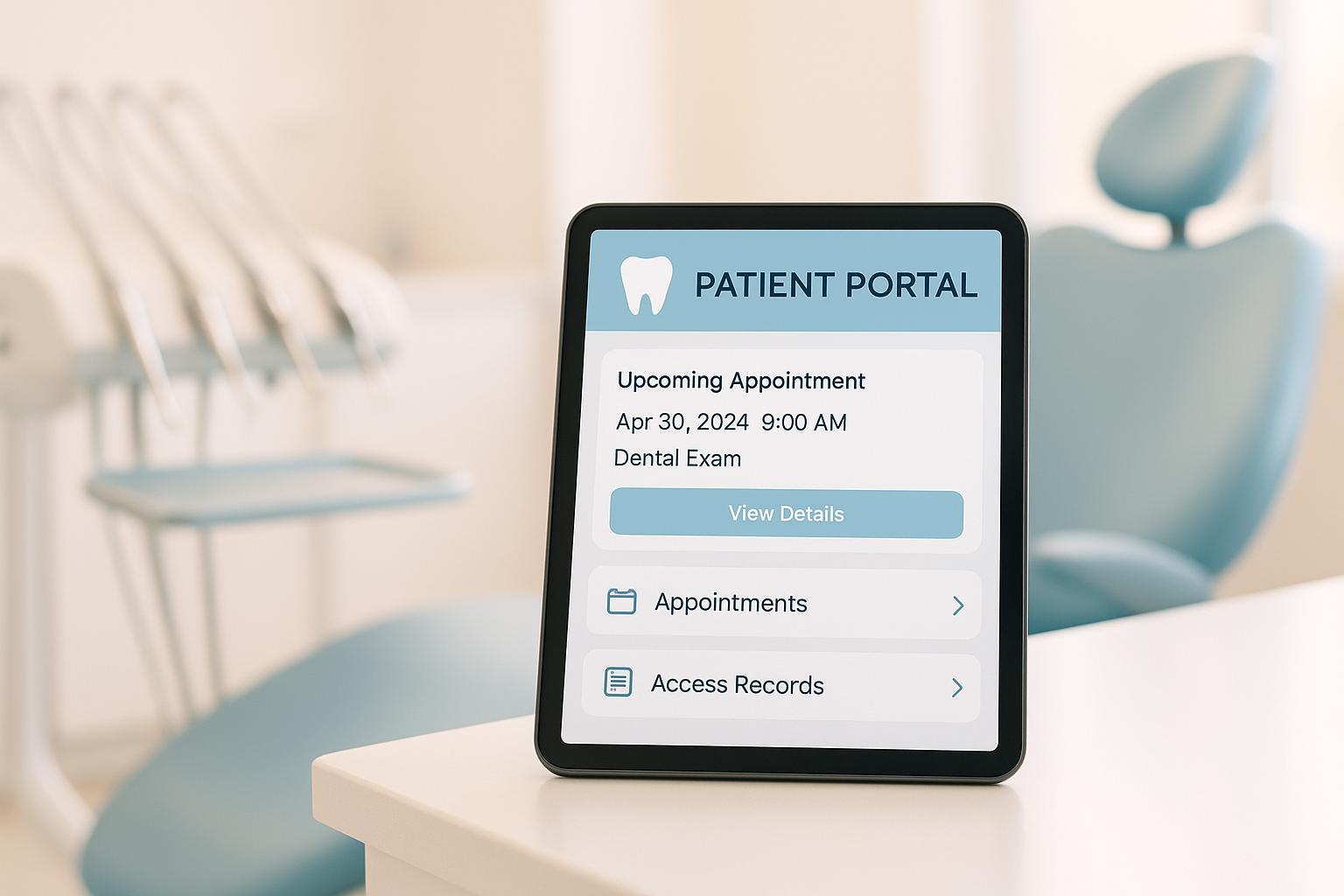
Many portals also feature user-friendly dashboards that organise everything into sections like payments, upcoming appointments, pending forms, and treatment plans [2]. This setup saves you from the hassle of digging through lengthy documents to find what you need.
Another benefit of this transparency is the ability to spot and correct errors in your records. Studies suggest that about 30% of health information in dental clinics contains inaccuracies [5]. By reviewing your records before appointments, you can help ensure your care is based on accurate information, improving communication and decision-making with your dental team.
This easy access lays the groundwork for managing more intricate care needs.
Supporting Complex Care Needs
For those juggling multiple treatments or seeing various providers, patient portals make coordination much simpler. Digital records allow seamless collaboration between your dentist, hygienist, and other healthcare professionals, ensuring every part of your treatment aligns.
If you’re dealing with complex medical conditions or taking multiple medications, having immediate access to your full treatment and medication history is invaluable. This information helps your dental team plan procedures carefully, avoiding potential interactions with your existing medications.
Portals also streamline specialist referrals. For instance, if your general dentist refers you to an orthodontist, periodontist, or oral surgeon, you can review referral details and treatment summaries beforehand. This means you’ll arrive at your specialist appointment fully informed and ready to discuss your care.
The 24/7 availability of your records means you’re not restricted to practice hours. Whether you’re preparing for an appointment, checking post-treatment instructions, or reviewing your treatment plan, the information is always there when you need it. This level of access supports the creation of tailored treatment plans designed specifically for your needs.
Personalised Treatment Plans and Better Patient Engagement
Custom Treatment Plans and Education
Patient portals bring a tailored approach to dental care by offering treatment plans that reflect your dental history, risk factors, and health goals. Instead of receiving one-size-fits-all advice, you get access to plans designed specifically for your needs. Plus, these platforms let you review and confirm treatment options at your own pace, giving you the flexibility to make informed decisions when it’s convenient for you [2].
Through these portals, your dental team can share detailed educational materials alongside your treatment plan [1]. This might include summaries of procedures, preparation instructions, and post-care guidelines. Since the portal is accessible 24/7, you can revisit this information whenever needed.
The system also provides personalised reports and risk assessments to help you better understand your oral health [6]. For example, if you’re at an increased risk for gum disease due to certain medications or conditions, the portal might include specific prevention tips and warning signs to monitor.
In March 2023, CareStack introduced a task-driven homepage. This feature lists tasks for patients to complete, with notifications sent once those tasks are finished [1]. These tools aim to make you a more active participant in your dental care. Research reveals that 92% of patients now have online access to their health records, and many believe that patient portals improve their understanding of dental health and build trust with their providers [1]. This personalised approach even extends to scheduling and reminders, making the entire process more user-friendly.
Appointment Scheduling and Reminders
Patient portals simplify appointment management, giving you control over your schedule. Instead of calling during business hours, you can browse available time slots and book appointments at your convenience. This feature is especially helpful for busy professionals or parents juggling multiple responsibilities.
The reminder system is another standout feature. You can choose to receive notifications via text, email, or voice calls – whichever suits your lifestyle best [1]. These reminders often include helpful pre-appointment instructions, ensuring you’re fully prepared.
Prescription management is also streamlined through these platforms. You can handle refills, review medication instructions, and track your progress with ease. This is particularly useful for treatments involving multiple medications or complex timing requirements.
Some portals even let you jot down questions or concerns ahead of your appointments [7]. This ensures you won’t forget to discuss anything important with your dental team.
The combination of flexible scheduling, detailed reminders, and seamless communication makes for a more engaging experience. Instead of feeling like a passive recipient of care, you become an active participant in every step of the process. This involvement often leads to better outcomes and a more satisfying overall experience.
Looking ahead, CareStack plans to roll out another time-saving feature in March 2024. Online form fields will automatically sync with the practice management system, so when you enter personal details, they’ll update directly in your profile. This eliminates redundant data entry and saves time for both you and your dental practice [1].
Better Practice Efficiency and Less Administrative Work
Digital Forms and Billing
Patient portals simplify administrative tasks by centralising them into one system. This integration allows staff to handle everything from scheduling to billing without juggling multiple programs, saving time and reducing inefficiencies [9].
Digital systems have transformed scheduling, making it far more efficient. Practices using centralised management systems report a 25% improvement in scheduling efficiency [12]. With 38% of appointments now self-scheduled, reception teams can focus on more complex issues rather than fielding constant phone calls, which often disrupt their workflow [9] [13].
Take McHale Dental in Houston, Texas, for example. They combined six essential services – Analytics, Scheduling, Patient Communications, Online Payments, Patient Forms, and Reviews – into one integrated platform using Practice by Numbers (PbN). This move resulted in impressive outcomes in just three months: A$22,000 collected through PbN’s online payment system, a 15% drop in missed appointments, and a 30% increase in new patient retention [11].
Digital forms also play a key role in reducing manual workload. Patients can complete their medical histories, insurance details, and consent forms before arriving at the practice. This information is automatically uploaded into the management system, cutting down on data entry errors and freeing staff to focus on patient care [10].
Billing becomes much smoother with online payment options through patient portals [10]. Practices using automated billing tools report a 40% reduction in administrative errors and quicker payment cycles [12]. Electronic claims processing offers even more advantages compared to traditional paper-based methods:
| Benefit | Description |
|---|---|
| Reduced Rejection Rates | Fewer errors mean claims are less likely to be rejected |
| Faster Processing | Claims are processed more quickly, leading to faster reimbursements |
| Improved Accuracy | Automation minimises manual errors |
| Enhanced Visibility | Real-time updates on claim status improve transparency |
Automated systems also take over routine administrative tasks, operating 24/7. This allows staff to dedicate their time to patient care instead of paperwork. The benefits ripple through the entire practice – morning huddles are more efficient, schedules run smoothly, and staff can avoid staying late or working through lunch breaks to catch up on tasks that could be automated [16].
Supporting Environmental Goals
Digital systems don’t just streamline operations – they also support sustainability efforts, aligning with Australia’s commitment to environmental responsibility. Moving towards paperless administration through patient portals reduces costs, improves efficiency, and significantly lowers a practice’s environmental footprint [15].
Consider the sheer amount of paper used in a typical dental practice: patient forms, treatment plans, appointment reminders, billing statements, insurance claims, and educational materials. Across thousands of patient interactions each year, this adds up to a considerable environmental impact. By adopting digital systems, practices can reduce paper usage, improving organisation and accessibility.
The shift to digital also reduces the need for physical storage. Traditional practices often rely on extensive filing cabinets and storage rooms. Digital records eliminate this requirement, freeing up space that can be repurposed for patient-focused activities.
Patients benefit as well. Instead of receiving multiple paper statements, appointment reminders, and educational materials by mail, they can access everything digitally. This not only reduces paper waste and postal delivery emissions but also provides patients with more convenient and timely access to their information.
"The simplicity that comes with a centralised solution for managing daily tasks means dental professionals and supporting staff can achieve peak efficiency in their activities." – Dental4Web [14]
Going paperless can also result in significant cost savings over time. Practices save on paper, printing, postage, and storage, while reducing the labour involved in filing and managing records [15]. These savings can be reinvested into improving patient care or expanding the practice.
Security is another critical advantage of digital systems. A data breach can cost a business up to 12% of its annual revenue [14]. Modern patient portals are designed with robust security features like data encryption, role-based access controls, and regular updates. These systems comply with the Australian Dental Association‘s data security standards [14], ensuring better protection of sensitive information and compliance with privacy regulations.
sbb-itb-2be92ed
Comparing Benefits for Patients and Practices
Benefits Table for Patients and Practices
Patient portals offer a range of benefits for both patients and dental practices, extending the advantages of improved communication and record access. Surveys reveal that two-thirds of adults prefer receiving dental records through a portal, while practices with portals report an 80% patient return rate, compared to 67% for those without [20][19].
Here’s a closer look at the specific benefits:
| Benefit | For Patients | For Practices |
|---|---|---|
| Communication | Secure messaging | Fewer administrative calls |
| Convenience | Self-booking appointments, easy refills, online payments [18][19] | Streamlined workflows, fewer no-shows [19] |
| Access | 24/7 access to records and educational resources [18][19] | Improved data accuracy and communication [19] |
| Engagement | Better care coordination, personalised education [19] | Stronger patient relationships, smoother co-pay processing [19] |
| Efficiency | Faster access to results, centralised health info [19] | More time for patient care instead of admin tasks [19] |
| Security | Encrypted communication and billing (HIPAA-compliant) [8] | Safer payment handling, easier regulatory compliance [8] |
These benefits highlight how patient portals enhance both the patient experience and practice operations. For example, nearly 70% of patients prefer receiving updates and reminders via SMS or email [17]. However, challenges remain. In 2019, 63% of insured adults who visited a healthcare provider never accessed their provider’s portal, and 40% were not even offered the service [19]. Yet, portal users are more engaged, with 30% visiting a primary care doctor within three years, compared to only 19% of non-users [19].
For dental practices, the potential is clear: over 80% of adults want their dental records shared electronically with medical providers [20]. This reflects a growing readiness for integrated digital health management.
The pandemic has also played a pivotal role in accelerating the use of digital tools. As stated by Patient Engagement HIT:
"The pandemic has served as a key use case for the patient portal in care management." [19]
What Is A Dental Patient Portal And How Does It Help? – The Pro Dentist
Conclusion: The Role of Patient Portals in Modern Dental Care
Patient portals are reshaping dental care across Australia, giving patients more control over their oral health while improving overall outcomes.
By offering secure online access to dental records and educational resources, these portals encourage patients to take an active role in managing their care[21][3].
For dental practices, the benefits go beyond patient engagement. Tools like appointment management systems have shown measurable results, with practices reporting only a 0.77% Failed To Attend rate and 97% chair utilisation. Additionally, online booking now accounts for half of all after-hours appointments, streamlining operations while meeting patient needs[22].
Teledentistry through patient portals is also addressing the challenges of Australia’s vast geography. With a caries screening sensitivity of 69.7% and specificity of 97.4%, these technologies are delivering high-quality care to remote areas. They could also provide significant cost savings, potentially reducing expenses within the health system by up to AUD 85 million[23].
FAQs
How do patient portals make communication with your dental team easier?
Patient portals make staying in touch with your dental team a breeze. They offer a secure space where you can send messages, check your health records, and manage appointments – all without the hassle of making phone calls. It’s a more convenient and efficient way to handle your dental care.
These portals also give you instant access to treatment plans and send appointment reminders, helping you stay on top of your care. Plus, they enable dental teams to tailor communication to your needs, saving time while ensuring you get the personalised attention you deserve.
How do patient portals support better management of complex dental treatments?
Patient portals simplify the management of complex dental treatments, offering patients secure, anytime access to their treatment plans, health records, and helpful educational materials. This ensures they can stay informed and keep their care on track.
These platforms also make it easier to connect with dental providers. Patients can quickly ask questions, schedule follow-ups, or get clarification on instructions – all in one place. By cutting through the hassle, patient portals improve care coordination and make the overall dental experience smoother and more convenient.
How do patient portals help dental practices become more environmentally friendly?
Patient portals play a key role in promoting environmentally conscious dental practices by cutting down on paper use through digital record-keeping and communication. Switching to electronic systems helps reduce waste while also simplifying workflows, leading to smoother and more energy-efficient operations. By embracing these digital tools, dental clinics can effectively shrink their environmental impact and improve their day-to-day efficiency.
Related Blog Posts
- Digital Dental X-Rays: How They Work
- AR in Dental Care: Patient Education Tools
- AI Research in Oral Disease Detection: Key Findings
- How AI Chatbots Improve Patient Engagement
Important Notice: Any surgical or invasive procedure carries risks. Before proceeding, you should seek a second opinion from an appropriately qualified health practitioner.
Individual results may vary. The information provided in this article is for educational purposes only and does not constitute medical advice.
Checkout Related Blogs


Get in touch with us
For more information, call us now to start feeling better. Or fill the form below to make appointment
The Latest News from Complete Smiles
How to Clean Clear Plastic Retainers
Checklist for Choosing Wearable Dental Devices
Checklist for Choosing Cloud AI Platforms in Dentistry
Complete Smiles Bella VistaAccepts All Major Health Funds, Including