





How AI Identifies Rare Oral Pathologies
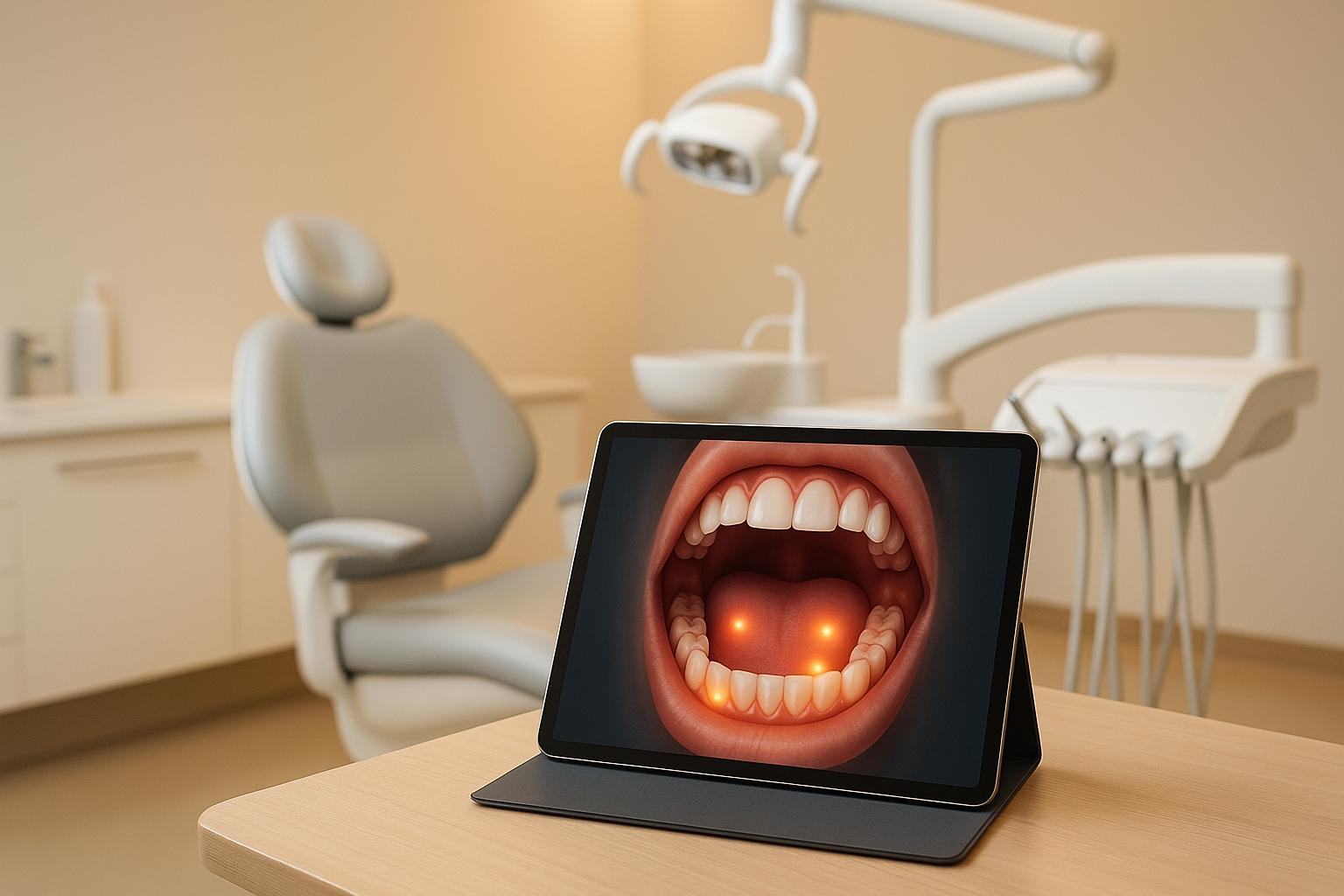
Artificial intelligence (AI) is transforming how dentists detect rare oral diseases. By analysing dental images and patient records, AI tools identify subtle signs of conditions that are often missed during routine check-ups. These systems utilise machine learning, deep learning, and computer vision to provide faster, more accurate insights, assisting clinicians in diagnosing conditions like oral cancer, jaw tumours, and periodontal disease early.
Key Points:
- AI excels at spotting rare oral diseases that are difficult to diagnose due to subtle symptoms or limited clinician exposure.
- Deep learning models, like CNNs, achieve up to 93% accuracy in analysing dental images.
- Generative Adversarial Networks (GANs) improve image quality and create synthetic training data to address data shortages.
- AI tools such as Overjet and Yomi integrate with existing systems, offering real-time diagnostic support and treatment planning.
- Challenges include data quality, privacy concerns, and high implementation costs, but clinician oversight ensures AI complements – not replaces – human expertise.
AI’s role in dentistry is growing, offering both improved detection rates and workflow efficiency. However, ethical use, compliance with Australian regulations, and maintaining patient trust remain critical.
Unleashing AI in Oral Pathology and Oral Medicine: Challenges and Opportunities #oralpathology360
AI Technologies Used for Detection
The foundation of AI-driven oral pathology detection lies in advanced technologies designed to process and analyse dental images with impressive accuracy. These systems integrate various methods to create powerful diagnostic tools that assist clinicians in identifying even the most challenging conditions. Here’s a closer look at the key techniques behind these advancements.
Machine Learning and Deep Learning Models
Machine learning and deep learning are the driving forces behind AI diagnostics in dentistry. Unlike traditional rule-based systems, these models learn patterns directly from data[9]. Deep learning, which relies on neural networks inspired by the structure of the brain, is especially effective for analysing dental images, handling tasks like classification, region detection, and segmentation[7].
Convolutional Neural Networks (CNNs) stand out for dental imaging tasks due to their ability to localise spatial features and detect edges. Studies show that CNNs achieve diagnostic accuracies ranging from 85% to 93%, while broader AI diagnostic systems report accuracies of about 82%[8]. For instance, a study by Ariji and colleagues demonstrated deep learning’s potential by automatically detecting cervical lymph nodes in patients with oral squamous cell carcinoma using CT images[7].
Computer Vision in Dental Imaging
Computer vision automates processes like segmentation, classification, and anomaly detection in dental radiographs – tasks traditionally done manually[10]. By identifying subtle patterns in radiographs, these systems enable quicker and more precise evaluations. For example, deep learning models have achieved classification accuracies exceeding 90% when identifying C-shaped anatomies[11].
AI-powered systems can also detect cavities, fractures, and tumours, facilitating earlier and more accurate diagnoses[6]. Considering that tooth decay impacts roughly 90% of the global population[5], these automated tools are essential for spotting rare and subtle anomalies. A standout example is Yomi, a robotic surgery platform developed by Neocis and cleared by the FDA. Yomi assists dentists with implant planning and placement using digital images and CT scans, offering real-time guidance through haptic and visual feedback during procedures[6].
Enhancing Images with Generative Adversarial Networks (GANs)
Generative Adversarial Networks (GANs) play a crucial role in addressing data limitations and improving image quality. By having two neural networks work against each other, GANs produce highly refined and realistic images. They enhance dental images through methods like artefact reduction, denoising, and super-resolution enhancement[10]. For instance, GANs can sharpen blurry images often found in the incisor region of panoramic radiographs[12].
GANs also create synthetic images to tackle data scarcity while safeguarding patient privacy[10]. This is particularly useful for rare oral pathologies, where training data is limited. Research by Yang and colleagues highlighted this capability, using StyleGAN2-ADA to generate periapical images of mandibular second molars with different canal configurations. Their study reported Fréchet inception distance (FID) scores of 72.762 (± 0.723) and 61.373 (± 3.035) for these synthetic images, and a visual Turing test showed that observers could only distinguish real from synthetic images 54% of the time, demonstrating the high realism achieved[11]. Advanced architectures like WGAN-GP further improve stability and quality during training, enabling the creation of synthetic images that support more accurate diagnoses of rare conditions[10]. By expanding datasets with high-quality synthetic images, GANs enhance diagnostic precision and support better clinical outcomes.
How AI Detection Works: Step-by-Step Process
AI has made impressive strides in identifying rare oral pathologies, and its process can be broken down into clear steps, from collecting data to applying findings in clinical settings.
Data Collection and Preparation
The process starts with gathering extensive, high-quality datasets. These include panoramic radiographs, CBCT scans, and intraoral photos. Clinicians play a key role here, marking affected areas in the images, which directly impacts the AI model’s accuracy. To ensure consistency, data is standardised across different equipment and clinical environments, maintaining uniform formats, resolution, and contrast. Additionally, techniques like data augmentation are used to introduce variability, helping the AI generalise better across diverse cases [13].
Once the data is prepared, the AI begins to identify patterns and markers that are often hard for the human eye to spot.
Finding Patterns and Markers
Using convolutional neural networks (CNNs), the AI examines pixel-level details to detect subtle signs of early-stage issues like minor bone loss or small periapical lesions – problems that clinicians might overlook [1]. The training process involves fine-tuning model parameters and employing loss functions and cross-validation to avoid overfitting [13]. This enables the AI to differentiate between normal anatomical structures and pathological changes.
For instance, AI can detect fatty degeneration in salivary glands on CT images, an indicator of Sjögren’s syndrome. It can also identify mucosal thickening or retention cysts in maxillary sinuses via CBCT scans [3]. In one study, a deep convolutional neural network achieved an impressive 98.3% accuracy and 94.4% sensitivity in identifying jaw cysts and tumours. Similarly, CNN models using near-infrared transillumination images have demonstrated superior speed and accuracy in detecting dental caries compared to traditional methods [13].
Classification and Clinical Use
After identifying patterns, the AI classifies its findings into actionable categories. Platforms such as Overjet integrate seamlessly with imaging systems and practice management software, offering real-time insights [14]. These tools provide automated measurements and visual overlays, which not only enhance clinical records but also simplify insurance claim processes.
Before clinical use, rigorous validation ensures the AI’s reliability, measuring metrics like accuracy, sensitivity, and specificity [13]. Remarkably, CNN models have shown diagnostic performance comparable to dentists with 3–10 years of experience. One study even reported an accuracy rate of 81.11% for AI systems, closely matching the 82.09% accuracy achieved by human practitioners [13].
Practices adopting AI tools have reported significant benefits, including improved efficiency and a 10–20% increase in case acceptance within just a few months [14]. Research from Pearl AI highlights that 43% of caries in dental X-rays go undiagnosed, and dentists often misjudge lesion depth 40% of the time. AI has improved detection rates by 37%, offering consistent and reliable support [15]. As these systems evolve, they continue to adapt to new clinical challenges, enhancing their utility over time.
sbb-itb-2be92ed
Benefits and Drawbacks of AI in Rare Pathology Detection
AI’s integration into detecting rare oral pathologies brings both promising advantages and notable challenges. It’s essential for practices to weigh these factors when considering AI systems.
Benefits of AI-Based Detection
Improved Diagnostic Accuracy and Speed
AI systems excel in diagnostic precision. For example, an AI model designed for diagnosing root caries achieved an impressive 97.1% success rate, with 95.1% precision and 99.6% sensitivity [4]. Similarly, AI tools for lymph node detection show an average accuracy of 86%, while orthodontic treatment outcome predictions reach around 73% success [16].
The speed of AI is equally striking. These platforms can analyse X-rays in real time, identifying cavities, tooth decay, bone loss, and infections [16]. FDA-cleared systems deliver immediate overlays on radiographs, providing objective insights [17]. This allows clinicians to diagnose conditions during consultations, significantly improving workflow efficiency.
Lower Workload and Reduced Errors
AI technologies help ease the burden on clinicians by automating tasks like dental charting and radiograph analysis. This reduces the chances of human error and helps ensure consistent care across different practitioners and settings [3][16]. By standardising diagnostic processes, AI supports a more uniform approach to patient care.
Early Detection of Pathologies
AI demonstrates a strong ability to detect conditions at their earliest stages, when treatment is most effective. It can identify oral cancer, caries, and periodontal diseases before they become clinically visible, which could lower the rates of late-stage oral cancer-related complications [3][4].
Despite these advancements, integrating AI into clinical settings comes with its own set of challenges.
Drawbacks and Challenges
While the benefits are compelling, there are hurdles to overcome when implementing AI systems.
Dependence on Data Quality and Training
AI systems rely heavily on the quality of their training data. Poor datasets, limited sample sizes, or bias in the data can compromise accuracy. For instance, in a study of 82 subjects with oral potentially malignant lesions, AI achieved an overall accuracy of 84–86%, but sensitivity for detecting high-grade dysplasia was just 18% [2]. Additionally, the "black box" nature of AI – where the decision-making process is opaque – can erode clinician trust in the technology [18].
Privacy, Security, and Ethical Issues
Handling patient data for AI training and validation demands strict adherence to confidentiality regulations. Robust security measures and responsible data governance are critical. Furthermore, algorithmic bias could unintentionally reinforce healthcare disparities based on factors like age, ethnicity, or socioeconomic status [18].
Infrastructure and Skill Set Demands
Implementing AI requires significant investment in infrastructure and staff training. Compatibility issues may arise when new systems don’t integrate smoothly with existing workflows, leading to siloed data and interoperability problems [18].
Cost and Regulatory Challenges
The high costs of AI implementation and navigating complex regulatory requirements can be particularly challenging for smaller practices. While funding opportunities and open-source solutions offer some relief, these hurdles remain significant [18].
Pros and Cons Comparison Table
| Benefits | Drawbacks |
|---|---|
| 97.1% success rate for root caries diagnosis [4] | 18% sensitivity for high-grade dysplasia detection [2] |
| Real-time analysis with instant results [16][17] | "Black box" nature limits interpretability [18] |
| Reduced clinician workload and stress [3][16] | Data privacy and security compliance needed [18] |
| Early detection of oral cancers and other pathologies [3][4] | Risk of algorithmic bias perpetuating disparities [18] |
| Availability of FDA-approved tools [16][17] | High costs and regulatory hurdles for implementation [18] |
Using AI in Australian Dental Practices
Incorporating AI into dental practices in Australia brings with it a host of regulatory, ethical, and oversight considerations. While AI offers advanced diagnostic capabilities, its adoption requires careful attention to patient safety, legal obligations, and the unique clinical landscape in Australia. Successfully integrating AI means balancing innovation with responsibility.
Regulatory and Compliance Requirements
Australian dental practitioners must navigate strict regulations when introducing AI into their practices. The Australian Health Practitioner Regulation Agency (AHPRA) has made it clear that the responsibility for AI use lies with individual practitioners. As AHPRA explains:
Individual health practitioners remain ultimately responsible for any and all AI used in the course of their medical practice [20].
This means practitioners must fully understand how AI systems function, including their training, biases, risks, and limitations [20]. Additionally, any AI diagnostic tools must comply with the Therapeutic Goods Administration (TGA) standards, ensuring they meet Australian medical device requirements before being used in clinical settings.
AI systems must also adhere to the Australian Privacy Principles and the Privacy Act 1988, which mandate encryption, secure data storage, and compliance with the Health Practitioner Regulation National Law. Practitioners should confirm that their professional indemnity insurance covers activities involving AI [20][23].
The Australian Government is exploring mandatory safeguards for AI in high-risk healthcare environments. While these are still under consideration, voluntary AI Safety Standards currently provide guidance for practices looking to prepare for future regulatory changes [21].
To stay compliant, dental practices should:
- Update privacy policies and consent forms to reflect AI usage.
- Develop internal policies for responsible AI implementation.
- Regularly review AHPRA’s guidance on AI in healthcare [22].
Once regulatory requirements are addressed, the focus shifts to ethical considerations.
Ethical Considerations in AI Use
Using AI ethically in Australian dental practices revolves around transparency, fairness, and respect for patient autonomy. The Australian AI Ethics Framework outlines eight key principles, including the importance of respecting human rights, preventing discrimination, and safeguarding privacy [19].
Practitioners must obtain informed consent from patients, clearly explaining how AI contributes to image analysis and diagnosis [23][24]. Transparency is vital – AI cannot be used behind the scenes without patients being fully aware of its role.
Fairness in AI is another critical challenge. Systems trained on limited or biased datasets can unintentionally reinforce healthcare inequalities, affecting certain demographic groups. The Australian Dental Association emphasises:
Dental professionals have a duty to ensure that the AI tools they use are developed with fairness and equity in mind [24].
This means practitioners should ensure AI systems are trained on diverse datasets and continually monitor their performance across different patient populations.
Data privacy goes beyond basic compliance. Practitioners must implement stringent security measures, such as encryption and secure storage, and ensure patients understand how their data is used in AI training and validation [23]. As the framework highlights:
AI systems should respect and uphold privacy rights and data protection, and ensure the security of data [19].
This requires ongoing vigilance as AI technology continues to advance.
Why Clinician Oversight Matters
Even with regulatory and ethical measures in place, clinician oversight remains indispensable. AI is a tool to assist, not replace, clinical expertise. This is especially important in diagnosing rare oral conditions, where professional judgment and clinical context are irreplaceable. Practitioners must critically evaluate AI-generated insights before incorporating them into treatment plans [24].
Accountability cannot be shifted to technology. If AI identifies potential rare pathologies, it is the practitioner’s responsibility to validate these findings using their clinical knowledge and, when necessary, additional diagnostic methods. This ensures that AI recommendations are tailored to each patient’s specific circumstances.
Maintaining accurate records is essential. Practitioners should document AI contributions alongside their own decision-making processes [24].
Finally, ongoing education is key. Dental professionals should participate in training programs and attend workshops to deepen their understanding of AI’s capabilities and limitations in healthcare [22]. This equips them to better oversee AI use and identify when further clinical investigation or specialist input is needed.
Conclusion
AI is reshaping how dental professionals detect rare oral pathologies. For example, some AI models boast an impressive 92% sensitivity and 91.9% specificity in diagnosing oral squamous cell carcinoma [26]. These systems can analyse intricate imaging data and patient records, uncovering patterns that might be missed by human eyes. This consistency and objectivity add a valuable layer to clinical decision-making.
The ability to process dental radiographs in real time and detect subtle pathological changes represents a major leap forward in oral healthcare. AI has shown capabilities like identifying periodontal bone loss with 83.3% accuracy and analysing cephalometric radiographs in mere seconds [4]. Such speed and precision pave the way for earlier detection and more tailored treatment plans, which can significantly improve patient outcomes.
However, bringing AI into Australian dental practices isn’t without its challenges. Compliance with regulations, ethical considerations, and ongoing clinical oversight are critical. As the Australian Dental Association highlights:
Applications of Artificial Intelligence in dentistry should prioritise patient safety, quality of care, continuity of care, and data privacy and security [25].
Key Takeaways
AI’s role in oral pathology detection is undeniably transformative. One of its standout advantages is its ability to standardise diagnostics across practices while maintaining high levels of accuracy [1]. It excels at identifying subtle signs of rare pathologies, even in cases where clinical experience may be limited [1]. Moreover, AI’s capability to analyse diverse data sources and assess risk factors strengthens its diagnostic potential [4].
In practical terms, AI addresses many challenges faced by dental professionals. With accuracy rates exceeding 90% in various studies, these tools provide reliable support for treatment planning and help minimise diagnostic errors [4]. Importantly, AI complements rather than replaces clinical expertise, offering additional data and insights to enhance human judgment.
Future of AI in Oral Pathology
The future of AI in dentistry extends well beyond detection. Emerging applications promise to revolutionise dental care by introducing predictive analytics for disease risk, preventive care strategies, and AI-driven treatment plans [1]. These advancements aim to integrate seamlessly with electronic health records, creating comprehensive patient profiles that enable personalised care. Additionally, future AI systems may improve the ability to predict the malignant transformation of oral lesions at earlier stages [5].
For Australian dental practices, this progress means access to more refined AI tools that not only enhance diagnostic accuracy but also align with local regulations.
As Mario Paganini from Overjet points out:
AI is not just enhancing what dentists can see – it’s helping set a higher standard for dental health care [1].
While AI continues to evolve, its success depends on maintaining a balance between innovation and ethical responsibility. Human oversight will remain crucial to ensure these technologies are implemented safely and effectively. By adhering to strict regulatory standards, AI is set to make the detection of rare oral pathologies more accessible and reliable across all levels of dental care in Australia.
FAQs
How does AI help diagnose rare oral pathologies more accurately and efficiently?
AI is transforming the diagnosis of rare oral conditions by using advanced tools like deep learning and image recognition. These technologies are trained to interpret complex dental images with incredible accuracy, often spotting subtle details that might escape the human eye during manual checks.
By automating the analysis, AI cuts down the time needed for diagnosis, giving dental professionals more room to concentrate on developing effective treatment plans. This blend of speed and precision not only helps detect rare conditions earlier but also plays a key role in improving patient care and management.
What ethical and privacy issues arise when using AI in dental care?
When using AI in dental care, several ethical considerations come into play. One key concern is minimising diagnostic errors to avoid misinterpretations that could affect patient outcomes. Another is addressing bias in AI algorithms, ensuring they work fairly across diverse patient groups. Above all, patients’ dignity and autonomy must be upheld, making it crucial to validate AI systems thoroughly for both accuracy and fairness.
Privacy is another significant issue. Protecting sensitive patient data from breaches or misuse requires robust data security measures. Dental practices need to follow all legal standards and be upfront about how patient information is collected, stored, and utilised. By prioritising transparency and security, practices can build trust and ensure AI is used responsibly in dentistry.
How can dental practices in Australia stay compliant when using AI technologies?
To meet compliance requirements when adopting AI technologies, Australian dental practices need to follow the regulations outlined by the Australian Dental Association (ADA) and the Australian Health Practitioner Regulation Agency (AHPRA). These rules are designed to uphold patient safety, data privacy, and the responsible use of AI, all under the guidance of qualified professionals.
Practices must also comply with the Privacy Act 1988 and other applicable health data laws to safeguard patient information. Keeping up-to-date with changes, such as AHPRA’s AI Code of Conduct introduced in August 2024, is essential for meeting ethical and legal obligations. Additionally, providing regular staff training and implementing strong data management systems can help ensure AI technologies are applied responsibly and in line with regulations.
Related Blog Posts
- AI Tools for Periodontal Disease Diagnosis
- AI Research in Oral Disease Detection: Key Findings
- How AI Analyses Periodontal Radiographs
- AI vs. Traditional Methods: Impacted Teeth Detection
Important Notice: Any surgical or invasive procedure carries risks. Before proceeding, you should seek a second opinion from an appropriately qualified health practitioner.
Individual results may vary. The information provided in this article is for educational purposes only and does not constitute medical advice.
Checkout Related Blogs




Get in touch with us
For more information, call us now to start feeling better. Or fill the form below to make appointment
The Latest News from Complete Smiles
How to Clean Clear Plastic Retainers
Checklist for Choosing Wearable Dental Devices
Checklist for Choosing Cloud AI Platforms in Dentistry

Complete Smiles Bella VistaAccepts All Major Health Funds, Including





