





Fluoride in Water: Impact on Kids’ Teeth

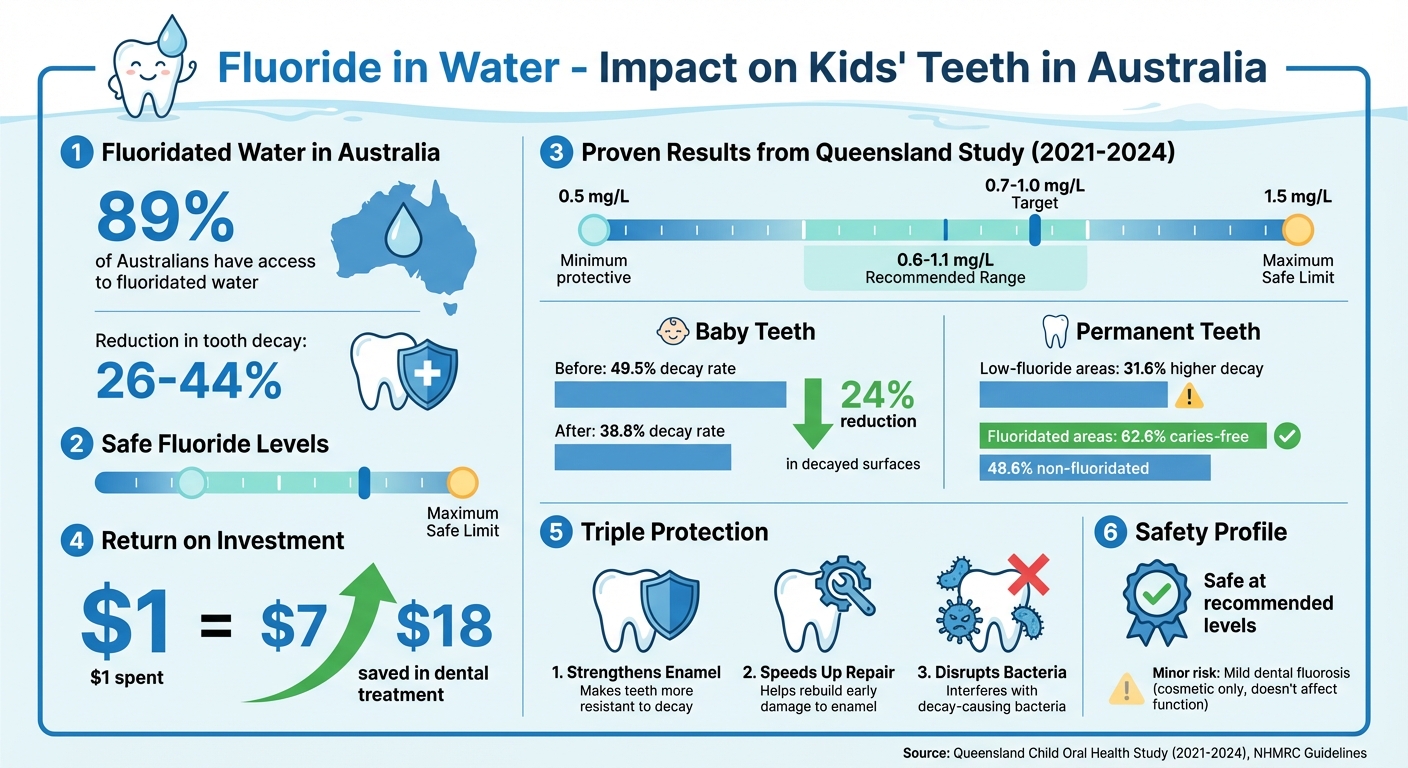
Fluoridated water helps protect children’s teeth by strengthening enamel, repairing early decay, and reducing harmful bacteria. In Australia, fluoride in drinking water reduces tooth decay by 26%-44%, benefiting 89% of the population with access to fluoridated water. Studies, including the Queensland Child Oral Health Study (2021-2024), show significant reductions in tooth decay for both baby and permanent teeth, especially in areas where fluoridation was newly introduced.
Key Points:
- How it works: Fluoride strengthens enamel, speeds up repair, and disrupts bacteria.
- Recommended levels: 0.7-1.0 mg/L in drinking water, safe up to 1.5 mg/L.
- Results: 24% drop in decayed baby teeth surfaces; permanent tooth decay 31.6% higher in low-fluoride areas.
- Safety: Fluoride is safe at recommended levels, with mild dental fluorosis being the only minor risk.
Parents can ensure their children benefit from fluoride by supervising brushing, using age-appropriate toothpaste, and consulting a dentist if living in non-fluoridated areas.
Fluoridated water is a cost-effective measure, saving $7 to $18 in dental treatment for every $1 spent, and continues to improve oral health across Australia.
Fluoride in Water: Key Statistics on Children’s Dental Health in Australia
How Fluoride in Water Prevents Cavities
How Fluoride Strengthens Tooth Enamel
Fluoride plays a vital role in protecting teeth, working through three main mechanisms. First, it helps prevent demineralisation by attaching itself to enamel crystals. This forms a kind of shield, stopping acids – produced by bacteria when they break down sugars – from dissolving the enamel [10][4].
Second, fluoride speeds up the remineralisation process. It draws calcium and phosphate to damaged areas of the enamel, aiding in repair. During this process, fluoride becomes part of the enamel, creating fluorapatite, a mineral tougher and more acid-resistant than the original hydroxyapatite [10][4].
"Fluoride combines with calcium and with phosphate to form a very rigid mineral." – Laurence Walsh, Dentistry Researcher, University of Queensland [1]
Lastly, fluoride disrupts harmful bacteria. It enters the bacteria and blocks enolase, which limits their ability to metabolise sugar and produce acid [10][5]. Although consuming fluoride during tooth development offers some benefit, the majority of protection comes from regular, topical exposure – like drinking fluoridated water [10][2]. This constant low-level exposure helps keep enamel strong throughout the day [5].
These mechanisms underscore the importance of maintaining recommended fluoride levels in water supplies.
Recommended Fluoride Levels in Drinking Water
In Australia, the National Health and Medical Research Council (NHMRC) advises a fluoride concentration of 0.7 to 1.0 mg/L in drinking water [12]. The safe range extends from 0.6 to 1.1 mg/L, with a maximum limit of 1.5 mg/L to minimise the risk of dental fluorosis in children during their tooth development years (roughly up to 6–8 years old) [12][2].
| Fluoride Level Type | Concentration (mg/L) | Purpose |
|---|---|---|
| Minimum Protective Level | ~0.5 | Lowest level for cavity prevention [12] |
| Recommended Range | 0.6–1.1 | Ideal for maintaining dental health [2][13] |
| Target Concentration | 0.7–1.0 | Standard for fluoridated water supplies [12] |
| Health Guideline Limit | 1.5 | Maximum to avoid fluorosis [12] |
In warmer regions, where people tend to drink more water, the target fluoride concentration is often adjusted to around 0.7 mg/L to ensure safety [12][5]. This level has been shown to be highly effective, with every $1 spent on water fluoridation saving an estimated $7 to $18 in dental treatment costs [5].
"Based on health considerations, the concentration of fluoride in drinking water should not exceed 1.5 mg/L." – National Health and Medical Research Council (NHMRC) [12]
Research Findings on Fluoridated Water and Children’s Teeth
What Clinical Studies Show
Australian studies provide compelling evidence that fluoridated water significantly improves children’s dental health. The Queensland Child Oral Health Study (QCOHS), conducted between 2021 and 2024 under the leadership of Professor Loc Do from the University of Queensland, examined 7,718 students aged 5–14 from various school systems. The study revealed a notable decrease in tooth decay among children aged 5–10, with the percentage of those experiencing decay in baby teeth dropping from 49.5% to 38.8% compared to data from 2010–2012. Additionally, the average number of decayed surfaces reduced by 24%, going from 4.1 to 2.9 [3][6].
"This is probably one of the largest and most comprehensive studies internationally investigating the effectiveness of, and safety of water fluoridation, using the before and after design." – Professor Loc Do, School of Dentistry, University of Queensland [3]
The benefits were even more pronounced in areas where fluoridation was newly introduced. In Logan-Beaudesert, where fluoridation began in December 2008, researchers observed impressive results: a 19% reduction in mean decay scores (from 4.54 to 3.66) and a drop in caries prevalence from 87% to 75% after 36 months of exposure. Similarly, in New South Wales, children from fluoridated areas had better oral health outcomes, with a mean decay score of 1.40 compared to 2.09 in non-fluoridated areas. Furthermore, 62.6% of children in fluoridated areas were caries-free, compared to just 48.6% in areas without fluoridation [14][15].
"The significant benefit of water fluoridation remained even after taking into consideration socioeconomic factors and health behaviours and was maintained in older children with adult teeth." – Professor Loc Do, School of Dentistry, University of Queensland [6]
These findings highlight the widespread benefits of fluoridation, showing improvements in both baby and permanent teeth.
Benefits for Baby Teeth and Adult Teeth
The advantages of fluoridated water extend beyond baby teeth, offering long-term protection for permanent teeth as well. A national Australian study found that consistent exposure to fluoridated water significantly reduced the likelihood of decay in both baby teeth (1.34 times lower odds) and permanent teeth (1.24 times lower odds) compared to children in low-fluoride areas. Permanent tooth decay was 31.6% higher in low-fluoride areas, while baby tooth decay was 28.7% higher [16][18].
In the Northern Territory, a study involving 24,546 children across 50 remote communities further confirmed these benefits. After the 2014 introduction of community water fluoridation in five remote areas (including Wadeye and Maningrida), children aged 11–17 experienced a decline of 0.40 fewer affected teeth, while those aged 7–10 with mixed dentition saw a reduction of 0.32 fewer affected teeth compared to control groups [17]. These results underline fluoride’s ability to protect both primary and permanent teeth, supporting better oral health over time.
Safety Concerns: Fluoride Risks and Benefits
Preventing Dental Fluorosis
Fluoride in water is a key player in cavity prevention, but understanding its minor risks helps put its benefits into perspective. One such risk is dental fluorosis – a minor change in tooth enamel that appears as white spots or lines, caused by excessive fluoride intake during early tooth development [2][11]. In Australia, fluorosis is generally mild or very mild. It doesn’t impact how teeth function and is rarely considered a cosmetic issue by those affected [2][11].
Interestingly, the main culprit for excessive fluoride exposure isn’t fluoridated water but improper toothpaste use. This is particularly relevant when preparing infant formula with fluoridated water. However, studies show that using fluoridated water for infant formula does not significantly raise the risk of fluorosis [19].
To minimise fluoride exposure, parents can follow these simple guidelines:
- For children under 18 months, clean their teeth with water only – skip the toothpaste.
- Between 18 months and 5 years, use a pea-sized amount of low-fluoride toothpaste, smeared thinly across the brush [19].
- Always supervise brushing to ensure toothpaste isn’t swallowed and store it out of reach [2].
- Fluoride mouth rinses should only be introduced for children aged 6 and older [19].
By sticking to these recommendations, parents can ensure their children get the cavity-fighting benefits of fluoride without the risk of overexposure. Despite these clear guidelines, myths about fluoride continue to circulate, so let’s examine what the evidence actually says.
Common Myths About Fluoride and Health
At the levels used in Australian water supplies (0.6 to 1.1 mg/L), fluoride has been thoroughly reviewed and shown to be safe. It’s not linked to major health concerns, as confirmed by the Australian Dental Association:
"There is reliable evidence that community water fluoridation at current Australian levels is not associated with cancer, Down syndrome, cognitive dysfunction, lowered intelligence or hip fracture" [2].
One persistent myth is that fluoride exposure affects children’s intelligence. However, a long-term study involving 2,700 children over eight years found no connection between fluoride and cognitive development [9]. Professor Loc Do from the University of Queensland, who led the research, clarified:
"Dental fluorosis is a reliable biomarker of fluoride exposure in early childhood… we did not find any link between fluoride exposure and IQ" [9].
Another study, set to conclude in 2025, examined over 26,000 students and found no evidence that fluoridated water negatively impacts academic performance or cognitive ability [9]. To put things in perspective, fluoride levels in Australian water are 50 to 200 times lower than those found safe in animal toxicity studies [9].
With fluoride reducing tooth decay by 26% to 44% in children and adolescents [2], the science strongly supports its safety and effectiveness when used within recommended levels. The evidence is clear: fluoride is a valuable tool in maintaining oral health, without compromising overall well-being.
sbb-itb-2be92ed
Fluoride and Australian Families: Local Guidelines and Tips
Water Fluoridation in Australia
Australia has established comprehensive water fluoridation programs to promote oral health. By 2017, 89% of Australians had access to fluoridated drinking water [13]. State and territory laws ensure fluoride levels are maintained, with each region operating under specific legislation. For instance, New South Wales adheres to the Fluoridation of Public Water Supplies Act 1957, Victoria follows the Health (Fluoridation) Act 1973, and Queensland regulates fluoride under the Water Fluoridation Act 2008 [20]. Interestingly, South Australia does not have dedicated fluoride legislation. Fluoride concentrations are often adjusted based on climate, with hotter regions using lower levels (around 0.7 mg/L) since people tend to drink more water in warm weather [12].
"Community water fluoridation continues to be the safest, most cost-effective, and equitable means to provide protection from tooth decay and has been successfully utilised in Australia for more than 60 years" [2].
The Australian Dental Association highlights the impact of this initiative, noting that Australians born after 1970 have experienced roughly half the level of tooth decay compared to earlier generations [8]. These efforts have significantly improved oral health nationwide, with practical tips available to help families optimise fluoride use at home.
Practical Advice for Parents
In addition to public water fluoridation, parents can take steps at home to ensure their children benefit from fluoride while staying safe. Toothpaste guidelines vary by age:
- For children under 18 months: Use water only with a soft-bristled brush.
- For children aged 18 months to 5 years: Apply a pea-sized amount of low-fluoride toothpaste (around 500 ppm).
- From age 6 onwards: Switch to full-strength fluoride toothpaste (1,000–1,450 ppm) [2][24].
Encourage children to spit out toothpaste after brushing to leave a protective fluoride layer on their teeth [21][24]. Since fluoridated water generally provides adequate fluoride, avoid supplements and choose water filters that retain fluoride. Be aware that reverse osmosis and distillation systems remove fluoride from water [2][21].
For families in areas without fluoridated water, or those relying on rainwater tanks, consulting a dentist is essential. Regular dental visits can help assess the risk of tooth decay and determine if additional fluoride treatments or brushing adjustments are needed [22][23][24].
Facts About Fluoride – Drinking Water, Dental Health and Research Studies | Kids Considered Podcast

Conclusion
The evidence leaves little doubt: fluoridated water plays a key role in protecting children’s teeth for life. By strengthening enamel, reversing early decay, and curbing harmful bacteria, fluoride offers a triple-action defence that reduces tooth decay by 26–44% [2][5][7]. The Queensland Child Oral Health Study, which reviewed data from over 7,700 schoolchildren between 2021 and 2024, highlighted a 24% drop in decayed tooth surfaces in baby teeth, with rates falling from 49.5% to 38.8% [3].
Research from the NHMRC confirms that fluoride levels of 0.6–1.1 mg/L are safe, showing no connection to cancer, lowered IQ, or other health concerns [8][2][5]. While mild dental fluorosis can occur, it does not affect tooth function [2]. Parents can minimise this risk by supervising their children’s brushing and ensuring the use of age-appropriate fluoride toothpaste.
The long-term benefits are equally clear. Australians born after 1970 experience about half the tooth decay of earlier generations [8]. As Professor Loc Do from the University of Queensland explains:
"Children who have poor oral health when they are young, are much more likely to have poor oral health when they grow up" [3]
Fluoridated water provides children with an early advantage, laying the groundwork for healthier teeth throughout their lives.
With proper brushing habits and access to fluoridated water, families can maximise cavity protection. Today, 89% of Australians benefit from fluoridated drinking water [4][7], making it an essential measure for better oral health across the country.
FAQs
How can I check if my tap water is fluoridated?
To determine if your tap water contains fluoride, reach out to your local water utility or council. They can provide specific details about the water supply in your area. Additionally, official health department websites often offer information about water fluoridation. These resources are a reliable way to check if your water is fluoridated.
Will a water filter remove fluoride from drinking water?
Most water filters struggle to remove fluoride from drinking water. Since fluoride dissolves and remains stable in water, standard filters – even the more advanced ones – aren’t equipped to eliminate it effectively.
Do kids still need fluoride toothpaste if they drink fluoridated water?
Yes, children still need fluoride toothpaste even if they drink fluoridated water. The fluoride in toothpaste works directly on the surface of the teeth, strengthening weakened enamel and providing extra defence against cavities. While fluoridated water helps, it’s not enough on its own to completely prevent tooth decay. Combining the two offers more thorough protection for their dental health.
Related Blog Posts
- How Fluoride Prevents Tooth Decay
- Top Benefits of Community Water Fluoridation
- Dental Fluorosis: Causes and Risk Factors
- 5 Ways To Prevent Tooth Decay From Snacking
Important Notice: Any surgical or invasive procedure carries risks. Before proceeding, you should seek a second opinion from an appropriately qualified health practitioner.
Individual results may vary. The information provided in this article is for educational purposes only and does not constitute medical advice.
Checkout Related Blogs



Get in touch with us
For more information, call us now to start feeling better. Or fill the form below to make appointment
The Latest News from Complete Smiles
How to Clean Clear Plastic Retainers
Checklist for Choosing Wearable Dental Devices
Checklist for Choosing Cloud AI Platforms in Dentistry

Complete Smiles Bella VistaAccepts All Major Health Funds, Including