





Ethics in Dental Treatment Planning

Ethics in dental treatment planning is about making decisions that prioritise patients’ well-being while maintaining trust. Dentists must balance clinical expertise with ethical principles like patient autonomy, beneficence, non-maleficence, justice, and veracity. These principles guide everything from informed consent to fair access to care and handling financial pressures.
Key takeaways:
- Patient autonomy: Respect patients’ right to choose, with clear communication about options, risks, and costs.
- Informed consent: More than a signature – it’s an ongoing, transparent discussion.
- Avoiding harm and promoting welfare: Decisions must prioritise health over financial incentives.
- Fair access: Ensure equal treatment opportunities for all, respecting diversity and inclusion.
- Transparency: Openly disclose costs, conflicts of interest, and treatment limitations.
Ethical challenges include avoiding overtreatment, navigating insurance restrictions, and managing cosmetic requests responsibly. Dentists must also adhere to Australian regulations, including accurate record-keeping, honest advertising, and continuous professional development to maintain high standards.
Ethics are the foundation of trust in dentistry, ensuring patient-centred care that’s transparent, fair, and safe.
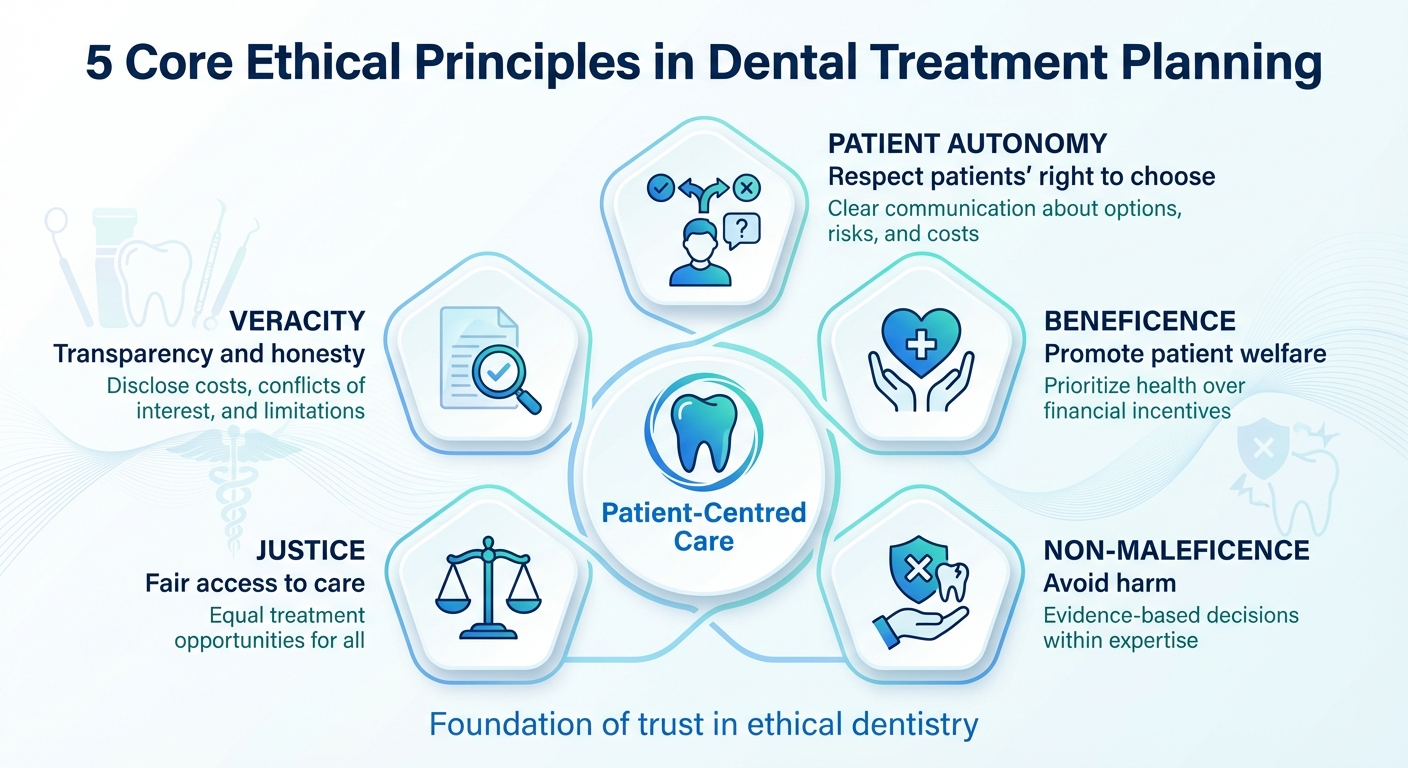
Five Core Ethical Principles in Dental Treatment Planning
Core Ethical Principles in Dental Treatment Planning
Patient Autonomy and Informed Consent
Respecting patient autonomy means honouring every individual’s right to make decisions about their healthcare. Dentists are responsible for presenting all viable treatment options so patients can choose what aligns with their personal values and needs. This must be done within the framework of accepted treatment standards [4].
Informed consent goes beyond a simple signature – it’s an ongoing conversation. According to the FDI World Dental Federation:
informed consent underpins ethics. It should be obtained after discussion with the patient as a two-way process. For complex or elective procedures, it should allow reflection [1].
Dentists should clearly explain the diagnosis, potential benefits, risks, and costs of all options, including choosing no treatment. Patients need adequate time and clear information to make decisions. It’s equally important to assess a patient’s capacity to decide and, in Australia, to ensure cultural safety by respecting their cultural background and beliefs. Consent should be formally documented, especially when sharing patient information or images, and reasonable alternatives should always be offered to encourage meaningful patient participation.
By fostering transparency and respect, dentists create a foundation for care that is both evidence-based and patient-centred.
Providing Benefit While Avoiding Harm
The ethical principles of beneficence (promoting good) and non-maleficence (avoiding harm) are essential in dental treatment planning. Every recommendation must prioritise the patient’s wellbeing and be supported by solid scientific evidence. This involves balancing the restoration of oral health with aesthetic considerations, while avoiding external pressures – like financial incentives – that might compromise clinical judgement.
Dentists should operate within their professional expertise and refer patients to specialists when necessary. Open and honest communication about the benefits, risks, and costs of treatment ensures patients are informed and realistic about their options, minimising the risk of overtreatment.
This careful approach builds trust and sets the stage for discussions on fairness in care.
Fair Access to Dental Care
The principle of justice emphasises that everyone deserves equal access to healthcare resources and opportunities. As the FDI World Dental Federation states:
Justice: Ensure that each person is given the healthcare opportunities and resources they require, treating every person with equal consideration and inclusion [1].
Given the link between oral health and overall wellbeing, ensuring fair access to dental care is a vital public health priority.
Dentists can better serve diverse patient groups by respecting cultural differences and practising tolerance. This includes practical steps like providing dental records upon request to support continuity of care and advocating for accessible, clear information about oral health. Treating every patient with dignity and respect not only empowers informed decision-making but also strengthens public trust in the dental profession.
Common Ethical Challenges in Treatment Planning
Preventing Overtreatment and Financial Conflicts
Balancing clinical integrity with financial pressures is one of the most persistent ethical challenges for dental practitioners. The temptation to recommend unnecessary procedures purely for financial benefit is a real concern in modern dentistry.
The AHPRA Code of Conduct addresses this directly, stating: "Good practice includes that you… provide treatment options that are based on the best available information and are not influenced by financial gain or incentives" [3]. This highlights the importance of basing treatment decisions on clinical necessity instead of financial motivations.
Transparency plays a key role here. Dentists must openly disclose any conflicts of interest and remain cautious of external influences, such as third-party incentives, that could compromise their clinical judgement. The FDI World Dental Federation emphasises this, urging practitioners to "exert self-regulation based on autonomy, beneficence and veracity" [2]. This principle encourages honest, patient-focused care, even when simpler and less costly options are viable. Ethical considerations also come into play when navigating insurance limitations or handling requests for cosmetic treatments.
Working Within Insurance Limitations
Insurance restrictions often create a complicated ethical environment. While coverage limitations can affect what patients can afford, the Australian Dental Association firmly states: "The clinical relationship between a Dental Practitioner and a patient is independent of the source of funding for the patient’s treatment" [5]. This means that treatment recommendations should always prioritise clinical needs, regardless of what an insurer might cover.
Providing informed financial consent is essential. Dentists are expected to supply written cost estimates, including item numbers from the Australian Schedule of Dental Services, so patients can confirm their rebates with their health fund [5]. These estimates should also clarify that costs may increase if unforeseen complications arise, and discussions should include any future maintenance expenses that could impact affordability in the long run.
When affordability becomes an issue, phased or cost-effective treatment plans can help. These plans should include clear, written estimates, allowing patients to evaluate their options and plan for future expenses. Advising patients to seek independent financial advice is often more ethical than suggesting unconventional funding methods. Similarly, ethical dilemmas can arise when addressing cosmetic treatment requests, where patient expectations may conflict with clinical judgement.
Responding to Cosmetic Treatment Requests
Cosmetic dentistry introduces its own set of ethical challenges, especially when patient desires don’t align with clinical recommendations. While aesthetic concerns are valid, they must be balanced with evidence-based practices and the principle of non-maleficence – avoiding harm.
Dentists should provide patients with a realistic understanding of the benefits and limitations of any proposed treatment, steering clear of exaggerated claims that could raise false expectations [2]. A cooling-off period can be helpful, giving patients time to reconsider decisions that may be influenced by social pressures or unrealistic goals.
If a cosmetic request risks compromising oral health or exceeds a dentist’s expertise, ethical practice requires an open and honest conversation. This might involve suggesting a more conservative treatment, referring the patient to a specialist, or even declining to proceed. The overarching aim is to "Consider the patient’s comprehensive well-being while striking a balance between restoring oral health and addressing aesthetic considerations" [1].
How to be ethical in dentistry? A conversation with Dr. Larry Jerrold
sbb-itb-2be92ed
Legal and Professional Requirements in Australia
In Australia, dental ethics are underpinned by legal frameworks established by AHPRA and the Dental Board of Australia. These regulations are designed to uphold professional standards and safeguard patient welfare. For dental practitioners, understanding and adhering to these requirements is crucial for compliant and ethical treatment planning. These legal standards work alongside ethical principles to ensure accountability and integrity in all aspects of dental care.
Following AHPRA Advertising Guidelines

AHPRA’s advertising regulations cover a wide range of promotional activities, including social media posts, business cards, and printed materials [7]. The broad scope of the definition aims to provide comprehensive protection for patients.
The key rule is simple: advertising must be truthful, evidence-based, and should not promote the overuse or unnecessary use of dental services [3]. Importantly, testimonials in any form are strictly prohibited [7]. This helps align advertising with ethical treatment planning by avoiding the creation of unrealistic patient expectations.
"The goal of these regulations is… to keep the public safe from false or misleading claims and to help them make informed choices about their healthcare." – Australian Dental Association [7]
Principal practitioners are responsible for all content shared on platforms they oversee, including material reposted from third-party sources [7]. Before sharing such content, ensure it complies with AHPRA standards. The Australian Dental Association suggests using a "patient litmus test" – view advertising from the perspective of a patient to ensure it provides clear and accurate information without misleading claims [7]. Non-compliance can result in penalties of up to $5,000 for individuals and $10,000 for corporations [7].
In addition to ethical advertising, maintaining accurate patient records is another cornerstone of professional practice.
Patient Records and Documentation
Keeping detailed and accurate records is both a legal requirement and a critical ethical practice. The Dental Board of Australia mandates that practitioners document every patient appointment in chronological order [6]. These records should be completed promptly.
For treatment planning, records must include the diagnosis, proposed treatment plan, all alternatives discussed with the patient, and evidence of the patient’s consent [6]. Transparency is also key – records must include treatment fee estimates to ensure patients have all the information needed to make informed decisions [6].
Records should be clear enough for other practitioners to understand, ensuring continuity of care if needed [6]. They must be objective, accurate, and free from bias. Practitioners cannot delegate the responsibility for the accuracy of these records to others [6]. Privacy laws generally require dental records to be retained for 7 to 10 years, and electronic records must be securely stored with reliable backup systems [6].
Maintaining Professional Competence
Professional competence is an ongoing responsibility, requiring continuous development and honest self-assessment. AHPRA and the Dental Board mandate that practitioners engage in regular continuing professional development (CPD) and self-reflection to maintain their skills and knowledge [3].
Practitioners must operate within their area of expertise and refer patients to other professionals when necessary for the patient’s best interest [3]. Adequate training and qualifications are essential to ensure competent practice [3]. This is not just a recommendation – it is a regulatory obligation designed to protect both patients and practitioners.
"Practitioners should minimise risk by maintaining their professional capability through ongoing professional development and self-reflection and understanding and applying the principles of clinical governance, risk minimisation and management in practice." – AHPRA and National Boards [3]
The Dental Board’s guidelines can be used in disciplinary proceedings to define appropriate professional conduct [6]. This makes maintaining competence a legal as well as ethical responsibility. Treatment decisions must prioritise clinical need and effectiveness, avoiding any influence from financial incentives [3]. This ensures that professional competence remains focused on patient welfare above all else.
Conclusion
Summary of Ethical Practice Guidelines
Ethical dental treatment planning revolves around prioritising patient-centred care, ensuring informed consent, and upholding professional integrity. Dentists must provide patients with all the necessary information to make independent decisions, while respecting their right to accept or decline treatment.
Treatment recommendations should be based on solid evidence and sound clinical judgement, free from financial influence. Practitioners are expected to operate within their scope of expertise and refer patients to specialists when required. Additionally, it is crucial to acknowledge and respect the cultural and historical contexts of patients, particularly Aboriginal and Torres Strait Islander Peoples, to deliver equitable and unbiased care.
"Good practice is centred on patients. It involves practitioners understanding that each patient is unique and working in partnership with patients, adapting what they do to address the needs and reasonable expectations of each person." – AHPRA
Maintaining accurate records, being transparent about adverse events, and committing to ongoing professional education are vital aspects of ethical practice. Furthermore, all professional communications, including advertising, must present factual and balanced information. Misleading claims or exaggerated statements have no place in ethical dentistry. These principles are essential for building and sustaining patient trust over time.
How Ethics Build Patient Trust
Ethical conduct is the cornerstone of trust in the practitioner–patient relationship. Patients are more likely to trust practitioners who exhibit not only clinical competence but also qualities like honesty, reliability, and compassion. This trust grows stronger when practitioners consistently adhere to ethical guidelines, demonstrating their unwavering commitment to the well-being of those they care for.
FAQs
What steps can dentists take to ensure patients give truly informed consent?
For patients to give informed consent, dentists need to break down the details of the proposed treatment in a way that’s easy to follow. This includes explaining why the treatment is needed, possible risks, expected benefits, and any alternative options. The key is to use plain, straightforward language that avoids medical jargon, ensuring patients fully grasp the information. Giving patients the chance to ask questions is equally important.
To confirm that the patient understands and agrees to proceed, dentists often rely on signed consent forms, particularly for more involved procedures. This step not only documents consent but also reinforces the patient’s confidence in their decision.
By keeping communication open and prioritising patient autonomy, dentists can create ethical treatment plans and build stronger, trust-based relationships with their patients.
What ethical principles guide the recommendation of cosmetic dental procedures?
When discussing cosmetic dental procedures, dentists need to focus on three key principles: patient safety, informed consent, and professional integrity. Patients should have a clear picture of what the procedure entails, including any potential risks, benefits, and limitations. This helps set realistic expectations and builds trust.
Ethics play a crucial role here. Dentists must avoid over-treatment or promotional tactics that could exploit vulnerable individuals or promise outcomes that aren’t achievable. Following the professional standards outlined by the Dental Board of Australia ensures transparency and honesty while keeping the patient’s best interests at the centre of care. The ultimate aim is to empower patients to make informed choices while safeguarding their well-being.
How do dentists ensure ethical treatment planning while considering financial factors?
Dentists uphold ethical standards in treatment planning by focusing on patient welfare and following professional guidelines. A critical aspect of this is ensuring informed financial consent. This means patients receive clear, upfront information about treatment costs, available payment options, and any potential funding sources. By doing so, patients can make well-informed decisions about their care, avoiding confusion or disputes over fees later on.
Another cornerstone of ethical treatment planning is respecting patient autonomy. Dentists achieve this by thoroughly explaining the benefits, risks, and costs of proposed treatments. While financial factors are considered, they never take precedence over the quality of care or the dentist’s professional responsibility. The ultimate goal is to base treatment decisions on what is clinically appropriate and in the patient’s best interest, free from undue financial influence.
Related Blog Posts
- Cultural Sensitivity in Dentistry: Key Challenges and Solutions
- Complex Dental Cases: Role of Multidisciplinary Teams
- Teledentistry in Australia: Legal and Ethical Issues
- What Counts as Evidence in Dental Advertising?
Important Notice: Any surgical or invasive procedure carries risks. Before proceeding, you should seek a second opinion from an appropriately qualified health practitioner.
Individual results may vary. The information provided in this article is for educational purposes only and does not constitute medical advice.
Checkout Related Blogs




Get in touch with us
For more information, call us now to start feeling better. Or fill the form below to make appointment
The Latest News from Complete Smiles
How to Clean Clear Plastic Retainers
Checklist for Choosing Wearable Dental Devices
Checklist for Choosing Cloud AI Platforms in Dentistry

Complete Smiles Bella VistaAccepts All Major Health Funds, Including





