





Enameloplasty: Conservative Tooth Reshaping Explained

Want to refine your smile without complex dental work? Enameloplasty, also known as tooth reshaping, is a quick, painless procedure that removes small amounts of enamel to smooth edges, fix minor chips, or adjust uneven tooth shapes. It’s done in just 30–60 minutes, requires no recovery time, and delivers permanent results.
Here’s what you need to know:
- Best for: Minor cosmetic fixes like smoothing jagged edges or slightly overlapping teeth.
- Not suitable for: Thin enamel, cavities, gum disease, or severe alignment issues.
- Cost: AU$50–AU$300 per tooth.
- Results: Permanent, but enamel doesn’t grow back.
Consult your dentist to see if this simple procedure is right for you.
Enameloplasty Procedure Side Effects Pros Cons Costs
The Enameloplasty Procedure
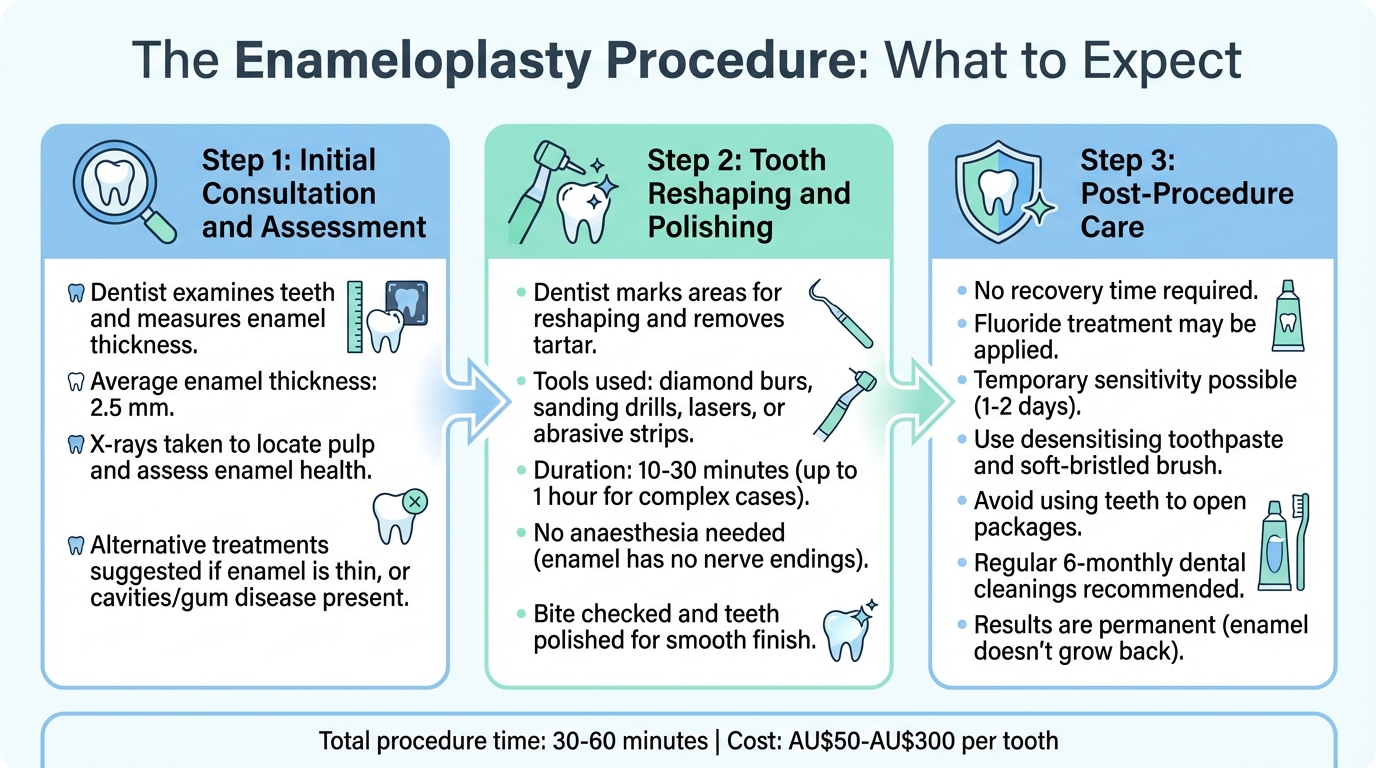
Enameloplasty Procedure: 3-Step Process from Consultation to Aftercare
Initial Consultation and Assessment
Before starting the reshaping process, your dentist will carefully examine your teeth. This involves measuring the thickness of your enamel and taking X-rays to ensure there’s enough enamel to work with – on average, enamel is about 2.5 mm thick [4]. X-rays also help pinpoint the location of the pulp, the inner part of the tooth [2][7].
If you have issues like thin enamel, cavities, or gum disease, your dentist might suggest other options like bonding or veneers instead [2][6]. Removing enamel from already compromised teeth could lead to irreversible damage, so this evaluation step is key [8]. Once your dentist confirms your enamel is healthy, the reshaping process can begin.
Tooth Reshaping and Polishing
After the initial assessment, your dentist will mark the areas of your teeth that need reshaping and clean off any tartar buildup [2][4][8]. The reshaping itself involves using specialised tools like diamond burs, sanding drills, or lasers to gently remove small amounts of enamel [2][4][7]. For finer adjustments, thin abrasive strips – similar to sandpaper – are used to smooth and contour the edges of your teeth [2][8].
This process usually takes about 10 to 30 minutes [4][8], although more intricate cases might take up to an hour. Since enamel doesn’t contain nerve endings, there’s no need for anaesthesia during the procedure [2][4][8]. Once the reshaping is done, your dentist will check your bite to ensure everything aligns properly. To finish, the teeth are polished to create a smooth, natural-looking surface [4][8].
Post-Procedure Care
After the reshaping and polishing, maintaining proper care is essential to preserve your results. The good news? There’s no recovery time – you can go back to your usual activities straight away [8]. Your dentist might apply a fluoride treatment or recommend using fluoride toothpaste to help strengthen the remaining enamel [8]. Some people may notice temporary sensitivity to hot or cold for a day or two, but this can be managed with desensitising toothpaste and a soft-bristled toothbrush [8].
To keep your results intact, avoid using your teeth for tasks like opening packages, and stick to regular six-monthly dental cleanings [6][8]. It’s important to remember that enamel doesn’t grow back, so the changes made during enameloplasty are permanent. Dr Anne Clemons from the Cleveland Clinic highlights this point:
"When you’re changing a tooth by yourself, you’re doing permanent damage. You’re changing that tooth permanently and there’s nothing we can do to bring that tooth back to where it was" [5].
Candidate Suitability for Enameloplasty
Best Cases for Enameloplasty
Enameloplasty is ideal for addressing small cosmetic imperfections that don’t require extensive dental work. It’s particularly effective for fixing minor chips, small fractures, pits, and craze lines[4][9]. The procedure can also enhance the overall shape and symmetry of teeth – pointy canines can be softened, jagged edges smoothed out, and irregular tooth shapes refined for a more balanced appearance[4][9]. It’s also useful for shortening teeth that are too long, levelling the smile line, or addressing slight overlaps without needing orthodontic treatment[4][9].
Besides improving aesthetics, enameloplasty can also promote better oral health. Smoothing out pits or overlaps where plaque and tartar tend to accumulate may help reduce the risk of tooth decay and gum disease[4][9]. Dentists may also use this procedure to fine-tune a tooth’s shape when preparing it for restorations like crowns or veneers, or to resolve minor bite issues. In many cases, enameloplasty is performed as a finishing touch after orthodontic treatments like braces or clear aligners to create a smooth, polished look[4][3].
While this procedure is highly beneficial for many, it’s not suitable for everyone.
When Enameloplasty Is Not Recommended
Enameloplasty isn’t the right choice for every patient. If your enamel is naturally thin or already worn down, removing more of it could expose the dentin or nerves, leading to sensitivity and increasing the risk of decay[11][4]. It’s important to remember that enamel doesn’t regenerate – once it’s removed, it’s gone for good.
Before considering enameloplasty, your overall dental health must be addressed. Issues like cavities, decay, or gum disease need to be treated first[8][12][13]. The procedure is also not recommended for teeth with deep cracks, large fractures, or those that have undergone root canal treatment[12][13]. Additionally, patients with significant tooth sensitivity or exposed dentin are generally not good candidates for this treatment[11][4].
Enameloplasty is designed for subtle changes only. If you’re dealing with severe crowding, large overlaps, or major bite problems, orthodontic treatments are usually more appropriate. Similarly, if you’re looking for a complete transformation or significant changes to your smile, options like veneers or bonding may be better suited to your needs. A thorough dental evaluation – including X-rays to assess enamel thickness and the position of the tooth pulp – is essential to determine whether enameloplasty is safe and suitable for you[11][8].
Benefits of Enameloplasty
After undergoing enameloplasty, many patients experience noticeable improvements in both the function and appearance of their teeth.
Cosmetic and Functional Enhancements
Enameloplasty, known for its minimally invasive nature, delivers a range of benefits. On the cosmetic side, it enhances tooth symmetry by addressing minor chips, smoothing uneven edges, and reshaping teeth for a more harmonious look [8]. Functionally, it eliminates sharp edges that could irritate the tongue or cheeks and can even help with slight bite issues. By smoothing out enamel irregularities, it reduces crevices where bacteria might hide, making oral hygiene easier to maintain [2].
Quick and Painless Procedure
One of the standout features of enameloplasty is how straightforward it is. Since tooth enamel doesn’t contain nerves or blood vessels, the procedure is painless and usually doesn’t require anaesthesia or numbing agents [2]. It’s also quick, typically taking just 30 to 60 minutes, with results visible immediately [2].
"Enameloplasty is a less invasive alternative to other cosmetic procedures like veneers." – Cleveland Clinic [8]
Another advantage? There’s no downtime. You can eat, drink, and return to your regular activities right after your appointment [2].
sbb-itb-2be92ed
Limitations of Enameloplasty
While enameloplasty can improve the appearance of your teeth, it’s important to recognise its limits before deciding if it’s the right option for you.
What Enameloplasty Cannot Fix
Enameloplasty is designed for minor cosmetic adjustments. It’s not a solution for major dental concerns like significant misalignment, wide gaps, or deep cracks. For these issues, treatments such as orthodontics, veneers, or crowns are better suited [3][2].
This procedure also doesn’t address internal tooth discolouration. In fact, removing too much enamel can make teeth look yellower by exposing the underlying dentin [4]. Additionally, enameloplasty isn’t appropriate for teeth affected by decay, cavities, or gum disease [7]. If your enamel is already worn down, this procedure may not be recommended either [4].
These limitations highlight the importance of careful evaluation before proceeding with enameloplasty.
The Irreversible Nature of Enamel Removal
One of the most critical aspects of enameloplasty is its permanence. Once enamel is taken away, it’s gone for good. Dr Anne Clemons, DMD, from the Cleveland Clinic, emphasises this point:
"When you’re changing a tooth by yourself, you’re doing permanent damage. You’re changing that tooth permanently and there’s nothing we can do to bring that tooth back to where it was." [5]
Removing too much enamel can weaken the tooth, making it more prone to cracks, breakage, and decay [4]. It can also lead to lasting sensitivity, particularly to hot, cold, or sugary foods and drinks [5]. To avoid these risks, dentists typically take X-rays before the procedure to check enamel thickness and the position of the tooth’s pulp. This ensures the treatment won’t compromise your long-term dental health [2].
Being aware of these irreversible factors is essential when weighing up enameloplasty as part of your cosmetic dental plan.
Combining Enameloplasty with Other Treatments
Enameloplasty is a great standalone option for small adjustments, but it can also deliver impressive results when paired with other cosmetic dental treatments. By combining procedures, multiple aesthetic concerns can be addressed in a single, coordinated approach. This strategy allows for a more personalised solution to meet various cosmetic needs.
Pairing with Teeth Whitening or Bonding
Teeth whitening focuses on improving colour, while enameloplasty refines the shape of your teeth [8][14]. Smoothing out rough edges with enameloplasty before whitening can prevent those areas from trapping stains. However, care must be taken during enameloplasty to avoid removing too much enamel, which could expose the naturally yellower dentin beneath.
Dental bonding is another procedure that works well alongside enameloplasty. While enameloplasty reshapes teeth by removing excess enamel, bonding uses tooth-coloured composite resin to fill gaps that reshaping alone cannot address [2][10]. Both treatments are quick and convenient, often completed in a single 30-to-60-minute session [1][10][14]. With costs ranging from AU$50 to AU$300 per tooth [4][2], this combination provides an affordable alternative to more extensive options like porcelain veneers.
Final Refinement After Orthodontic Treatment
Enameloplasty is often used as a finishing touch after orthodontic treatments, such as braces or Invisalign. Once teeth are straightened, you might notice uneven edges, natural ridges (mamelons), or overly pointy canines that stand out more. Enameloplasty smooths out these imperfections, creating a more uniform appearance by aligning the length and shape of your teeth [4][15]. This minor adjustment can tie together your orthodontic results, leaving you with a polished and harmonious smile.
"Enamel shaping is used when a tooth needs very fine adjustments — when the surface is a little rough, for instance, or one tooth is a little squarer than a matching tooth" [16].
Dr Kellee Kattleman Stanton of the American Academy of Cosmetic Dentistry highlights how enameloplasty is ideal for subtle refinements. If performed as part of the final stage of orthodontic care, the cost of enameloplasty may even be included in the overall fee for your braces or clear aligners [4].
Conclusion
Enameloplasty offers a simple and effective way to enhance your smile. This minimally invasive procedure is designed to address small cosmetic imperfections, often in just one session lasting 10–60 minutes. With costs typically ranging from AU$50 to AU$300 per tooth [4], it provides a practical and affordable option for many. Plus, since tooth enamel lacks nerve endings, the process is virtually painless.
The results of enameloplasty are permanent because enamel does not grow back. Before proceeding, dentists carefully assess the thickness of your enamel using clinical exams and X-rays to ensure the treatment is safe [4].
"A dentist is the only person who can tell you whether enameloplasty is safe in your situation." – Cleveland Clinic [8]
In addition to improving aesthetics, enameloplasty can also enhance functionality by smoothing sharp edges and reducing spots where plaque and tartar tend to build up. However, it’s important to note that this procedure is best suited for minor tweaks rather than addressing major alignment issues or large gaps.
If you’re considering enameloplasty, consult your dentist to see if it’s the right choice for you. They’ll ensure the procedure is performed safely while preserving the natural structure of your teeth.
FAQs
Can enameloplasty be done on teeth with existing dental work?
Enameloplasty is generally recommended for natural, healthy teeth and isn’t typically advised for teeth that already have dental work, like fillings, crowns, or veneers. That said, it can sometimes be used as part of the preparation process for new restorations, rather than modifying existing ones.
If you have prior dental work and are thinking about enameloplasty, it’s essential to talk with your dentist. They can help determine the most suitable option based on your specific situation.
What’s the difference between enameloplasty and veneers for improving your smile?
Enameloplasty and veneers are both popular cosmetic dental treatments, but they serve different purposes and involve varying levels of tooth modification.
Enameloplasty is a less invasive option that focuses on gently reshaping the enamel. By smoothing out chips, evening edges, or refining the overall tooth shape, this procedure can address minor imperfections. It’s a quick, single-visit process with no recovery time, making it ideal for those who want subtle improvements while keeping their natural tooth structure intact. However, it’s important to note that enameloplasty doesn’t change tooth colour, close significant gaps, or resolve major cosmetic concerns.
Veneers, in contrast, are thin, custom-designed shells applied to the front of teeth. To prepare for veneers, a small amount of enamel or dentine is removed, allowing the veneers to fit seamlessly. They are a better choice for more noticeable transformations, such as altering tooth colour, size, shape, spacing, or correcting mild alignment issues. Veneers are durable and resist staining, but they involve a more invasive process and come with a higher price tag compared to enameloplasty.
Ultimately, your dentist can guide you in choosing the right option based on your specific needs and the current state of your teeth.
Can enameloplasty be done alongside teeth whitening?
Enameloplasty and teeth whitening are two distinct dental procedures, each addressing a different aspect of your smile. Enameloplasty involves reshaping or contouring the teeth to refine their appearance or improve functionality. On the other hand, teeth whitening focuses on brightening the colour of your teeth for a more radiant look.
While these treatments serve separate purposes, they can work well together when done at different stages, helping you achieve a balanced and polished smile. If you’re thinking about combining the two, it’s a good idea to consult your dentist to create a treatment plan that suits your specific goals.
Related Blog Posts
- What Is Minimally Invasive Cavity Preparation?
- Ultimate Guide to Dental Bonding for Minor Damage
- How Diet Impacts Tooth Enamel
- What Is Crown Lengthening?
Important Notice: Any surgical or invasive procedure carries risks. Before proceeding, you should seek a second opinion from an appropriately qualified health practitioner.
Individual results may vary. The information provided in this article is for educational purposes only and does not constitute medical advice.
Checkout Related Blogs




Get in touch with us
For more information, call us now to start feeling better. Or fill the form below to make appointment
The Latest News from Complete Smiles
How to Clean Clear Plastic Retainers
Checklist for Choosing Wearable Dental Devices
Checklist for Choosing Cloud AI Platforms in Dentistry

Complete Smiles Bella VistaAccepts All Major Health Funds, Including





