




CPD Requirements for Dental Hygienists in Australia

Continuing Professional Development (CPD) is mandatory for dental hygienists in Australia to maintain their registration. Here’s what you need to know:
- Requirement: Complete 60 CPD hours every three years.
- Breakdown: At least 48 hours (80%) must focus on scientific or clinical topics, with up to 12 hours (20%) for non-scientific areas like communication or practice management.
- Deadline: Registration renewal, including CPD compliance, is due by 30 November each year.
- Activities: CPD can include workshops, online courses, conferences, or self-directed study. Activities must align with professional development goals.
- Record Keeping: Maintain detailed records of CPD activities, including provider names, dates, and hours, to prepare for potential audits.
Staying up to date with CPD ensures you meet regulatory standards and continue to provide safe, effective care. For new graduates or those returning mid-cycle, hours are calculated on a pro-rata basis.
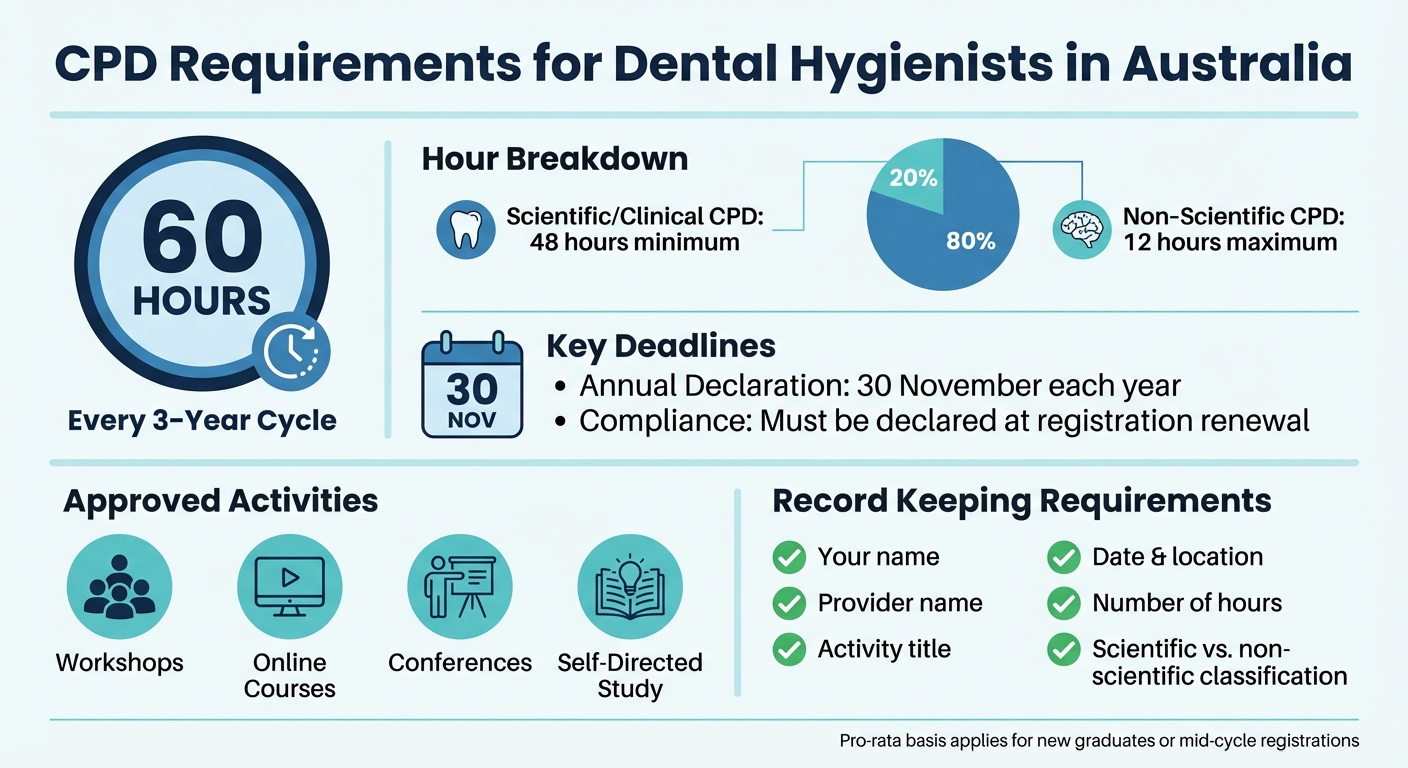
CPD Requirements for Dental Hygienists in Australia: 60-Hour Breakdown
CPD Requirements and Compliance
The Dental Board of Australia has set clear requirements for dental hygienists to maintain their registration. These guidelines help you plan your Continuing Professional Development (CPD) activities and ensure you’re ready when it’s time to renew.
Minimum CPD Hours
Dental hygienists are required to complete 60 hours of CPD over a three-year cycle. You can distribute these hours in a way that suits your schedule [2]. If you’re registering for the first time or returning to the profession, your required hours will be calculated on a pro-rata basis [1]. For those with dual registration – such as being both a dental hygienist and a dental therapist – the total remains 60 hours; there’s no need to complete separate requirements for each qualification [2].
Out of the 60 hours, at least 48 must focus on scientific or clinical topics, leaving up to 12 hours for non-scientific areas [1].
| CPD Category | Requirement | Hours (per 3-year cycle) |
|---|---|---|
| Total CPD Hours | Minimum | 60 hours [1] |
| Scientific/Clinical | Minimum 80% | 48 hours [1] |
| Non-Scientific | Maximum 20% | 12 hours [1] |
It’s important to track non-scientific hours separately [1]. Once you’ve got the basics down, it’s time to explore the kinds of activities that qualify.
Approved CPD Activities
Now that you know how many hours you need, you can choose from a variety of CPD activities. The Dental Board doesn’t have a list of "approved" providers or mandatory courses. Instead, their guidelines emphasise that "The Board has not specified any mandatory CPD activities and expects dental practitioners to engage in a range of CPD activities in line with the objectives of CPD" [1]. This means you have the flexibility to pick activities that genuinely enhance your practice and professional growth.
Your CPD hours can come from various formats, including face-to-face workshops, conferences, online courses, or even self-directed study [1]. For example, as of December 2025, eIntegrity Healthcare e-Learning offered programmes like "e-Den | A High-quality Dental Programme" and "Medical and Pharmacology | Human diseases and medical and dental", both of which qualify as clinical CPD for dental practitioners [1]. These examples highlight the range of online options available. The key is to ensure that each activity aligns with CPD objectives and helps maintain or expand your professional skills. Even time spent using the Dental Board’s reflective practice tool can count towards your CPD hours [2].
Non-Scientific Activities
While clinical expertise is the main focus, you can allocate up to 12 hours to non-scientific topics, such as practice management or communication skills. This 20% cap ensures your CPD remains centred on clinical competence while recognising the importance of broader skills in professional success.
Non-scientific hours can cover areas like patient communication, compliance requirements, or team leadership [1][2]. These topics are essential for creating a well-rounded, effective practice and contribute to your overall professional development. Even though these hours are fewer, they play a crucial role in helping you manage your practice and interact effectively with both patients and colleagues.
Record Keeping and Audit Preparation
Keeping accurate CPD records is non-negotiable. The Dental Board of Australia can request your documentation at any time as part of a compliance audit. By organising your CPD portfolio from the outset, you can avoid unnecessary stress if an audit arises. This step is key to staying on track with your CPD requirements.
Documentation Requirements
You can maintain your CPD portfolio either as hard copies or in digital format. Whichever method you choose, make sure it includes six essential details for every CPD activity:
- Your name
- The provider’s name
- The activity title
- The date (plus time and location, or "Online" for virtual courses)
- The number of hours
- Whether the activity is classified as scientific (clinical) or non-scientific
As HealthcareLink explains:
These records can be kept in hard copy or electronically and will need to be provided when requested by the Dental Board, for example during a ‘compliance audit’ [1].
Don’t forget to document evidence of self-directed learning, such as online courses or independent study. One common mistake is misclassifying CPD hours, which can lead to exceeding the 12-hour limit for non-scientific activities or not meeting the 48-hour minimum for clinical topics [1].
Preparing for Audits
Start building your CPD portfolio right away. Set up a dedicated folder – either digital or physical – and file each certificate or log as soon as you complete an activity. Make sure every record includes the six mandatory details [1]. Maintaining accurate records not only simplifies audits but also helps you plan your future CPD activities effectively.
sbb-itb-2be92ed
Aligning CPD with Professional Goals
CPD hours play a pivotal role in shaping your career. Since the Dental Board of Australia doesn’t prescribe specific activities, you have the flexibility to choose courses that align with your ambitions. Whether you’re aiming to specialise in areas like cosmetic dentistry or orthodontics, or exploring a transition into teaching or research, your CPD choices can be tailored to support your goals.
Planning Your CPD Activities
Begin by pinpointing the areas where you’d like to grow. Professional associations such as the Dental Hygienists Association of Australia (DHAA) and the Australian Dental and Oral Health Therapists Association (ADOHTA) offer targeted sessions tailored to your specific field. As the Australian Dental Council highlights:
"Professional associations representing the different divisions of dentistry often run events and CPD sessions that may be of interest to you if who would like to continue to develop your knowledge and expertise." [3]
Explore what leading dental networks are offering. Topics like facial injections, Invisalign, paediatric dentistry, or holistic care approaches that prioritise overall patient wellbeing are just a few examples of areas where CPD can help you expand your expertise. Use tools and resources to evaluate your knowledge gaps and identify opportunities for growth.
When planning, ensure a balance in your CPD activities. Allocate time to both scientific and non-scientific learning to build a well-rounded skill set.
Balancing Scientific and Non-Scientific CPD
Your CPD plan should include at least 48 hours (80%) of clinical or scientific learning. These activities are essential for maintaining and advancing your technical competencies. However, don’t underestimate the importance of the remaining 12 hours (20%) for non-scientific CPD. These hours can be used to enhance skills like communication, leadership, and practice management – key areas that can elevate your career beyond clinical work.
Spread your CPD hours evenly across the cycle to accommodate evolving interests and professional needs. Incorporate a mix of self-directed learning and hands-on workshops, ensuring that all providers meet Australian regulatory standards. This balanced approach not only keeps you compliant but also helps you grow in multiple dimensions of your profession.
Summary
CPD Requirements Overview
If you’re a registered dental hygienist in Australia, you need to complete 60 hours of Continuing Professional Development (CPD) every three years to maintain your registration with the Dental Board of Australia [4]. Out of these, at least 48 hours (80%) should focus on clinical or scientific learning, while up to 12 hours (20%) can cover non-scientific areas like communication skills or practice management [1][2].
To stay compliant, you’ll also need to follow the Board’s codes, maintain professional indemnity insurance, hold appropriate radiation licences (based on your state), and work under dentist supervision [4]. Each year, by 30 November, you must declare your CPD compliance during your annual registration renewal [2]. Detailed record-keeping is essential – this includes documenting provider names, dates, and the type of CPD activity – as the Dental Board conducts compliance audits [1][2]. Staying updated with evolving standards is equally crucial for maintaining your professional standing.
Staying Updated with CPD Changes
As CPD standards are updated over time, keeping informed is just as important as meeting the current requirements. Regularly check the Dental Board of Australia website and AHPRA resources for changes to registration standards and guidelines [2][4]. Joining professional groups like the Dental Hygienists’ Association of Australia (DHAA) can also give you access to industry updates and valuable resources [4].
For new graduates or those returning to work mid-cycle, it’s a good idea to calculate your pro-rata CPD requirements early. This helps you avoid falling short of the required hours by the end of the three-year cycle [4]. While there’s no fixed yearly requirement, spreading your CPD activities across the cycle not only ensures compliance but also supports consistent professional growth [2].
FAQs
What are the consequences of not meeting CPD requirements on time?
Failing to meet the 60-hour Continuing Professional Development (CPD) requirement within the three-year cycle can result in serious consequences, including the Dental Board of Australia potentially refusing to renew your registration.
While the Board has previously exercised leniency during exceptional situations, like the disruptions caused by COVID-19, this flexibility isn’t something you can rely on moving forward. To stay on the safe side, it’s crucial to monitor your CPD hours regularly and ensure you’re meeting the necessary standards.
How can I make sure my CPD activities support my professional development as a dental hygienist?
To make sure your Continuing Professional Development (CPD) activities align with your professional goals, it’s important to start by understanding the Dental Board of Australia’s requirements. Dental hygienists are required to complete 60 hours of CPD over a three-year cycle, with at least 48 hours (80%) dedicated to clinical or scientific activities directly related to oral health care. This structure provides a solid foundation for planning CPD activities that comply with regulations while supporting your career growth.
Set specific objectives to align your CPD with the skills or knowledge you want to develop. Whether it’s learning new techniques or refining your patient communication, choose activities like workshops, online courses, or independent study that meet the Board’s standards. Keep a thorough record of your CPD activities, noting details like dates, hours, providers, and how each activity contributes to your professional goals. Regularly reflect on what you’ve learned to ensure it positively impacts your practice and addresses areas where you want to improve.
By taking a strategic approach to planning and documenting your CPD, you’ll not only stay compliant but also enhance your career and deliver better outcomes for your patients.
What information do I need to keep in my CPD records for an audit?
To get ready for a CPD audit, make sure your records contain a thorough log of each activity. Include details like the date, title, provider, number of hours, and specify if the activity was clinically or scientifically focused. Be sure to attach supporting documents such as certificates of attendance, proof of completion, or receipts when available.
Staying organised and keeping your records current will help you meet the CPD requirements set by the Dental Board of Australia.
Related Blog Posts
- Scope of Practice for Dental Hygienists in Australia
- Compliance Audits in Australian Dental Practices
- Dental Hygienist Career Outlook in Australia
- Scope of Practice for General Dentists in Australia
Important Notice: Any surgical or invasive procedure carries risks. Before proceeding, you should seek a second opinion from an appropriately qualified health practitioner.
Individual results may vary. The information provided in this article is for educational purposes only and does not constitute medical advice.
Checkout Related Blogs



Get in touch with us
For more information, call us now to start feeling better. Or fill the form below to make appointment
The Latest News from Complete Smiles
How to Clean Clear Plastic Retainers
Checklist for Choosing Wearable Dental Devices
Checklist for Choosing Cloud AI Platforms in Dentistry
Complete Smiles Bella VistaAccepts All Major Health Funds, Including