





Checklist for Securing AI Dental Systems

AI dental systems are transforming Australian dental clinics, but they also introduce risks related to patient data security. Here’s a quick guide to safeguard your practice:
- Legal Compliance: Follow the Privacy Act 1988 and Australian Privacy Principle (APP) 11 to protect sensitive health data. Ensure AI tools are TGA-approved and listed on the ARTG.
- Data Security: Use encryption, multi-factor authentication (MFA), and role-based access control (RBAC). Monitor systems for unusual activity and keep software up to date.
- Patient Consent: Clearly explain AI use to patients and document their consent. Offer alternatives for those who choose not to involve AI.
- Vendor Management: Choose vendors with Australian data centres or those compliant with APP 8. Regularly audit their certifications, security measures, and contracts.
- Staff Training: Educate staff on AI limitations, cybersecurity, and privacy laws. Conduct annual refreshers and document all training sessions.
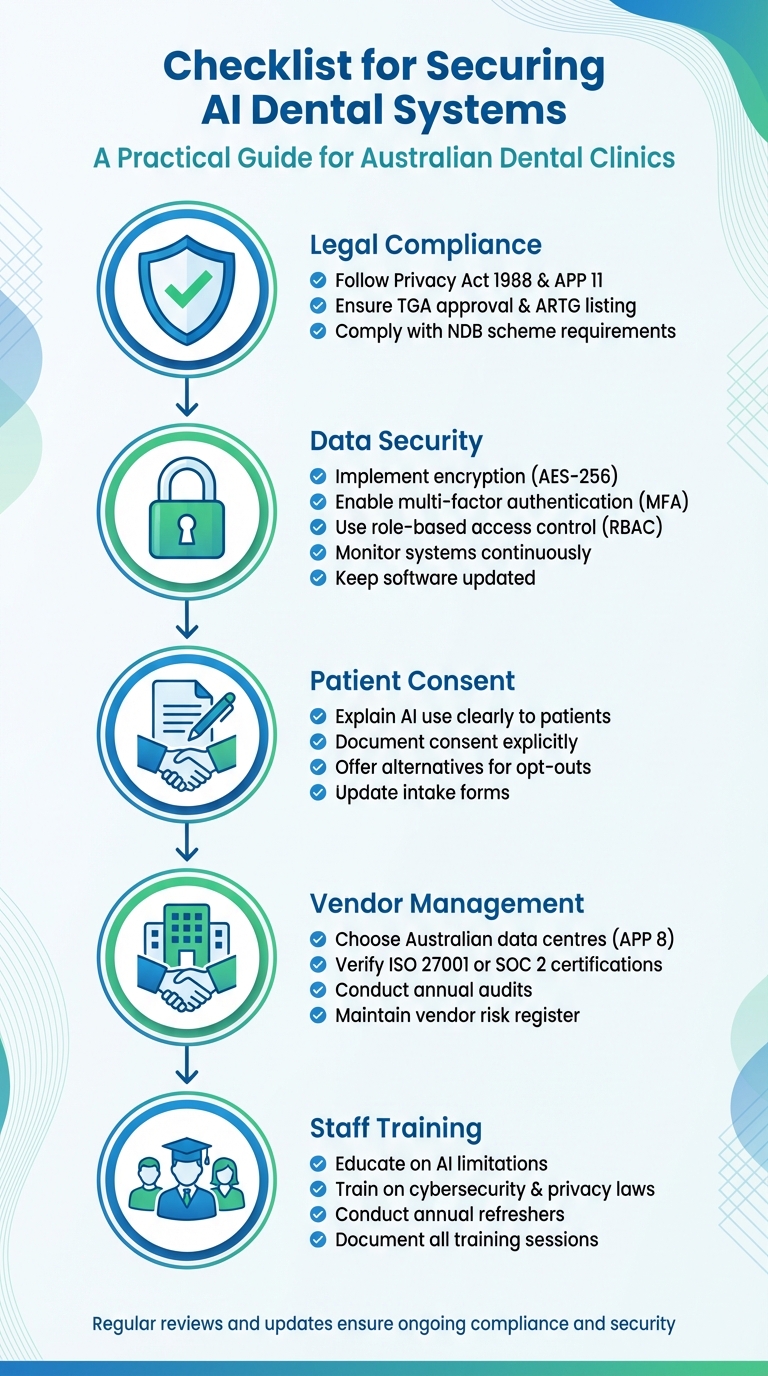
5-Step Checklist for Securing AI Dental Systems in Australian Clinics
Dental Office Cybersecurity and HIPAA Compliance : How Not to Make a $50,000 Mistake
Legal and Regulatory Requirements
Australian dental clinics incorporating AI systems must navigate several regulatory frameworks. Under the Privacy Act 1988, clinics handling AI-generated diagnostic data are required to take reasonable steps to safeguard sensitive health information against misuse or unauthorised access, in line with APP 11.
The Therapeutic Goods Administration (TGA) oversees AI software used for diagnosis, screening, or treatment planning, classifying it as Software as a Medical Device (SaMD). Before adopting any AI diagnostic tool, clinics must ensure the product is listed on the Australian Register of Therapeutic Goods (ARTG). Additionally, under the Notifiable Data Breaches (NDB) scheme, clinics are obligated to notify both the Office of the Australian Information Commissioner (OAIC) and affected individuals if a breach involving an AI system is likely to cause serious harm.
Setting Up AI Oversight
Assign a dedicated individual – such as a practice manager or an appointed AI officer – to oversee the compliance and operation of AI systems. This person should maintain a detailed inventory of AI tools, including their versions, vendor information, and the types of data processed. It’s also important to document how data flows through the clinic, from patient intake to AI processing and final storage.
To clarify responsibilities, use a RACI matrix. This tool helps define roles and prevents accountability gaps, addressing potential risks like data sovereignty issues (e.g., when data is stored outside Australia) and insufficient vendor assessments. Regular reviews, including annual audits and continuous monitoring, are essential to manage the clinic’s reliance on AI systems. These measures ensure the clinic stays aligned with Australian privacy standards.[1][2]
Meeting Australian Privacy Laws
Once oversight processes are in place, clinics must ensure compliance with privacy laws. Conduct a Privacy Impact Assessment (PIA) for each AI tool to evaluate how health data is collected, stored, and processed. If cloud storage is used, confirm that patient data is stored within Australian data centres to comply with APP 8. Update the clinic’s privacy policy to explicitly mention the use of AI and clarify how patient information may be shared with third-party systems.
Vendor contracts should include clauses that guarantee adherence to Australian privacy regulations, clearly define data ownership, and outline breach notification responsibilities. To comply with the NDB scheme, establish workflows that include breach detection alerts, forensic logging, and risk assessment processes to determine if notification is required.[1]
Patient Consent and Transparency
Patients deserve to know when AI tools are part of their care. In line with Australian Privacy Principle 5, clinics must inform patients about how their health information is collected and used, including any processing by third-party AI systems. This means patients should be made aware before an AI tool is used to analyse X-rays or assist in treatment planning. These consent practices should align with the clinic’s broader data security measures.
Explaining AI Use to Patients
When AI tools are employed, it’s essential to explain their role clearly. For example, staff can describe how the clinic uses computer-based systems to flag potential issues on X-rays, while emphasising that the dentist always reviews the results and makes the final diagnosis and treatment decisions. This ensures patients understand that AI is a support tool, not a replacement for professional judgement.
Practical ways to communicate this include:
- Providing a simple, easy-to-read information leaflet at reception.
- Including a clear explanation of AI tools in new-patient welcome packs.
- Using a standard script to explain AI involvement during care.
During appointments, clinicians can also display AI-annotated images on a screen and walk patients through how these assist in the overall assessment. A brief notice in the waiting room can further inform patients that the clinic uses approved AI tools under dentist supervision.
Recording Patient Consent
After explaining AI use, it’s crucial to document patient consent thoroughly. Explicit consent should be obtained when AI processes sensitive data. Update patient intake forms to include a checkbox for AI-assisted diagnostic tools, and record consent discussions in the patient’s file. Consent forms and privacy notices should clearly state that AI supports, but does not replace, the clinician, who always reviews – and can override – AI findings.
For patients who prefer not to involve AI, their choice must be respected. Record their refusal, offer alternatives like traditional radiograph interpretation, and reassure them that opting out will not affect the quality of their care. Clinics should ensure their systems can disable AI features for individual patients when necessary.
Technical Security Measures
Securing AI systems is crucial in safeguarding sensitive health information and protecting against cyber threats. Robust technical measures are the foundation of any secure AI deployment.
Access Control and Network Security
Role-based access control (RBAC) is a key strategy for limiting data access to only what’s necessary for each staff member’s role. Start by identifying every role in your practice – dentists, oral health therapists, receptionists, practice managers, and IT support – and outline the specific AI features each role needs. For instance, clinical staff might require access to AI-assisted X-rays, while administrative staff handle tasks like managing configurations or exporting data. Keeping clinical and administrative functions distinct is essential for maintaining security.
Strengthen access further with multi-factor authentication (MFA) using phishing-resistant methods like FIDO2 security keys or authenticator apps, especially for privileged and remote access. Simplify access management by implementing single sign-on (SSO) linked to your practice’s identity provider, reducing reliance on passwords. To prevent unauthorised use, set session timeouts to log out inactive users automatically in shared environments, and restrict high-risk actions based on IP addresses or physical locations.
Maintain a regularly updated inventory of all devices connected to AI systems – such as imaging sensors, workstations, tablets, and cloud services. Conduct quarterly reviews of access permissions, and immediately adjust them when staff join, change roles, or leave. Real-time alerts for unusual activities, like repeated failed logins, unexpected data exports, or spikes in image processing, can help detect potential issues early. Additionally, monitor your network for unusual outbound connections from AI servers, which could signal malware or data breaches.
These measures provide a strong foundation for protecting sensitive data.
Data Encryption and System Monitoring
Pair access controls with encryption and continuous monitoring to ensure comprehensive protection. End-to-end encryption secures patient data from the moment it’s captured until it reaches the authorised processing environment. Store encryption keys separately – using a Hardware Security Module or a cloud-based Key Management Service – and disable outdated protocols like SSL 3.0 or older TLS versions. Before sending data to AI models for analysis or training, consider de-identifying sensitive information through encryption-based masking or hashing.
Minimise data collection by processing only the information necessary for each task. Use anonymisation and input/output filters to prevent accidental data leakage. Regularly scan AI applications and their integrations for vulnerabilities, and ensure timely application of vendor security updates. Vendor-provided dashboards can also be valuable for tracking service status, error trends, and security alerts. Integrate these tools into your broader IT monitoring setup for a more unified approach.
Finally, prepare for potential security incidents by maintaining clear, documented procedures. These run-books should guide staff – whether receptionists or clinicians – on how to respond to alerts. For example, steps might include temporarily disabling AI access, notifying the practice manager, and contacting the vendor or IT provider for further action.
sbb-itb-2be92ed
Vendor Selection and Management
Choosing the right vendor is crucial for protecting your practice from potential breaches, compliance issues, and system failures.
Vendor Evaluation Before Purchase
Start by confirming where the vendor stores and processes patient data. For Australian practices, selecting vendors with data centres located in Australia simplifies compliance with the Privacy Act 1988, particularly the Australian Privacy Principle 8, which governs cross-border data flows. If data must be stored offshore, ensure the vendor provides clear documentation proving their data protection measures align with Australian standards.
Ask for valid security certifications such as ISO/IEC 27001:2022 or SOC 2 Type II to confirm that their security controls have been independently audited. Verify that the vendor adheres to robust encryption standards, like AES-256 for data at rest and TLS 1.2+ for data in transit. For clinical diagnostic tools, ensure they are registered with the Therapeutic Goods Administration (TGA) as required.
It’s also essential to have a Business Associate Agreement (BAA) or similar contract in place. This document should outline the vendor’s security responsibilities, breach notification timelines, and compliance obligations. Service level agreements (SLAs) should clearly define expectations around system uptime, support response times, and security updates. To minimise risk, share only the data necessary for the AI function and ensure all data transfers use encrypted channels. These measures help strengthen the security framework of your practice.
Regular Vendor Reviews
Initial evaluations are just the beginning – ongoing oversight is equally important. Conduct annual audits to confirm that vendors continue to meet security certifications and fulfil their contractual obligations. Regularly review their security reports, incident metrics, and compliance evidence. Whenever significant system updates occur, reassess risks to identify any new data flows, access requirements, or third-party dependencies.
Maintain a vendor risk register to document each AI vendor. This should include details like the types of patient data involved (e.g., radiographs or clinical notes), data storage locations, identified risks, and mitigation actions. If high-risk issues arise – such as changes in data hosting locations, weakened security controls, or new AI outputs that might influence clinical decisions – escalate them to practice leadership or consult your indemnity provider or professional adviser. Keep detailed records of all decisions, justifications, and steps taken to mitigate risks. These records are essential for audits and medico-legal situations, ensuring a clear governance trail in case of incidents or complaints.
| Regular Review Cadence | Activities |
|---|---|
| Annual | Audit vendor BAAs, security certifications, and compliance evidence |
| Event-Driven | Reassess risks and conduct penetration tests after major system changes |
| Ongoing | Monitor logs, review incident metrics, and update access permissions as needed |
Staff Training and Procedures
Having strong technical measures is crucial, but they’re only part of the equation. Well-trained staff and clearly defined procedures are essential to ensure the security of your AI system. Without proper training, even the best technical controls can fail. Human errors – like falling for phishing scams, mishandling data, or relying too heavily on AI outputs – are some of the biggest contributors to healthcare data breaches [7, 8]. To minimise these risks, combine thorough training programs with written guidelines that clearly detail staff responsibilities.
Training Staff on AI Security
Start by covering the basics of AI-related cybersecurity. Staff using AI platforms should be trained to identify phishing attempts, create strong, unique passwords, and enable multi-factor authentication [3]. Clinical staff, in particular, need to understand that AI outputs should be treated as a second opinion. They must recognise the limitations of AI systems and be aware of risks like automation bias [2, 5]. This training should also include a focus on Australian privacy laws, especially the Privacy Act 1988, which governs the handling, storage, and de-identification of patient data.
Training isn’t a one-and-done activity. Formal sessions should be refreshed annually, with additional training introduced whenever there are major changes – like onboarding a new AI vendor, significant system updates, or after a security incident or near miss [3, 7]. Document every session thoroughly, noting dates, attendees, topics covered, and any newly introduced procedures. This documentation not only strengthens internal governance but also ensures readiness for external audits.
A solid training program lays the groundwork for creating effective, actionable security procedures.
Creating Security Procedures
Training alone isn’t enough – knowledge has to be translated into daily practice through well-documented procedures. Your AI usage policy should clearly define which staff members are authorised to access AI systems, outline how these systems can be used, and specify the checks required before acting on AI-generated recommendations. For clinical workflows, it’s important to include steps for recording AI involvement, overriding AI suggestions when necessary, and documenting final clinical decisions.
For administrative tasks, procedures should focus on data minimisation. Staff should avoid entering unnecessary patient information into AI tools, and all approved systems must use secure, encrypted channels. Incident response plans should be clear and actionable, detailing immediate steps like halting the use of a compromised system, logging out, disconnecting if needed, and notifying the appropriate personnel. These plans should also include instructions on how to document the event thoroughly [1].
Conclusion
Protecting AI dental systems is a continuous effort to safeguard patient data, comply with legal requirements, and maintain the trust of your community. The checklist provided here integrates legal compliance, patient consent, technical protections, vendor oversight, and staff training into a practical approach that dental clinics in Australia can adopt and improve over time. It ensures that every aspect of your AI system is carefully evaluated, from regulatory adherence to clear patient communication.
To uphold patient consent and transparency, make sure patients are fully informed whenever AI is used in their care. Whether it’s for diagnosis, imaging analysis, or treatment planning, patients deserve to know how AI is involved and how their data is being managed. Document their consent clearly, as this not only aligns with ethical standards but also builds trust by prioritising safety and openness.
Strengthen your technical defences with tools like encryption, multi-factor authentication, access controls, and continuous monitoring. Pair these measures with well-documented procedures and regular reviews. For example, maintaining a vendor risk register that tracks your AI tools – along with their risk levels, review schedules, and any unresolved issues – provides a structured approach to governance. Treat this checklist as a dynamic resource: adapt and refine it as regulations shift, new threats arise, or your practice adopts emerging technologies.
Regular staff training is essential. Educate your team on AI’s limitations, privacy obligations under the Privacy Act 1988, and cybersecurity best practices to reduce human error, which remains the leading cause of healthcare data breaches. Translate this training into actionable steps, such as securing logins, obtaining AI-specific consent, and identifying suspicious activity. New staff should be introduced to these protocols during onboarding, with refresher sessions scheduled annually or whenever changes occur.
Consider appointing an internal AI lead or forming an oversight group to manage consent processes, vendor assessments, staff training, and incident responses. This role ensures that all these elements work together seamlessly. By embedding these practices into your daily operations, you can ensure AI serves as a reliable tool – enhancing, not replacing, professional judgement – while treating patient data with the same level of care as their clinical needs.
FAQs
How can dental clinics protect patient data and comply with Australian privacy laws when using AI systems?
To ensure patient data is secure and comply with Australian privacy laws, dental clinics can take several practical measures:
- Perform a privacy impact assessment to identify risks and address them before they become issues.
- Implement secure data storage and encryption methods to protect sensitive information.
- Limit access to patient records to authorised staff only.
- Obtain informed consent from patients for collecting, using, and storing their data.
- Regularly review and update privacy policies to stay aligned with the Privacy Act 1988 and Australian Privacy Principles (APPs).
- Work only with AI vendors who meet strict privacy standards and ensure they sign data processing agreements.
- Provide staff with training on privacy obligations and effective data protection practices.
Being upfront with patients about how their data is stored, used, and safeguarded not only builds trust but also helps maintain compliance with legal requirements.
How can dental clinics explain AI use and ensure patients provide informed consent?
Dental clinics should prioritise using straightforward, easy-to-understand language when explaining how AI is integrated into their services. Clearly outline its purpose, what patients might gain from it, and any limitations it may have. Providing written materials that detail this information can be helpful, and patients should always have the chance to ask questions to clarify any uncertainties.
When it comes to obtaining informed consent, ensure patients fully comprehend the details shared with them and willingly agree before moving forward with any AI-assisted procedures. Make sure to document this consent carefully and keep the lines of communication open to address any follow-up concerns or questions they might have.
What should dental clinics consider when choosing and managing AI technology providers?
When choosing and working with AI technology providers, dental clinics need to focus on compliance with Australian healthcare regulations and data privacy laws, like the Australian Privacy Act. It’s crucial to assess the provider’s security measures – think encryption, access controls, and data breach protocols – to keep patient information safe.
Set up clear contracts that define who owns the data, outline security responsibilities, and specify compliance requirements. Regular audits and system monitoring are essential to maintain both performance and security. By staying on top of updates and ensuring AI tools are used ethically, clinics can protect patient data while maintaining excellent standards of care.
Related Blog Posts
- How AI Analyses Periodontal Radiographs
- Real-Time AI in Dental Imaging: What to Know
- Checklist for AI Dental Software
- How AI Detects Periodontal Disease Early
Important Notice: Any surgical or invasive procedure carries risks. Before proceeding, you should seek a second opinion from an appropriately qualified health practitioner.
Individual results may vary. The information provided in this article is for educational purposes only and does not constitute medical advice.
Checkout Related Blogs




Get in touch with us
For more information, call us now to start feeling better. Or fill the form below to make appointment
The Latest News from Complete Smiles
How to Clean Clear Plastic Retainers
Checklist for Choosing Wearable Dental Devices
Checklist for Choosing Cloud AI Platforms in Dentistry

Complete Smiles Bella VistaAccepts All Major Health Funds, Including





