





How Full-Mouth X-Rays Aid Diagnosis
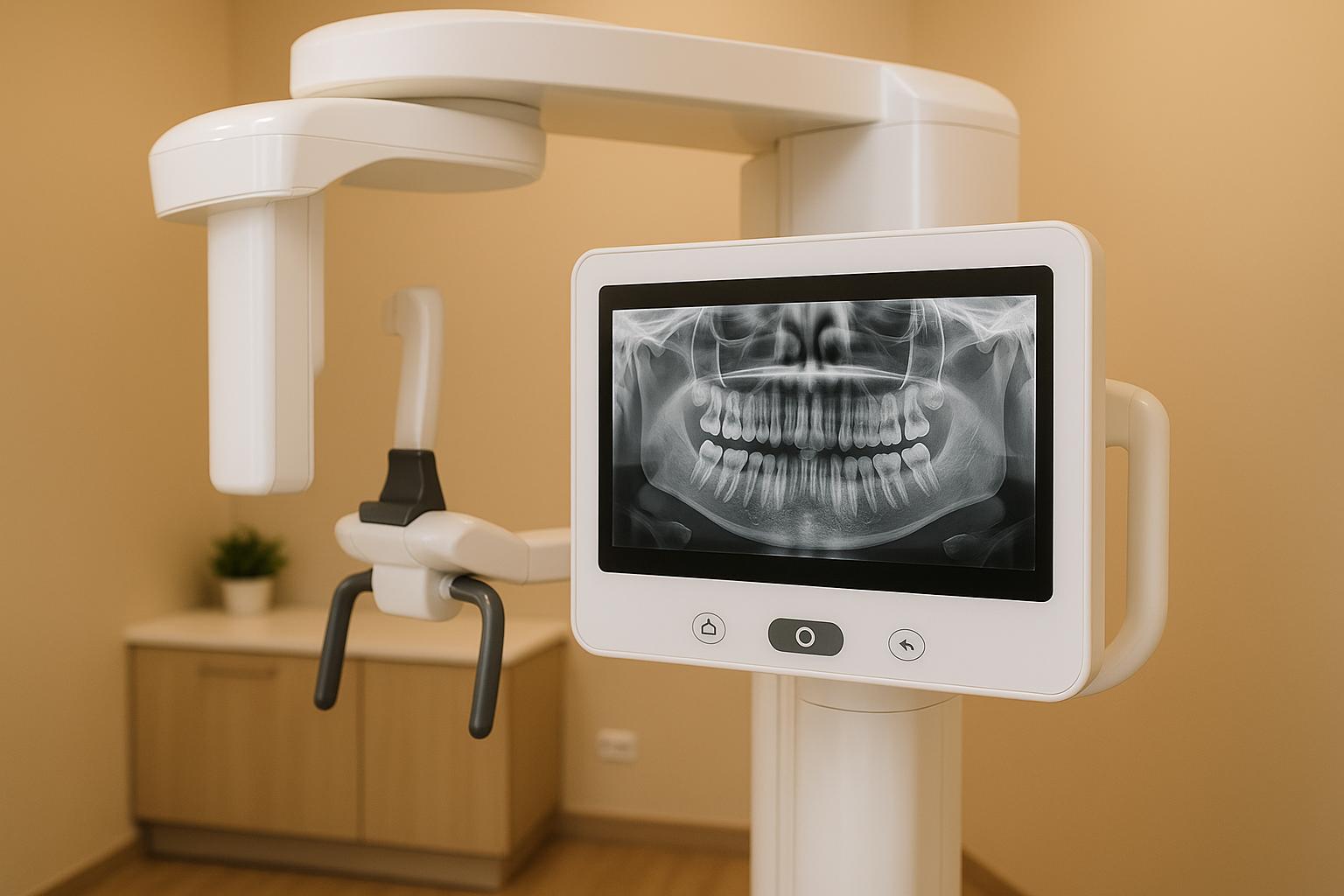
Full-mouth X-rays give dentists a detailed view of your teeth, jawbones, and surrounding areas in one session. This imaging method combines periapical X-rays (focused on individual teeth and roots) and panoramic X-rays (wide view of the jaw). It’s a quick, painless process that typically takes 10–15 minutes and uses modern digital technology to reduce radiation exposure by up to 80% compared to traditional methods. Here’s what they help with:
- Cavities & Decay: Detect hidden cavities, even under fillings or crowns.
- Bone Health & Gum Disease: Identify bone loss and stages of gum disease early.
- Oral Diseases & Structural Issues: Reveal cysts, tumours, infections, and impacted teeth.
- Tooth & Jaw Development: Monitor growth and alignment in children and teens.
- Treatment Planning: Essential for dental implants, root canals, and orthodontics.
Digital X-rays are safe, with radiation exposure comparable to a few days of natural background radiation. Protective measures like lead aprons ensure safety for sensitive groups like children and pregnant women. Dentists recommend full-mouth X-rays every 6–18 months, depending on individual needs, to maintain optimal oral health.
How To Understand Your Dental X-rays (Dental Hygienist Explains)
Key Diagnostic Uses of Full-Mouth X-Rays
Full-mouth X-rays are a powerful tool for uncovering dental issues that might go unnoticed during routine exams. These detailed images help dentists catch problems early, allowing for precise treatment plans that support better oral health. Below, we break down their key diagnostic uses.
Finding Cavities and Hidden Decay
Some cavities, especially those between teeth (interproximal cavities), can be hard to spot with a standard exam. Full-mouth X-rays can detect these hidden cavities and even decay lurking beneath existing fillings or crowns [1][3]. Catching decay early often means less invasive treatments, while untreated issues can progress and require more complex procedures.
Because full-mouth X-rays capture images of every tooth at once, they ensure no area is overlooked, even those that are difficult to examine during a visual inspection.
Checking Bone Health and Gum Disease
Gum disease, or periodontal disease, can cause bone loss long before symptoms like pain or swelling appear. Full-mouth X-rays provide a clear view of bone density and structure around tooth roots, helping dentists identify the stage of gum disease [1][3][4]. This information is critical for monitoring bone changes and tailoring treatments to slow or stop further damage.
For patients considering dental implants, these X-rays offer essential insights into the condition of the jawbone, revealing whether it’s strong enough to support implants or if additional procedures like bone grafting are needed. This detailed evaluation also helps detect other structural issues that could impact treatment success.
Spotting Disease and Structural Problems
Full-mouth X-rays go beyond cavities – they can uncover cysts, tumours, and infections that might not show any obvious symptoms [1][5][8]. They also provide a clear view of impacted wisdom teeth, showing their position and angle. This helps dentists decide if removal is necessary to avoid future complications. Additionally, these X-rays can reveal jawbone irregularities caused by grinding, stress fractures, or trauma, enabling early intervention to prevent further damage [2].
Tracking Tooth and Jaw Development
For children and teenagers, full-mouth X-rays are incredibly useful in tracking how permanent teeth are developing and how the jaw is growing [1][3]. These images can highlight alignment problems, missing or extra teeth, and other developmental concerns. They also allow dentists to assess tooth positions and root angles, making them an essential tool for orthodontic planning.
Planning Complex Treatments
When it comes to complex dental procedures, having a detailed view of the mouth is essential. For root canal therapy, full-mouth X-rays reveal the number, shape, and curvature of root canals, helping endodontists anticipate challenges [1][2]. Similarly, these X-rays play a key role in planning dental implants by mapping out bone quality, nerve locations, and sinus positions, ensuring safe and precise implant placement.
Even for designing dentures or partial dentures, full-mouth X-rays provide critical information about the condition of remaining teeth, bone levels, and other anatomical details. This ensures the final prosthetic fits well and functions effectively.
Benefits and Comparison with Other Imaging Methods
Full-mouth X-rays stand out for their ability to provide a detailed and comprehensive view of the teeth and surrounding structures. While several imaging options exist for dental diagnostics, each serves specific purposes, and full-mouth X-rays excel in certain areas.
How Full-Mouth X-Rays Compare
Full-mouth X-rays capture all teeth and the surrounding bone in detail, enabling dentists to identify a wide range of dental issues in a single session [1][2]. Unlike other methods, they offer individual images of each tooth, its root, and the adjacent bone, which is critical for early detection and precise treatment planning, especially in complex cases [1].
On the other hand, bitewing X-rays are designed to focus on the crowns of the back teeth and are highly effective for spotting cavities between teeth. However, they lack the scope needed for a comprehensive evaluation. Panoramic X-rays, while capable of capturing the entire mouth in one shot, trade fine detail for broader coverage. They are better suited for assessing jaw structure, positioning of wisdom teeth, or orthodontic needs rather than diagnosing individual tooth problems [2][5].
These differences highlight the unique role of full-mouth X-rays in providing a complete diagnostic picture.
Comparison Table: Common Dental Imaging Methods
| Imaging Method | Coverage | Detail Level | Typical Use Cases | Radiation Exposure |
|---|---|---|---|---|
| Full-Mouth X-rays | All teeth & supporting bone | High (individual teeth) | Comprehensive diagnosis, treatment planning, new patient exams | Moderate (lower with digital) |
| Bitewing X-rays | Crowns of back teeth | High (limited area) | Detecting cavities between teeth, monitoring bone levels | Low |
| Panoramic X-rays | Entire mouth, jaws, sinuses | Moderate | Overview of jaw, wisdom teeth, orthodontic assessment | Low to moderate |
Full-mouth X-rays are particularly useful for new patients without recent imaging, those with extensive dental work or gum disease, and individuals requiring detailed treatment planning for procedures like implants, orthodontics, or surgery [1][2]. They also reveal subtle abnormalities that may go unnoticed with bitewing X-rays, allowing for prompt intervention and better long-term outcomes [1][3].
Drawbacks of Full-Mouth X-Rays
While full-mouth X-rays offer unmatched diagnostic detail, they do come with a drawback: slightly higher radiation exposure compared to bitewing or panoramic X-rays. This is because a full-mouth series typically involves 14–20 individual images to cover the entire mouth comprehensively [1][4].
However, advancements in digital X-ray technology have significantly reduced radiation exposure – by up to 80% compared to traditional film methods [6][8]. Despite requiring more time than a single panoramic image, the process is relatively quick, usually taking less than 15 minutes [1]. This small time investment results in a wealth of diagnostic information.
Australian dental clinics are increasingly adopting digital X-ray systems, reflecting a commitment to patient safety and diagnostic precision [6][8]. By leveraging modern technology, clinics ensure minimal radiation exposure while maintaining the high standards of care patients expect.
sbb-itb-2be92ed
Patient Considerations and Safety Guidelines
Understanding the precautions and special factors surrounding full-mouth X-rays allows patients to make better choices about their dental care. Today’s dental practices follow strict safety protocols to protect patients while gathering the essential diagnostic details needed for effective treatments.
Radiation Safety and Modern Technology
Australian dental practices adhere to the ALARA principle ("As Low As Reasonably Achievable"), which prioritises minimising radiation exposure while still obtaining high-quality diagnostic images [7]. This principle ensures that patients receive the lowest possible radiation dose necessary for accurate diagnosis.
Modern digital X-ray systems have revolutionised dental imaging, reducing radiation exposure by up to 80% compared to traditional methods [6][8]. This advancement allows for detailed imaging to detect cavities, gum disease, bone loss, and other oral health concerns while keeping radiation levels minimal.
To put things into perspective, the effective radiation dose from a full-mouth X-ray series is approximately 0.150 mSv. This is far less than the natural background radiation Australians are exposed to annually, which ranges between 1.5 and 2.0 mSv [6][8]. Essentially, the radiation from a full set of dental X-rays is equivalent to just a few days of natural exposure.
Additional protective measures, like lead aprons and thyroid collars, are commonly used in Australian dental clinics to shield patients from unnecessary exposure [1][6]. Combined with the speed and precision of digital imaging, these measures also reduce the likelihood of retakes, further limiting radiation exposure. These safeguards are particularly important when addressing the needs of specific patient groups.
Special Populations: Children and Pregnant Patients
Certain groups, such as children and pregnant women, require extra care when it comes to full-mouth X-rays. Pregnant patients should always inform their dentist if they are pregnant or believe they might be, as this allows adjustments to be made [1][7].
For pregnant women, non-urgent X-rays are often delayed until after pregnancy. If imaging is necessary, dentists take extra precautions, such as using additional lead shielding, to protect both the mother and the baby [7]. These decisions are made collaboratively between the dentist and patient, weighing the benefits of diagnosis against any potential risks.
Children also require special attention due to their developing bodies and increased sensitivity to radiation. Full-mouth X-rays play a key role in monitoring tooth and jaw development, enabling early identification of potential issues [2][3]. However, the frequency and necessity of imaging for children depend on their oral health, stage of development, and specific risk factors.
Dentists carefully evaluate whether the benefits of X-rays outweigh the risks for each child. These images can help detect developmental abnormalities, impacted teeth, and other concerns that might affect a child’s dental health as they grow [3]. By tailoring approaches to each patient, dentists ensure that even the most vulnerable groups benefit from the diagnostic tools available.
Informed Consent and Patient Communication
Safety protocols are only part of the equation – clear communication is crucial for informed consent. Dentists must explain both the benefits and potential risks of full-mouth X-rays so patients can make well-informed decisions about their care [3][7].
Patients need to understand that full-mouth X-rays can uncover hidden issues such as cavities, gum disease, infections, cysts, tumours, and jawbone abnormalities [1][4]. These insights enable dentists to create personalised treatment plans, catch problems early, and plan precise interventions before symptoms escalate.
For most adults, dental X-rays are recommended every 6–18 months, although the frequency can vary based on individual health needs and risk factors [3][7]. Those with ongoing dental concerns or a history of issues may require more frequent imaging to monitor changes over time [1].
Dentists should also address any concerns about safety by explaining the protective measures in place, such as lead aprons and the reduced radiation levels of modern digital X-rays [1][6]. For patients who are anxious about radiation exposure, practitioners can reassure them that the procedure is painless and involves only minimal discomfort. They can also emphasise that patients are free to relax or even chat during the process [2].
Full-Mouth X-Rays in Complete Dental Care
Full-mouth X-rays are more than just a diagnostic tool – they’re a cornerstone in providing thorough dental care. These images go beyond what the eye can see during a routine check-up, offering insights that are essential for everything from regular exams to advanced specialist treatments. By integrating full-mouth X-rays into dental care, practitioners can uncover hidden issues and provide more precise, effective solutions.
A Holistic View of Oral Health
Full-mouth X-rays reveal problems that might be missed during a visual exam. Modern imaging techniques ensure the process is quick, safe, and highly detailed, allowing dentists to identify concerns like early gum disease or tiny cavities before they become bigger issues.
Take, for example, a patient with no visible symptoms but a history of gum disease. A full-mouth X-ray might reveal early signs of bone loss. With this information, a dentist can develop a tailored plan – such as deep cleaning and close monitoring – to manage the condition and prevent further complications.
Personalised Treatment Plans
The detailed insights from full-mouth X-rays allow dentists to craft treatment plans that are specifically designed to meet each patient’s unique needs. Instead of relying on a standardised approach, these images help determine the best course of action. Whether it’s addressing bone loss with periodontal therapy, removing an impacted tooth, or preparing for cosmetic treatments like veneers or dental implants, the imaging guides a targeted and efficient strategy.
For most patients, full-mouth X-rays are recommended every 6–18 months, with more frequent imaging for those facing ongoing dental challenges [3]. This personalised approach ensures that any issues are caught and treated early, supporting both preventive care and minimally invasive treatments.
Advanced Clinics and Specialist Expertise
In advanced dental clinics, full-mouth X-rays are a key part of diagnostic protocols, especially for complex treatment planning. At Complete Smiles Bella Vista, led by Dr. James Hanna, advanced imaging is seamlessly integrated into both general and specialist dental services.
These X-rays are invaluable for procedures requiring detailed planning, such as assessing bone quality for dental implants or evaluating tooth alignment and root health for orthodontic treatments. By combining X-ray findings with clinical exams and patient history, dentists can coordinate treatments more effectively, improving outcomes and enhancing patient satisfaction.
Modern digital systems have further revolutionised full-mouth X-rays, offering faster processing times and reduced radiation exposure. This technology supports a preventative, patient-focused approach, ensuring that dental care is not only thorough but also as safe and efficient as possible.
Conclusion: The Value of Full-Mouth X-Rays in Diagnosis
Full-mouth X-rays play a crucial role in modern dentistry, offering insights that go far beyond what can be identified during a visual examination. These detailed imaging tools help dentists uncover hidden issues, plan treatments with precision, and achieve better results for their patients.
By providing a complete view of the mouth, full-mouth X-rays allow dentists to spot problems early – before they become major concerns. Whether it’s early signs of bone loss, developing cysts, impacted teeth, or decay hidden beneath existing dental work, these X-rays enable preventive care that can save patients from more complex and costly treatments down the line[2].
Thanks to advancements in digital X-ray technology, concerns about radiation exposure have been significantly reduced, while the quality of diagnostic imaging has improved. The process itself is quick and efficient, typically taking only 10–15 minutes[1][2]. This combination of speed and thoroughness makes full-mouth X-rays a practical and cost-effective alternative to multiple, more targeted imaging sessions.
With the detailed information provided by these X-rays, dentists can create treatment plans tailored to each patient’s specific needs. This personalised approach is especially important for complex procedures like orthodontics, dental implants, or periodontal therapy, where precision is key. Full-mouth X-rays ensure that treatments are based on a comprehensive understanding of the patient’s oral health.
As dental technology continues to evolve, the importance of full-mouth X-rays in diagnosis is only expected to grow. For patients, choosing a dental practice that uses advanced imaging technology means access to more accurate diagnoses and better care. Regular full-mouth X-rays – recommended every 6 to 18 months depending on individual risk factors[3] – are a proactive way to maintain oral health and avoid unexpected dental emergencies.
In contemporary dentistry, full-mouth X-rays are indispensable for accurate diagnoses, effective treatment planning, and achieving the best possible outcomes.
FAQs
How often should I have full-mouth X-rays, and does it depend on my dental health?
The need for full-mouth X-rays varies based on your unique dental health. Your dentist will consider your oral health history, current condition, and any potential risks to decide how often they’re necessary.
For some individuals, full-mouth X-rays might only be required every few years. However, those dealing with ongoing dental issues may need them more often. Regular dental check-ups are key to determining the right X-ray schedule for your situation.
Are full-mouth X-rays safe for children and pregnant women?
Full-mouth X-rays involve a very low dose of radiation, making them safe when proper precautions are in place. However, extra caution is essential for children, as their developing cells are more sensitive to radiation. Pregnant women should also notify their dentist to ensure additional measures are taken to safeguard the baby.
Dentists usually rely on protective tools like lead aprons and collars to reduce exposure. If you’re pregnant, suspect you might be, or have questions about your child’s safety, make sure to inform your dentist before having any X-rays done.
How do full-mouth X-rays help dentists diagnose and plan treatments?
Full-mouth X-rays give dentists a thorough look at all your teeth, jawbone, and the surrounding areas. This type of imaging is especially useful for spotting hidden problems like tooth decay, gum disease, bone loss, or infections that might not show up during a standard check-up.
With this complete view, dentists can identify more complex dental issues and create tailored treatment plans. Catching these problems early not only helps prevent complications but also promotes better oral health in the long run.
Related Blog Posts
- How X-Rays Help in Dental Treatment Planning
- Digital Dental X-Rays: How They Work
- Radiographic Staging of Periodontal Diseases
- How AI Improves Diagnostic Consistency in Dentistry
Important Notice: Any surgical or invasive procedure carries risks. Before proceeding, you should seek a second opinion from an appropriately qualified health practitioner.
Individual results may vary. The information provided in this article is for educational purposes only and does not constitute medical advice.
Checkout Related Blogs




Get in touch with us
For more information, call us now to start feeling better. Or fill the form below to make appointment
The Latest News from Complete Smiles
How to Clean Clear Plastic Retainers
Checklist for Choosing Wearable Dental Devices
Checklist for Choosing Cloud AI Platforms in Dentistry

Complete Smiles Bella VistaAccepts All Major Health Funds, Including





