





Benefits of Early Orthodontic Assessments

Early orthodontic assessments, typically recommended by age 7, help identify potential dental and jaw issues before they escalate. These evaluations focus on jaw growth, tooth alignment, and bite development, allowing orthodontists to guide growth during a child’s formative years. Common concerns like crowding, bite irregularities, jaw imbalances, and harmful habits (e.g., thumb-sucking) can be addressed more effectively when caught early.
Key takeaways:
- Crowding & Spacing: Early detection prevents complex issues like misaligned permanent teeth.
- Bite Irregularities: Misaligned bites can lead to chewing difficulties, speech problems, and uneven tooth wear if untreated.
- Jaw Growth Issues: Early treatment supports proper jaw development, reducing the need for extensive corrections later.
- Harmful Habits: Addressing habits like thumb-sucking early can prevent long-term dental complications.
Scheduling an orthodontic check-up by age 7 ensures timely monitoring or intervention, even if immediate treatment isn’t required. Early assessments simplify future treatments and improve oral health outcomes.
What are the benefits of Early Orthodontic Intervention?
sbb-itb-2be92ed
Common Dental Issues Detected Early
Early orthodontic assessments play a crucial role in spotting potential problems during the development of a child’s teeth and jaw. Some issues are easy to spot, while others require a trained professional to identify. Below are some of the most common concerns that these assessments help uncover.
Crowding and Spacing
Crowding often happens when a primary tooth blocks the path for a permanent tooth to emerge. In many cases, this resolves naturally as the primary tooth is replaced. However, if a primary molar is lost too early, it can lead to spacing problems. In such cases, a space maintainer might be needed to keep the gap open until the permanent tooth is ready. Dr. Udit Bhatnagar explains:
"Early loss of a primary molar, however, can cause space loss which, without appropriate management, can create spacing issues for the permanent successor." [3]
Spotting these problems early allows for timely intervention, which can prevent the need for more complex treatments later. Similarly, identifying bite issues early can make orthodontic corrective measures more effective.
Bite Irregularities
Malocclusion, or a misaligned bite, affects about 56% of people worldwide [4]. While not every case requires treatment, leaving it unaddressed can lead to issues like uneven tooth wear, chewing difficulties, speech problems (such as lisping), and even jaw pain over time. The Cleveland Clinic highlights the risks of untreated malocclusion:
"untreated malocclusion can be harmful. It causes several health concerns that can worsen with age, like tooth decay and gum disease." [4]
| Bite Irregularity | Potential Long-Term Impact if Unaddressed |
|---|---|
| Crossbite | Uneven tooth wear; asymmetric jaw growth |
| Deep Overbite | Jaw discomfort; gum irritation; tooth wear |
| Underbite | Chewing challenges; altered facial appearance |
| Open Bite | Difficulty biting food; speech issues |
| Overjet | Higher risk of tooth trauma |
Correcting these bite issues early on can help avoid complications later in life.
Jaw Growth Imbalance
A narrow upper jaw can limit space for permanent teeth and is often associated with mouth breathing. Skeletal imbalances, where the upper and lower jaws grow at different rates, can also be identified during early assessments. Early treatment is particularly effective because the jaw is still growing and can be guided more easily. Lemchen Salzer Orthodontics notes:
"By proactively creating space and supporting proper jaw development, we can guide the natural growth of the jaws and prevent severe misalignments in the future." [5]
Addressing jaw growth concerns early can significantly reduce the likelihood of needing complex corrective treatments later.
Harmful Oral Habits
Habits like thumb-sucking or prolonged dummy use can influence the development of a child’s teeth and jaw. These behaviours can push front teeth forward, narrow the upper jaw, and create an open bite where the front teeth don’t meet when the mouth is closed. If these habits stop by around ages 4 to 5, the effects often self-correct [3]. However, habits that persist beyond this age can cause more permanent changes. Dr. Udit Bhatnagar warns:
"Some children, particularly those who persist with an oral habit beyond [age five], will develop irreversible ‘damage’ to their developing occlusion." [3]
Early orthodontic assessments give families the chance to address these habits early, using techniques like positive reinforcement or reward systems. In more stubborn cases, a palatal crib appliance may be recommended to help break the habit.
Benefits of Early Orthodontic Assessments
Early orthodontic assessments play a key role in guiding dental development and addressing potential problems before they escalate. By identifying issues early, this approach makes use of natural growth phases to improve outcomes and reduce the need for more intensive treatments later.
Guides Jaw and Tooth Development
During a child’s growth phase, tools like palatal expanders and space maintainers can help shape jaw and tooth alignment, creating the necessary space for permanent teeth to come in properly. Once growth slows or stops, achieving similar results becomes far more challenging.
The American Association of Orthodontists explains it well:
"Waiting until all permanent teeth have come in, or until facial growth is nearly complete, can make certain corrections more difficult." [2]
By working with the body’s natural growth patterns, early assessments allow orthodontists to address developmental concerns more effectively, often making later treatments less invasive.
Reduces the Need for Complex Treatment Later
Tackling dental imbalances early can minimise the risk of more serious complications, such as crowding or bite issues. This type of interceptive care targets the root causes, reducing the likelihood of needing extractions or surgical procedures down the line. While a second phase of treatment during adolescence might still be necessary to refine tooth positioning, it’s typically less complicated when early groundwork has been done.
"Early evaluation helps families understand what is happening now, what might happen later, and whether action today can prevent a more complicated situation tomorrow." – American Association of Orthodontists [2]
Supports Better Oral Health
Properly aligned teeth are easier to clean, while crowded teeth can make brushing and flossing more difficult, increasing the risk of decay and gum disease. Early orthodontic intervention helps children develop good oral hygiene habits with teeth that are easier to maintain. Additionally, correcting alignment early can protect protruding teeth from accidental injuries, which are more common during everyday activities in childhood.
When to Schedule an Orthodontic Assessment
Recommended Age for a First Assessment
The American Association of Orthodontists suggests that children should have their first orthodontic evaluation by the age of 7 [2]. This is because, by this age, most kids have a mix of baby and permanent teeth, making it easier to assess jaw growth and predict how their adult teeth will come in. Often, this early visit doesn’t lead to immediate treatment but helps establish a monitoring plan. Importantly, you don’t need a referral from a general dentist – parents can directly book an appointment with an orthodontist.
"The American Association of Orthodontists recommends that a child’s first orthodontic check-up happen when an orthodontic problem is first recognised, and no later than age 7." – American Association of Orthodontists [2]
Let’s take a closer look at situations where an even earlier evaluation might be beneficial.
Signs That a Child May Need an Earlier Assessment
If your child shows any of the following signs, it might be worthwhile to schedule an orthodontic check-up sooner:
| Sign | Why It Matters |
|---|---|
| Early or late loss of baby teeth | Can cause neighbouring teeth to shift, leading to crowding or issues with permanent teeth coming in. |
| Thumb sucking or pacifier use beyond age 4–5 | These habits can push front teeth forward and narrow the upper jaw. |
| Mouth breathing | May signal a narrow palate, which can impact jaw and facial development. |
| Jaw shifting, clicking, popping, or difficulty chewing | Could indicate bite problems, jaw strain, or other alignment issues. |
| Crowded, overlapping, or protruding teeth | Visible alignment concerns that might require attention. |
Speech difficulties, like a persistent lisp or trouble pronouncing certain sounds, may also hint at alignment issues. Identifying these signs early allows for timely intervention, which can help guide proper dental and facial development.
For families in Australia, clinics such as Complete Smiles Bella Vista (https://completesmilesbv.com.au) provide expert orthodontic evaluations as part of a thorough dental care approach.
What Happens After an Assessment
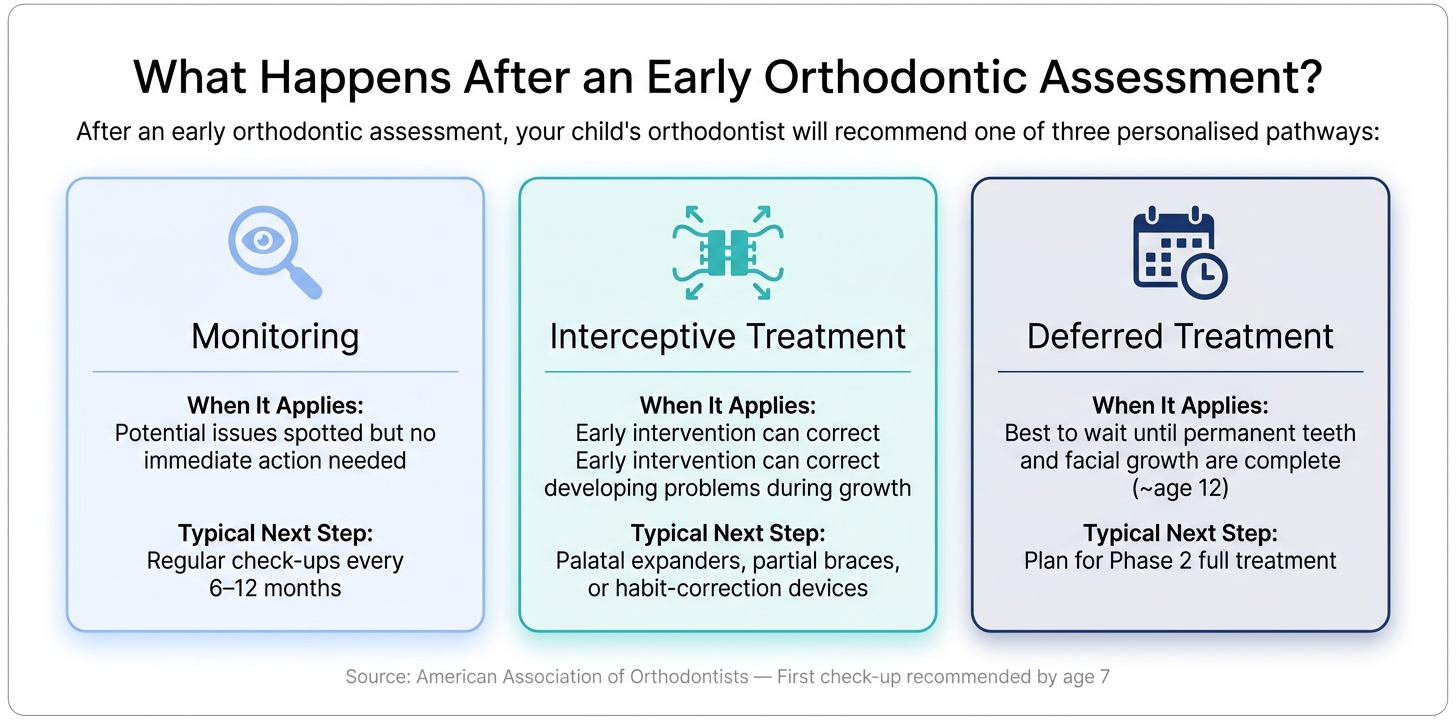
Early Orthodontic Assessment: 3 Pathways After Evaluation
After an early orthodontic assessment, there are typically three outcomes: ongoing monitoring, early interceptive treatment (Phase 1), or waiting until permanent teeth and facial growth are fully developed. This personalised approach ensures that each child’s treatment adapts as they grow.
As the American Association of Orthodontists puts it:
"The goal is not to rush every child into braces. Instead, early care helps an orthodontist identify developing problems and, when needed, guide growth in a way that can improve your child’s long-term oral health and bite function." [2]
Monitoring and Regular Reviews
If no immediate treatment is necessary, the orthodontist will generally recommend a monitoring plan. This involves regular check-ups – usually every six to twelve months – to keep an eye on jaw development and the progress of permanent teeth. During these visits, the orthodontist may also assess habits like thumb-sucking or unusual swallowing patterns, which can influence dental alignment over time. This steady observation allows for timely intervention if any new concerns arise.
Interceptive Treatment
Interceptive treatment is recommended when addressing an issue early can prevent more complicated procedures later. By intervening during the growth phase, orthodontists can guide jaw development or create space for permanent teeth. Common tools include palatal expanders to widen a narrow upper jaw and partial braces to correct crossbites or underbites. In some cases, extractions might be necessary [1]. Fixed appliances are often preferred for younger children since they don’t rely on the child remembering to use them consistently [6].
Deferred Treatment
Sometimes, it’s best to wait until all permanent teeth have come in and facial growth is complete – usually by around age 12. In these cases, the orthodontist will outline what to expect and continue periodic monitoring. Full treatment (Phase 2) will then be planned at the optimal stage of development.
Here’s a quick comparison of the three pathways:
| Pathway | When It Applies | Typical Next Step |
|---|---|---|
| Monitoring | When potential issues are spotted but don’t require immediate action | Regular check-ups every 6–12 months |
| Interceptive Treatment | When early intervention can correct developing problems during growth | Use of expanders, partial braces, or habit-correction devices |
| Deferred Treatment | When it’s best to wait until permanent teeth and facial growth are complete | Plan for Phase 2 treatment, usually around age 12 |
Conclusion
Getting an early orthodontic assessment can make a big difference in long-term oral health. By evaluating jaw growth and spotting potential issues early, it’s often possible to simplify treatment and avoid more complicated procedures later. This proactive approach allows for tailored care – whether it’s regular monitoring, early intervention during growth, or waiting for the right time to start full-phase treatment.
For parents, it’s important to understand that an assessment at age 7 doesn’t mean braces are inevitable. Instead, it’s about giving a professional the chance to track your child’s development and step in only if necessary. Each plan – whether it’s observation, early treatment, or delayed care – is designed specifically for the child’s needs, as discussed throughout this article.
If you’re unsure where to begin, consider reaching out to a practice like Complete Smiles Bella Vista. They offer orthodontic consultations as part of their broader dental services, helping to identify issues early and create a roadmap for better oral health outcomes.
FAQs
Will my child need braces after an age-7 check-up?
At age 7, most children won’t need braces. However, scheduling an early orthodontic evaluation is still a smart move. It helps spot potential dental issues early, giving parents and professionals a chance to address them before they become more serious. This proactive approach can lead to healthier teeth in the long run and might even minimise the need for complicated treatments later on.
How do I know if my child needs an assessment earlier than 7?
If your child is experiencing challenges like difficulty chewing, crowded teeth, noticeable gaps, or an unusual bite, it might be worth scheduling an orthodontic assessment sooner rather than later. According to the American Association of Orthodontists, children should ideally have their first orthodontic evaluation by the age of seven. However, if these concerns arise earlier, consulting an orthodontist can help determine whether early treatment could be beneficial. Addressing dental issues during developmental stages often leads to more effective outcomes.
What does Phase 1 (early) orthodontic treatment involve?
Phase 1 orthodontic treatment focuses on addressing dental concerns during a child’s mixed dentition phase, typically between the ages of 6 and 9. This stage involves a mix of baby and permanent teeth, making it an ideal time to guide jaw growth and ensure there’s enough space for incoming adult teeth. Treatments may include tools like braces, expanders, or space maintainers. By tackling issues such as overbites, underbites, or other bite problems early on, this approach can minimise the need for more complex treatments later and support proper dental and jaw development during a crucial growth period.
Related Blog Posts
- How to Prevent Malocclusion in Children
- What Are Interceptive Orthodontic Appliances?
- Genetic vs. Environmental Causes of Crooked Teeth
- How Early Diagnosis Prevents Orthodontic Issues
Important Notice: Any surgical or invasive procedure carries risks. Before proceeding, you should seek a second opinion from an appropriately qualified health practitioner.
Individual results may vary. The information provided in this article is for educational purposes only and does not constitute medical advice.
Checkout Related Blogs




Get in touch with us
For more information, call us now to start feeling better. Or fill the form below to make appointment
The Latest News from Complete Smiles
How to Clean Clear Plastic Retainers
Checklist for Choosing Wearable Dental Devices
Checklist for Choosing Cloud AI Platforms in Dentistry

Complete Smiles Bella VistaAccepts All Major Health Funds, Including





