





AI-Powered Image Analysis: What Dentists Need to Know

AI-powered image analysis is transforming dentistry in Australia, offering precise tools to interpret radiographs and improve patient care. Here’s what you need to know:
- Accuracy: AI systems achieve over 90% accuracy in diagnosing dental issues like caries, bone loss, and even early signs of oral cancer.
- Efficiency: These tools analyse radiographs in seconds, reducing human error and saving time during patient visits.
- Patient Communication: AI-generated visuals make it easier for patients to understand their conditions, increasing treatment acceptance rates by 24%.
- Clinical Support: While AI provides valuable insights, dentists remain responsible for final decisions, ensuring a balance of technology and expertise.
- Data Security: Compliance with Australian privacy laws is critical when integrating AI into dental practices.
AI tools are already reshaping workflows, from caries detection to orthodontic planning. With proper integration, training, and oversight, these systems can enhance diagnostics, streamline operations, and improve patient outcomes – without replacing the expertise of dental professionals.
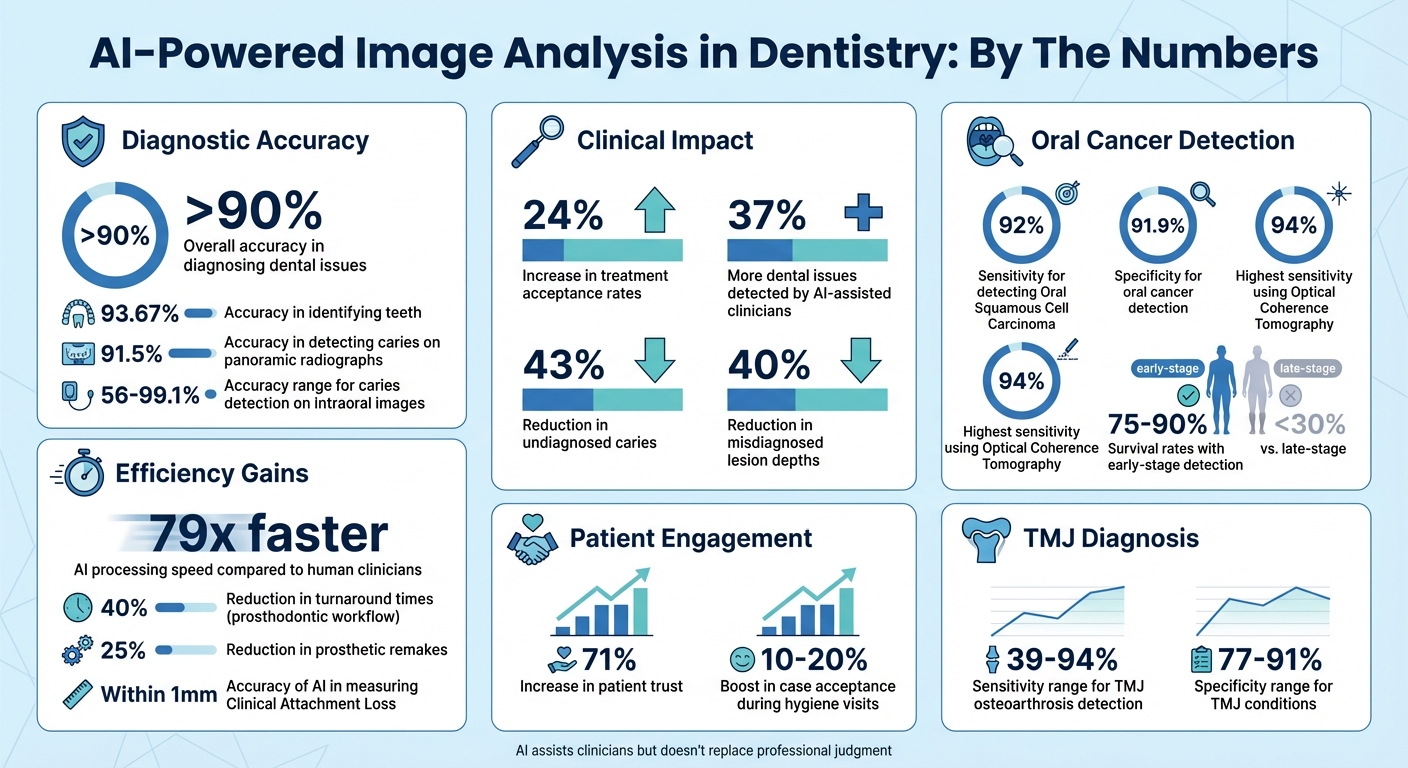
AI in Dental Radiology: Key Statistics and Accuracy Rates
Benefits of AI in Dental Radiographic Analysis
Improved Diagnostic Accuracy
AI has transformed dental radiography by enhancing diagnostic precision, bringing several clinical advantages to the table. By eliminating much of the guesswork in interpreting radiographs, AI streamlines the process and minimises human error. Convolutional Neural Networks (CNNs) excel at analysing layered image data, identifying patterns that might go unnoticed during hectic clinical sessions. These systems can detect dental issues regardless of how the image is oriented, offering a level of consistency that’s hard to match with manual interpretation [1].
This accuracy tackles a key challenge in dentistry: missed diagnoses. Interproximal caries, for instance, are a common cause of clinical negligence claims [7]. As the British Dental Journal points out:
AI’s promise lies in enhancing precision, reducing administrative burden and supporting clinical decision-making. But the clinician remains accountable, for better or worse [7].
Early Detection and Prevention
AI is particularly adept at picking up on subtle signs of disease in its early stages. For example, a 2020 study led by Fu et al., involving 44,409 images, found that CNNs performed on par with oral cancer specialists in detecting abnormalities [1]. Similarly, a 2022 study by Kearney, which analysed 80,326 images, showed that AI could measure clinical attachment loss with an accuracy within 1mm of clinician standards [1].
This capability aligns with the principles of minimal intervention dentistry, enabling early detection of pathologies and less-invasive treatments. General practitioners can utilise AI to flag suspicious findings, ensuring timely referrals to specialists. This can lead to earlier identification of serious conditions like oral cancer or significant bone loss, often before symptoms become noticeable [1]. Such early intervention not only improves patient outcomes but also streamlines clinical workflows.
Consistency and Time Efficiency
AI ensures standardised reporting across all patients, removing the variability that can arise from different clinicians interpreting the same images [8]. These platforms can review and annotate digital X-rays within seconds, offering real-time insights without sacrificing accuracy [5][8]. By acting as a dependable benchmark, AI enhances both speed and reliability in radiographic analysis [1].
The benefits extend beyond just diagnosis. According to Wei Chen and colleagues from Melbourne Dental School:
AI applications can be advantageous in reducing practitioner workload and chairside time [1],
freeing up dentists to concentrate more on treatment planning and patient care, rather than spending valuable time on manual image analysis. This efficiency ultimately enhances the overall clinical experience for both patients and practitioners.
AI in Dentistry: Transforming Efficiency, Diagnosis, and Case Acceptance
Clinical Applications of AI in Dental Radiology
AI is reshaping dental radiology by enhancing diagnostic precision and enabling earlier detection of oral health issues.
Caries Detection and Periodontal Assessment
AI-powered Convolutional Neural Networks (CNNs) are making caries detection more efficient, especially in busy clinical settings. These systems can analyse bitewing, periapical, and panoramic radiographs to identify caries that might otherwise go unnoticed. They detect lesions with varying degrees of radiographic extension, including interproximal caries, achieving accuracy rates that range from 56% to 99.1% for intraoral images and 91.5% for panoramic radiographs [4][9].
When it comes to periodontal health, AI assists in detecting bone loss by segmenting key anatomical structures like teeth and alveolar bone. In one study involving 80,326 images, an AI tool was developed to calculate Clinical Attachment Loss (CAL) with an accuracy within 1 mm of clinician-determined standards [1]. This allows for earlier and more consistent identification of periodontal disease progression. Acting as a clinical support system, AI highlights potential problems that require further manual evaluation [1].
These advancements pave the way for AI’s expanding role in orthodontics and temporomandibular joint (TMJ) evaluations.
Orthodontic Planning and TMJ Diagnosis
AI is also transforming orthodontic planning and TMJ diagnostics. In orthodontics, AI automates cephalometric landmark identification, simplifying the analysis process and aiding in treatment planning. By analysing lateral cephalograms, AI can predict growth patterns and help determine whether orthodontic treatments or surgical interventions are necessary. Interestingly, orthodontics accounts for about 12% of research on dental AI applications [1].
For TMJ disorders, AI detects structural abnormalities and conditions like osteoarthrosis through radiographic segmentation. Sensitivity for identifying TMJ osteoarthrosis ranges from 39% to 94%, while specificity falls between 77% and 91% [10]. AI-generated 3D models from CBCT scans provide detailed visualisations of the jaw, and treatment simulations enable clinicians to explain complex procedures to patients more effectively. As the British Dental Journal highlights:
In orthodontics and implantology, AI tools are helping develop more efficient workflows and enhancing the consent process through treatment simulations [7].
Oral Cancer Screening
AI is proving invaluable in the early detection of oral cancers and potentially malignant disorders, which general practitioners may find challenging to identify. Deep learning models classify lesions as benign, malignant, or potentially malignant, reducing observational fatigue and identifying pixel-level changes invisible to the human eye [11]. Early detection through AI significantly improves survival rates, with outcomes ranging from 75–90% for early-stage diagnosis compared to less than 30% for late-stage cases [11].
AI systems designed for detecting Oral Squamous Cell Carcinoma have achieved a sensitivity of 92% and specificity of 91.9% [11]. When analysing Optical Coherence Tomography images, AI demonstrated the highest sensitivity at 94%, surpassing photographic images (91%) and autofluorescence (89%) [11]. These tools can also assess lymph node metastasis and predict five-year survival rates, aiding in comprehensive treatment planning. However, as the British Dental Journal stresses:
AI, although a valued tool, should supplement rather than replace healthcare professionals [11].
It’s essential that any AI-generated findings are verified by a registered dental practitioner who considers the patient’s complete clinical history and examination [3].
sbb-itb-2be92ed
Implementing AI in Your Dental Practice
AI’s diagnostic capabilities are well-documented, but incorporating it into your dental practice requires careful planning. The aim is to ensure AI tools enhance your workflow without causing disruptions, working smoothly alongside your existing systems while maintaining essential human oversight.
Workflow Integration
To make AI adoption seamless, select software that integrates directly with your current Practice Management Software (PMS) and imaging systems, such as Dentrix or Planmeca Romexis. This reduces technical hiccups and allows AI to function as a "digital diagnostic assistant", analysing radiographs in real time while the patient is still in the chair. This setup supports immediate clinical decisions and enhances patient care [6].
Before fully implementing the tool, conduct a silent trial to evaluate how well it performs in your specific practice environment. This ensures the technology integrates smoothly without affecting patient care [2]. Once workflow integration is optimised, the focus should shift to safeguarding patient data.
Data Privacy and Compliance
Protecting patient data is not just a priority – it’s a legal requirement under Australian law. Any AI tools you use must comply with the Office of the Australian Information Commissioner (OAIC) guidelines, which outline secure storage and handling of patient information [3]. Patient data should only be used for the purpose it was collected, and explicit consent must be obtained before processing it.
Establish independent oversight to monitor AI performance, ensuring vendors take responsibility for data security [3]. Additionally, inform patients if their data is being used to train AI systems. This transparency helps address any privacy concerns [3][1].
Generative AI should be limited to low-risk tasks, like summarising clinical notes, and every AI-generated output must be reviewed by a practitioner before being added to patient records [3]. It’s also important to educate patients about the risks of using public AI systems for self-diagnosis, emphasising how your practice safeguards their personal information.
Training and Education
Once systems are in place and data protocols are established, the next step is training your staff to use AI effectively. Your team must understand how to operate AI tools, interpret their outputs, and recognise their limitations. Training should also cover how to explain AI findings to patients and address the ethical considerations of using patient data in AI systems [3][6]. Always emphasise that AI is a tool to assist clinicians, not replace them, and that all AI-generated results must be validated by a registered dental practitioner before influencing any clinical decisions [3][1].
Professional courses, webinars, and frameworks introduced in 2025 focus on the legal and ethical risks associated with AI use [5]. Consider incorporating AI education into your Continuous Professional Development (CPD) programme. Familiarity with technical concepts – like how Convolutional Neural Networks detect subtle features such as incipient caries or bone loss – can help you assess AI recommendations critically and explain findings clearly to patients [5].
Vendor demonstrations and comprehensive team training are essential to maintain consistent standards and ensure everyone in your practice is confident in using these tools effectively.
Future Developments in AI-Powered Dental Imaging
AI technology in dentistry is evolving quickly, with the next wave of advancements set to reshape how dental practices function. From smarter treatment recommendations to sharper imaging, these innovations aim to make dental care more precise and efficient. Building on current tools, these advancements are paving the way for a transformative era in dental imaging.
Automated Treatment Planning
AI systems are stepping up from simply identifying issues to offering automated treatment plans based on radiographic data. These advanced algorithms can now analyse conditions like caries, bone loss, and periapical lesions in real time, enabling dentists to discuss treatment options during the very first visit [13][15].
In a groundbreaking demonstration in 2024, Perceptive showcased the potential of AI by completing the world’s first AI-guided robotic crown-cutting procedure. The system carried out the task in just 15 minutes with an impressive 90% accuracy – more than doubling the usual 40% accuracy rate for automated attempts [15]. While fully robotic dental procedures remain experimental, the AI technology driving treatment planning is already becoming a practical tool for everyday use.
Generative Adversarial Networks (GANs) are also being developed to improve treatment planning. These networks can refine blurred images and fix artefacts in CBCT scans caused by dental prostheses or incomplete scans [12]. On top of that, AI combined with Natural Language Processing (NLP) is expected to generate written diagnostic reports directly from radiographic images, easing the administrative load for dental professionals [12][3].
These advancements not only simplify the treatment planning process but also contribute to better patient care and outcomes.
Better Patient Outcomes
With improved diagnostic accuracy, AI is helping dentists deliver earlier and more effective interventions. Studies show that AI-assisted clinicians detect 37% more dental issues, significantly reducing diagnostic gaps, such as 43% of undiagnosed caries and 40% of misdiagnosed lesion depths [16]. This enhanced detection capability allows for timely interventions and better preventive care.
AI is also improving patient trust and engagement. Data shows that incorporating AI increases patient trust by 71% and boosts case acceptance by 10–20%, particularly during hygiene visits [13][16]. Tools like AI-generated visual overlays, which use colour-coded highlights to show pathologies, make it easier for patients to understand their conditions. This clarity not only reduces anxiety but also encourages active participation in their treatment plans [13][16].
Another exciting development is predictive modelling. Advanced algorithms are being designed to foresee potential dental problems based on factors like patient history, genetics, and lifestyle. This shifts the focus from reactive treatment to proactive, preventive care [15][16].
Fewer Radiographic Retakes
Low-quality radiographic images often lead to retakes, which means more radiation exposure and longer appointment times. AI is tackling this issue with real-time image quality assessment and enhancement. GANs are being used to improve radiographic images instantly, correcting issues like degradation, improper exposure, or digital artefacts before the images are even reviewed [14].
This technology is already delivering tangible results. For instance, Stomadent Dental Laboratory introduced an AI-driven prosthodontic workflow in 2025 for a medium-sized clinic. By integrating AI into CBCT segmentation and CAD/CAM design, the clinic reduced turnaround times by 40% and cut prosthetic remakes by 25% [15].
AI also processes radiographic images up to 79 times faster than human clinicians. This means practitioners can get immediate feedback on image quality while the patient is still in the chair [15]. Any issues with positioning or exposure can be corrected on the spot, reducing the need for retakes. The benefits are clear: less radiation exposure, shorter appointments, and a more efficient workflow that saves time for both the practice and the patient. This streamlined process ensures better resource allocation and smoother operations for dental practices.
Conclusion
AI-powered image analysis is reshaping dental radiography, offering more precise and efficient diagnostic capabilities that put patients at the centre of care. With systems achieving impressive results – 93.67% accuracy in identifying teeth and 91.5% accuracy in detecting caries [4] – this technology can spot subtle features in radiographs that might be missed by the human eye. These advancements translate to reduced workloads, quicker decision-making, and better communication with patients.
That said, AI is a tool to assist, not replace, professional judgement. As the Australian Dental Association reminds us, "Patient safety must be the primary consideration for any dental AI system" [3]. Ultimately, it is the registered dental practitioner who carries the responsibility for interpreting diagnostics and deciding on treatment, ensuring that patient care remains ethical and legally sound.
For dental practices looking to incorporate AI, a cautious and measured approach is essential. Start with low-risk applications like managing administrative tasks or improving patient communication. Always ensure compliance with data privacy laws and maintain close oversight of AI-generated outputs. Regularly auditing the performance of AI systems in your practice can help confirm that they meet clinical standards and contribute meaningfully to patient outcomes [3].
Since 2019, AI research has advanced rapidly [1], equipping dental professionals with tools that enable earlier detection of conditions, clearer communication, and more consistent diagnoses. These developments highlight AI’s role as a powerful support system, complementing the expertise of clinicians.
As the British Dental Journal aptly puts it:
"The clinician remains accountable, for better or worse. As technology evolves, cautious optimism, combined with rigorous oversight, will be the key to unlocking its full potential in dentistry." [7]
FAQs
How does AI enhance dental imaging and diagnosis?
Artificial intelligence (AI) is transforming dental imaging and diagnosis by using advanced tools like machine learning and computer vision. These technologies are trained to analyse radiographs and detect subtle signs of disease, offering quick and reliable assessments for panoramic, periapical, and cone-beam CT scans. By reducing the risk of human error, AI helps improve the accuracy of diagnoses.
AI systems can pinpoint issues such as tooth decay, bone loss, and periapical lesions with remarkable precision. They deliver consistent, standardised results, enabling clinicians to make well-informed, evidence-based decisions. This not only improves patient care but also saves valuable time. Across Australia, dental practices are increasingly adopting AI solutions that prioritise patient safety and align with evidence-based care standards.
What should dentists know about privacy when using AI for image analysis?
Privacy is an important aspect for dental practices that use AI-driven image analysis, as it involves managing sensitive patient information, including radiographs and treatment plans. In Australia, this type of data must adhere to the Privacy Act 1988, the Australian Privacy Principles, and, where relevant, the Health Records Act 2001. Patient data should only be collected for valid purposes, stored securely, and shared either with informed consent or under legally permitted circumstances.
To stay compliant, dental professionals should take the following steps:
- Obtain clear and explicit consent from patients, ensuring they understand how AI will handle their data.
- De-identify or anonymise patient data before sharing it with third-party AI providers.
- Ensure vendors sign data-processing agreements that align with Australian security requirements.
- Keep audit trails to monitor who accesses the data and how it’s used.
Additionally, practices need to regularly evaluate AI systems for accuracy and bias, strengthen security protocols as necessary, and report any breaches to the Office of the Australian Information Commissioner within 72 hours. It’s essential to remember that AI serves as a supportive tool to aid dentists, not a replacement for their professional judgement.
How does AI assist dentists in detecting oral diseases early?
Artificial intelligence (AI) is transforming the way dental images are analysed. With its advanced algorithms, AI can examine radiographs, intra-oral photos, and other dental scans to detect subtle patterns that might escape the human eye. By identifying anatomical landmarks, segmenting teeth, and flagging abnormal tissues, AI serves as a powerful support tool for clinicians – offering a second opinion while respecting their expertise.
AI has proven highly effective in spotting early signs of conditions such as oral cancer, lichen planus, periodontal bone loss, and incipient caries. It can also detect issues like periapical pathology and osteoporosis-related changes on panoramic radiographs, often surpassing the accuracy of traditional visual assessments. This early detection capability allows dentists to act promptly, improving both patient care and safety.
In Australia and beyond, dental practices are incorporating AI into routine examinations to boost diagnostic accuracy. By using AI, clinicians can spend more time confirming findings, discussing treatment plans, and delivering personalised care – all while benefiting from the technology’s ability to catch problems early.
Related Blog Posts
- AI vs. Traditional Methods: Impacted Teeth Detection
- AI-Powered Dental Imaging: Future Trends
- AI-Powered Radiology: What Dentists Need to Know
- AI vs Radiographs: Caries Detection Accuracy
Important Notice: Any surgical or invasive procedure carries risks. Before proceeding, you should seek a second opinion from an appropriately qualified health practitioner.
Individual results may vary. The information provided in this article is for educational purposes only and does not constitute medical advice.
Checkout Related Blogs




Get in touch with us
For more information, call us now to start feeling better. Or fill the form below to make appointment
The Latest News from Complete Smiles
How to Clean Clear Plastic Retainers
Checklist for Choosing Wearable Dental Devices
Checklist for Choosing Cloud AI Platforms in Dentistry

Complete Smiles Bella VistaAccepts All Major Health Funds, Including





