



AI Dental Charting: How It Works

AI dental charting automates oral health documentation using advanced algorithms. It analyses X-rays, interprets speech, and generates clinical notes with high accuracy, helping dentists identify issues like caries, bone loss, and restorations. By reducing manual tasks, it saves time, improves precision, and enhances patient understanding through visual reports and treatment simulations. Key technologies include:
- Computer Vision: Processes dental images to detect structures and pathologies.
- Natural Language Processing (NLP): Converts spoken observations into structured notes.
- Machine Learning: Identifies patterns in dental images for diagnostics.
For example, Australia’s Eyes of AI, in partnership with CSIRO, developed a system detecting 96.8% of dental objects in under three minutes. Tools like Overjet and Pearl also integrate voice recognition and real-time X-ray analysis, streamlining workflows and improving diagnosis. However, challenges like cost, data privacy, and algorithmic bias require careful oversight by qualified practitioners. AI is not a replacement for clinical judgement but a tool to assist it.
IDS 2025 – AIzac Revolutionizes Dental Documentation with AI-Powered Charting & Notes
Technologies That Power AI Dental Charting
AI dental charting brings together three key technologies to streamline clinical documentation: computer vision, natural language processing (NLP), and machine learning. Each plays a distinct role in automating tasks and enhancing efficiency.
Computer vision processes visual data from X-rays and intraoral images using Convolutional Neural Networks (CNNs). These deep learning models apply numerous mathematical filters to identify dental structures, restorations like crowns and fillings, and issues such as caries or bone loss [6][8]. Interestingly, over a quarter of dental AI research and development focuses on radiology and imaging diagnostics [6].
Natural Language Processing (NLP) allows machines to understand and generate human language. This technology drives voice-powered documentation systems that convert spoken clinical observations into structured notes, eliminating the need for manual data entry [8][9]. A notable example is Overjet’s acquisition of DentalBee in December 2025, which enabled the integration of voice-based documentation into its platform, letting practitioners record findings hands-free during exams [5].
Machine learning serves as the backbone of AI dental charting. Through supervised learning, algorithms are trained on millions of labelled dental images to identify patterns. For instance, a 2025 study using the YOLOv7x model for real-time tooth detection in intraoral videos achieved a mean average precision of 78.8% [7].
Let’s explore how these technologies enhance everyday clinical workflows.
Voice Recognition and Hands-Free Charting
Voice recognition is transforming dental practices by enabling hands-free documentation. This approach not only boosts workflow efficiency but also improves hygiene standards, particularly during periodontal exams where multiple measurements need to be recorded quickly.
NLP plays a crucial role here by converting spoken dental terms into structured digital data for electronic dental records [9]. For instance, Bola AI provides a voice-activated periodontal charting system that integrates with popular practice management software, simplifying the process of recording clinical measurements [13].
Beyond dictation, these systems ensure clinical conversations are transcribed into consistent formats suitable for insurance claims and patient records. This automation reduces the risk of claim denials by improving documentation accuracy, freeing dental teams to focus on patient care. According to the Australian Dental Association, while generative AI holds promise for improving information management in dentistry, its outputs must always be verified by qualified professionals [1].
Computer Vision and Tooth Detection
Computer vision technology, inspired by the human visual system, uses deep learning to analyse dental images. CNNs process pixel data through multiple layers of interconnected "neurons", enabling them to identify and classify dental structures [6].
This technology can segment tooth components, detect features like caries and restorations, and even measure bone levels [5][11]. One standout example is Pearl’s "Second Opinion" software, which is approved for real-time analysis of both 2D and 3D X-rays in over 100 countries, including for patients as young as four years old [11].
In June 2025, researchers at the University of Sharjah showcased a real-time dental charting system using the YOLOv7x model. Analysing 100 intraoral videos and over 186,000 image frames, they achieved a precision of 72.5% and a recall of 77.9% across 32 tooth classes [10]. Unlike static radiographs, video analysis offers multiple angles and better lighting, enhancing pattern recognition.
"CNNs can provide an added value and decision support tool for dental imaging for example because they can detect micro features much more precisely than the human eye."
– Michelle Mason, The Dental Review [6]
AI-powered systems, trained on millions of annotated images, can identify treatment opportunities that might escape the human eye. Research suggests dentists may miss up to 40% of potential findings on radiographs [12]. Denti.AI’s "Auto-Chart" was the first FDA-cleared dental AI tool to automatically populate restorative work and missing teeth into patient charts, cutting manual clicks by 70% [12].
Speech-to-Text and Automated Note Generation
Speech-to-text technology simplifies clinical documentation by converting spoken findings into structured digital records. This reduces administrative burdens and ensures accuracy, allowing dental teams to focus more on patient care [9].
When Overjet acquired DentalBee, the goal was to enhance chair-side efficiency by enabling voice commands for clinical note generation directly within their platform [5]. This reflects a growing trend towards voice-activated systems that minimise cross-contamination risks while optimising time spent with patients.
How AI Dental Charting Works: Step-by-Step
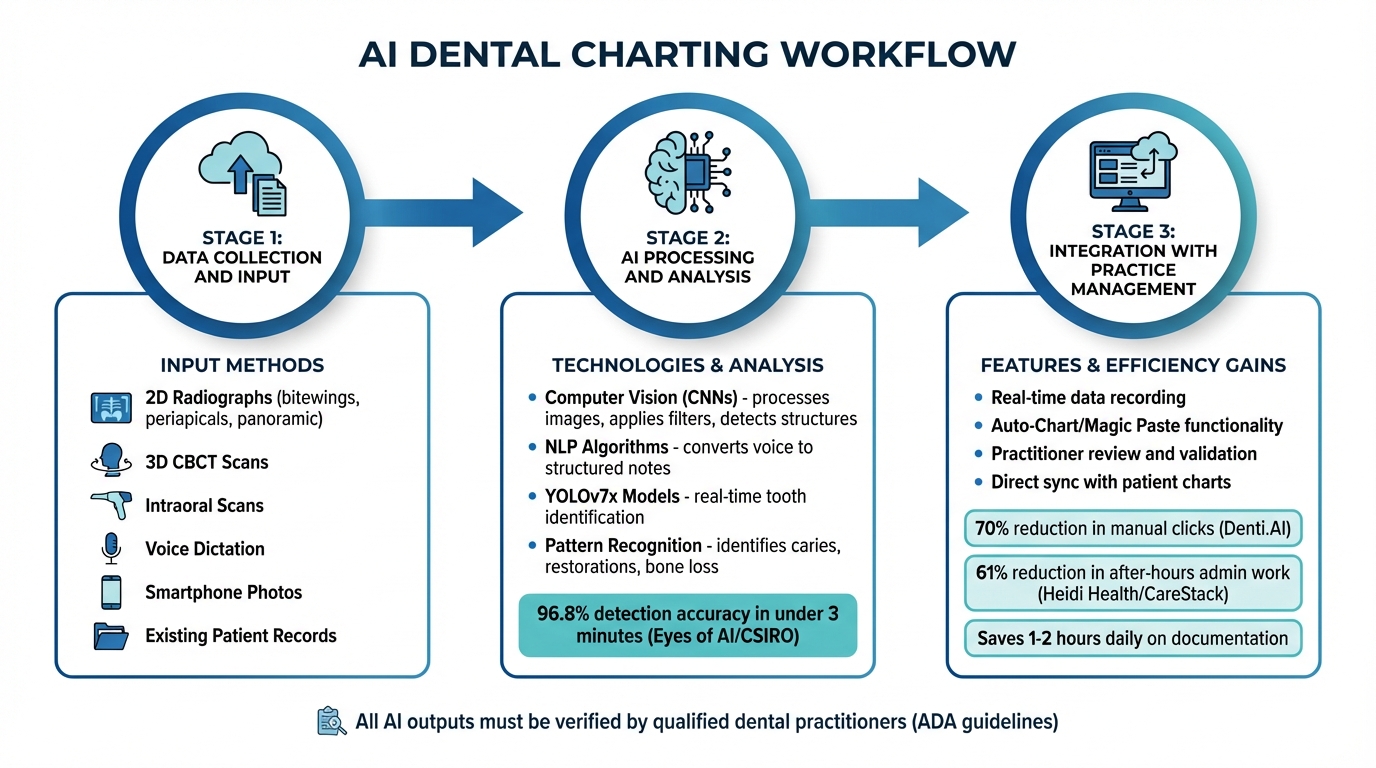
How AI Dental Charting Works: 3-Stage Process from Data Collection to Practice Integration
AI dental charting plays a key role in streamlining modern dental workflows. It operates through three main stages, each contributing to precise and efficient clinical documentation.
Data Collection and Input
The process begins with gathering clinical data during patient examinations. Dentists use a variety of tools to collect this information, including 2D radiographs (bitewings, periapicals, and panoramic images), 3D CBCT scans for more complex cases, and intraoral scans for digital impressions. Voice dictation and smartphone photos also allow practitioners to document findings efficiently, whether in-person or through teledentistry consultations.
Additionally, the system integrates existing patient records, such as treatment histories, medical forms, and prior clinical notes. Some practices even allow patients to upload their data before appointments, which helps optimise the time spent in the chair.
| Data Type | Input Method | Primary Use Case |
|---|---|---|
| 2D Radiographs | Direct upload from imaging software | Detecting caries, measuring bone loss |
| 3D CBCT Scans | Digital file integration | Planning implants, mapping nerve canals |
| Intraoral Scans | Digital impression scanners | CAD/CAM restorations, orthodontic planning |
| Clinical Notes | Voice dictation / Microphone | Automated note creation and documentation |
| Smartphone Photos | Patient mobile upload | Remote triage, virtual consultations |
AI Processing and Analysis
Once the data is collected, advanced AI algorithms take over to analyse it. For visual data, convolutional neural networks (CNNs) process images by applying hundreds of filters to detect dental structures, restorations, and potential issues. These algorithms convert images into numerical data, which aids in forming accurate diagnoses.
For instance, models like YOLOv7x can identify teeth in real-time from video streams, offering dynamic insights beyond static images. Meanwhile, natural language processing (NLP) algorithms handle voice data by converting unstructured dictations into formatted clinical notes that align with dental templates.
"The AI findings are shown as augmentation on the image, as well as in a dental chart and a list of detections. Saving the findings allows automated, systematic and comprehensive reporting." – Professor Falk Schwendicke, Head of Oral Diagnostics, Charité – Universitätsmedizin Berlin [8]
Integration with Practice Management Systems
The final step involves syncing AI-generated outputs with existing practice management software. Dentists can activate the AI tool directly from the patient’s chart using a dedicated button [15][12]. The system records data in real-time, presenting findings for review and validation before finalising entries.
Features like "Magic Paste" or "Auto-Chart" simplify this process by instantly transferring structured notes, confirmed conditions, and treatment codes into the appropriate fields. For example, in July 2025, Heidi Health implemented a four-step integration with CareStack that reduced after-hours administrative work by 61% and improved note quality satisfaction by 38% [15]. Similarly, Denti.AI’s patented Auto-Chart technology cuts manual clicks by 70%, saving clinicians one to two hours daily on documentation tasks [12].
This seamless integration not only improves workflow efficiency but also sets the stage for discussing the broader benefits and challenges of AI dental charting.
sbb-itb-2be92ed
Benefits and Challenges of AI Dental Charting
Benefits of AI in Dental Practices
AI dental charting brings a host of improvements to modern dental practices, particularly in terms of accuracy, efficiency, and patient interaction. For instance, traditional periodontal documentation often takes 15–20 minutes per patient. However, voice-activated AI systems can cut this down to just five minutes, addressing the 11% capacity loss typically associated with manual charting tasks [21].
When it comes to diagnostics, AI algorithms excel at identifying early signs of dental issues, such as caries, bone loss, and periapical lesions – problems that might otherwise go unnoticed. These systems boast impressive performance metrics, with accuracy rates reaching 95.3%, sensitivity at 92.1%, and specificity at 96.3% [19].
AI also enhances the patient experience. Real-time visual overlays and verbalised measurements during exams make it easier for patients to understand their dental conditions. This improved clarity has been linked to a 40% increase in acceptance rates for procedures like scaling and root planing [21]. Additionally, case studies highlight the financial benefits practices can achieve from these advancements [21].
Beyond clinical improvements, AI simplifies many administrative tasks. From automating clinical notes to streamlining insurance documentation and appointment scheduling, AI technologies are highly efficient, with voice recognition systems achieving near-perfect accuracy at 99% [21]. As the Australian Dental Association points out:
"Properly trained and deployed, AI systems can facilitate improved health outcomes in the community at the patient, practice, and public health level" [1].
These advantages demonstrate the transformative potential of AI in dentistry, setting the stage to explore the challenges that come with its integration.
Challenges and Limitations
Despite its benefits, integrating AI into dental practices comes with challenges that can’t be ignored. For smaller practices, the high upfront costs for technology, training, and ongoing maintenance can be a significant hurdle [20]. Moreover, the "black box" nature of AI – where clinicians can’t easily understand the reasoning behind AI-generated results – can lead to trust issues. Professor Falk Schwendicke of Charité – Universitätsmedizin Berlin underscores this by stating:
"AI systems, like all diagnostic and therapeutic methods in medicine, must adhere to the principles of evidence-based care" [8].
Data privacy and security are also critical concerns. Adhering to strict OAIC guidelines is essential to protect patient information and prevent breaches [1][18]. As the British Dental Journal notes:
"The clinician remains accountable, for better or worse" [18].
This means that practitioners are ultimately responsible for AI-generated records and treatment plans. Additionally, integrating AI into existing practice management systems can be tricky, especially when dealing with complex data formats like CBCT scans, which may not align with standard computer vision algorithms [6].
The main challenges and strategies to address them are summarised in the table below:
| Challenge | Description | Mitigation Strategy |
|---|---|---|
| Technology Dependence | Risk of over-reliance on automated outputs | Require a registered dental practitioner to review and approve all AI findings [1] |
| Data Privacy | Potential for breaches or non-compliance with OAIC guidelines | Implement robust encryption and clear data-sharing protocols [1][18] |
| Integration Issues | Difficulty in syncing AI with existing systems | Use systems that adhere to standardised data formats (e.g., ANSI/ADA No. 1110-1) [17] |
| Algorithmic Bias | Poor performance on certain demographics | Validate AI tools with diverse, independent datasets rather than relying solely on manufacturer data [17][8] |
| Legal Liability | Uncertainty over accountability for AI errors | Ensure clinicians remain the final decision-makers, signing off on all charts [18] |
Algorithmic bias is another concern. If training datasets lack diversity or proper annotation, the resulting AI models may produce biased outcomes or unintentionally discriminate [1][17]. Similarly, AI tools may struggle to maintain accuracy when applied to new clinical environments or diverse patient populations [8]. The ADA Federal Council stresses:
"Patient safety must be the primary consideration for any dental AI system" [1].
To ensure this, practitioners should prioritise AI tools that meet established quality standards and have been validated with independent, third-party datasets, rather than relying solely on data provided by manufacturers [17][8].
Current Applications and Future of AI Dental Charting
Applications in Australian Dental Practices
AI-driven dental charting is making waves in Australian dental practices, especially in areas like radiographic analysis, teledentistry, and documentation. These advancements are directly improving diagnostics and streamlining administrative processes. For instance, computer vision systems are now capable of identifying caries, periodontal disease, and periapical lesions in various types of X-rays – such as OPG, bitewing, and periapical – with impressive accuracy [1][6].
Generative AI is also taking on administrative tasks, automating report generation, creating smile simulations, and pre-screening potential patients. Clinics like Ooralea Dental Care, led by Dr Raghu Channapati, and Arnold Street Dental, headed by Dr David O’Malley, are leveraging platforms like Smilo.ai to incorporate these efficiencies into their workflows [2]. This technology is particularly beneficial for teledentistry, enabling remote consultations and ongoing treatment monitoring – a critical service for patients in rural and remote areas [16][2].
AI isn’t just limited to diagnostics and paperwork. It’s also playing a role in treatment planning, aiding in orthodontic and prosthodontic decisions by predicting outcomes. For example, AI-designed crowns can cut fabrication time by 25–30% compared to traditional methods. Similarly, robotic systems for implant placements are achieving exceptional precision, with a mean coronal deviation of just 0.7 ± 0.3 mm [22]. Recognising the need for AI literacy, large dental groups like Bupa Dental are investing in training initiatives. In July 2024, Bupa launched the Edison Academy, offering flexible, self-paced courses to help dental professionals enhance their understanding of data and AI [3].
These advancements are laying the groundwork for even more sophisticated technologies that will shape the future of AI dental charting.
Future Trends in AI Dental Charting
The next wave of AI dental charting is moving towards integrated systems that do far more than simple data entry. One promising development is the concept of Digital Twins – virtual patient models that combine radiographs, genetic data, and treatment histories to simulate how a patient might respond to dental interventions [22]. This could allow dentists to test different treatment options virtually, improving both patient outcomes and their willingness to proceed with recommended care.
Another key trend is the push for greater transparency in AI systems, leading to the rise of explainable AI (XAI). These models provide visual explanations, such as feature importance, to help dentists understand the rationale behind AI-generated diagnostic suggestions [22]. This transparency is crucial for building trust and aligns with the Australian Dental Association’s stance that AI should enhance, not replace, clinical judgement [1]. Federated learning is also gaining attention, allowing for collaborative development of AI models while ensuring patient data remains on local servers to maintain privacy [22].
Advancements in computer vision are also forging ahead. Dr Dadong Wang, who leads the Quantitative Imaging Research Team at CSIRO’s Data61, highlighted the potential of AI in dental imaging:
"The AI-powered models we developed can automatically identify important features and potential anomalies in dental scans, with impressive accuracy" [4].
Looking to the future, AI could integrate multi-omics data, such as oral microbiome profiles, to predict broader health risks. For example, it may help identify links between periodontitis and cardiovascular disease [22]. Early cancer detection is another area showing promise, with AI models achieving a pooled sensitivity of 92% and specificity of 91.9% in detecting oral squamous cell carcinoma [22].
Despite these advancements, the Australian Dental Association has made its position clear:
"The use of Generative AI in dentistry should be limited to low-risk applications, where its output can and will be verified by a Dental Practitioner… It should not be used wholly and autonomously for clinical decision-making" [1].
To ensure safety and compliance, practitioners must verify AI outputs and store all patient data on secure servers located within Australia [2][3].
Conclusion
AI dental charting is reshaping the way diagnostics, documentation, and patient care are handled in Australian dental practices. With computer vision models achieving sensitivity rates between 80% and 92% [14], AI-assisted CAD tools cutting down case times by 30–45 minutes [14], and diagnostic support increasing treatment acceptance rates by 24% [23], the impact is clear.
By streamlining processes and reducing subjectivity, AI systems help minimise diagnostic errors caused by fatigue while generating preliminary reports for clinicians to review [5][14]. This means more time can be dedicated to patient care. As Professor Falk Schwendicke from Charité – Universitätsmedizin Berlin explains:
"AI will be useful for synthesizing an increasing amount of data in dentistry, allowing more automated, efficient and precise care" [8].
However, the Australian Dental Association underscores that patient safety remains the top priority. AI is meant to enhance clinical judgement, not replace it [1].
FAQs
How does AI dental charting enhance diagnostic accuracy?
AI dental charting uses cutting-edge computer vision and deep learning to interpret dental X-rays and clinical images with remarkable accuracy. It can pinpoint cavities, detect pathology, and identify other dental issues consistently, minimising the risk of human error and providing more dependable diagnoses.
By assisting dental professionals in making well-informed decisions, this technology simplifies the diagnostic process and enhances patient care. Its data-driven methodology is reshaping dental practices throughout Australia, making them more efficient and effective.
What challenges do dental practices face when adopting AI technology?
Adopting AI in dental practices isn’t as simple as installing new software – it comes with its own set of challenges. A major concern is ensuring patient safety, data privacy, and adherence to Australian health regulations. Dental clinics must create strong governance frameworks and implement secure consent processes to handle sensitive patient information responsibly.
Another hurdle is the technical complexity involved in training AI systems. Dental data, such as radiographs, intra-oral scans, and charting, often varies across clinics and needs to be standardised and accurately coded. On top of that, while AI can provide recommendations, it’s crucial that these remain under human oversight. This means dental teams need to build technical skills while ensuring clinicians maintain ultimate decision-making authority.
Finally, AI tools must undergo thorough validation to prove their accuracy and reliability. Ethical concerns, like anonymising patient data and preventing any misuse, are also critical in building trust among both dental professionals and patients. Tackling these challenges head-on allows practices to integrate AI effectively, improving dental care without compromising safety or quality.
How does AI dental charting ensure patient data is kept private and secure?
AI dental charting systems take data privacy and security seriously, complying with Australian regulations like the Privacy Act 1988 and the Health Records Act 2001. By following the Australian Privacy Principles, these systems ensure that patient information is encrypted, anonymised, and accessible only to authorised personnel.
Beyond meeting legal requirements, these AI tools are equipped with strong security measures to protect patient confidentiality and block unauthorised access. These practices align with the Australian Dental Association’s recommendations on using artificial intelligence in dentistry, ensuring patient data is managed with care and high security standards.
Related Blog Posts
- AI vs. Traditional Methods: Impacted Teeth Detection
- How AI Improves Diagnostic Consistency in Dentistry
- AI-Powered Radiology: What Dentists Need to Know
- AI vs Radiographs: Caries Detection Accuracy
Important Notice: Any surgical or invasive procedure carries risks. Before proceeding, you should seek a second opinion from an appropriately qualified health practitioner.
Individual results may vary. The information provided in this article is for educational purposes only and does not constitute medical advice.
Checkout Related Blogs



Get in touch with us
For more information, call us now to start feeling better. Or fill the form below to make appointment
The Latest News from Complete Smiles
How to Clean Clear Plastic Retainers
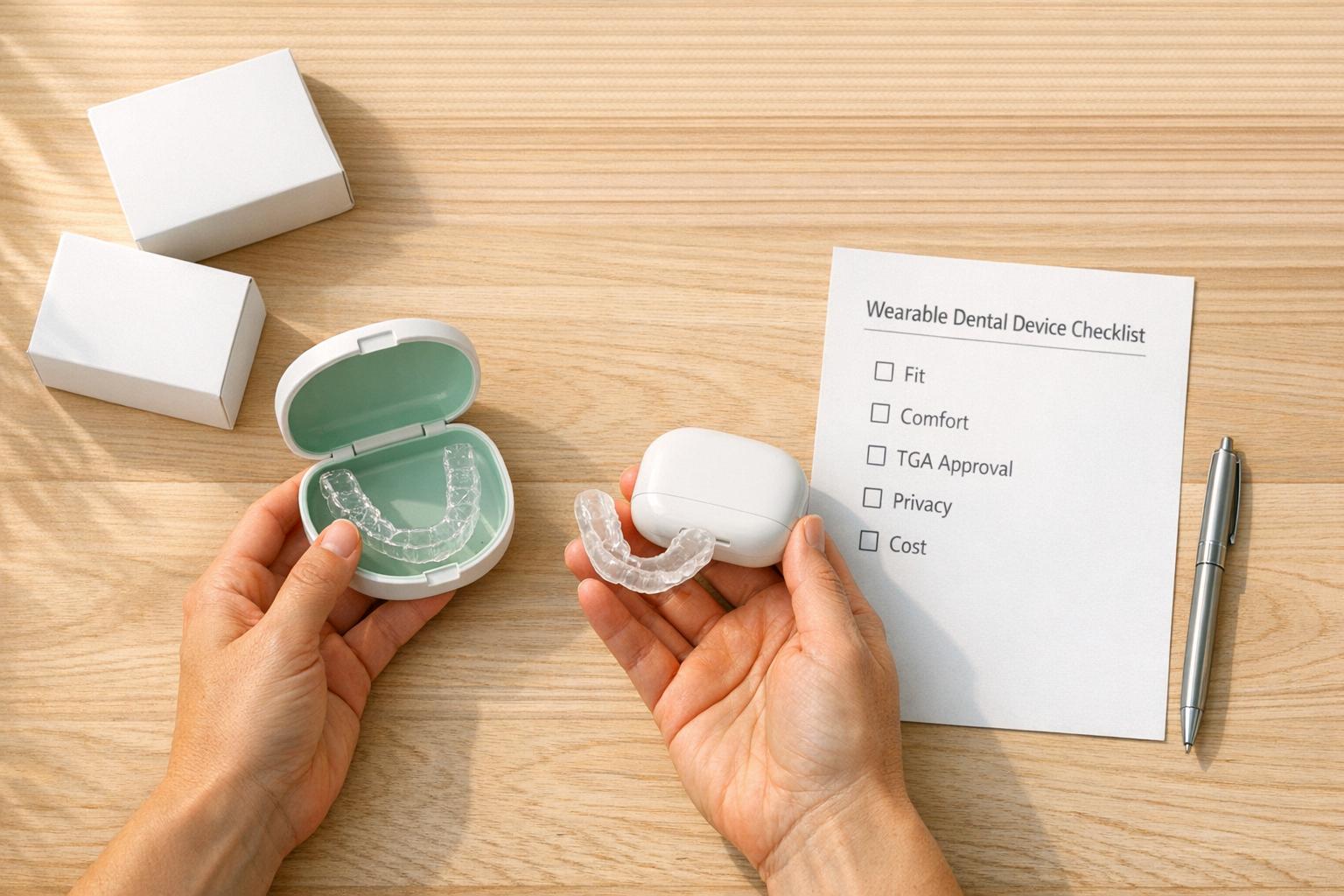
Checklist for Choosing Wearable Dental Devices
Checklist for Choosing Cloud AI Platforms in Dentistry
Complete Smiles Bella VistaAccepts All Major Health Funds, Including