





Advanced Training Options for Dental Hygienists
Dental hygienists in Australia have diverse pathways to advance their careers, meet regulatory requirements, and expand their skill sets. Options include upgrading qualifications, completing CPD hours, or pursuing specialised training. Here’s a quick overview:
- Advanced Diploma of Oral Health (Dental Hygiene) (2 years): Focuses on clinical skills for preventive care. Costs approx. $61,593/year.
- Bachelor of Oral Health (Therapy and Hygiene) (3 years): Offers dual qualification as a dental hygienist and therapist. Includes restorative care for children and young adults.
- Fellowship Programs: Advanced training in areas like paediatric dentistry and orthodontics. Includes remote, simulation-based modules.
- ADC Exam Preparation: For overseas-trained hygienists, covering written and practical exams to qualify for Australian practice.
Each pathway aligns with AHPRA registration and the requirement to complete 60 CPD hours over three years. Costs, duration, and entry requirements vary, so choosing the right option depends on your career goals and circumstances.
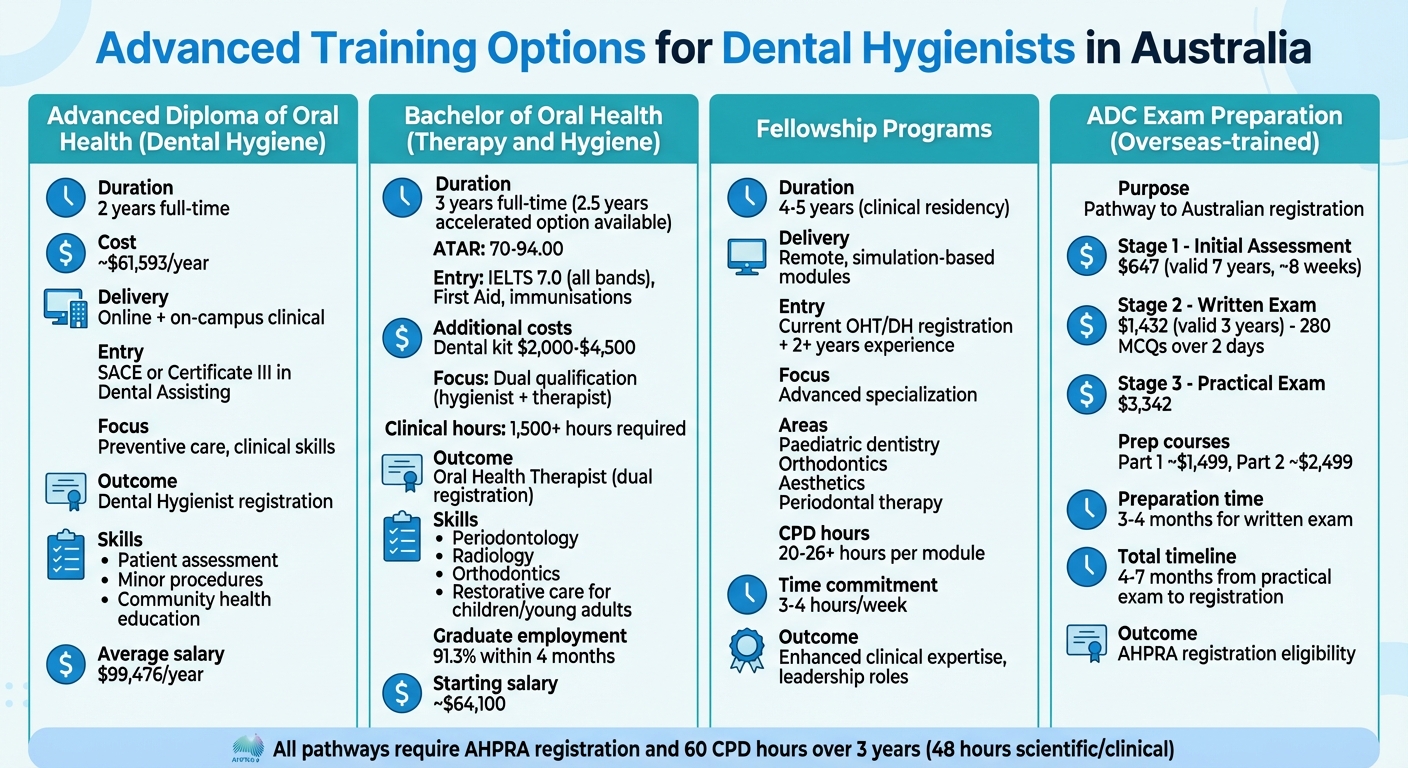
Comparison of Advanced Training Pathways for Dental Hygienists in Australia
Advanced Diploma of Oral Health (Dental Hygiene) (10926NAT)
Program Overview
The Advanced Diploma of Oral Health (Dental Hygiene) is a two-year, full-time vocational qualification offered by TAFE institutions and registered training organisations. It focuses on building the hands-on clinical skills needed for dental hygiene practice. The program includes a mix of 9 national and 25 enterprise competency units, ensuring a comprehensive skill set for graduates[9].
The curriculum aligns with the Dental Board of Australia‘s scope of practice, placing a strong emphasis on preventive care. This includes treatments for gingival and periodontal conditions, x-ray interpretation, fluoride applications, and general oral health maintenance. As an accredited program, graduates are eligible for immediate registration with the Australian Health Practitioner Regulation Agency (AHPRA)[6][7]. Delivered over four semesters, the course combines online learning with on-campus clinical training for a balanced educational experience[8].
Entry Requirements
Each training provider sets its own entry requirements. For example, TAFE SA requires applicants to have completed the South Australian Certificate of Education (SACE) or an equivalent secondary qualification. Alternatively, candidates can qualify with a Certificate III (or higher) in Dental Assisting[8]. Some institutions may also require applicants to pass a dental-specific assessment.
International students need to demonstrate English proficiency. This can be achieved with an overall IELTS score of 7.0 (with no individual band below 7.0) or a "B" grade in all sections of the Occupational English Test (OET)[7].
Career Applications
Graduates of this program are eligible to register as dental hygienists and work in a variety of settings, including private dental practices, government health services, and community oral health clinics. Beyond clinical roles, the qualification can lead to opportunities in health promotion, such as community education, dietary counselling, and developing preventive oral health initiatives. With its strong practical focus, the diploma ensures graduates are ready to step into the workforce and contribute to the management and prevention of oral diseases[8].
Bachelor of Oral Health (Therapy and Hygiene)
Program Structure and Duration
The Bachelor of Oral Health is a three-year, full-time program available at several Australian universities. It offers a dual qualification, preparing students to work as both dental hygienists and dental therapists – commonly referred to as Oral Health Therapists. This dual scope allows graduates to provide restorative care for children and young adults.
The course content is diverse, covering areas such as:
- Dental science: Topics include bioscience, pharmacology, and head and neck anatomy.
- Social science: Subjects like preventive dentistry, ethics, and psychology are explored.
- Clinical dentistry: Students learn instrumentation, radiography, and treatment planning.
- Vocational clinical practice: Hands-on training is a key component.
From the first year, students engage in clinical work, progressively building their skills. By the final year, placements expand to a variety of settings, such as metropolitan teaching hospitals and rural community health centres.
Entry requirements depend on the institution. For example, ATAR scores for 2026 range from 70 to 94.00. Applicants must also meet specific criteria, including:
- English proficiency (minimum IELTS score of 7.0 in each band)
- Certifications like Senior First Aid and Working with Children Check
- Up-to-date immunisation records
- Budgeting for dental instrument kits, which can cost between AUD $2,000 and $4,500
All programs are accredited by the Australian Dental Council, allowing graduates to register with AHPRA. This qualification enables Oral Health Therapists to provide dental hygiene care across all age groups and perform restorative treatments for children and young adults. For instance, at the University of Sydney, students are required to complete at least 1,500 hours of practical experience during their studies [10].
With such a comprehensive education, graduates are well-prepared for a variety of career paths.
Career Outcomes
Graduates of the Bachelor of Oral Health program have a range of career opportunities in settings like private dental practices, public hospitals, community clinics, aged care facilities, and even teledentistry services. Thanks to their dual qualification, Oral Health Therapists can offer both preventive and restorative care, which significantly broadens their employment options.
Job prospects in this field are strong. For example, 91.3% of dental science and oral health graduates from Charles Sturt University found employment within four months of completing their degree [11]. The median starting salary for graduates is approximately AUD $64,100 [11].
Beyond clinical roles, this degree can lead to careers in health promotion, research, and education. For those interested in academic or research pathways, some universities, like the University of Melbourne, offer an Honours year for students with a weighted average mark of at least 65% [12]. This additional year provides a stepping stone into research and teaching positions.
Fellowship in Oral Health Therapy
Scope and Benefits
The Fellowship in Oral Health Therapy offers experienced practitioners a chance to sharpen their restorative and therapeutic skills through advanced, simulation-based training. These programs go beyond routine preventive care, focusing on areas like posterior and anterior direct aesthetics, paediatric dentistry, orthodontics for auxiliaries, and non-surgical periodontal therapy. A standout example is the RipeGlobal Fellowship, which uses cloud-based, hands-on simulations to deliver training remotely. Some modules include over 20 hours of Continuing Education (CE) or Continuing Professional Development (CPD), with others exceeding 26 hours [13].
"This program will expand your restorative capabilities, build your clinical confidence, and connect you with world-class mentors and a global peer community, so you can deliver exceptional patient care and be recognised for your expertise." – RipeGlobal [13]
While these fellowships enhance clinical expertise and confidence, formal expansion into adult practice in Australia still requires completing a recognised university course. However, earning Fellowship status can position practitioners as key contributors within multidisciplinary teams, paving the way for leadership roles and mentoring opportunities [13][14]. The next step is understanding the application process and eligibility.
Application Process
To qualify for a clinical Fellowship, applicants must be certified and actively practising as Oral Health Therapists or Dental Hygienists [13]. Registration is completed through the provider’s website, with intakes often closing by early July for programs starting in August. For those hesitant to commit to the full Fellowship, standalone modules are available to address specific clinical needs.
Payment plans are flexible, ranging from full upfront payment to monthly instalments. Enrolment typically includes a simulation kit for hands-on practice, lifetime access to course materials, and mentorship in small groups. The program generally requires a weekly time commitment of 3–4 hours, with individual simulation sessions lasting around 5 hours [13].
ADC Exam Preparation Courses for Dental Hygienists
Purpose of ADC Exams
The Australian Dental Council (ADC) assessment process is a required pathway for overseas-qualified dental hygienists whose credentials aren’t automatically recognised by the Dental Board of Australia [4][5]. These exams ensure that international practitioners meet the professional standards, knowledge, clinical skills, and judgement necessary to practise safely in Australia.
"The ADC dental practitioner assessment process ensures overseas qualified dental practitioners have the professional qualities, knowledge, judgement, and clinical skills needed to practise safely in Australia." – The Australian Dental Council [5]
The ADC assessment involves three distinct stages:
- Initial Assessment: Costs A$647, valid for seven years, and usually takes about eight weeks to process.
- Written Examination: Costs A$1,432, valid for three years, with the next session scheduled for 20 March 2026. This exam includes 280 multiple-choice questions spread over two days.
- Practical Examination: Costs A$3,342 and is set for 10–11 June 2026.
To be eligible, candidates must have completed at least two years of recognised full-time study [1][4][15]. Below, we’ll explore independent programs designed to help candidates prepare for these assessments.
Available Preparation Programs
The ADC explicitly states that it does not endorse or recommend any independent preparation courses [1].
"We do not recommend or endorse any proprietary or informal courses advertising as preparation for the practical examination. These courses are developed and run without ADC input." – The Australian Dental Council [1]
Despite this, many independent providers offer structured courses aimed at helping candidates prepare for both the Written and Practical Examinations. These programs are typically divided into two phases:
- Part 1 – Written Examination Preparation: Costs around A$1,499.
- Part 2 – Practical Examination Preparation: A four-day course priced at approximately A$2,499 [16].
Additionally, technical mock tests are available for about A$650, and Communication OSCE (Objective Structured Clinical Examination) courses cost around A$1,399 [16]. Candidates are encouraged to dedicate three to four months to prepare for the written exam [17]. Many providers also offer flexible schedules, such as evening and weekend sessions, to accommodate working professionals [16].
sbb-itb-2be92ed
AHPRA Registration and Continuing Professional Development (CPD) Requirements
AHPRA Registration Overview
If you’re a dental hygienist practising in Australia, you must register with the Dental Board of Australia, which is overseen by the Australian Health Practitioner Regulation Agency (AHPRA). Without this registration, working in the profession is not legally permitted [5].
For those who have trained overseas, the road to AHPRA registration involves completing the Australian Dental Council (ADC) assessment process. After passing the practical examination, you’ll receive an ADC certificate, which confirms your eligibility to apply for registration with the Dental Board of Australia [1]. This registration process assesses your education, training, and professional experience [5]. To apply, you’ll need to submit proof of your qualifications [4], a valid government-issued photo ID [1], and your ADC certificate [1]. The entire process, from completing the practical exam to receiving your results, typically takes four to seven months [1].
Once registered, you’ll need to focus on maintaining your professional skills through CPD activities.
CPD Guidelines for Dental Hygienists
The Dental Board of Australia requires dental hygienists to complete 60 hours of CPD over a three-year period. Of these, at least 80% (48 hours) must focus on scientific or clinical activities, such as periodontal treatment techniques, radiography, or infection control [18]. The remaining 20% can cover non-scientific topics, including areas like practice management, ethics, or patient communication [18]. Additionally, holding a current CPR certificate is compulsory [18].
It’s important to keep detailed records of your CPD activities, including certificates and reflections, as these may be subject to audits. To assist with planning, the Dental Board of Australia offers resources to help identify courses that meet the required scientific criteria [18].
Comparison of Training Pathways
Duration and Delivery Methods
The Advanced Diploma of Oral Health (Dental Hygiene) is a two-year program that combines online learning with hands-on clinical training [2][3].
On the other hand, the Bachelor of Oral Health typically takes three years of full-time, on-campus study to complete [3][19]. At Griffith University, the Bachelor of Dental Hygiene includes 951 hours of work-integrated learning starting from the second trimester [19]. For those seeking a faster route, La Trobe University offers an accelerated 2.5-year option [3].
For those pursuing fellowship programs in specialist dental fields, the commitment is more extensive, generally lasting four to five years. These programs are structured as clinical residencies or hospital-based training [3]. The variation in duration and delivery methods reflects the differing demands and entry requirements for each pathway.
Entry Requirements
The Advanced Diploma offers flexible entry criteria, which makes it an attractive option for career changers or those new to the field [2].
In contrast, Bachelor’s programs have stricter academic and language requirements. For example, Griffith University requires an IELTS Academic score of 7.0, with no sub-score below 6.5. Admission is highly competitive, often based on strong academic results from secondary or tertiary education [19].
For fellowship programs, applicants need prior qualifications, professional registration, and demonstrated experience in the field [3][20]. For example, the University of Melbourne’s Graduate Certificate in Dental Therapy (Advanced Clinical Practice) requires current registration with the Dental Board of Australia and at least two years of professional practice [21]. Each pathway not only sets its own entry standards but also equips students with unique skills and expertise.
Skills and Knowledge Gained
The Advanced Diploma prioritises practical clinical skills. Graduates learn to perform minor dental procedures, conduct patient assessments, and deliver community health education [2]. This pathway ensures graduates are job-ready, with annual earnings averaging around $99,476 [2].
"With the Bachelor of Dental Hygiene you’ll gain the ability to provide patient-centred oral health care, including assessment, diagnosis, treatment, management and education." – Griffith University [19]
Bachelor’s programs go further by offering broader clinical autonomy. Students gain expertise in areas like periodontology, radiology, orthodontics, oral pathology, and pharmacology [19]. Through rotations in specialty clinics, they develop diagnostic skills for treating patients of all ages and qualify for dual registration [3][19].
For experienced practitioners, advanced certificates and fellowships provide opportunities to expand their scope of practice. For instance, the University of Melbourne’s Graduate Certificate equips dental therapists with skills in treatment planning and restorative services for adult patients. This program includes 80 hours of mentored clinical practice, with an indicative first-year fee of $16,992 [21]. These advanced pathways allow professionals to deepen their expertise and take on more complex responsibilities.
Complete Smiles Bella Vista: Supporting Advanced Training

For dental hygienists aiming to further their skills, hands-on experience is a crucial part of the journey. At Complete Smiles Bella Vista, under the guidance of Dr. James Hanna, hygienists have the opportunity to apply their formal education in a practical setting. This approach directly supports the advanced training pathways previously outlined.
The practice provides valuable exposure to key areas like orthodontics, dental implants, and cosmetic dentistry. Hygienists actively engage in patient education, such as teaching effective plaque prevention methods for those with orthodontic appliances, while also refining techniques like tooth whitening. This real-world application bridges the gap between theoretical learning and practical execution.
Additionally, under structured supervision, hygienists participate in essential clinical tasks. These include taking and interpreting dental X-rays and crafting tailored treatment plans, all of which contribute to building the clinical expertise needed for advanced qualifications.
Conclusion
Deciding on the best advanced training pathway largely depends on your career aspirations and personal circumstances. For those focused on preventive care, the Advanced Diploma of Oral Health (Dental Hygiene) offers a two-year path to registration, with an estimated annual cost of around $61,593 [2]. On the other hand, if you’re aiming to broaden your scope into restorative care for patients of all ages, the Bachelor of Oral Health provides a more expansive qualification. This three-year program opens doors to practising as a Dental Hygienist, Dental Therapist, or Oral Health Therapist [3].
When evaluating your options, it’s essential to factor in both the time commitment and financial investment. Vocational diplomas generally span two years, while bachelor-level programs require three [3]. If you’re an overseas-qualified practitioner, the ADC assessment pathway involves several fees and multiple examination stages.
Before committing to a program, ensure it is accredited by the Australian Dental Council and approved by the Dental Board of Australia. This guarantees your qualification will meet the requirements for AHPRA registration. Additionally, keep in mind that training providers may have specific entry requirements you’ll need to meet [2].
FAQs
What’s the difference between an Advanced Diploma and a Bachelor of Oral Health for dental hygienists?
The Advanced Diploma of Oral Health (Dental Hygiene) is a vocational qualification classified as AQF Level 5 and typically takes around two years of full-time study to complete. Its focus is on hands-on skills, such as taking dental impressions, applying fluoride treatments, and performing basic diagnostic tasks. Entry requirements are generally straightforward, often requiring Year 12 (or an equivalent qualification). Upon graduation, students can register with AHPRA to work as dental hygienists.
On the other hand, the Bachelor of Oral Health is an AQF Level 7 university degree that requires three years of full-time, on-campus study. This program blends scientific theory, research, and clinical practice, preparing graduates to work as oral health therapists. It also opens doors to broader career opportunities, including roles in leadership, public health, and research, as well as options for further academic study.
The main distinctions between these qualifications lie in their level, duration, entry requirements, and career prospects. The Advanced Diploma is shorter and more focused on practical training, making it a quicker route to becoming a dental hygienist. In contrast, the Bachelor’s degree offers a more comprehensive academic foundation and equips graduates for a wider range of roles within the oral health field.
How can fellowship programs benefit a dental hygienist’s career?
Fellowship programs, like those offered by the Royal Australasian College of Dental Surgeons (RACDS), serve as a mark of distinction for dental hygienists, showcasing their advanced expertise and professional knowledge. Earning this credential highlights a dedication to excellence, ethical practice, and evidence-based care – qualities that set fellows apart as leaders in their profession.
These programs can significantly broaden career horizons, opening pathways in private clinics, hospitals, community health centres, aged-care facilities, and even academic or government roles. Fellows often step into roles that involve spearheading preventive care programs, mentoring peers, or contributing to research and policy-making efforts. This not only boosts career development but may also provide greater job stability and the potential for higher earnings.
By blending advanced education with hands-on experience, fellowship empowers dental hygienists to deliver outstanding patient care while building valuable connections and exploring diverse opportunities within Australia’s dental sector.
How can overseas-trained dental hygienists qualify to practise in Australia?
To practise as a dental hygienist in Australia, overseas-trained professionals must comply with the standards outlined by the Dental Board of Australia. The journey typically starts with an initial assessment conducted by the Australian Dental Council (ADC). This step involves verifying the applicant’s qualifications, professional standing, and registration history. To qualify, candidates must show proof of completing a recognised two-year full-time dental hygiene program and possess an unrestricted licence from their home country. The assessment comes with a fee of $647 AUD and generally takes about eight weeks to process.
Once the initial assessment is cleared, candidates move on to the written examination, a one-day test designed to assess their clinical knowledge. The cost for this exam is $1,432 AUD. A passing score here grants eligibility to take the practical examination, which evaluates hands-on skills and clinical competence. This practical test is offered twice a year and costs $3,342 AUD. Successfully passing this stage allows candidates to apply for general registration with the Dental Board of Australia.
For some, the process may be simpler. Dental hygienists with qualifications from recognised countries, such as New Zealand or certain programs in the UK, might be eligible for direct registration, bypassing the full ADC pathway. It’s also important to note that applicants must satisfy any visa or skills-assessment requirements set by the Department of Home Affairs before they can begin practising in Australia.
Related Blog Posts
- Scope of Practice for Dental Hygienists in Australia
- Training Programs for Intraoral Scanners in Australia
- Dental Hygienist Career Outlook in Australia
- CPD Requirements for Dental Hygienists in Australia
Important Notice: Any surgical or invasive procedure carries risks. Before proceeding, you should seek a second opinion from an appropriately qualified health practitioner.
Individual results may vary. The information provided in this article is for educational purposes only and does not constitute medical advice.
Checkout Related Blogs




Get in touch with us
For more information, call us now to start feeling better. Or fill the form below to make appointment
The Latest News from Complete Smiles
How to Clean Clear Plastic Retainers
Checklist for Choosing Wearable Dental Devices
Checklist for Choosing Cloud AI Platforms in Dentistry

Complete Smiles Bella VistaAccepts All Major Health Funds, Including





