





Study: Impact of Videos on Patient Understanding
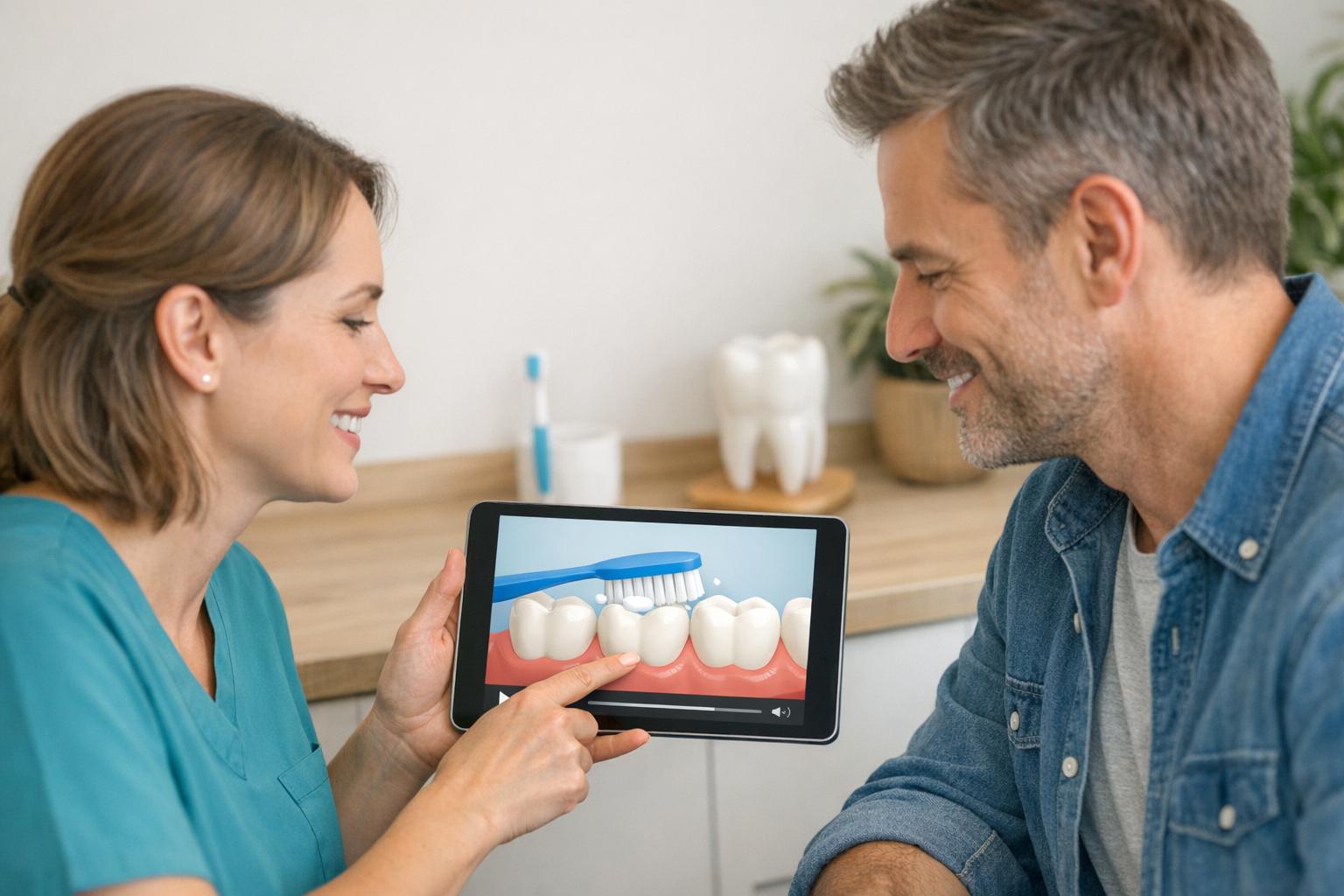
Videos in dental care are transforming how patients understand and retain information. Research highlights that video education improves memory, reduces anxiety, and encourages better oral hygiene habits. For example, 96.8% of patients at Sydney’s Westmead Centre for Oral Health found videos helpful, with a 39.8% increase in dental cleaning aid use and a 21.3% drop in sweet consumption after four weeks.
Key findings:
- Retention: Videos outperform brochures, with animations boosting recall by over 3x compared to static visuals.
- Satisfaction: 97.6% of patients prefer videos for clarity and confidence in dental care.
- Behaviour Change: Post-treatment videos improve compliance with home care instructions.
From waiting room loops to quick in-consultation clips, videos are reshaping patient education by making complex procedures easier to grasp and fostering healthier habits. The evidence is clear – patients want and benefit from this engaging approach.
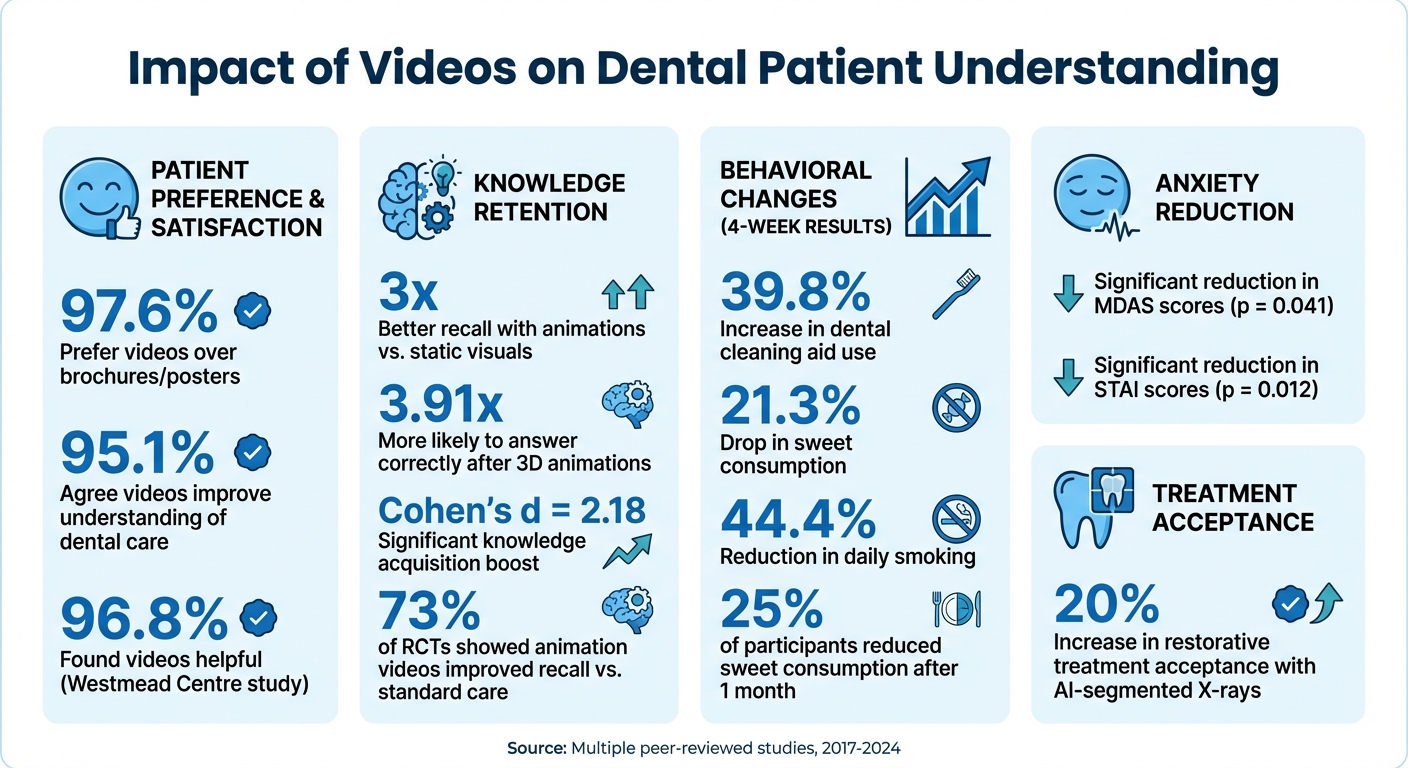
Video Education Impact on Dental Patient Outcomes: Key Statistics
Research Findings on Video Effectiveness
Better Information Retention
Studies show that videos can outperform traditional methods in helping patients retain dental information. For example, research in dental education found that video-based learning significantly boosted knowledge acquisition, with a notable quantitative effect (Cohen’s d = 2.18) [2]. In fact, 73% of randomised controlled trials reported that animation videos improved health information recall more effectively than standard care [6].
Videos work by engaging both visual and auditory senses, making it easier for patients to grasp complex dental concepts [2]. A South Indian study at the Sibar Institute compared 3D animations to 2D projections and found that participants exposed to 3D animations had a significantly higher recall rate (p < 0.001) and were 3.91 times more likely to answer questions correctly [8].
Higher Patient Satisfaction
Beyond improving memory, video education also enhances patient satisfaction. Evidence from the Westmead Centre for Oral Health revealed that 97.6% of dental patients preferred video-based education over brochures or posters, with 95.1% agreeing that videos improved their understanding of dental care [3].
This preference for video content has practical benefits for dental practices. Between January and March 2024, VideaHealth observed a 20% increase in restorative treatment acceptance when patients at Lumio Dental were shown AI-segmented X-rays during consultations [9]. Florian Hillen, CEO of VideaHealth, emphasised the transformative potential of such technology:
"Dental AI is the great equaliser. It changes the dynamic forever by offering unbiased and data-driven analysis that both the patient and the dentists can view and discuss together during the visit." [9]
Positive Behaviour Changes from Video Education
Video education also encourages lasting behavioural improvements. The Westmead Centre study found that patients maintained better oral hygiene and dietary habits four weeks after watching educational videos [3].
"Video format oral health education used in dental waiting rooms was found to be effective in educating patients and instigating both immediate and sustained self-reported behaviour change."
– Michelle McNab, Department of Education, Oral Health, Westmead Hospital [3]
Additionally, a 2022 randomised trial at the Universidad de San Carlos in Guatemala demonstrated that a brief two-minute video could lower patient anxiety. Patients who watched the video before oral biopsies had significantly reduced anxiety scores on both the Modified Dental Anxiety Scale (p = 0.041) and the State-Trait Anxiety Inventory (p = 0.012) compared to those who received standard verbal information [7].
These benefits – ranging from better understanding and reduced anxiety to sustained positive habits – highlight how video education can improve overall dental care. Patients who feel informed and at ease are more likely to maintain regular appointments and adopt healthier oral practices.
Welcome to Spear Patient Education
Video Formats Used in Dental Education
Dental practices use various video formats to meet different patient needs. Popular options include animations, whiteboard videos, and live presentations by dentists. Research shows that 80% of studies on video animations reported positive effects on patient knowledge [3][5][11].
The type of video chosen often depends on how complex the information is and what the patient requires. For example, animations are great for breaking down complicated biological processes that might be hard to explain with just text or static images [11][12]. On the other hand, videos featuring real people, like dentists, are often the most effective for encouraging behavioural changes [3][4]. A good example of this is a 69-minute DVD loop introduced at the Westmead Centre for Oral Health between March and June 2017. It featured 12 segments on topics like reducing sugar intake and quitting smoking. After four weeks, 253 patients showed a 39.8% increase in the use of dental hygiene tools and a 44.4% drop in daily smoking [3][4]. Below, we’ll explore the benefits of each format in more detail.
Animated Procedure Guides
Animated guides stand out as one of the most effective ways to simplify complex dental procedures, making them easier for patients to understand. These are especially helpful for explaining intricate intraoral treatments. For instance, a trial at Umm Al-Qura University involving 150 participants showed that animated videos significantly improved knowledge and retention about root canal treatments compared to leaflets [10].
"Educational videos are more effective than leaflets in delivering and retaining information about root canal treatment." – Afnan A. Nassar, Department of Preventive Dentistry, Umm Al-Qura University [10]
Three-dimensional animations take this a step further by offering even greater clarity. A study at the Sibar Institute of Dental Sciences in India, involving 80 dental students, found that 3D animations led to better knowledge recall and understanding of anatomy and treatments compared to 2D videos (p < 0.001) [8]. Additionally, animations can ease patient anxiety by avoiding the graphic details often seen in photographic videos [11].
"Animations can also highlight important content better than a photographic video, and edited animations may be more acceptable to patients who do not want to see realistic portrayals of medical interventions." – Thirimon Moe-Byrne, Department of Health Sciences, University of York [11]
Dentist-Led Explanation Videos
Dentist-led videos complement animations by providing a personal touch. These live presentations are particularly effective for sharing preventive care tips, dietary advice, and hygiene demonstrations, helping patients grasp essential concepts [3][4]. However, traditional verbal explanations can overwhelm patients, especially those with lower health literacy [5][11]. Younger patients, like Millennials, often prefer customised digital animations over standard "talking head" videos [13]. Combining both formats – animations for complex details and dentist-led videos for reassurance – creates a balanced and effective educational strategy.
Post-Treatment Instruction Videos
Post-treatment videos help patients retain important home care instructions, boosting their satisfaction and confidence. These videos are especially useful for individuals with low health literacy or language barriers. For example, a randomised trial conducted at Umm Al-Qura University in Saudi Arabia in March 2025 involved 126 dental extraction patients. It compared traditional written instructions with a 3-minute instructional video sent via WhatsApp. The video group showed significantly better retention of post-operative care information, highlighting the role of videos in overcoming communication challenges [1].
Effective post-treatment videos often include visual aids, like green checkmarks for correct actions and red "X" marks for mistakes, to simplify instructions without relying solely on text [1][11]. Patients who watched educational videos lasting 5 to 20 minutes reported the highest satisfaction levels and preferred videos as their go-to source for oral care information [3][4]. One study even found that 25% of participants reduced their sweet consumption a month after watching oral health videos [3][4].
sbb-itb-2be92ed
Practical Applications for Dental Practices
Using Videos During Patient Consultations
At Universidad de San Carlos, a simple yet effective approach significantly reduced patient anxiety: a 2-minute video explaining oral biopsy procedures. Delivered via tablets with wireless earphones to 60 patients, the intervention showed measurable reductions in anxiety levels, as assessed by the State-Trait Anxiety Inventory (STAI) and Corah’s Modified Dental Anxiety Scale (MDAS) [7].
"The use of multimedia tools improves patient understanding of surgical procedures, reduces anxiety and increases satisfaction." – Oscar Toralla, Department of Odontology, Universidad San Carlos de Guatemala [7]
To enhance patient experience further, sharing post-consultation videos through platforms like WhatsApp enables patients to revisit instructions at home. This reinforces the key messages discussed during their visit [1]. Importantly, in-consultation videos should remain short – ideally between 2 and 3 minutes – to ensure clarity and retention of essential information [7]. However, these videos should complement, not replace, verbal and written instructions, offering patients a well-rounded reference for later [1].
Additionally, waiting rooms provide another opportunity to educate patients. Videos here can transform idle time into a moment of learning.
Educational Videos in Waiting Rooms
Waiting room videos are a smart way to make use of downtime before appointments. Between March and June 2017, the Westmead Centre for Oral Health in Sydney trialled a 69-minute loop of 12 oral health videos in its main waiting area. The results? A 39.8% increase in the use of dental cleaning tools and a 21.3% drop in sweet consumption among 253 adult patients after just four weeks [3].
Interestingly, most patients engage with these videos for less than 10 minutes, with peak attention spanning sessions of 5 to 20 minutes [3]. To maximise impact, looping video segments ensures key messages are repeated, while subtitles and moderate audio levels help maintain clarity in busy environments.
Challenges and Practical Considerations
While video-based education has clear advantages, it’s not without hurdles. Background noise, short attention spans, and hearing difficulties – particularly among older patients – can reduce the effectiveness of audio content [3][4]. Research shows that 71.9% of patients in waiting rooms watch educational videos for under 10 minutes [3].
To address these challenges, focus on concise, visually engaging content. For example, use symbols like green checkmarks (✔) to highlight correct actions and red X marks for mistakes. This approach makes information accessible, even for patients with varying literacy levels [1]. Tailoring videos to reflect the linguistic and cultural preferences of the audience can also build trust and boost engagement [7]. While videos can clarify information immediately, reinforcing key points through follow-up methods ensures better long-term retention [3][4].
| Video Integration Method | Primary Benefit | Recommended Duration |
|---|---|---|
| Waiting Room Display | Prepares patients; utilises wait time | 5–20 minute loops [3] |
| In-Consultation Tablet | Reduces procedure-specific anxiety | 2–3 minutes [7] |
| Post-Op Mobile Link | Improves home compliance/retention | 3 minutes [1] |
Some Australian dental practices are already adopting these video-based strategies. For instance, Complete Smiles Bella Vista (https://completesmilesbv.com.au) is exploring ways to incorporate multimedia tools into consultations and waiting areas, aiming to improve patient understanding and encourage informed decision-making.
Conclusion
Video-based education has proven to be a game-changer in improving patient understanding and engagement. Research shows that an overwhelming 97.6% of patients prefer videos over traditional brochures, with studies highlighting significant knowledge improvements (Cohen’s d = 2.18) and noticeable behavioural changes as a result of video education[3][2].
This approach is especially impactful for patients with lower health literacy. By combining visual and auditory elements, videos break down complex procedures into manageable explanations while also helping to ease pre-treatment anxiety. Another advantage is the consistency they offer – every patient receives the same clear, high-quality information, regardless of how busy the practice might be. These benefits align perfectly with the article’s focus on improving patient communication through video demonstrations.
Michelle McNab from Westmead Hospital’s Department of Education, Oral Health, has also highlighted the effectiveness of video education in promoting both immediate and lasting behavioural changes in patients[3].
Incorporating video tools into dental practices doesn’t require a major overhaul. Waiting rooms can double as learning spaces with looping educational videos, while chairside consultations can benefit from concise, targeted clips to help patients visualise procedures. Additionally, post-treatment videos sent to patients’ devices can reinforce home care instructions at the moments they need them most. These small adjustments in communication methods can make a big difference.
Australian practices, like Complete Smiles Bella Vista (https://completesmilesbv.com.au), are already demonstrating how video-based education can seamlessly become part of routine care. Their example shows how simple it is to integrate these tools into practice while prioritising patient education.
As dental care evolves, video tools offer an easy yet effective way to enhance patient outcomes, satisfaction, and long-term oral health habits. The evidence is clear, and patients have spoken – they prefer this medium.
FAQs
How do videos help patients understand dental procedures compared to brochures?
Videos have proven to be a powerful tool for improving patient understanding of dental procedures, often outperforming traditional brochures. Studies reveal that video demonstrations can boost oral health knowledge, encourage better habits like improved plaque control and healthier dietary choices, and even assist with smoking cessation efforts. Patients tend to find videos more engaging, straightforward, and practical, which helps them retain the information more effectively.
On top of that, videos are a cost-efficient way to deliver consistent and clear messages, making them a valuable resource for both patients and dental professionals. By visually breaking down procedures, videos help minimise confusion and improve communication, contributing to better overall patient outcomes.
What types of videos help patients better understand complex dental procedures?
Videos that break down complex dental procedures work best when they include detailed visuals, step-by-step demonstrations, and simple, clear narration. Studies indicate that these elements not only improve patient understanding but also boost their confidence in the treatment process.
By using straightforward language and focusing on openness, educational videos can bridge the communication gap between patients and dental professionals. This approach makes it easier to address questions and manage expectations effectively.
Can watching videos really improve long-term oral health habits?
Research indicates that video education can significantly improve long-term oral health habits by making dental care information easier to understand and more engaging. Studies have found that videos not only boost knowledge but also help people develop better oral hygiene skills and adopt positive attitudes toward dental care.
For example, patients who viewed educational videos in dental clinics reported adopting healthier oral care routines. Many even reduced behaviours like smoking or consuming excess sugar. What’s more, some of these benefits lasted well beyond the initial viewing.
However, experts emphasise that videos are most effective when paired with other educational methods and one-on-one communication. By combining engaging video content with personalised advice, dental professionals can encourage healthier habits and improve patient understanding.
Related Blog Posts
- AR in Dental Care: Patient Education Tools
- How Empathy Improves Dental Patient Outcomes
- Patient-Reported Outcomes in Digital Dentistry
- How 3D Dental Models Improve Patient Understanding
Important Notice: Any surgical or invasive procedure carries risks. Before proceeding, you should seek a second opinion from an appropriately qualified health practitioner.
Individual results may vary. The information provided in this article is for educational purposes only and does not constitute medical advice.
Checkout Related Blogs




Get in touch with us
For more information, call us now to start feeling better. Or fill the form below to make appointment
The Latest News from Complete Smiles
How to Clean Clear Plastic Retainers
Checklist for Choosing Wearable Dental Devices
Checklist for Choosing Cloud AI Platforms in Dentistry

Complete Smiles Bella VistaAccepts All Major Health Funds, Including





