





Smile Makeover Consultation: Step-by-Step Guide

A smile makeover consultation is your first step towards transforming your smile. It’s all about aligning your aesthetic goals with dental health while ensuring you have a clear understanding of procedures, costs, and timelines. Here’s what you need to know:
- Purpose: Addresses issues like discolouration, gaps, misalignment, chips, or missing teeth.
- Preparation: Bring medical history, dental records, and think about your smile goals.
- Process: Includes a discussion about your preferences, an oral health check, and a tailored treatment plan.
- Costs: Vary widely – from $800 to $15,000 depending on complexity. Example: Bonded ceramic restorations for six teeth cost $7,500–$12,500.
- Timeline: Ranges from quick fixes (like whitening in an hour) to months for orthodontics or complex cases.
Your dentist will guide you through options like whitening, veneers, bonding, or implants, ensuring both functional and aesthetic improvements. The consultation sets the stage for a smile that suits you and lasts long-term. Stay involved by asking questions and reviewing the plan thoroughly.
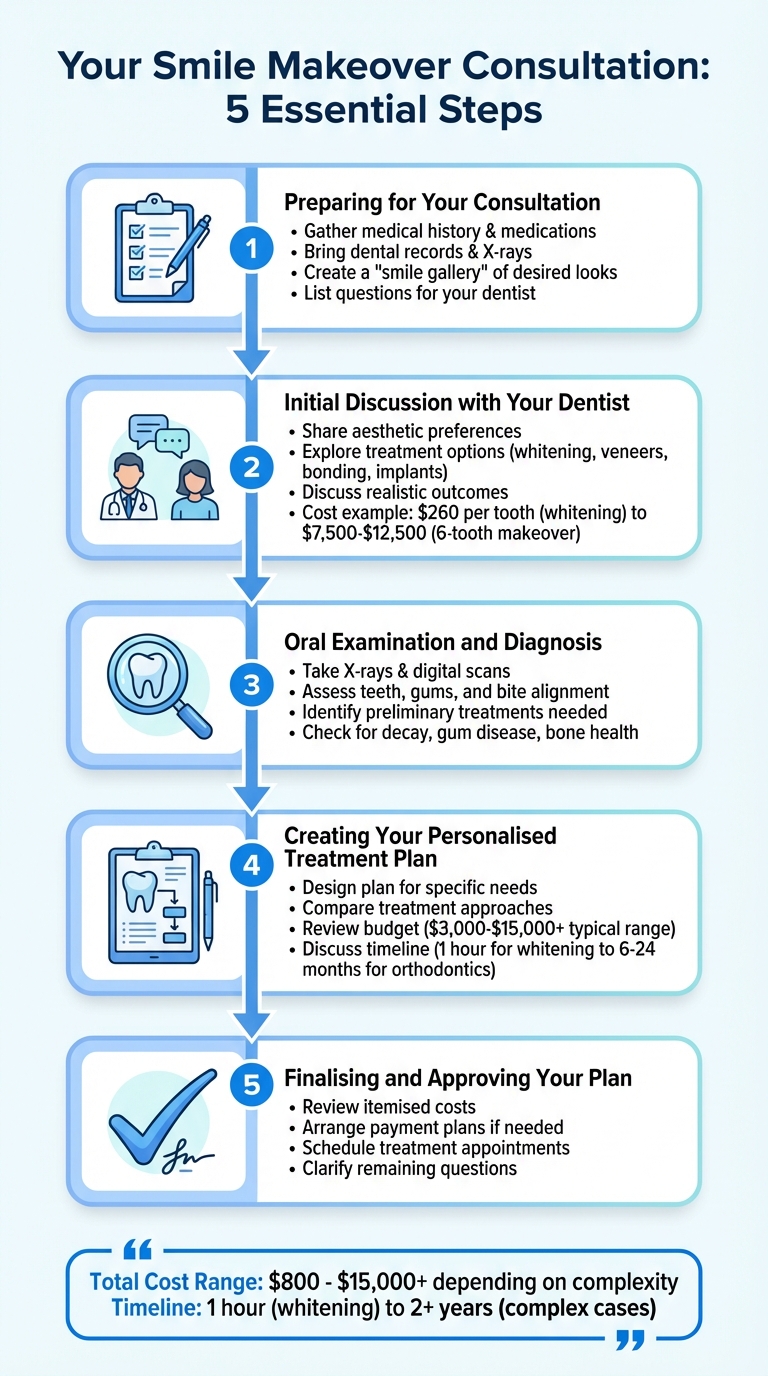
5-Step Smile Makeover Consultation Process Guide
Smile Makeover Process & Timeline | What You Need to Know
Step 1: Preparing for Your Consultation
Getting ready for your consultation helps turn it into a productive planning session. Arriving with all the necessary information allows your dentist to create a precise treatment plan and saves valuable time during your visit. This step ensures that everything needed for an accurate diagnosis and tailored planning is readily available.
Gathering Your Medical and Dental History
Bring along a list of your current medical conditions and medications, as these can influence your treatment options [1][5]. If you have recent X-rays, digital scans, or records of previous dental treatments, be sure to include those – they offer a detailed look into your oral health history [1]. If your records are incomplete, try to arrive 15 minutes early to sort things out [5]. Don’t forget to bring your private health fund card and any government dental scheme details to clarify your coverage [5].
Identifying Your Smile Goals
Take some time before your appointment to think about what you’d like to change about your smile. Is it the colour, gaps, chips, or alignment? Also, consider what you want to keep, like functional aspects such as how your teeth affect your speech or eating [2]. To communicate your goals clearly, you could create a "smile gallery" by collecting photos of smiles you admire – whether from public figures or other sources [1][2]. If you’re often in photos or videos, let your dentist know, as this can impact decisions about materials and translucency [2].
Listing Questions for Your Dentist
Write down any questions you have for your dentist. These might include which procedures are best suited to your concerns, how long the treatment will take, and the number of appointments required [1]. It’s also worth asking about potential risks, complications, or side effects linked to the recommended treatments [1][4]. If you’re unsure about committing to a procedure, ask if a digital smile design or physical mock-up can be created to help you visualise the results [1][2]. Additionally, find out if there are any preliminary treatments – like addressing gum disease or bone loss – that need to be completed before starting cosmetic work [1][2]. Understanding the expected lifespan of restorations and their maintenance requirements will also help you make informed choices about your dental investment [2].
Step 2: Initial Discussion with Your Dentist
After sharing your medical history and goals, your dentist will engage you in a detailed conversation to outline what’s achievable. This step is crucial to ensure you and your dentist are aligned on expectations and realistic outcomes. The discussion naturally transitions into a comprehensive oral examination, which helps confirm the foundation for your treatment plan.
Sharing Your Aesthetic Preferences
Be clear about the changes you want and the features you’d like to keep. If you’re concerned about specific issues like worn edges, discolouration, or gaps, mention them. Also, let your dentist know your preferences for tooth length, especially for the middle front teeth, and whether you prefer a natural appearance or a brighter, more polished "Hollywood" smile.
As Dr. Peter Henderson from Smile Solutions explains, "Most importantly, I point out what’s NOT possible. Some people say they want BIGGER teeth… if the teeth are tight against each other then there’s no room for bigger teeth without creating some space first." [2]
Your dentist will also ask about any functional needs, such as playing wind instruments or specific speech requirements, to ensure your treatment plan accommodates these factors.
Exploring Available Treatment Options
Your dentist will walk you through the procedures that can address your concerns. For example:
- Teeth whitening can remove stains.
- Porcelain veneers are ideal for repairing chips, wear, or gaps.
- Dental bonding may be suitable for minor chips or small gaps.
- Dental implants are often necessary for missing teeth.
If your teeth are too crowded for veneers, orthodontic treatment might be suggested, possibly involving arch broadening before any cosmetic procedures. Costs can vary widely depending on the treatment. For instance, in-chair teeth whitening may cost about $260 per tooth, while a six-tooth makeover with bonded ceramic restorations could range from $7,500 to $12,500 [1][2].
Determining Suitability and Realistic Outcomes
Your dentist will assess your oral health to ensure you’re a good candidate for treatment. A stable foundation – healthy gums, strong bone structure, and robust tooth roots – is vital before any cosmetic work begins. They’ll also evaluate your bite and habits like grinding or clenching, as these can influence the materials used and the durability of the restorations.
In some cases, preliminary treatments might be necessary to prepare for cosmetic work. For example, gum therapy or orthodontics could be recommended to create a stable base for your makeover. This step ensures your treatment plan is tailored to both your needs and long-term oral health.
Step 3: Oral Examination and Diagnosis
After discussing your goals and preferences, your dentist will conduct a thorough examination to evaluate the health of your teeth, gums, and jaw. This step is crucial because a solid oral foundation is necessary to ensure successful treatment outcomes.
Taking X-Rays and Digital Scans
Dental X-rays are used to examine areas that aren’t visible during a routine visual check. These images provide details about your tooth roots, jawbone density, and any hidden issues like decay or infections that could interfere with cosmetic treatments. Digital scans and impressions are also taken to create accurate 3D models of your teeth, which are essential for designing restorations that fit perfectly.
Some clinics may use Digital Smile Design (DSD) technology. This combines photographs and scans to produce a digital preview of your potential results, allowing you to visualise the changes before committing to any treatment. These diagnostic tools help your dentist develop a comprehensive plan tailored to your needs.
Assessing Teeth, Gums, and Bite Alignment
During the examination, your dentist will carefully check for cavities, tooth decay, and the health of your tooth roots and pulp. They’ll also inspect any existing dental work, like fillings or crowns, for wear or damage, and look for signs of bruxism (teeth grinding or clenching).
Your gum and bone health are equally important. The dentist will check for periodontal disease, bone loss, and gum symmetry. If you have excess gum tissue causing a "gummy smile", this will also be noted. Additionally, they’ll examine your bite alignment, tooth spacing, and jaw joint (TMJ) function to identify any problems, such as crowding or gaps, that might need attention before starting cosmetic treatments.
| Assessment Category | Specific Issues Checked |
|---|---|
| Teeth | Cavities, decay, root health, pulp condition, existing restorations |
| Gums & Bone | Periodontal health, bone density, gum symmetry, tissue concerns |
| Bite & Jaw | Alignment, bruxism damage, TMJ issues, tooth angles |
| Aesthetics | Discolouration, gaps, chips, lip movement, "gummy" smile |
Identifying Required Preliminary Treatments
If the exam reveals any oral health issues, these must be addressed before moving forward with cosmetic treatments. Active problems like gum disease, tooth decay, or root infections need to be treated first to provide a stable base for further work. Skipping this step could lead to complications later, such as the need for root canals or extractions after cosmetic procedures.
Preliminary treatments may include professional cleaning to reduce gum inflammation, fillings to treat decay, or orthodontic work to correct misalignment or crowding. Your dentist will include these steps in your overall treatment plan, ensuring that your cosmetic procedures are both safe and effective. By addressing these foundational issues now, you’ll set yourself up for long-lasting results.
sbb-itb-2be92ed
Step 4: Creating Your Personalised Treatment Plan
Once your dental examination is complete, the next step is crafting a treatment plan tailored just for you. This plan merges your aesthetic preferences with the clinical findings, ensuring a balanced approach to achieving your ideal smile.
Designing a Plan for Your Specific Needs
Your dentist carefully evaluates your teeth and facial features to create a smile that complements your overall appearance. This involves considering factors like tooth shape, colour, alignment, skin tone, lip contour, and facial structure [6][1].
By comparing your goals with the clinical assessment, your dentist suggests treatments that align with both. For instance, if you have gaps in your teeth, porcelain veneers might be recommended for a polished look, while composite bonding could be offered as a less invasive and more budget-friendly solution [1]. Material choices are also tailored – zirconia is often used for back teeth due to its strength, while porcelain is favoured for front teeth because of its natural light-reflecting quality.
Advanced tools like 3D scans and digital design allow you to visualise the potential results before any treatment begins [6][1]. Some clinics even offer temporary restorations so you can "test drive" the changes before committing to the final design [11].
"A smile makeover isn’t a one-size-fits-all solution, as everyone’s mouth is unique." – EVP Dental [8]
Comparing Different Treatment Approaches
Your dentist will guide you through the options, weighing the benefits and drawbacks of each based on your goals, budget, and lifestyle. For example, composite bonding can cost between $400 and $1,800 per tooth, requires minimal preparation, and can be done in a single visit. However, it typically lasts only 3–7 years and is more prone to staining [1].
For discoloured teeth, professional whitening offers a quick fix, brightening your smile in just an hour for $260 to $610 [6][1]. In cases where discolouration is severe or shape adjustments are needed, veneers might be the better long-term choice.
| Treatment Option | Estimated Cost (AUD) | Durability | Best For |
|---|---|---|---|
| Professional Whitening | $260–$610 | Temporary (touch-ups needed) | Surface stains and discolouration |
| Composite Bonding | $400–$1,800 per tooth | 3–7 years | Minor chips, gaps, or quick fixes |
| Porcelain Veneers | ~$2,036 per tooth | 10–20 years | Major changes in shape and colour |
| Dental Crowns | Up to $2,100 per tooth | 10–15 years | Restoring damaged or heavily restored teeth |
| Dental Implants | $4,000–$6,000 per tooth | 20+ years | Replacing missing teeth |
Discussing Budget and Timeline
Cost is a key consideration for any smile makeover. A moderate makeover might range from $3,000 to $15,000, while more extensive work, like full-mouth reconstruction, can exceed $60,000 [10]. For example, a makeover involving bonded ceramic restorations on six teeth typically costs between $7,500 and $12,500 [2]. After your examination, your dentist will provide a detailed quote so you know exactly what to expect.
If affordability is a concern, ask about breaking the treatment into phases. For instance, you might start with whitening and bonding, then move on to veneers later [10][8]. Many clinics also offer interest-free payment plans through services like Zip, Humm, or Afterpay [3][8][4].
The timeline depends on the complexity of your case. Orthodontic treatments like clear aligners can take 6 months to 2 years, while veneers or crowns often require about two weeks to fabricate, during which temporary restorations are used [8][2]. Sometimes, treatments must follow a specific sequence – for example, orthodontic alignment may need to be completed before placing veneers, which can extend the timeline [1][2].
Your lifestyle and functional needs also play a role in planning. Whether you’re preparing for a big event or need adjustments for activities like playing a wind instrument, your dentist will factor these into the schedule. Technologies like same-day crowns or digital smile design can also help reduce the number of appointments needed [1][9].
"Before committing to construction of the laboratory-made restorations, your choices of colour and whiteness, tooth shape, size and arrangement must be ‘locked in’, as changes in these choices after restorations are made can incur substantial additional laboratory and clinical work with resulting additional costs." – Dr. Peter Henderson, Dentist, Smile Solutions [2]
With your treatment plan and schedule in place, the next step is to finalise and approve the strategy.
Step 5: Finalising and Approving Your Plan
Take the time to carefully review your treatment plan before moving forward with your smile makeover.
Reviewing Costs and Payment Arrangements
Your dentist will provide a detailed, itemised treatment plan that breaks down the cost of each procedure [2]. If you have private health insurance, check whether your clinic is a preferred provider to maximise your rebates. Many practices can process claims on the spot, so you’ll only need to pay the gap amount on the day.
If you’re concerned about costs, ask about payment plans to spread out expenses. Some clinics also accept government programs like the Child Dental Benefits Schedule (CDBS) or Department of Veterans’ Affairs (DVA) cards, which can help reduce upfront costs.
Once you’re satisfied with the financial details, book your appointments to begin your treatment.
Scheduling Your Treatment Appointments
After finalising the costs, it’s time to lock in your treatment schedule. If your plan includes lab-made restorations like veneers or crowns, keep in mind that these typically take about two weeks to fabricate [2]. During this period, you’ll wear temporary restorations. Your dentist may schedule a follow-up visit a few days after the initial preparation to ensure you’re comfortable with eating, speaking, and appearance.
For more complex cases, such as those involving orthodontics or multiple specialists, the process may take longer. For example, clear aligner treatments can last anywhere from six months to over two years [8]. Additionally, your dentist might schedule follow-up reviews – such as at one week, one month, three months, and six months after the final treatment – to monitor your progress and ensure your gums and teeth are responding well.
Clarifying Any Remaining Questions
Before proceeding, make sure all your questions are answered. Discuss any concerns about risks, potential side effects, or complications, especially if your plan involves surgery or more invasive procedures. It’s also important to confirm recovery times and any specific post-treatment care requirements.
For long-term treatments, like wearing retainers after Invisalign or maintaining hygiene routines for implants, ensure you understand what will be expected of you. If available, request a trial fit or digital simulation to visualise the final results before committing to permanent changes. Be sure your clinic is QIP (Quality Innovation Performance) accredited, which guarantees adherence to strict safety and quality standards [7]. If you struggle with dental anxiety, ask about options like sedation or local anaesthesia to make the experience more comfortable.
"A smile makeover is a personalised treatment plan… You and your dentist will work together to create your ideal treatment plan, which will give you all the information you need about your procedures, costs and the treatment timeline."
– EVP Dental [8]
Conclusion
A smile makeover consultation is a partnership between you and your dentist, blending your personal goals with their professional guidance to craft a treatment plan tailored just for you. By carefully following the steps of the consultation, you’ll have a clear picture of what lies ahead in your transformation journey.
Selecting a skilled dentist plays a key role in achieving the desired results. Their expertise ensures your makeover begins with a healthy foundation, and the treatment plan is designed to bring the vision from your consultation to life – the result of your shared efforts [2].
This teamwork creates a strong base for your ongoing dental care. Open communication allows your dentist to understand your preferences while helping you set realistic expectations. This mutual understanding helps align the final outcome with your goals and what is clinically achievable.
To ensure lasting success, stick to your treatment schedule, attend all appointments, provide feedback during trial stages, and maintain regular check-ups. The consultation phase is the cornerstone of your smile makeover journey, paving the way for a smooth transformation. With thoughtful preparation and professional support, your new smile can boost both your appearance and your confidence.
FAQs
What should I think about when setting goals for my smile makeover?
When planning your smile makeover, think about the specific changes you’d like to see. Are you looking to address discolouration, straighten misaligned teeth, close gaps, or repair chips? Having a clear vision of the aesthetic outcome you want is key, but it’s equally important to consider how these changes fit with your overall oral health.
It’s crucial to keep your expectations realistic. A consultation with a skilled dental professional can provide clarity on the procedures available, the results you can expect, and any limitations based on your current dental condition. Whether you’re considering whitening, veneers, or orthodontic solutions, your dentist can help design a personalised plan that matches both your goals and your budget.
Before diving into cosmetic treatments, make sure your oral health is in top shape. Resolving any existing dental issues first will lay a solid foundation for a smile makeover that not only looks great but lasts for years to come.
What are the best ways to manage the cost of a smile makeover in Australia?
Managing the cost of a smile makeover doesn’t have to be overwhelming. With a bit of planning and by exploring your options, you can make it more manageable. The overall expense will depend on the specific treatments you need – whether it’s veneers, crowns, orthodontics, or dental implants – and the fees charged by your dental provider. The good news is that many clinics offer flexible payment options. These can include in-house payment plans, health fund contributions, personal loans, or credit card payments, making it easier to spread out the costs over time.
It’s always worth having an open conversation with your dentist about your budget during the initial consultation. They can provide a clear estimate and suggest treatment options that align with your financial situation. Thinking ahead and focusing on the long-term benefits of durable treatments can help you achieve the smile you want without straining your budget.
What are the risks or complications associated with cosmetic dental treatments?
Cosmetic dental treatments, like smile makeovers, come with some potential risks, which largely depend on the procedures you’re undergoing. Common side effects might include temporary sensitivity, mild discomfort, or irritation, especially after treatments such as veneers or crowns. Occasionally, there may be allergic reactions to the materials used.
More serious complications, though rare, could involve issues like restoration failure, damage to nearby teeth, or nerve irritation, which might require additional treatment. Addressing any pre-existing dental health problems is crucial, as these can increase the chances of complications during or after the procedure.
To keep risks to a minimum, it’s important to choose a qualified dental professional to plan and perform your treatment. Clear communication about your expectations and following proper aftercare instructions are key to achieving safe, long-lasting results.
Related Blog Posts
- Guide to Choosing the Right Cosmetic Dental Treatment
- Factors Affecting Porcelain Veneers Pricing
- Cost Comparison: Implants, Bridges, and Dentures in 2025
- 5 Factors Affecting Orthodontic Treatment Feasibility
Important Notice: Any surgical or invasive procedure carries risks. Before proceeding, you should seek a second opinion from an appropriately qualified health practitioner.
Individual results may vary. The information provided in this article is for educational purposes only and does not constitute medical advice.
Checkout Related Blogs




Get in touch with us
For more information, call us now to start feeling better. Or fill the form below to make appointment
The Latest News from Complete Smiles
How to Clean Clear Plastic Retainers
Checklist for Choosing Wearable Dental Devices
Checklist for Choosing Cloud AI Platforms in Dentistry
Complete Smiles Bella VistaAccepts All Major Health Funds, Including





