





How Chemical Etching Improves Implant Surface Properties

Chemical etching is a process that transforms titanium implant surfaces to improve their compatibility with bone. By using acids like hydrofluoric or hydrochloric acid, the technique creates micro and nano-level textures that promote better bone integration. This method removes contaminants, increases surface roughness, enhances wettability, and strengthens the protective titanium oxide layer, all of which are critical for implant stability and long-term success.
Key Points:
- Surface Roughness: Creates micro-pits (1.5–2.5 µm) and nanopores (100–500 nm) for better cell attachment.
- Wettability: Reduces water contact angle, improving protein adsorption and cell adhesion.
- Corrosion Resistance: Strengthens the titanium oxide layer, preventing ion release and ensuring durability.
- Clean Surface: Unlike sandblasting, it avoids contamination by residual particles.
In Australia, chemically etched implants comply with TGA standards, offering reliable results for dental practitioners. This method supports faster healing, better osseointegration, and improved long-term outcomes for patients.
Processing & Characterization of Additively Manufactured Titanium Alloys for Biomedical Implants
How Chemical Etching Changes Implant Surfaces
Chemical etching works at a microscopic level to alter titanium surfaces, creating conditions that promote better integration with bone. By stripping away the contaminated native oxide layer and replacing it with a refined, reactive surface, this process enhances properties like roughness, wettability, and corrosion resistance, all of which are critical for successful implants.
Surface Roughness and Morphology
Acid etching reshapes titanium surfaces, creating a unique structure that supports cell attachment and bone integration. The process forms micropits (1.5–2.5 µm) for physical anchorage and nanopores (100–500 nm) that allow deeper interaction with cells. These features combine to create spiral-like nano-structures that improve the implant’s overall stability[1][3].
The transformation in surface morphology is striking. The surface becomes dominated by valleys and holes, as indicated by a negative surface skewness (Ssk)[1]. This recessed topography is ideal for bone cells, which naturally anchor into such features. Marenzi and colleagues observed:
Acid-etched surfaces were characterised by the presence of deeper valleys and higher peaks than the sandblasted surfaces[2].
These etched surfaces also exhibit a high fractal dimension, offering complex geometries that actively encourage cell proliferation[2].
Wettability and Surface Energy
Chemical etching doesn’t just change the shape of the surface – it also makes titanium more hydrophilic. By removing contaminants like atmospheric carbon and introducing micro-roughness, the process significantly improves wettability. For example, hydrochloric acid treatment can reduce the water contact angle to as low as 59.0° ± 0.9°, making the surface more conducive to biological interactions[8]. As Zahran and colleagues point out:
The topography and wettability of the surface influence the first stages of bone formation, the quality of osseointegration, and the ability to retain the initial blood clot[1].
This relationship between surface roughness and wettability aligns with the Wenzel equation. Essentially, as micro-roughness increases on an already hydrophilic surface, the water contact angle decreases further, enhancing the effect. Timing plays a crucial role here – hydrofluoric acid etching for 5–7 minutes achieves optimal wettability, while extending the treatment to 10 minutes can reduce this benefit despite increased roughness[1]. This balance is vital for maximising protein adsorption and cellular attachment during the early healing stages.
Corrosion Resistance and Titanium Oxide Layer
Chemical etching also strengthens the titanium oxide (TiO₂) layer, which protects implants from the corrosive environment inside the body. The native oxide layer, typically about 6 nanometres thick, can be significantly enhanced with acidic treatments. For instance, acidic Piranha solutions (H₂SO₄/H₂O₂) can increase the oxide layer thickness to 45–50 nanometres after 24 hours of treatment[9]. This thicker, more stable TiO₂ layer, rich in Ti⁴⁺ ions, not only improves corrosion resistance but also serves as a nucleation site for bone-like apatite formation[4][5][9].
Unlike other methods, chemical etching avoids embedding particles into the surface, ensuring a cleaner and purer oxide layer[2]. This purity enhances both biocompatibility and corrosion resistance by preventing the release of harmful metal ions into surrounding tissues. Together, these changes create a surface that supports strong osseointegration and long-term implant stability.
Step-by-Step Guide to Chemical Etching for Titanium Implants
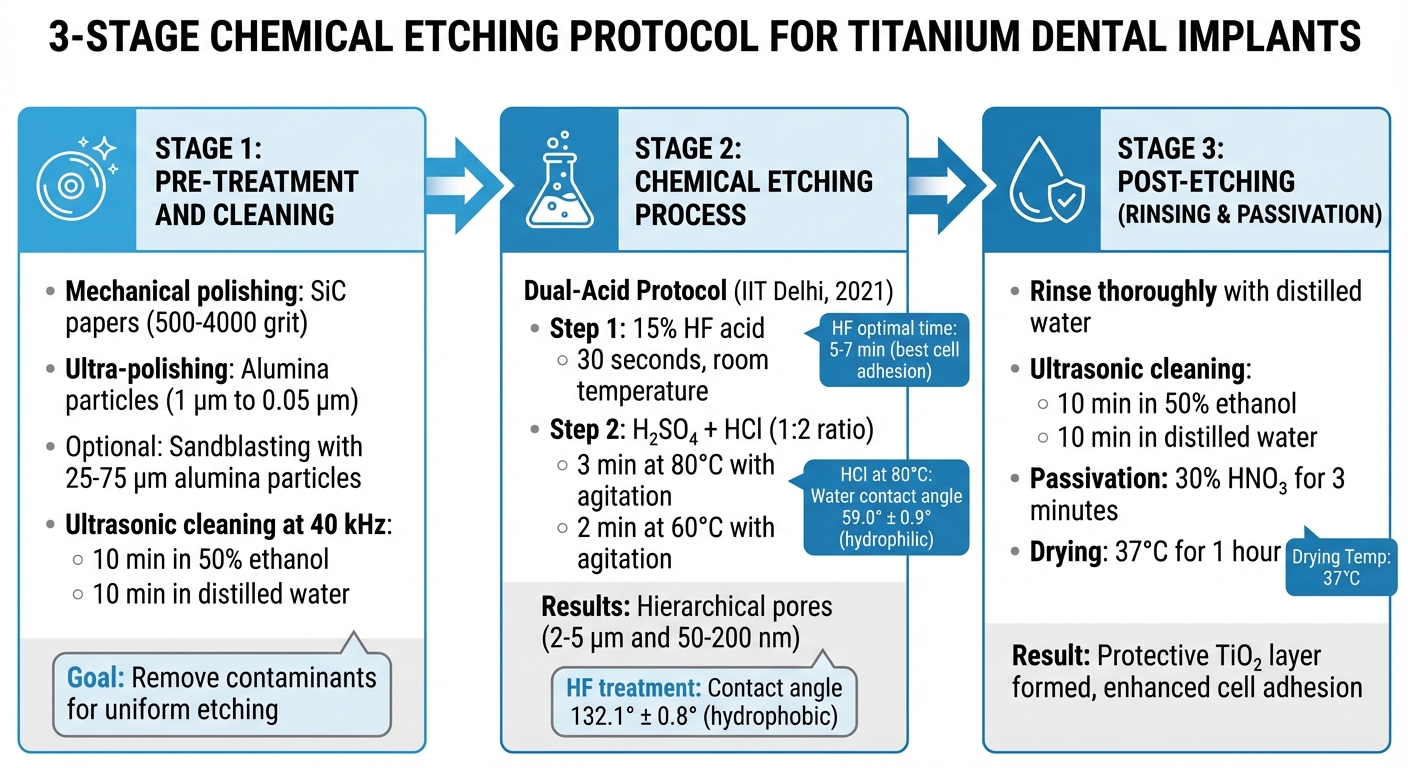
Chemical Etching Process for Titanium Dental Implants: 3-Stage Protocol
Chemical etching is a precise process that alters the titanium surface to improve osseointegration. Each stage requires meticulous attention to detail to ensure consistent and reproducible outcomes.
Pre-Treatment and Cleaning
Before exposing titanium to acids, the surface must be thoroughly prepared. Start with mechanical polishing using silicon carbide (SiC) papers ranging from 500 to 4000 grit, followed by ultra-polishing with alumina particles (from 1 µm down to 0.05 µm). If needed, sandblasting with 25–75 µm alumina particles can further refine the surface. After polishing, clean the surface ultrasonically at 40 kHz – first in 50% ethanol for 10 minutes, then in distilled water for another 10 minutes. This step ensures the removal of contaminants, which is critical for achieving uniform etching. Once cleaned, proceed directly to the chemical etching stage to prevent recontamination.
Chemical Etching Process
After pre-treatment, immerse the titanium in acid solutions under carefully controlled conditions to modify its surface morphology. In October 2021, researchers Pankaj Chauhan, Veena Koul, and Naresh Bhatnagar from IIT Delhi introduced a dual-acid protocol specifically for Ti6Al4V ELI alloy implants. This method involves two steps:
- Immerse the implant in 15% hydrofluoric acid (HF) for 30 seconds at room temperature.
- Follow with a mixture of 96% sulfuric acid (H₂SO₄) and 37% hydrochloric acid (HCl) in a 1:2 ratio, etching at 80°C for 3 minutes and then at 60°C for 2 minutes under agitation. This creates a hierarchical pore structure with features ranging from 2–5 µm to 50–200 nm[11].
Both temperature and duration play a critical role in determining the final surface characteristics. For instance, research conducted at the University of Granada in November 2016 highlighted that HF etching increases surface roughness progressively up to 10 minutes. However, cell adhesion peaked between 5–7 minutes and declined with longer etching, despite the rougher surface. This suggests that optimising the etching time is as important as the choice of acid[1]. Additionally, different acids produce unique surface morphologies. For example, HCl treatment at boiling temperatures (80°C) creates hydrophilic micro-porous surfaces with a water contact angle as low as 59.0° ± 0.9°, while HF-treated surfaces are hydrophobic, with contact angles reaching up to 132.1° ± 0.8°[8].
Post-Etching: Rinsing and Passivation
After etching, removing residual acids and stabilising the surface is crucial for biocompatibility. Immediately rinse the implant thoroughly with distilled water, then clean it ultrasonically in 50% ethanol for 10 minutes, followed by another 10-minute rinse in distilled water. This ensures all acid residues are eliminated.
To stabilise the surface, immerse the implant in 30% nitric acid (HNO₃) for 3 minutes. This passivation step not only removes any remaining contaminants but also forms a protective titanium dioxide (TiO₂) layer. This layer enhances cell adhesion and shields the implant from corrosion[1]. Finally, dry the treated surface at 37°C for 1 hour[1]. Takuya Matsumoto, in Applied Surface Science, emphasised the potential of acid etching combined with alkali and heat treatments, stating:
Acid etching prior to alkali- and heat-treatment would be a promising method for enhancing the affinity of Ti to host bone tissue.[5]
sbb-itb-2be92ed
Clinical Benefits of Chemically Etched Surfaces
The advancements in surface characteristics achieved through chemical etching directly translate into several clinical advantages.
Improved Osseointegration and Bone-Implant Contact
Chemically etched surfaces feature micropits and nanopores that significantly expand the surface area available for bone cell attachment. This micro-roughened texture enhances surface energy and wettability, allowing blood proteins to adsorb more efficiently and promoting faster osteoblast adhesion. Interestingly, studies reveal that etched surfaces can form bone-like apatite within 3 days, compared to 5 days for non-etched surfaces[5]. The etching process also produces surfaces with a high fractal dimension – characterised by irregular, deeper valleys and sharper peaks – which correlates more strongly with cell adhesion than traditional roughness metrics. As A. Jemat observed:
Acid etched surfaces had increased cell adhesion and bone formation, thus enhancing the osseointegration[7].
Commercially available chemically modified titanium surfaces boast a clinical efficacy exceeding 95% over a 5-year period[4]. This reliability underscores their value for both early fixation and long-term implant stability.
Better Early Stability and Long-Term Success
The micro-roughness created by dual acid etching promotes mechanical interlocking between the bone and implant, resulting in higher removal torque values and superior biomechanical fixation. Sandblasted and acid-etched (SLA) surfaces, which combine macro-cavities (5–20 µm) with micro-pits (0.5–3 µm), support both early stability and long-term biological integration[7]. These etched surfaces demonstrate greater resistance to reverse torque removal compared to traditional machined surfaces. Moderately micro-roughened profiles provide an ideal environment for bone response, enabling a combination of mechanical stability and accelerated biological integration. This leads to shorter healing times and quicker loading protocols. Beyond stability, these surface modifications also improve the implant’s resistance to corrosion.
Reduced Corrosion and Biocompatibility Risks
Chemical etching creates a thicker, uniform titanium dioxide (TiO₂) layer that serves as a protective shield against corrosion and ion release. Additionally, the process results in a clean surface free from foreign contaminants. J.I. Rosales Leal from the University of Granada explained:
Surface O is increased because the HF acid etching removes contaminated layers, enhancing surface reactivity and forming a thick layer of TiO₂. This layer… has been reported to play a key role in protection and to increase cell adhesion[1].
Practical Considerations for Clinicians and Researchers in Australia
Selecting TGA-Approved Implant Systems
When selecting titanium implants with chemically etched surfaces, it’s essential for Australian clinicians to confirm that the system is registered on the Australian Register of Therapeutic Goods (ARTG) for the intended clinical use. Check the manufacturer’s specifications for critical parameters like an average surface roughness of 1.0–2.0 μm [2] to ensure the implant meets clinical demands. Pay attention to wettability; while standard SLA surfaces can become hydrophobic over time, chemically modified SLA (modSLA) surfaces remain hydrophilic when treated under nitrogen and stored in saline [12]. Additionally, evaluate topographic features such as skewness (Ssk) and kurtosis (Sku). Research suggests that cells tend to favour surfaces with negative skewness and kurtosis values in the range of 4–5 [1]. Lastly, consider the material composition of the implant, as commercially pure titanium and titanium alloys like Ti6Al4V may respond differently to surface treatments [4][7].
Designing Research Experiments
Once an implant system is chosen, researchers must refine etching protocols to align with clinical performance needs. Australian researchers investigating chemical etching should systematically adjust variables such as acid concentration, temperature, and immersion time to achieve the desired surface properties, with special attention to optimising etching time [1][3]. Employ advanced tools like white light confocal microscopy, XPS, and SEM to thoroughly analyse surface modifications [1][2]. For wettability, dynamic contact angle measurements (using advancing and receding methods) provide more precise results compared to static sessile drop methods [1]. Biological performance can be assessed in vitro using MG-63 osteoblast-like cells to measure factors like adhesion, proliferation, and differentiation markers such as alkaline phosphatase activity [1][6]. When choosing etching acids, concentrated hydrochloric acid generally delivers more uniform nanopore formation (100–500 nm) and better surface modification compared to sulfuric acid [3]. Fine-tuning these etching conditions directly contributes to the improved osseointegration and stability discussed earlier.
Educating Patients About Implant Surface Technologies
Bridging technical advancements with patient care involves clear explanations about how surface modifications improve implant integration. Patients should understand that chemical etching creates a micro-roughened surface, which enhances osseointegration – the direct connection between the implant and living bone [4]. This subtractive process removes metal to create a texture that promotes bone cell attachment [7][2]. Reassure patients that these advanced etching methods are rigorously controlled to maintain hydrogen levels within safe limits (typically 130–150 ppm) to avoid material embrittlement [10]. Highlight that these surface modifications encourage early bone formation, which is especially beneficial for individuals with compromised bone quality or those requiring immediate loading [1][3]. Visual aids, like SEM images, can be helpful in showing the honeycomb or nanoporous structures that foster deep bone integration [3][10]. However, remind patients that while these technologies enhance early stability, long-term success still depends on factors like oral hygiene and overall health [4].
Conclusion
Chemical etching has emerged as a leading method for enhancing the performance of titanium implants, particularly in the context of osseointegration and clinical stability. By improving surface roughness, wettability, and corrosion resistance, this technique creates a moderately roughened surface that promotes faster osseointegration, better bone–implant contact, and stronger biomechanical stability compared to smoother or mechanically treated surfaces [2][4]. Additionally, the enhanced surface energy and wettability from chemical etching accelerate protein adsorption and initial cell attachment – key factors in the early healing process [1][4].
One standout advantage of chemical etching is its ability to produce a contaminant-free surface, unlike sandblasting, which may leave residues [2][10]. It also supports the formation of a thick, stable titanium oxide (TiO₂) layer, boosting both biocompatibility and long-term corrosion resistance [9].
Clinical studies highlight the reliability of chemically etched surfaces, reporting over 95% efficacy at five years and 90% implant survival rates over a decade [4][1]. These statistics emphasise the importance of selecting TGA-approved chemically etched systems for achieving optimal patient outcomes in Australia.
For clinicians and researchers in Australia, understanding the science behind chemical etching is essential for making informed choices about implant systems and designing effective research protocols. The future of dental implantology lies in developing surfaces with precise, standardised topographies and chemistries to deepen our understanding of how proteins, cells, and tissues interact with implants [4]. By focusing on surface technologies that combine biological effectiveness with material safety, practitioners can not only improve patient outcomes but also contribute to advancing the field through robust scientific exploration.
FAQs
How does chemical etching enhance the surface of dental implants for better integration?
Chemical etching plays a key role in preparing titanium implants by creating a micro- and nano-rough surface. This textured surface increases the implant’s overall surface area and enhances its wettability, making it more conducive to interaction with biological tissues. These properties are particularly beneficial for encouraging the attachment and growth of osteoblasts – the cells responsible for forming new bone. As a result, the osseointegration process, where the implant fuses with the surrounding bone, is accelerated.
Additionally, chemical etching ensures the implant surface is clean and free from contaminants, making it more compatible with cellular activity. This meticulous preparation contributes to better integration with bone tissue, supporting the implant’s long-term stability and durability.
How does increased surface roughness and wettability benefit dental implants?
When dental implants have increased surface roughness, they develop micro- and nano-scale textures that improve how they physically connect with bone. These textures create a stronger mechanical bond and encourage bone cells to attach more effectively, leading to greater stability and security for the implant over time.
Additionally, higher wettability – or hydrophilicity – of the implant surface plays a crucial role. This characteristic attracts proteins and supports cell adhesion, speeding up osseointegration. Osseointegration is the essential process where the implant fuses with the surrounding bone, ensuring it remains durable and reliable in the long run.
Why is chemical etching a better option than sandblasting for treating implant surfaces?
Chemical etching is a popular choice for titanium implants because it creates macro-, micro-, and nano-roughness on the surface without adding any contaminants. Unlike sandblasting, which can leave behind unwanted particles, chemical etching delivers a cleaner, biocompatible surface that supports improved integration with surrounding tissue.
Additionally, this method enhances the implant’s resistance to corrosion and refines its surface structure, making it a reliable option for long-term durability and performance, particularly in dental applications.
Related Blog Posts
- Osseointegration and Titanium Surface Design
- Surface Modifications for Better Osseointegration
- Titanium Implant Surface Modifications for Osseointegration
- Sandblasting and Acid Etching for Titanium Implants
Important Notice: Any surgical or invasive procedure carries risks. Before proceeding, you should seek a second opinion from an appropriately qualified health practitioner.
Individual results may vary. The information provided in this article is for educational purposes only and does not constitute medical advice.
Checkout Related Blogs




Get in touch with us
For more information, call us now to start feeling better. Or fill the form below to make appointment
The Latest News from Complete Smiles
How to Clean Clear Plastic Retainers
Checklist for Choosing Wearable Dental Devices
Checklist for Choosing Cloud AI Platforms in Dentistry
Complete Smiles Bella VistaAccepts All Major Health Funds, Including





