





How Retention Appointments Prevent Teeth Shifting

Retention appointments are the key to keeping your teeth straight after orthodontic treatment. Once your braces or aligners come off, your teeth can naturally shift back to their original positions due to elastic ligaments, bone remodelling, and natural forces like biting and ageing. Without regular check-ups, this movement – called orthodontic relapse – can undo your results.
Retention appointments help by:
- Ensuring your retainer fits correctly and hasn’t been damaged.
- Monitoring for early signs of tooth movement and addressing them quickly.
- Adjusting or replacing retainers as needed to maintain alignment.
- Creating personalised retention plans based on your treatment history, tooth movement, and risk factors.
Skipping these appointments increases the risk of teeth shifting, which could mean costly additional treatment. Regular check-ups, combined with proper retainer wear and maintenance, are the best way to protect your investment and keep your smile in place.
What To Expect At Your Appointment | Retainers
Why Teeth Move After Orthodontic Treatment
Why Teeth Shift After Orthodontic Treatment and How Retention Prevents It
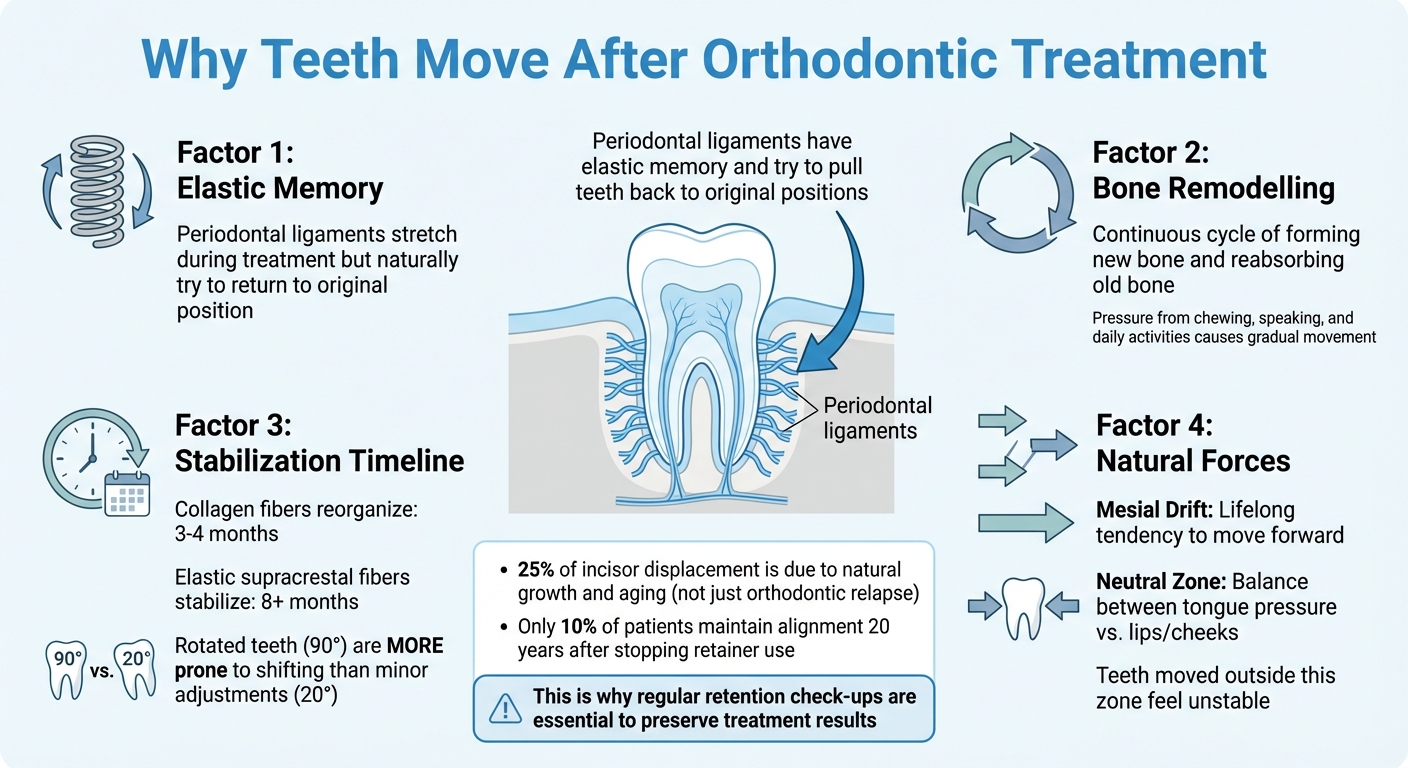
To keep your orthodontic results intact, it’s important to understand why teeth tend to shift after treatment. Unlike what some might think, your teeth aren’t rigidly fixed to your jawbone. Instead, they’re held in place by periodontal ligaments – tiny elastic fibres that connect each tooth to the bone. During orthodontic treatment, braces or aligners stretch and compress these ligaments to reposition your teeth. However, these ligaments have an elastic memory, meaning they naturally try to pull your teeth back to their original spots [7][3].
Another factor at play is bone remodelling. This natural process involves the continuous cycle of forming new bone and reabsorbing old bone. Everyday activities like chewing, speaking, and even laughing add pressure that contributes to gradual tooth movement over time [7][8].
Timing is also critical. After your teeth are moved, the collagen fibres in the periodontal ligament need about three to four months to reorganise. Meanwhile, the elastic supracrestal fibres around the neck of your teeth can take much longer – up to eight months or more – to fully stabilise. Teeth that have been rotated significantly, like a 90-degree adjustment, are especially prone to shifting compared to minor adjustments of, say, 20 degrees [9][10].
Another natural phenomenon is mesial drift, which is the lifelong tendency of teeth to move forward toward the front of the mouth. Your teeth rest in what’s called a "neutral zone", where the forces from your tongue balance against those from your lips and cheeks. If teeth are moved out of this zone during treatment, they may feel unstable until the surrounding muscles and tissues adapt [10]. These natural forces, combined with age, often lead to changes in tooth alignment over time.
Interestingly, research shows that about 25% of incisor displacement in post-orthodontic patients is due to natural growth and ageing rather than orthodontic relapse alone [11]. As you age, changes in jaw structure and natural physiological processes further contribute to tooth movement [9]. This highlights why regular retention check-ups are so important to preserve the results of your treatment.
How Retention Appointments Maintain Alignment
Retention appointments are essential for keeping your smile in alignment after orthodontic treatment. These regular check-ups allow your orthodontist to spot potential issues early, ensuring your retainer is working as it should and that your teeth haven’t started to shift. Think of these visits as routine maintenance for your teeth – just like servicing a car to keep it running smoothly.
During these appointments, your orthodontist conducts a detailed examination to look for any signs of orthodontic relapse. They focus on changes like reduced arch length, altered spacing, or front teeth moving out of place. The lower front teeth, being particularly prone to crowding, often get extra attention during these evaluations [1][4]. Identifying even minor shifts early allows your orthodontist to address them promptly, which research shows can make a big difference [2].
Another key part of the visit is checking the retainer itself to ensure it fits well and is in good shape.
Checking Retainer Fit and Condition
Your orthodontist uses the retainer’s fit as a diagnostic tool. For removable retainers like Essix or Hawley models, you’ll be asked to insert the appliance to check if it fits snugly over your teeth. If the retainer feels tight or doesn’t sit properly, it could indicate that your teeth have shifted and need attention [6][9].
"If you suspect a patient’s teeth have moved following an orthodontic treatment, in the first instance, try in their retainer to see if it fits." – Dr. Lawrence Neville, Principal Dentist and Owner, Spa Dental [9]
For fixed retainers, such as bonded lingual wires, your orthodontist will examine the wire closely to ensure it’s still securely attached. They’ll check for loose bonds, bent wires, or sharp edges that might irritate your tongue. Fixed retainers can also trap plaque, so your orthodontist will look for any buildup that could affect both the retainer and your gum health [2][6][9].
The condition of the retainer material is just as important. Removable retainers are inspected for signs of warping, cracks, or other damage, while fixed retainers are checked for broken bonds or wire fractures. Damaged retainers not only fail to keep your teeth aligned but can sometimes cause unwanted movement [13][11].
| Retainer Type | Assessment Method | Common Issues Checked |
|---|---|---|
| Removable (Essix) | Physical try-in and seating check | Warping, cracks, poor fit [12][9] |
| Fixed (Lingual Wire) | Visual and tactile inspection | Broken bonds, bent wires, sharp edges [2][6] |
| Removable (Hawley) | Wire tension and acrylic base check | Bent wires, ill-fitting plates [2][9] |
Always bring your removable retainer to every appointment so your orthodontist can evaluate its condition. If you notice issues between visits – like a tight removable retainer or a sharp edge on a fixed one – contact your orthodontist straightaway rather than waiting for your next check-up [2][6].
Adjusting or Replacing Retainers
If minor tooth movement is caught early, your orthodontist might use your existing retainer as a "positioner" to guide your teeth back into alignment [11]. However, if the retainer no longer fits properly or shows significant wear, it may need replacing. Removable plastic retainers, for example, naturally degrade over time and often need to be replaced every one to two years as they lose their strength [1].
"A loose or faulty retainer may need to be replaced to ensure it is effective in holding your teeth in place." – Orthodontix [6]
If a removable retainer feels tight, it’s a sign that your teeth may have shifted. In such cases, increased wear time might help. Consultant Orthodontist Rupal Shah explains:
"The appropriate amount of retainer wear is that which means their retainer should never feel excessively tight when re-inserted" [11].
Fixed retainers, on the other hand, require a different approach. If the wire becomes loose, broken, or distorted, your orthodontist will repair or replace it during your appointment [13][11]. These retainers have a reported failure rate of around 23%, which highlights the importance of regular professional inspections [4]. Many orthodontists recommend having fixed retainers checked and cleaned every six months during routine dental visits to prevent plaque buildup and ensure the bonds remain intact [2][9].
If you’ve had dental work done – like new fillings or crowns – between appointments, let your orthodontist know. Changes in tooth shape can affect how your retainer fits, and this information helps them decide if adjustments or replacements are needed to keep your teeth aligned [12].
Creating Individual Retention Plans
Once your orthodontist evaluates the fit and condition of your retainer, they’ll design a retention plan tailored to your specific needs. This plan takes into account your unique risk factors, treatment history, and individual circumstances. If minor shifts are detected during follow-up visits, adjustments are made to keep your teeth aligned over the long term.
Your pre-treatment dental condition plays a big role in shaping your retention strategy. For example, cases involving severe rotations or spacing typically require more intensive retention. Another key factor is how far your teeth have been moved from the "neutral zone" – the natural balance point between your tongue and cheeks. As noted by orthodontic researchers:
"The teeth lie in an area of balance between the tongue on one side and the cheeks and lips on the other side… the further the teeth are moved out of this zone of stability, the more unstable they are likely to be." – Simon J. Littlewood et al., Evidence-Based Orthodontics [10]
Biological factors also influence your retention plan. Most periodontal ligament fibres reorganise within three to four months, but it’s often recommended to continue retention for at least six months for optimal results. Your age and ongoing growth patterns are also considered, as skeletal changes can persist well into adulthood [3][14]. These factors help determine whether you’ll need full-time or night-time retainer use.
Orthodontists generally advise full-time retainer wear (20–22 hours per day) for the first 3–6 months to stabilise your teeth. After this period, most patients switch to wearing their retainers only at night [1]. If your retainer feels tight when you put it back in, it’s a sign your teeth may be shifting, and you should increase how often you wear it [11]. For patients at higher risk of relapse, a fixed retainer might be recommended to ensure continuous stability [10][14].
The prevailing clinical advice is to commit to indefinite retention [14]. Research shows that only 10% of patients maintain properly aligned teeth 20 years after stopping retainer use [11]. Considering the cost of traditional braces can range from A$6,000 to A$15,000 for lingual braces [9], maintaining your retainer is a smart way to protect your investment.
sbb-itb-2be92ed
Maintaining Retainers Between Appointments
Taking good care of your retainer between appointments is key to ensuring it stays effective and lasts as long as possible. Regular maintenance helps prevent bacteria buildup and keeps your appliance in great condition.
How to Clean Retainers Properly
If you have a removable retainer, cleaning it daily is a must. Ideally, clean it right after you take it out. Use a soft-bristled toothbrush with mild dish soap or non-antibacterial hand soap. Avoid standard toothpaste – it contains abrasive ingredients that can scratch the surface of your retainer, creating tiny grooves where bacteria can thrive [15].
For a deeper clean, soak your retainer once a week. You can use white vinegar for 15 minutes or make a mixture of baking soda and distilled water to balance the pH and remove deposits. Denture or retainer cleaning tablets are also an option, but keep in mind that products like Polident and Efferdent often contain persulfate, which can cause allergic reactions if not rinsed thoroughly [16]. Always rinse both your mouth and the retainer after eating before putting it back in – this prevents food particles from getting trapped.
For fixed retainers, cleaning requires a different approach since they can’t be removed. Use tools like floss threaders, interdental brushes, or water flossers to clean between the wire and your teeth. If you have a removable retainer, always store it in its protective case – never wrap it in a napkin, as this is one of the most common ways retainers accidentally end up in the bin [23,25]. Some orthodontists even suggest keeping retainers in distilled water when not in use to stop the material from drying out and cracking [16].
By sticking to a proper cleaning routine, you can extend the life of your retainer. But just as important is steering clear of habits that might damage it.
Habits That Damage Retainers
Heat is one of the biggest threats to your retainer. Never expose it to boiling water, dishwashers, microwaves, direct sunlight, or the inside of a hot car, as high temperatures can warp the plastic and ruin its fit [4,16,23]. Storing your retainer without its protective case can also lead to damage or distortion [17]. And don’t forget about pets – dogs are especially drawn to the smell of saliva and might chew on your retainer if they get hold of it [16,25].
Avoid cleaning your retainer with harsh chemicals like bleach, alcohol-based mouthwashes, or hydrogen peroxide, as these can break down the material. With proper care, Hawley retainers can last anywhere from 5 to 10 years, while clear Essix retainers typically last six months to a few years due to wear and tear [15]. Replacing a lost or damaged retainer can cost a few hundred dollars [18], so taking the time to maintain yours is definitely worth it.
When to Contact Your Orthodontist
Taking care of your retainer between appointments is crucial, but knowing when to seek professional help can make all the difference in keeping your teeth aligned.
If your retainer feels tight or uncomfortable, it could mean your teeth are starting to shift [7]. Missing a few nights? Try wearing your retainer more often – every night or even full-time for a few days [5][6]. However, if it causes pain or doesn’t fit at all, don’t force it. Instead, reach out to your orthodontist for an assessment [5].
Be on the lookout for visible changes in your teeth. New gaps, rotated front teeth, or crowding – especially in the lower front – are red flags [7][5]. Changes in your bite, like difficulty chewing or jaw clicking, are also signs that your retainer may no longer be doing its job effectively [5].
Damaged retainers need immediate attention. A warped, cracked, or broken removable retainer won’t work properly [2][5]. For fixed retainers, loose or sharp wires – or a completely dislodged wire – mean it’s time to call your orthodontist [2]. Lost your retainer? Don’t delay. Teeth can start shifting within days, especially if your treatment was recent [19].
Once you’ve identified an issue, your orthodontist will recommend the best course of action. For minor shifting, you may just need to wear your current retainer more frequently [5][6]. If it’s damaged or doesn’t fit, a replacement will be necessary, typically costing between $150 and $300 [19]. Mild relapse can often be corrected with clear aligners in as little as 4 to 8 weeks, avoiding the need for braces [9]. For those who find it difficult to keep up with removable retainers, a fixed retainer might be suggested for permanent stability [9]. In more severe cases, full re-treatment may be required [5][9].
"I like to explain it to patients as similar to the braces that hold up your pants. Retainers hold up your smile." – Dr. Lawrence Neville, Principal Dentist and Owner, Spa Dental [9]
This analogy highlights why acting quickly is so important. Prompt action makes corrections easier and helps manage costs. Don’t forget to bring your retainer to each check-up so your orthodontist can check the fit [5][6].
Conclusion
The retention phase is just as important as the orthodontic treatment itself. While braces or aligners do the heavy lifting to align your teeth, retention ensures those results last a lifetime. It’s what protects the time, effort, and money you’ve invested in creating your perfect smile.
Research shows that without proper retention, teeth naturally tend to shift back to their original positions. This is why regular monitoring of your retainer is crucial. Fixed retainers can loosen over time, and removable ones may warp without you realising it[2][11].
"Wearing retainers is equally as important as the orthodontic treatment itself!" – Orthodontics Australia[2]
Scheduling check-ups every 6 to 12 months gives your orthodontist the chance to spot small issues before they escalate. Whether it’s adjusting how often you wear your retainer or making minor corrections with clear aligners, early action can save you from more extensive treatments down the track.
Think of retention as a permanent part of your dental care routine. Always bring your retainer to appointments, stick to your orthodontist’s wear schedule, and don’t ignore any signs of discomfort or damage. By staying consistent with your retention plan and keeping up with regular check-ups, you can ensure your smile stays as stunning as the day your braces came off.
FAQs
Why are retention appointments important after finishing orthodontic treatment?
Retention appointments are essential for preserving your new smile after orthodontic treatment. Once your braces or aligners come off, your teeth may start to shift back to their original positions as the surrounding tissues and ligaments gradually stabilise.
Regular retention check-ups allow your dentist or orthodontist to confirm that your retainer fits correctly and is being used as advised. This helps prevent your teeth from moving out of alignment and ensures your smile stays intact. Staying consistent with these appointments is crucial to maintaining your treatment results and reducing the chances of needing further corrections down the road.
How do I know if my retainer needs to be replaced or adjusted?
If your retainer is cracked, broken, misshapen, or doesn’t fit well – whether it feels overly tight, too loose, or causes persistent discomfort – it might need to be adjusted or replaced. Also, if it’s not keeping your teeth in their correct alignment, it’s a good idea to reach out to your dentist or orthodontist as soon as possible.
Routine check-ups play a key role in making sure your retainer is doing its job and preventing any unwanted movement of your teeth after orthodontic treatment.
What happens if I don’t wear my retainer as instructed?
Skipping your retainer after orthodontic treatment can lead to orthodontic relapse – a situation where your teeth slowly move back to their earlier positions. This shift can cause problems like crowding, gaps, bite issues, discomfort, or even tension in your jaw.
In some instances, you might need more orthodontic treatment to fix these changes – something that could have been avoided by regularly wearing your retainer. Simply put, following your orthodontist’s advice and using your retainer as instructed is an easy and effective way to preserve your smile and safeguard the results of all that hard work.
Related Blog Posts
- When to Replace Your Retainer: Key Indicators
- Ultimate Guide to Preventing Orthodontic Relapse
- Patient Compliance in Orthodontics: Key Insights
- Studies on Retainers for Jaw Alignment
Important Notice: Any surgical or invasive procedure carries risks. Before proceeding, you should seek a second opinion from an appropriately qualified health practitioner.
Individual results may vary. The information provided in this article is for educational purposes only and does not constitute medical advice.
Checkout Related Blogs




Get in touch with us
For more information, call us now to start feeling better. Or fill the form below to make appointment
The Latest News from Complete Smiles
How to Clean Clear Plastic Retainers
Checklist for Choosing Wearable Dental Devices
Checklist for Choosing Cloud AI Platforms in Dentistry
Complete Smiles Bella VistaAccepts All Major Health Funds, Including





