





Scope of Practice for General Dentists in Australia

In Australia, general dentists provide a range of treatments, from routine check-ups to minor surgeries, guided by strict regulations from the Dental Board of Australia and Ahpra. Dentists can only perform procedures they are trained and experienced in, ensuring patient safety. For advanced treatments like complex extractions or orthodontics, they must refer patients to specialists or pursue additional qualifications. Regular professional development is also mandatory to maintain their skills and stay compliant with evolving guidelines.
Key points:
- General dentists handle basic procedures like fillings, cleanings, and simple extractions.
- Advanced treatments (e.g., implant placement, wisdom teeth removal) may require extra training or referrals.
- Dentists must adhere to the Scope of Practice Registration Standard, which defines their legal and professional boundaries.
- Collaboration with specialists and allied dental professionals is essential for complex cases.
- New regulations, such as those for non-surgical cosmetic procedures, come into effect from September 2025.
This system ensures dentists deliver safe, high-quality care while respecting their professional limits.
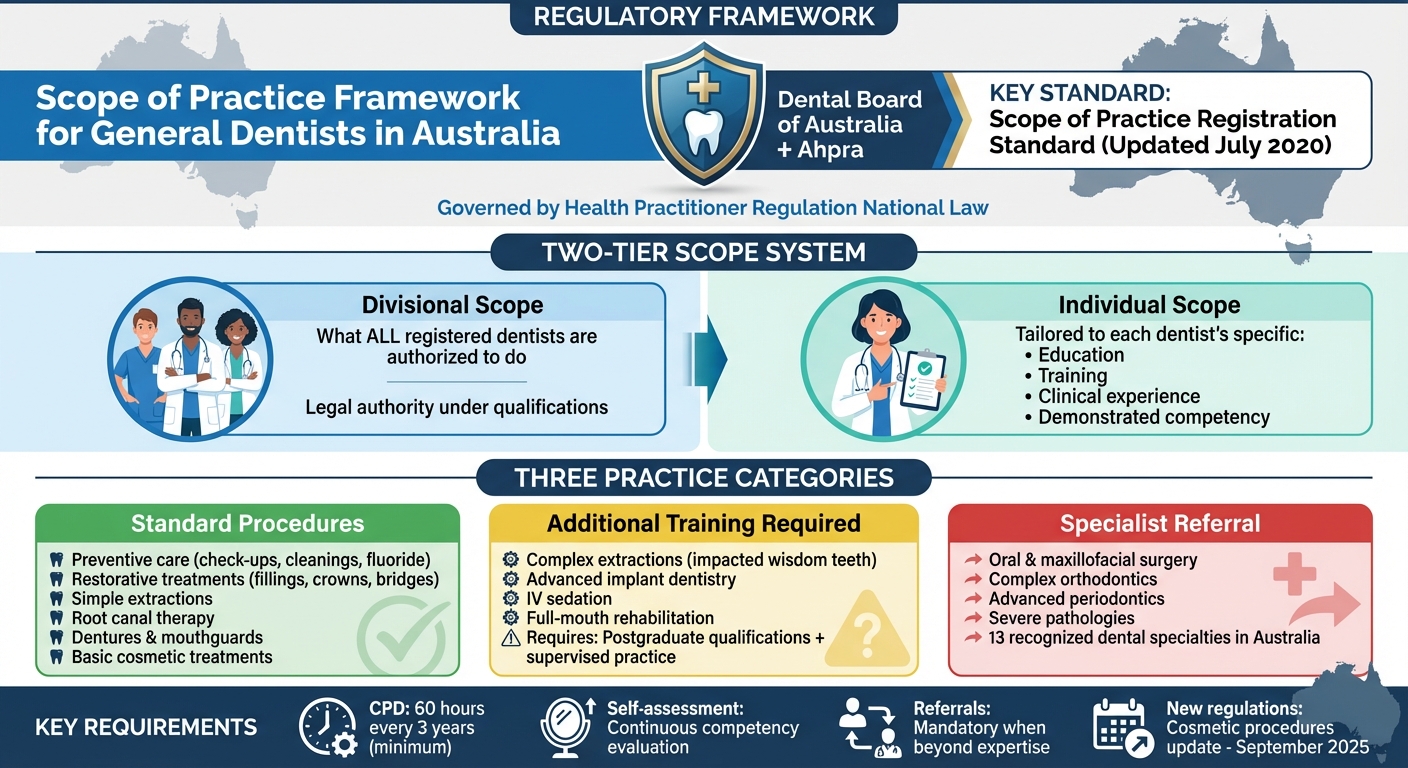
Scope of Practice Framework for General Dentists in Australia
What Is Scope of Practice for General Dentists?
Definition and Purpose
The Dental Board of Australia defines scope of practice as "the full range of activities and responsibilities which individuals within the profession are educated, trained and competent to perform" [2][4]. For general dentists, this includes all activities permitted by law and sets clear boundaries between their duties and those of other dental professionals [1][2].
This definition plays an essential role in ensuring patient safety. By clearly outlining what dentists can and cannot do, it helps maintain high standards of care. Dentists are expected to operate only in areas where they have proven competence, which not only protects patients but also guides professional decision-making. For instance, dentists must decide whether to perform a treatment, pursue further training, or refer the patient to a colleague who has the required expertise.
The scope is divided into two levels: divisional scope and individual scope. The divisional scope defines what all registered dentists are authorised to do under their qualifications. Meanwhile, the individual scope is tailored to each dentist’s specific education, training, and clinical experience [1][2]. Even if a procedure falls under the divisional scope, a dentist must evaluate whether it aligns with their personal capabilities before proceeding.
These principles are enforced through detailed regulations, which are outlined below.
Regulatory Framework
The scope of practice for dentists operates under a well-defined regulatory framework. This framework is based on the Health Practitioner Regulation National Law, which is enforced by the Dental Board of Australia in collaboration with the Australian Health Practitioner Regulation Agency (Ahpra). Central to this is the Scope of Practice Registration Standard, which mandates that registered dentists practise only within the limits of their education, training, competence, and experience [2][4][6]. This standard helps dentists determine when they can perform specific procedures and when they should refer patients or pursue additional qualifications.
Certain activities are further restricted by law. Under Section 121 of the National Law, only registered dental practitioners are allowed to perform "restricted dental acts" [1]. This ensures that unregistered individuals, regardless of their training or experience, are legally barred from carrying out these procedures.
The regulatory framework is not static – it evolves to address new developments. For example, Ahpra recently introduced updated requirements for non-surgical cosmetic procedures performed by dental practitioners, which will take effect in September 2025 [5]. To stay compliant, dentists must regularly review Dental Board publications and participate in professional development activities to keep up with these changes.
Permitted Procedures and Restricted Activities
Procedures General Dentists Can Perform
In Australia, general dentists are authorised to perform a variety of procedures within the scope of dental practice as defined by Section 121 of the Health Practitioner Regulation National Law [1][2][8][9]. These procedures cover a broad spectrum of preventive, restorative, and minor surgical treatments.
Preventive care includes routine check-ups, scaling, fluoride treatments, fissure sealants, and oral health education to help maintain good dental hygiene [1][2]. In terms of restorative treatments, general dentists handle fillings for decay or trauma, as well as creating inlays, onlays, crowns, and bridges [1][2]. They can also carry out minor oral surgery, such as simple tooth extractions, incision and drainage for straightforward infections, and select soft-tissue procedures [1][8].
Other services provided by general dentists include root canal therapy for both single and multi-rooted teeth, designing and fitting full and partial dentures, creating splints and mouthguards, performing non-surgical periodontal therapy, and offering cosmetic treatments like teeth whitening, veneers, and aesthetic bonding [1][2]. Newly qualified dentists are generally expected to manage comprehensive examinations, routine restorations, uncomplicated extractions, basic periodontal care, straightforward root canals for single-rooted teeth, and common dental emergencies [1][7].
While these procedures fall within the general practice domain, certain treatments require additional training and qualifications.
Procedures Requiring Additional Qualifications
For more complex procedures, dentists must pursue advanced training, mentorship, or postgraduate education to ensure safe and effective treatment [1][2][9]. For example, complex extractions – such as removing impacted wisdom teeth near critical structures – often require additional skills and knowledge [8]. Similarly, advanced implant dentistry, which includes techniques like sinus lifts and ridge augmentation, demands structured education, though simpler single-tooth implants may be performed by appropriately trained general dentists [1][8].
Orthodontic treatment for severe malocclusions is typically referred to orthodontists [8][3], while oral and maxillofacial surgery for conditions like facial fractures, complex pathologies, or tumour removal is handled by specialists [8][3]. Other procedures, such as advanced periodontics (including regenerative surgeries and complex grafting), full-mouth prosthodontic rehabilitation, and specialised paediatric dentistry for children with medical complexities, are also best left to specialists [1][8][3].
General dentists must understand their limits and refer patients when a case exceeds their expertise or the reasonable scope of general practice [1][8]. While many procedures are legally allowed, it’s crucial for dentists to assess their own training and experience honestly to ensure they can perform treatments safely and effectively.
How Training and Experience Shape Individual Practice
Education and Professional Development
The education dentists receive in Australia lays the groundwork for the procedures they perform confidently in their practice. General dentists typically complete an accredited Bachelor of Dental Surgery (BDS) or Doctor of Dental Medicine (DMD), equipping them to handle routine tasks like examinations, fillings, scaling, and basic extractions [1][2][7].
The Australian Dental Council (ADC) outlines core competencies for new dental practitioners in three key areas: professionalism, communication and collaboration, and critical thinking [7]. These competencies establish a baseline, but a dentist’s scope of practice expands through further education and structured training programs.
For more advanced procedures – such as complex implant dentistry, orthodontics, or intravenous sedation – dentists must pursue postgraduate qualifications that include supervised, hands-on training beyond standard CPD [2][4]. The Dental Board of Australia (DBA) emphasises that while CPD is essential for maintaining and refining skills, it cannot replace the foundational training required for high-risk treatments [2][4].
The DBA requires dentists to complete at least 60 hours of CPD every three years. However, it is up to each practitioner to critically evaluate whether their training adequately prepares them for specific procedures [4][9]. Beyond formal education, practical, supervised experience is crucial for honing these skills.
Clinical Experience and Demonstrated Competency
Experience alone does not equate to competence in handling complex dental cases. What matters is demonstrated competency and the ability to manage complications safely [1][4][7].
While formal education provides the foundation, real-world experience sharpens a dentist’s skills. Supervised clinical practice helps dentists build confidence and proficiency over time. For example, a newly qualified dentist might focus on simple single-rooted extractions, while a more experienced practitioner, with proper mentoring, may handle multi-rooted extractions or provisional crown preparations [1][7]. However, this progression must be gradual, with dentists continually assessing their own abilities rather than assuming that experience alone guarantees competence [1][4].
To ensure safe practice, the DBA and ADA recommend that dentists define their personal scope of practice by maintaining detailed records of their CPD activities, clinical cases, and outcomes. Peer reviews and clinical audits are also encouraged as part of this process [4][7].
When a case falls outside a dentist’s training or experience, referral to a specialist is not just recommended – it’s mandatory [1][8][4]. Attempting procedures beyond one’s scope can lead to disciplinary action and, more importantly, risks patient safety [1][2][4].
sbb-itb-2be92ed
Referrals and Working with Other Dental Professionals
When to Refer Patients to Specialists
Knowing when to refer a patient is a cornerstone of safe and effective dental care. According to the Dental Board of Australia’s Scope of Practice Registration Standard, dentists are required to refer or delegate care when a patient’s needs go beyond their expertise [1][9]. Similarly, the Ahpra Code of Conduct emphasises that practitioners must operate within their own skill set and initiate referrals as needed [1].
In certain situations – particularly those involving advanced or high-risk cases – referrals become essential. These include complex endodontic treatments, severe periodontal disease, suspected oral pathologies, difficult extractions, comprehensive orthodontic work, and cases requiring advanced sedation [2][8]. Referring such cases ensures patients receive the most appropriate care from specialists with the necessary expertise.
Australia has a well-defined system of 13 recognised dental specialties, which provides a clear pathway for referrals from general practitioners to specialists. These specialties include fields like endodontics, orthodontics, periodontics, oral and maxillofacial surgery, and prosthodontics [2][8][3]. Since the updated standard took effect on 1 July 2020, formalised referral networks between general dentists and specialists have become more prevalent. This not only enhances the quality and continuity of care but also ensures compliance with regulatory standards [2][8][6].
To facilitate smooth transitions to specialist care, it’s considered best practice to establish written referral protocols and build trusted networks of preferred specialists. Every referral should include detailed clinical notes, diagnostic imaging, and clear objectives for treatment [2][8][9]. Such preparation helps streamline the specialist’s work and reflects a high level of professional responsibility.
Collaboration with other dental professionals is equally important in providing comprehensive care.
Working with Dental Hygienists and Therapists
In addition to specialist referrals, general dentists often collaborate with a multidisciplinary team to deliver the best outcomes for their patients. The Dental Board of Australia and Ahpra stress the importance of effective communication and documented handovers as part of safe, patient-centred care [1][9][6]. Dentists frequently work alongside dental hygienists, dental therapists, oral health therapists, and dental prosthetists, each operating within their defined scope of practice.
Dental hygienists, therapists, and oral health therapists focus on preventive and basic restorative care, escalating more complex issues to the dentist when necessary. When delegating tasks to these professionals, dentists must ensure the work aligns with the recipient’s qualifications and expertise. Proper handovers should include clear instructions, recall schedules, and any warning signs that might require immediate attention [1][9].
Under Section 121 of the National Law, it is strictly prohibited for dentists to direct unqualified or unregistered individuals to perform restricted procedures. Failure to delegate responsibly can lead to disciplinary actions from AHPRA, potential loss of registration, or liability for patient harm [1][9].
Delegation and teamwork are integral to a dentist’s scope of practice, ensuring patients receive well-rounded care. The regulatory updates introduced in 2020 were designed to enable every dental practitioner to maximise their skills while maintaining accountability for safe decision-making, whether through referrals or task delegation [8][6]. This approach supports a collaborative environment across all divisions of dental professionals, ensuring optimal patient outcomes [1].
Recent Changes to Scope of Practice Guidelines
On 1 July 2020, the Dental Board of Australia introduced a major update to the Scope of Practice Registration Standard. Instead of sticking to a fixed list of approved procedures, the new approach is built around a competency-based framework [6]. This means dental practitioners are now responsible for evaluating their own education, training, and experience before performing any restricted dental acts [1][2]. According to the Dental Board, the update "enables all dental practitioners to exercise their full scope of practice" [6]. This shift emphasises personal accountability and redefines the training needed for expanding one’s practice.
For general dentists, this change aligns with the broader regulatory focus on accurate self-assessment of clinical skills. The Australian Dental Association highlights that while the standard outlines a baseline scope for all general dentists, performing more advanced or specialised procedures falls under what’s called a "programme to extend scope" [2]. This is particularly relevant in the field of cosmetic dentistry. Continuing Professional Development (CPD) alone is not enough for dentists to take on higher-risk treatments [2][4]. Instead, they must complete accredited courses, formal postgraduate studies, or mentored training before independently carrying out procedures like implant dentistry or complex endodontic work.
Another significant change introduced in 2020 was the removal of the requirement for a structured professional relationship for dental hygienists, dental therapists, and oral health therapists. This change allows these professionals to practise independently [1]. By July 2022, allied dental practitioners were also granted eligibility for individual provider numbers, which has improved referral processes and strengthened collaboration within dental practices [1].
Looking ahead, new Ahpra guidelines for non-surgical cosmetic procedures are set to come into effect in September 2025 [5].
Conclusion
In Australia, maintaining a clear scope of practice is essential for ensuring safe and high-quality dental care. General dentists are expected to perform procedures only within their proven skill set, regularly assessing their abilities and referring patients to specialists when necessary.
A competency-based framework now provides opportunities for dentists to broaden their practice through accredited programmes, formal postgraduate education, or guided training. The Australian Dental Association emphasises that failure to comply with scope standards can lead to disciplinary actions [1][2][4]. This highlights the clinical and legal responsibilities that apply uniformly across all Australian states and territories.
This regulatory framework also plays a crucial role in building patient trust. When dentists operate within their defined scope, they communicate transparently about their qualifications and limitations, helping patients make informed decisions with realistic expectations about treatment outcomes. Collaborative efforts between general dentists, specialists, hygienists, and therapists further enhance the quality of care provided to patients.
The scope of practice is not about limiting what dentists can do but ensuring that every procedure is performed by someone with the right expertise. By staying informed about regulatory updates, carefully documenting their skills, and making appropriate referrals, general dentists uphold the standards that safeguard both patients and the profession. A commitment to continuous learning and professional growth ensures that dental care evolves to meet the changing needs of patients while maintaining the highest quality standards.
FAQs
What types of procedures are general dentists in Australia qualified to perform?
General dentists in Australia are equipped to handle a variety of everyday dental treatments that are part of their standard practice. These services include oral check-ups, professional teeth cleaning, fillings, tooth extractions, and preventive care to help maintain oral health.
They can also perform treatments like fluoride applications, basic restorative procedures, and offer guidance on keeping your teeth and gums healthy. However, for more advanced or specialised dental work, they may either pursue further training or refer patients to a dental specialist.
When should a general dentist in Australia refer a patient to a specialist?
When a general dentist in Australia encounters a case that exceeds their expertise or scope of practice, it’s essential to refer the patient to a specialist. This often applies to treatments involving complex procedures like orthodontics, oral surgery, or advanced endodontics. Additionally, if a patient’s condition requires specialised attention to guarantee both safety and effective care, a referral becomes necessary.
Referrals are also warranted when a case demands specific equipment, techniques, or specialised knowledge that a general dentist may not have access to. This ensures the patient benefits from the best possible care. Professional regulations guide dentists to always prioritise patient safety and well-being in such circumstances.
What is the scope of practice for general dentists in Australia under current regulations?
The scope of practice for general dentists in Australia is carefully regulated to ensure patients receive safe and evidence-based treatment. Dentists are equipped to handle a variety of procedures, ranging from routine preventive care and restorative work to more advanced tasks like root canals and minor oral surgeries. However, they are required to stay within their areas of expertise and refer patients to specialists when a case falls outside their skill set.
Recent regulations place a strong focus on patient safety, proper delegation of tasks, and strict adherence to professional standards established by the Dental Board of Australia and AHPRA. These guidelines not only protect patients but also ensure that care is tailored to individual needs, while maintaining a clear distinction between general dentistry and specialised fields.
Related Blog Posts
- Scope of Practice for Dental Hygienists in Australia
- Teledentistry Guidelines in Australia
- Scope of Practice for Dental Therapists in Australia
- Dental Hygienist Career Outlook in Australia
Important Notice: Any surgical or invasive procedure carries risks. Before proceeding, you should seek a second opinion from an appropriately qualified health practitioner.
Individual results may vary. The information provided in this article is for educational purposes only and does not constitute medical advice.
Checkout Related Blogs




Get in touch with us
For more information, call us now to start feeling better. Or fill the form below to make appointment
The Latest News from Complete Smiles
How to Clean Clear Plastic Retainers
Checklist for Choosing Wearable Dental Devices
Checklist for Choosing Cloud AI Platforms in Dentistry

Complete Smiles Bella VistaAccepts All Major Health Funds, Including





