





Scope of Practice for Dental Hygienists

Dental hygienists in Australia focus on preventive and clinical oral health care within regulated boundaries. Their scope of practice is defined by the Dental Board of Australia, ensuring they only perform tasks they are trained and authorised to handle. Key responsibilities include:
- Preventive care such as scaling, fluoride application, and oral hygiene education.
- Clinical support like oral examinations, radiographs, and periodontal assessments.
- Administering local anaesthesia and performing minor procedures like temporary fillings.
While hygienists can work independently without formal supervision from dentists, they must stay within their professional limits and refer patients for advanced treatments like surgical extractions or orthodontics. Registration with the Dental Board of Australia and completion of 60 CPD hours every three years is mandatory to maintain professional standards. This ensures safe, effective care and supports ongoing skill development.
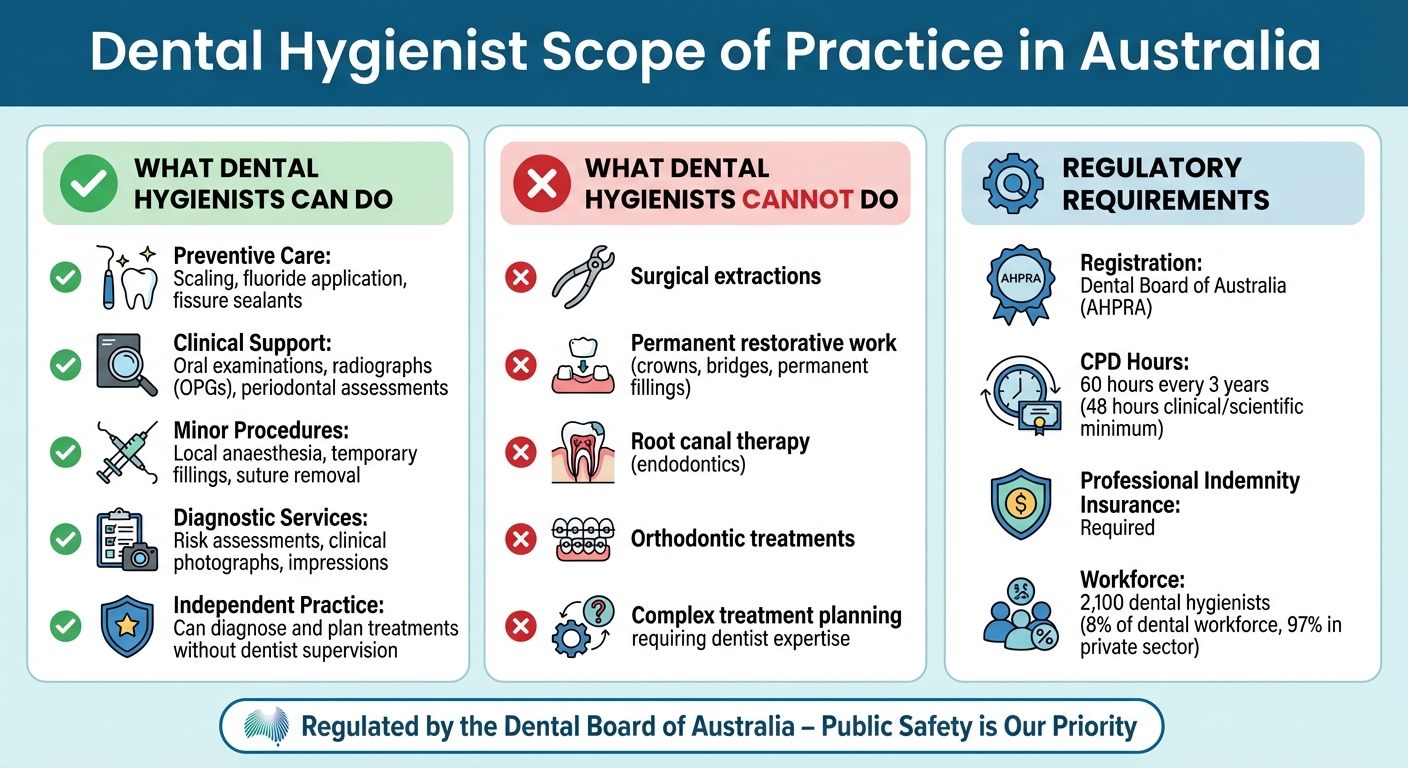
Dental Hygienist Scope of Practice in Australia: Key Responsibilities and Restrictions
Q&A! | FROM A DENTAL HYGIENIST/ORAL HEALTH THERAPIST | EMMATALKSTEETH
sbb-itb-2be92ed
What Dental Hygienists Are Authorised to Do
Dental hygienists in Australia play a crucial role in maintaining and promoting oral health. Their responsibilities are clearly outlined by the Dental Board of Australia, ensuring they work within regulated guidelines. Every procedure they perform aligns with the Dental Board’s standards, focusing on both prevention and clinical support.
Preventive Care Services
A significant part of a dental hygienist’s work revolves around preventing dental issues and encouraging healthy oral habits. This includes procedures like scaling and root debridement (above and below the gumline), fluoride applications, and placing fissure sealants to guard against tooth decay. They also offer personalised oral hygiene advice, dietary tips to minimise cavity risks, and smoking cessation guidance.
Beyond these, hygienists can perform additional tasks such as administering local anaesthesia (including infiltration and inferior alveolar nerve blocks), placing temporary fillings, applying tooth whitening products, and removing sutures when necessary.
Diagnostic and Clinical Support
Hygienists also provide vital diagnostic and clinical services. They carry out thorough oral examinations and periodontal assessments to evaluate gum health. They are qualified to capture intraoral and extraoral images, including panoramic radiographs (OPGs), which assist in treatment planning. Other responsibilities include conducting risk assessments, taking clinical photographs, and creating impressions and study models.
Notably, dental hygienists can independently diagnose and plan treatments. With around 2,100 dental hygienists representing about 8% of Australia’s regulated dental workforce, they play a key role in patient care. Most of these professionals – 97% – work in the private sector, contributing significantly to oral health services [1].
Working Independently and With Other Dental Professionals
Dental hygienists in Australia now have more freedom in their professional practice than ever before. However, with this independence comes a heightened sense of responsibility. The regulatory environment has shifted to focus on individual competence while still prioritising the importance of teamwork in patient care. Key changes in regulations highlight this evolving landscape.
Changes in Regulatory Requirements
One major regulatory update has been the removal of the structured professional relationship requirement. Previously, dental hygienists were required to have a formal, documented agreement with a dentist before they could practise. This change now allows hygienists to work independently, without needing predefined oversight from a supervising dentist.
That said, this independence comes with clear boundaries. According to the Dental Board of Australia’s "Scope of Practice Registration Standard", hygienists must only perform procedures they are educated, trained, and competent to handle [2]. This places the onus on individual practitioners to regularly assess their own skills and ensure they stay within their professional limits.
Referral and Collaborative Care
Even with increased autonomy, collaboration remains a cornerstone of effective dental care. Hygienists are required to refer patients to dentists or specialists when cases fall outside their expertise. This is not just a regulatory requirement but also an ethical one, ensuring patient safety and optimal care [2].
To facilitate this, hygienists are encouraged to establish clear referral pathways with local dentists and specialists. These pathways ensure smooth transitions for patients who require more complex treatments. The Dental Board of Australia underscores the importance of this teamwork, stating:
Public safety is our priority.
While formal oversight arrangements are no longer mandatory, maintaining a collaborative care model is still crucial. This approach ensures that patients receive comprehensive and seamless oral health care, reinforcing the balance between independence and teamwork in the profession.
What Dental Hygienists Cannot Do
Procedures That Require a Dentist
Dental hygienists operate within specific legal and professional boundaries. According to the Health Practitioner Regulation National Law, certain ‘restricted dental acts’ are reserved exclusively for dentists or dental specialists. These restrictions cover procedures that involve permanent changes to the structure of the mouth. For instance, surgical extractions – where gum tissue or bone must be cut – fall under the dentist’s domain. Likewise, advanced restorative work like crowns, bridges, or permanent fillings, as well as endodontic therapy (root canals) and orthodontic treatments for misaligned teeth or jaws, are outside a hygienist’s scope. While hygienists are instrumental in spotting oral health concerns, tasks like formal diagnoses and creating comprehensive treatment plans are the responsibility of dentists [5]. This distinction ensures that hygienists practise safely and within their professional limits.
Understanding Your Professional Boundaries
Knowing and respecting professional boundaries is crucial for safe and effective practice. The Dental Board of Australia requires hygienists to perform only those tasks they have been trained and deemed competent to handle. On 20 December 2024, the Dental Board updated its ‘Know your scope’ guidance, emphasising the importance of regularly evaluating one’s clinical skills and understanding limitations [3][4]. Hygienists must refer patients needing surgical extractions or complex restorative work to a dentist or specialist [5]. This approach helps maintain high standards of care and patient safety.
Growing Your Skills Through Continuing Professional Development
Continuing Professional Development (CPD) helps dental hygienists stay up to date with the latest clinical techniques while ensuring they practise safely and effectively. The Dental Board of Australia requires CPD to ensure practitioners maintain sharp clinical skills and current knowledge throughout their careers [4]. This ongoing learning not only enhances clinical expertise but also ensures compliance with regulatory standards, such as mastering advanced scaling techniques or using new diagnostic tools.
Required CPD Hours
CPD is essential for keeping your practice compliant and up to date. In Australia, dental hygienists must complete 60 hours of CPD over a three-year cycle to maintain professional registration. Of these, at least 48 hours (80%) must focus on clinical or scientifically based activities, while up to 12 hours (20%) can cover non-scientific areas like practice management or communication skills [4][6]. If you’re registering for the first time or reinstating your registration, your required hours will be adjusted on a pro-rata basis [6].
It’s important to keep thorough records of your CPD activities, including the provider’s name, activity title, date and location, hours completed, and whether the activity was scientific or non-scientific. These records may be audited by the Board [6].
Training Options for Skill Development
CPD isn’t just about meeting minimum hours – it’s an opportunity to expand your clinical expertise. Activities such as seminars, workshops, clinical training, or self-directed study are all valid options, provided they have clear learning objectives and directly relate to your practice. Prioritise CPD that enhances your existing skills or safely broadens your scope of practice. For instance, advanced scaling techniques, radiography certification, or updated infection control protocols are highly relevant choices.
To ensure your CPD aligns with your professional scope, consult the Board’s "Know Your Scope" resources [3][4]. A balanced approach – combining clinical training with non-clinical education like ethics or patient communication – can support well-rounded professional growth. This tailored training helps you stay confident and competent within your defined practice boundaries.
Meeting Regulatory and Ethical Standards
In Australia, dental hygienists operate under strict regulatory and ethical standards to ensure safe and professional practice. These rules not only protect patients but also uphold the integrity of the profession by ensuring only qualified individuals provide oral health care.
Registration and Licensing Requirements
To practise legally, dental hygienists must register with the Dental Board of Australia through AHPRA. Maintaining active registration is essential to use the title "Dental Hygienist" and perform clinical procedures [7][8]. Registration requirements include:
- Holding Professional Indemnity Insurance (PII).
- Demonstrating recency of practice.
- Passing a criminal history check [7].
For overseas-trained practitioners, additional steps are required, such as meeting English language proficiency standards. This typically means achieving an IELTS Academic score of 7.0 in each band or a minimum B grade in each component of the OET [8].
Since dental hygienists often take radiographs, they must also follow state-specific radiation licensing laws [9]. Registration standards must be confirmed annually, and compliance is subject to AHPRA audits. Practitioners and employers are encouraged to keep detailed records of PII certificates and other required documents. Regularly checking the AHPRA Register of Practitioners ensures registration is current and identifies any conditions or restrictions [7].
Professional Accountability and Oversight
Registration is just the first step; maintaining ethical and professional standards is an ongoing responsibility. The Dental Board of Australia plays a key role in ensuring public safety by enforcing these standards. As the Board explains:
The Dental Board of Australia works to ensure that Australia’s dental practitioners are suitably trained, qualified and safe to practise. Public safety is our priority [4].
This oversight includes a notification system for managing complaints or concerns about professional misconduct or competence [2]. Practitioners must also follow ethical guidelines, including infection prevention protocols and the Aboriginal and Torres Strait Islander Health and Cultural Safety Strategy, which aims to address racism in healthcare [4].
Under the National Law, practitioners are required to report "notifiable conduct" to protect the public from harm [4]. For those facing health or professional challenges, the Dental Practitioner Support service offers confidential, 24/7 assistance [4]. Additionally, the Board may impose conditions or restrictions on a practitioner’s registration, with these measures transparently displayed on the national register [4].
Conclusion
Grasping the scope of practice for dental hygienists is key to ensuring safe and effective oral health care across Australia. This scope is shaped by their education, training, and proven skills, allowing them to operate within their professional limits while delivering crucial preventive care.
Dental hygienists serve as key preventive specialists, concentrating on the prevention and management of oral diseases through both clinical treatments and patient education. By working alongside dentists and other oral health professionals, they contribute to a team-based approach that enhances patient outcomes.
Keeping registration with the Dental Board of Australia through AHPRA is more than just a formality; it reflects a commitment to professional responsibility and the safety of the public. As the Dental Board of Australia emphasises:
"The Dental Board of Australia expects dental practitioners to practise in a way that maintains and enhances public health and safety." [4]
FAQs
Can a dental hygienist work without a dentist in Australia?
In Australia, dental hygienists play a key role in preventive and diagnostic dental care. While they can carry out certain procedures on their own, they usually work as part of a broader dental team. Importantly, they must collaborate with or work under the supervision of a dentist and are not allowed to practise completely independently.
When should a hygienist refer me to a dentist or specialist?
When a dental hygienist encounters an issue beyond their expertise – like tooth decay that requires a filling or more complex conditions – they’ll refer you to a dentist or specialist. These referrals might involve orthodontic treatments, surgical procedures, or restorative care. This process ensures you get the right treatment from qualified professionals, adhering to Australian regulations and the standards set by the Dental Board of Australia.
What counts as CPD for a dental hygienist in Australia?
In Australia, Continuing Professional Development (CPD) is essential for dental hygienists to stay current and enhance their expertise. Over a three-year cycle, practitioners must complete at least 60 hours of CPD. Of these, a minimum of 80% should focus on clinical or scientific areas, such as hands-on training, accredited courses, or evidence-based self-study. The remaining 20% can address non-scientific skills like effective communication or practice management.
It’s important for practitioners to maintain detailed records of their CPD activities, as these may be required for audits.
Related Blog Posts
- Scope of Practice for Dental Hygienists in Australia
- Scope of Practice for Dental Therapists in Australia
- Dental Hygienist Career Outlook in Australia
- Scope of Practice for General Dentists in Australia
Important Notice: Any surgical or invasive procedure carries risks. Before proceeding, you should seek a second opinion from an appropriately qualified health practitioner.
Individual results may vary. The information provided in this article is for educational purposes only and does not constitute medical advice.
Checkout Related Blogs




Get in touch with us
For more information, call us now to start feeling better. Or fill the form below to make appointment
The Latest News from Complete Smiles
How to Clean Clear Plastic Retainers
Checklist for Choosing Wearable Dental Devices
Checklist for Choosing Cloud AI Platforms in Dentistry

Complete Smiles Bella VistaAccepts All Major Health Funds, Including





