





Prohibited Dental Ads: Key Rules in Australia
Did you know? In Australia, dental advertising is heavily regulated to protect public health and trust. Non-compliance can lead to fines of up to $5,000 for individuals and $10,000 for corporations per offence, along with potential disciplinary actions.
Here’s what you need to know:
- False or Misleading Claims: Every claim in ads must be evidence-based. Misleading statements like "pain-free" or "guaranteed results" are prohibited.
- Testimonials: Patient reviews about clinical outcomes are banned, even on social media.
- Inducements: Discounts or offers must include clear terms and conditions upfront.
- Unrealistic Expectations: Ads cannot promise guaranteed or exaggerated treatment outcomes.
- Specialist Titles: Only registered specialists can use terms like "specialist" or "specialises in".
- Surgical Ads: Must include a mandatory warning: "Any surgical or invasive procedure carries risks. Before proceeding, you should seek a second opinion from an appropriately qualified health practitioner."
- Data Privacy: Marketing must comply with the Privacy Act 1988, ensuring patient data is secure and used responsibly.
Why does this matter? Breaching these rules is a criminal offence under the National Law, with serious financial and professional consequences. By focusing on clear, accurate, and compliant advertising, dental practices can build patient trust and avoid penalties.
Keep reading for practical tips to stay compliant and protect your practice.
1. False or Misleading Claims
AHPRA has strict rules against false, misleading, or deceptive advertising in the dental industry. According to Australian law, any statement that creates a false impression about dental services is considered a breach [6].
Interestingly, research shows that 52% of general dental practice websites featured false or misleading information, and 85% of these websites failed to meet at least one legal or regulatory advertising requirement [7]. These numbers highlight how common non-compliance is and the significant need for improvement in advertising practices.
What Makes a Claim False or Misleading?
For a claim to be valid, it must be backed by evidence at the time it is made [6]. Misleading advertising often results from leaving out key details. For example, promoting treatment prices without mentioning extra consultation fees or follow-up costs can mislead patients. Similarly, burying crucial information in fine print that contradicts the ad’s main message is also considered deceptive [6].
Common Examples of Prohibited Claims
One of the most frequent issues involves unsupported benefit claims. Statements like treatments being "pain-free", "risk-free", or universally "effective" are problematic unless solid evidence supports them [9]. Another common violation involves unproven results, such as guaranteeing specific aesthetic outcomes or pain relief without proper validation [6].
A high-profile case from another industry serves as a reminder of the severe consequences for making misleading claims. These examples reinforce the importance of ensuring every statement in advertising is accurate and evidence-based – a standard that all dental practices must adhere to.
Practical Compliance Strategies
To stay compliant, it’s helpful to view advertisements from the patient’s perspective. AHPRA advises ensuring that claims provide enough information for patients to make well-informed decisions [4]. If evidence doesn’t fully support a claim, it’s better to leave it out altogether to avoid misleading patients [4].
Practices should also keep documentation to back up every claim. The language used in ads is equally important – avoid making absolute guarantees. For instance, instead of saying treatments are "completely painless", it’s more accurate to state that efforts are made to "minimise discomfort" or "reduce pain wherever possible" [9].
"To keep the public safe from false or misleading claims and to help them make informed choices about their healthcare." – AHPRA’s Advertising: Strategy [4]
This statement sums up the purpose of these regulations perfectly. The goal is to protect patients and ensure they can make informed decisions, not to hinder legitimate marketing. By focusing on accuracy and transparency, dental practices can comply with the rules while also earning patient trust. The next section will explore other important compliance topics, such as the use of testimonials and inducements.
2. Testimonials and Patient Reviews
In Australia, using patient testimonials in dental advertising is strictly forbidden under the law. This restriction applies universally, covering clinic websites, social media, TV, radio, and other promotional platforms [8]. The rule is part of a broader effort to prevent misleading claims and ensure compliance with advertising standards.
Understanding the Complete Ban
The Australian Health Practitioner Regulation Agency (AHPRA) enforces a complete ban on dental patient testimonials across all platforms. This includes not only testimonials displayed on your own channels but also those quoted from external websites or social media [8].
The rationale behind this ban is straightforward: clinical testimonials can mislead patients into relying on unqualified advice instead of seeking proper professional consultations. It’s important to understand what constitutes a prohibited testimonial to avoid breaching these regulations.
What Counts as a Clinical Testimonial?
Not every positive comment about a dental practice is considered a prohibited testimonial. AHPRA makes a clear distinction between clinical and non-clinical feedback. Here’s an example:
"Not all reviews or positive comments made about a regulated health service are considered testimonials. For example, comments about customer service or communication style that do not include a reference to clinical aspects are not considered testimonials for the purpose of the National Law." [10]
In essence, reviews that discuss clinical details – such as treatment specifics, outcomes, or practitioner expertise – are classified as testimonials and are therefore banned. On the other hand, comments about non-clinical aspects like customer service or communication style fall outside the scope of this prohibition.
The Compliance Reality
Despite the clear guidelines, non-compliance remains an issue. Research reveals that 11.5% of general dental practice websites and a staggering 76.9% of specialist social media platforms violate these rules [7]. Between 2011 and 2016, advertising-related complaints made up 2.5–23.8% of all complaints lodged with AHPRA against dental professionals [7].
Financial Penalties and Enforcement
Violations of these testimonial rules can lead to hefty fines, as previously discussed. AHPRA prioritises enforcement against testimonials that pose the greatest risks – those that are false, misleading, or deceptive, offer gifts or inducements without clear terms, create unrealistic expectations of treatment outcomes, or promote unnecessary health services [10]. These measures highlight the importance of adhering to compliant advertising practices.
Practical Compliance Strategies
Instead of encouraging patients to leave testimonials on your platforms, direct them to independent forums where they can freely share their experiences [8]. If your practice collaborates with influencers, ensure their comments are strictly limited to non-clinical aspects of their experience. Include clauses in influencer agreements that allow for modifications to ensure compliance with the National Law [10].
The Australian Dental Association echoes these guidelines in Policy Statement 6.9, stressing that dental advertising must be "accurate, clear and balanced" [1]. By focusing on factual, non-clinical information, dental practices can stay within legal boundaries while effectively engaging with potential patients. This understanding of testimonial restrictions sets the stage for addressing other advertising challenges, such as unauthorised inducements.
3. Inducements and Discounts
Promotions and discounts in dental advertising can become a legal minefield if the terms aren’t clearly outlined. Under Australian law, it’s illegal to offer discounts or gifts without fully disclosing the associated terms and conditions [3]. The issue isn’t the discount itself but the lack of transparency surrounding how it works. When advertising any deals, it’s mandatory to clearly state the terms and conditions upfront [5]. Without this, patients might be misled into making healthcare decisions based on incomplete or unclear information.
As with all advertising practices, complete transparency is key to staying compliant with AHPRA guidelines.
The "Free" Offer Dilemma
One common pitfall involves promoting "free" services. A typical example is offering a "free check-up and clean", which turns misleading if the costs are hidden by inflating prices for other services [3]. This approach creates the illusion of a free service when, in reality, the expense is simply shifted elsewhere. However, this type of offer is acceptable if all the relevant details and conditions are fully disclosed [3].
Frequent Compliance Issues
Many dental practices struggle with meeting disclosure requirements. For instance, advertising discounts online without providing clear and easily accessible terms is a common breach of compliance [7]. These problems often arise when key details are buried in fine print or made difficult to locate. Terms and conditions aren’t just a legal box to tick – they must be readily available and easy to understand [5].
Tips for Staying Compliant
To avoid legal trouble, be upfront and transparent when advertising discounts or gifts, and clearly outline any limitations or conditions [3]. This includes specifying exactly what the offer includes, what it excludes, any timeframes, eligibility criteria, and whether other services are required. It’s also critical to avoid using language that could be misinterpreted [3].
By prioritising clarity, you not only meet legal requirements but also set realistic expectations for patients.
Financial Penalties
Non-compliance can lead to fines of up to $5,000 per offence for individuals, with the potential for disciplinary actions regarding registration [4]. Additionally, breaches may prompt investigations by bodies like the ACCC or TGA [4], exposing practices to scrutiny from multiple regulators.
"The goal of these regulations is, according to AHPRA’s Advertising: Strategy legislation and guidelines, ‘to keep the public safe from false or misleading claims and to help them make informed choices about their healthcare.’" [4]
This enforcement approach highlights the protective intent behind these rules. Understanding how to handle inducements and discounts is a crucial step toward tackling the next compliance challenge: managing patient expectations about treatment outcomes.
4. Unrealistic Treatment Expectations
Dental advertisements in Australia must steer clear of promising unrealistic outcomes, as this violates the law. Ads should never create an unreasonable expectation about the results of a treatment. From a patient’s perspective, any claims made in advertising should be carefully evaluated to ensure they don’t imply exaggerated benefits. Misleading patients about treatment outcomes can lead to serious regulatory repercussions for practitioners [4].
The ‘Before and After’ Photo Ban
Using before and after photos in dental advertising is prohibited because these images can give the impression of guaranteed results [1]. Even with patient consent, practitioners must ensure that any visuals are authentic, unaltered, and do not lead to unrealistic expectations [10]. This restriction protects patients from being misled by overly optimistic portrayals of treatment outcomes [1].
Research Reveals Widespread Non-Compliance
According to a 2022 study, 33.9% of general dental websites were found to promote benefits that are likely unachievable. Additionally, 82.2% of these sites failed to mention risks or limitations associated with treatments [7]. These findings highlight a concerning trend of non-compliance within the industry.
Common Expectation Pitfalls
Similar to the guidelines on truthful advertising and transparent inducements, all claims in dental ads must be backed by evidence. A common mistake is focusing solely on best-case scenarios, which can unintentionally set unrealistic expectations. Avoid using terms like "magical" or "miraculous", or guaranteeing outcomes, as these can mislead patients. Advertising should always provide a balanced view, discussing both the benefits and the limitations of treatments [1].
Practical Compliance Strategies
To ensure compliance, practitioners should look at their advertisements through the eyes of a patient. Does the ad provide all the necessary information for an informed decision? Presenting clear, balanced, and accurate information is key. Before sharing third-party content, verify that it aligns with advertising regulations [4].
"When preparing their advertising, a health practitioner should always put the public first and ensure their advertising is not false, misleading or deceptive." – Martin Fletcher, AHPRA CEO [5]
This emphasis on realistic advertising naturally leads into the discussion of proper usage of specialist titles and qualifications in the sections that follow.
5. Misuse of Specialist Titles
Beyond adhering to rules on testimonials and discounts, dental advertising must also tackle the issue of specialist title misuse. Under Australian law, only dentists with proper specialist registration can use terms like "specialist", "specialises in", "specialty", or "specialised" in their advertising materials [5].
The Legal Distinction
It’s crucial for dental practitioners to grasp the legal difference between general practice and specialist advertising. Without the necessary specialist registration or endorsement from the Dental Board, using specialist terminology is considered unlawful [8]. Even phrases like "specialises in" are closely monitored, as they can suggest a level of expertise that may not be accurate [8]. These rules are designed to help patients easily differentiate between general practitioners and those with verified advanced training in a specific area.
Permitted Alternatives for General Practitioners
General practitioners can still highlight their skills without breaching the rules. Instead of claiming specialist status, they can use phrases like "special interest in" or "has substantial experience in" [5]. Such wording effectively communicates expertise without implying specialist qualifications. When listing your qualifications or memberships, ensure they are credible, current, and verifiable. Be transparent by including the full title of any award, the awarding organisation, and the date it was received [5].
Financial Consequences
The penalties for misusing specialist titles are no small matter. Individuals found in violation can face fines of up to $5,000, while corporations may be penalised as much as $10,000 [8]. Registered practitioners may also face disciplinary actions that could jeopardise their ability to practise. These strict measures reflect how seriously regulators take this issue. In fact, dental practitioners experience the highest complaint rate among 14 health professions, with 42.7 complaints per 1,000 practitioners annually [11]. Such statistics emphasise the importance of following the rules around title usage.
Practical Compliance Steps
To stay compliant, always verify your registration status and use titles that accurately represent your qualifications. For example, if you use the title "doctor", make it clear that you are a dentist [5][3].
"As a licensed medical practitioner, it is your responsibility to see to it that your advertisements meet the guidelines and do not go against any AHPRA regulations."
– Kristan Johnson, CEO, Altitude Digital [8]
Clearly outline your qualifications and complete the necessary specialist training before advertising any advanced skills [3]. When in doubt, stick to conservative language. This approach not only ensures compliance with advertising standards but also safeguards both your reputation and the trust of your patients.
6. Promoting Unnecessary Treatments
When it comes to dental advertising, it’s crucial to avoid promoting treatments that aren’t clinically necessary. Australian regulations make it clear: marketing that encourages unnecessary or indiscriminate use of health services is strictly banned[4]. This rule ensures that advertising practices are carefully monitored to protect patients from misleading or excessive promotional tactics.
The Scope of the Problem
Research highlights the extent of the issue. About 39.6% of dental practice websites promote services that may not be necessary, and a staggering 85.4% of cosmetic treatment ads present these procedures as universally beneficial[7]. This kind of messaging can mislead patients, pushing them toward treatments they might not need.
Prohibited Marketing Tactics
Certain marketing strategies are off-limits. For instance, avoid language that pressures patients to seek treatments just to "look better" or "feel confident." Similarly, using time-sensitive offers, vouchers, or online deals to drive demand is not allowed[8].
The Regulatory Intent
The primary goal of these guidelines is to protect patients. Misleading ads can compromise safety and prevent people from making informed choices about their care. By enforcing these rules, regulators aim to ensure patients have the information they need to make thoughtful decisions, free from unnecessary pressure or confusion[8].
Compliance Guidelines
To stay compliant, dental practices must ensure their advertising is clear, accurate, and balanced. Avoid exaggerated claims and focus on providing straightforward information that patients can easily understand. A good rule of thumb? Look at your advertising through the eyes of a patient. Does it offer all the essential details for an informed decision without setting unrealistic expectations?[4]
Keep marketing materials simple and factual. More detailed discussions about procedures can happen during consultations. Remember, practitioners are responsible for all content they share, even if it’s sourced from external providers or templates[4].
7. Surgical Procedure Warnings
In Australia, advertising for surgical or invasive dental procedures comes with strict requirements. One of the key regulations is the inclusion of a specific warning statement, ensuring patients are fully informed before making decisions about their care. This rule aims to promote transparency and patient safety in all promotional materials.
The Mandatory Warning Statement
Every advertisement must feature the following exact warning:
"Any surgical or invasive procedure carries risks. Before proceeding, you should seek a second opinion from an appropriately qualified health practitioner." [12]
This statement must appear exactly as written, serving as a clear reminder of potential risks associated with surgical or invasive treatments.
Placement and Visibility Requirements
The warning must be displayed prominently. It should never be relegated to fine print or hidden in hard-to-notice areas. Instead, the text should be as visible and noticeable as the primary content of the advertisement, ensuring patients can easily read and understand it.
Risk Disclosure Requirements
Beyond the mandatory warning, advertisements should also outline potential risks and any limitations of the treatment [1].
"Advertising of dental services or treatment should provide patients with information regarding the provision of services. It should be accurate, clear and balanced." – ADA Policy Statement 6.9 [1]
This approach ensures that advertisements present a balanced view, highlighting not just the benefits but also the possible risks. This helps patients make well-rounded decisions about their treatment options.
Enforcement and Consequences
Non-compliance with these advertising rules can result in significant penalties: up to $5,000 for individuals and $10,000 for organisations [4]. The Australian Health Practitioner Regulation Agency (AHPRA) actively monitors advertisements and investigates complaints to maintain public health standards [4].
Practical Implementation
To meet these requirements, include the warning statement in a prominent position within your advertisements. For example, if you’re promoting procedures like dental implants, wisdom tooth extractions, or jaw surgery, place the warning near the procedure description or close to any call-to-action elements. This applies to all advertising platforms, ensuring consistency and compliance across various mediums.
sbb-itb-2be92ed
8. Data Privacy in Marketing
When dental practices collect patient information for marketing, they must adhere to the Privacy Act 1988 and follow the Australian Privacy Principles (APPs) [13].
Legal Obligations Under the Privacy Act
The Privacy Act 1988 governs how dental practices handle personal information, ensuring all data – from email addresses to treatment histories – is managed according to strict legal standards [13]. Practices are required to safeguard patient data, preventing unauthorised access, modification, or disclosure [13].
Managing Risks in Marketing Data
To protect patient information, dental practices should implement a risk management plan that addresses privacy and security [13]. This plan must identify potential vulnerabilities, such as data breaches or cyber-attacks, and outline strategies like:
- Encrypting sensitive data
- Implementing access controls
- Conducting staff training programs
Regularly updating these measures ensures they remain effective against evolving threats and comply with current regulations.
Staying Compliant in Digital Marketing
Digital marketing comes with unique challenges. Practices should adopt measures like multi-factor authentication, strong password policies, and screen privacy protections [13][14]. On social media, patient information must never be shared without explicit, written consent [13].
Using Cloud Services for Data Storage
When using cloud-based services for marketing, Australian healthcare providers must comply with local privacy laws [13]. Opting for a cloud service provider that stores data within Australia is highly recommended, as this ensures alignment with local legal protections and facilitates cooperation with Australian authorities [13]. If using an overseas provider, confirm they comply with the Australian Privacy Principles and have adequate safeguards against potential risks [13]. Additionally, practices should work closely with their chosen provider to configure security settings in line with relevant legislation.
Consent for Marketing Materials
Before using any personal information for marketing, dental practices must obtain informed consent [15]. For example, if a patient’s image is used in promotional material, explicit, written permission is required. The consent must clearly outline the purpose and explain how the information will be used [15].
Consequences of Privacy Breaches
Non-compliance with the Privacy Act 1988 can lead to severe penalties, including hefty fines, legal consequences, and a loss of patient trust [13]. Breaching advertising rules under the National Law is a prosecutable offence, which may result in disciplinary actions affecting professional registration [4].
Support for Dental Practices
To help dental practices manage their privacy obligations, the Australian Dental Association (ADA) provides resources, such as a Data and Information Management Checklist and a Data Breach Response Plan [13]. Additionally, the Office of the Australian Information Commissioner (OAIC) offers guidance to ensure practices meet their legal responsibilities [13].
9. Enforcement and Penalties
Strict enforcement plays a critical role in addressing misleading claims and exaggerated promises in dental advertising. In Australia, when dental professionals breach advertising regulations, the consequences can be severe, affecting both their finances and professional standing. Multiple regulatory bodies are involved in ensuring compliance, highlighting the importance of adhering to advertising standards across all dental practices.
AHPRA, the Australian Health Practitioner Regulation Agency, is the primary authority responsible for enforcing advertising requirements under the National Law. Notably, between 2011 and 2016, complaints related to advertising made up between 2.5% and 23.8% of all complaints against dental professionals[7].
Financial Penalties
Under the National Law, the financial repercussions for advertising breaches are substantial. Individual practitioners can be fined up to $5,000 per offence, while corporate entities may face penalties as high as $10,000 for each violation[4].
Professional Consequences
Breaching advertising regulations is classified as a prosecutable offence under the National Law[4]. Such violations can lead to disciplinary actions, including placing conditions on a practitioner’s registration, suspension, or even cancellation of their registration in the most severe cases. These consequences apply to both current and former registered health practitioners if their conduct is deemed unprofessional in relation to advertising breaches[2].
Multi-Agency Enforcement
AHPRA works collaboratively with other regulatory bodies to address advertising violations. Depending on the nature of the breach, cases may be referred to organisations like the Australian Competition and Consumer Commission (ACCC) or the Therapeutic Goods Administration (TGA)[4]. The ACCC handles cases involving misleading or deceptive conduct under Australian Consumer Law, while the TGA oversees advertising related to therapeutic goods under the Therapeutic Goods Act 1989. This multi-agency approach ensures a robust enforcement framework.
Rectifying Non-Compliance
Dental professionals have the opportunity to address issues before facing severe penalties. AHPRA encourages practitioners to use their "Check, correct and comply" resource, which offers examples of non-compliant advertising and practical guidance on making necessary changes[4]. By reviewing their advertising from the perspective of patients, practitioners can ensure their content provides accurate, complete information that supports informed healthcare decisions without fostering unrealistic expectations[4].
Practical Steps for Compliance
To steer clear of enforcement actions, dental professionals should avoid making claims that lack solid evidence and focus on presenting clear, straightforward information for patients[4]. It’s also crucial to ensure that any shared content from external sources aligns with advertising regulations. For detailed guidance, practitioners should consult AHPRA’s advertising guidelines[4].
10. Case Study: SmileDirectClub Litigation
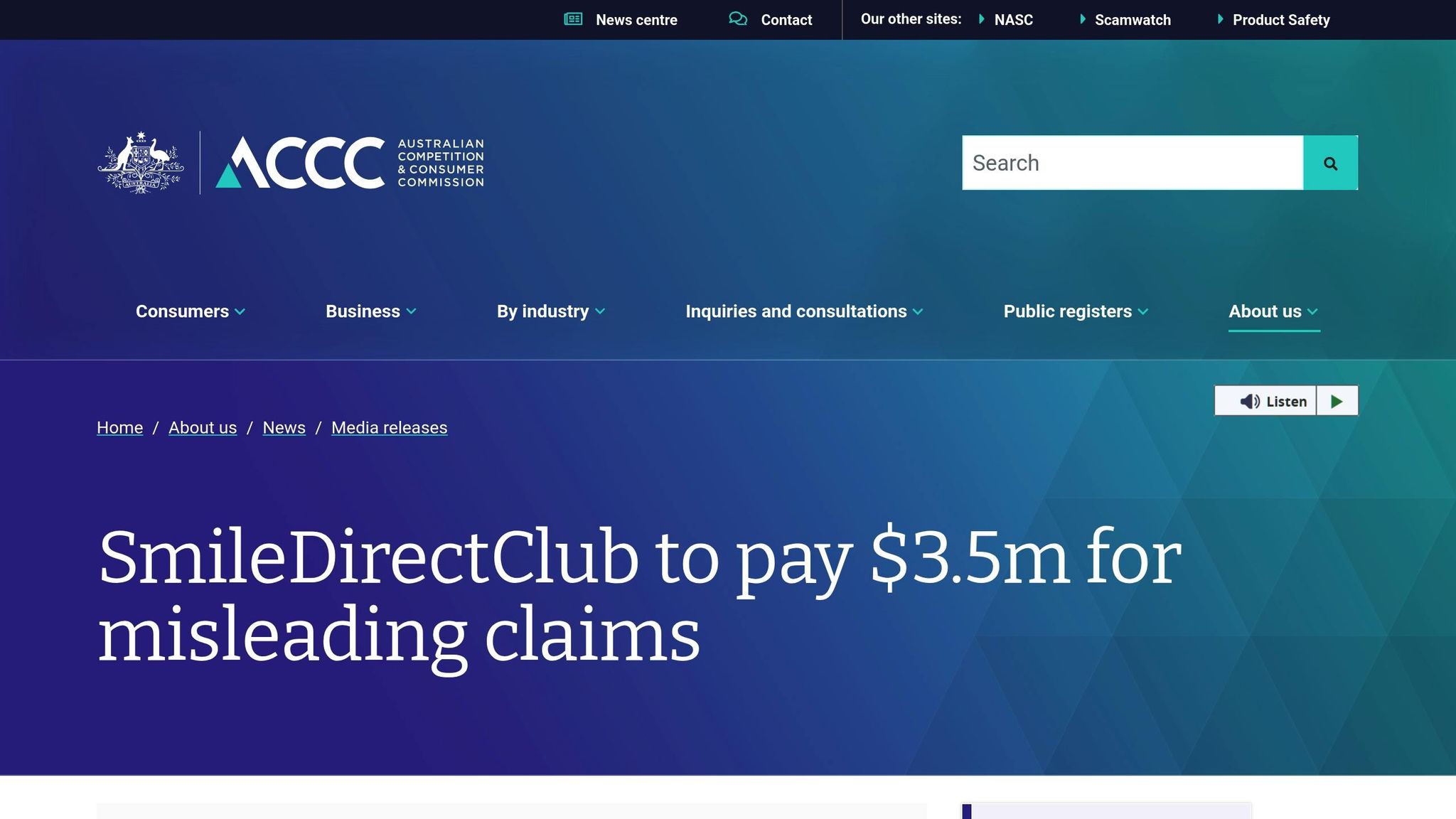
The SmileDirectClub case serves as a stark example of what can happen when advertising standards are ignored. It highlights the serious legal and financial repercussions of making misleading claims in dental advertising.
The Violations
From May 2019 to October 2020, SmileDirectClub Aus Pty Ltd, along with its US parent company, made false claims through various advertising channels. They misled consumers into believing they could receive reimbursements from their private health funds for teeth aligners and related treatments, which were priced between $2,499 and $3,155 [16]. However, the company failed to confirm whether orthodontic coverage applied to their teledentistry services, which were conducted without in-person consultations [17].
The Reality Behind the Claims
The reality was far from what SmileDirectClub advertised. Data showed that 98.5% of Australian private health insurers did not cover SmileDirectClub’s aligner treatments [16]. Despite this, at least 26,300 consumers signed up for the service during the period, misled by the inaccurate promise of reimbursements [16].
Financial Impact and Penalties
The fallout was costly. The Federal Court fined SmileDirectClub $3.5 million and ordered compensation for affected customers. During the period of these violations, SmileDirectClub Aus reported a net revenue of $46,128,911, despite posting an operating loss of $15,023,175 [17]. The company admitted to breaching Australian Consumer Law and cooperated with the Australian Competition and Consumer Commission (ACCC) in making joint submissions [17].
ACCC’s Response
The ACCC acted decisively in response to these breaches. Commissioner Liza Carver emphasised the importance of compliance with consumer laws, stating:
"Making false or misleading statements is a breach of Australian Consumer Law. This outcome is a reminder to all companies, whether established businesses or new entrants, that they must ensure they comply with Australian consumer laws when they sell their products and services to Australian consumers" [16].
Key Lessons for Dental Professionals
This case is a powerful reminder for dental professionals about the importance of adhering to advertising regulations. Any claims regarding insurance coverage or treatment benefits must be thoroughly verified and backed by evidence. Transparency and accuracy are not just ethical obligations but also legal requirements under Australian Consumer Law. Failure to comply can lead to hefty fines, legal consequences, and a tarnished professional reputation.
11. Compliant Advertising Methods
Creating compliant dental advertisements requires a solid understanding of AHPRA’s framework and a thoughtful approach that protects both your practice and your patients. By focusing on clarity, transparency, and accuracy, you can align your advertising with regulatory expectations while building trust with your audience.
Start with the Patient’s Perspective
The best way to ensure your advertising is compliant is to view it through the eyes of your patients. Does your content provide all the necessary information for them to make an informed decision? Does it avoid creating unrealistic expectations? This patient-focused mindset is the foundation of compliant advertising strategies [4].
Use Clear and Accurate Language
Precision in your wording is critical. Make sure any specialist titles are backed by valid registration, and be transparent about your qualifications. For instance, instead of simply writing "Dr. John Smith", use "Dr. John Smith (Dentist)" to clearly communicate your profession. This level of clarity helps patients understand your role and avoids any potential for confusion or misinterpretation [8].
Be Transparent with Pricing and Promotions
When advertising prices, discounts, or promotions, include all the necessary details. Specify terms like expiry dates, eligibility criteria, and locations. Transparency in financial information ensures patients have a clear understanding of what is being offered, avoiding any chance of misleading them [9].
Support Claims with Evidence
Every claim in your advertising must be backed by reliable evidence. If you can’t verify a statement with credible, verifiable sources, leave it out. Any scientific information should come from reputable sources and be presented in a straightforward, unbiased way. Save more detailed, personalised explanations for patient consultations, where you can discuss their specific needs and questions [4][8].
Monitor Social Media Content
On social media and other digital platforms, you are responsible for all content you post or share. This includes material from other sources. Before sharing, ensure it complies with AHPRA guidelines to avoid inadvertently breaching regulations [4].
Avoid Prohibited Content
Certain types of content, such as patient testimonials and before-and-after images, are explicitly prohibited under AHPRA guidelines. Make sure these do not appear in your advertising materials.
Leverage AHPRA Resources

AHPRA offers a range of tools to help you stay compliant. Their "Check, correct and comply" resource, for example, provides practical examples of non-compliant advertising and explains how complaints are handled [4]. Familiarising yourself with these resources can help you better understand and meet your advertising obligations.
Consult Professionals When Needed
If you’re ever unsure about compliance, seek advice from experts who are well-versed in AHPRA guidelines. Regulations can change, and professional guidance ensures your advertising remains both compliant and effective [8].
"Advertising of dental services or treatment should provide patients with information regarding the provision of services. It should be accurate, clear and balanced." – ADA Federal Council, Policy Statement 6.9 [1]
Compliance is about more than avoiding penalties – it’s about building trust and maintaining your professional reputation. By adopting these strategies, you can create transparent, ethical advertising that aligns with AHPRA’s framework and supports your practice’s long-term success.
Conclusion
Australia’s dental advertising rules are more than just guidelines to avoid penalties – they’re essential for building patient trust. The standards set by AHPRA and the Dental Board of Australia serve a critical purpose: to protect the public from false or misleading claims and to empower them to make informed healthcare decisions [4].
However, research shows a concerning level of non-compliance. Over 85% of GDP websites in Australia fail to meet the legal and regulatory advertising requirements [7]. This puts practitioners at risk, as advertising complaints made to AHPRA accounted for 2.5–23.8% of all complaints against dental registrants between 2011 and 2016 [7]. Breaching these rules is a criminal offence, with fines of up to $5,000 for individuals and $10,000 for body corporates per offence. Beyond financial penalties, violations can lead to disciplinary action and harm to professional reputations [2] [4].
On the flip side, ethical advertising offers substantial benefits. By being transparent and truthful in your marketing, you’re not just ticking regulatory boxes – you’re showing respect for your patients and upholding the integrity of your profession. Honest advertising enables patients to make better decisions about their oral health while fostering trust, which is the cornerstone of enduring patient relationships.
Take the time to review AHPRA’s guidelines and ensure your marketing materials – from your website to social media – are compliant and clear. Every piece of content you share reflects your dedication to ethical practice and patient care. By adhering to these standards, you protect not just your practice but also your reputation.
"Although any dentist may advertise, no dentist shall advertise or solicit patients in any form of communication in a manner that is false or misleading in any material respect." – ADA Code [18]
FAQs
What happens if a dental practice in Australia breaches advertising regulations?
The Risks of Non-Compliance with Advertising Regulations in Australia
Failing to follow advertising regulations in Australia can have serious repercussions for dental practices. Individuals could face fines as high as $60,000, while corporations might be penalised up to $120,000 for each offence. In extreme situations, practitioners could even face imprisonment for up to three years.
Since breaching these rules is classified as a criminal offence, it can also trigger disciplinary actions. These actions might include consequences for a practitioner’s registration with AHPRA. Typically, practices are given a 60-day window to address and fix any identified issues. However, unresolved breaches can lead to additional audits and further penalties. Staying compliant isn’t just about following the rules – it’s about avoiding legal troubles and safeguarding professional standing.
What should dental practitioners in Australia know about using testimonials in their advertising?
In Australia, dental practitioners are required to adhere to strict AHPRA guidelines when advertising their services, particularly regarding the use of testimonials. According to the National Law, testimonials that mention clinical aspects – like treatment outcomes or results – are not allowed. This rule is in place to prevent misleading claims and to avoid setting unrealistic expectations for patients.
That said, feedback focusing on non-clinical elements, such as customer service or communication, is permitted as it doesn’t violate these regulations. Practitioners must carefully review any patient feedback before using it in advertising to ensure it aligns with the Dental Board of Australia’s standards. Failing to comply with these rules can result in penalties, making it crucial for practitioners to follow them closely.
Why is it important for dental advertisements in Australia to avoid misleading treatment expectations, and how can this be achieved?
Avoiding Misleading Treatment Expectations in Dental Advertisements
Maintaining honest and transparent communication in dental advertisements is crucial to building trust and prioritising patient well-being. Overstated or misleading claims can lead to disappointment, patient complaints, or even legal troubles, as they may create unrealistic expectations about treatment outcomes. Ethical advertising plays a key role in helping patients make informed choices based on accurate and reliable information.
To ensure this, dental practices should focus on providing clear and truthful messaging. Avoid making exaggerated promises, back up all claims with solid evidence, and use straightforward language that patients can easily understand. It’s also essential to have open conversations with patients about their treatment options. This not only helps set realistic expectations but also strengthens trust, creating a more positive experience for everyone involved.
Related Blog Posts
- Cultural Sensitivity in Dentistry: Key Challenges and Solutions
- Guide to Choosing the Right Cosmetic Dental Treatment
- What Are Biocompatible Dental Materials?
- Scope of Practice for Dental Hygienists in Australia
Important Notice: Any surgical or invasive procedure carries risks. Before proceeding, you should seek a second opinion from an appropriately qualified health practitioner.
Individual results may vary. The information provided in this article is for educational purposes only and does not constitute medical advice.
Checkout Related Blogs




Get in touch with us
For more information, call us now to start feeling better. Or fill the form below to make appointment
The Latest News from Complete Smiles
How to Clean Clear Plastic Retainers
Checklist for Choosing Wearable Dental Devices
Checklist for Choosing Cloud AI Platforms in Dentistry

Complete Smiles Bella VistaAccepts All Major Health Funds, Including





