





Hybrid vs. Traditional Implants in Bone Loss Cases
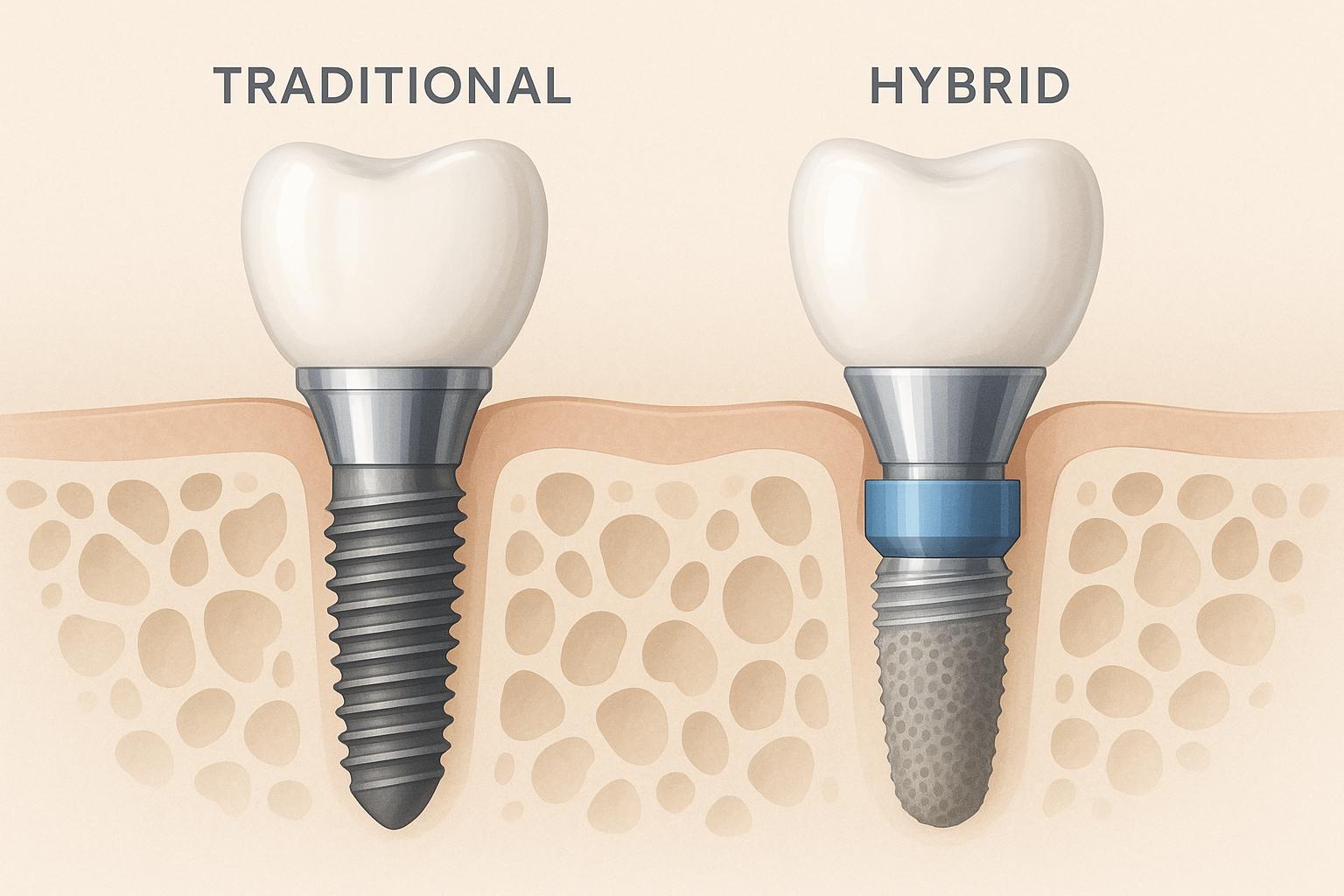
When dealing with severe bone loss, choosing between hybrid and standard implants depends on your jawbone condition, recovery goals, and budget. Here’s what you need to know:
- Standard implants work well if you have sufficient bone or are willing to undergo bone grafting. They are inserted individually and fuse with the bone over several months, offering long-term stability.
- Hybrid implants are designed for severe bone loss. They use multiple posts to support a full-arch prosthesis, often skipping the need for bone grafting. This approach shortens treatment time and reduces costs.
Quick Comparison
| Feature | Standard Implants | Hybrid Implants |
|---|---|---|
| Bone Grafting | Often required | Rarely needed |
| Treatment Time | 6–18 months (with grafting) | 2–3 weeks |
| Cost | AUD $20,000–$40,000+ per arch | AUD $23,000–$35,000 per arch |
| Suitability for Bone Loss | Limited; requires healthy bone | Works well with compromised bone |
| Stability | High with adequate bone | High, even with less bone |
Hybrid implants are ideal for faster recovery and minimal surgical interventions, while standard implants offer flexibility for individual teeth replacement in healthy bone conditions. Consult your dentist to determine the best option for your needs.
Standard Implants: Benefits and Limitations
How Standard Implants Work
Standard dental implants consist of titanium posts that are surgically inserted into the jawbone to replace missing tooth roots. These implants serve as a foundation for crowns, bridges, or dentures. The key to their success lies in a process called osseointegration, where the implant fuses with the jawbone over several months [5].
The surgical placement of these implants requires precision, followed by a healing period of 3–6 months to allow osseointegration. When there is sufficient bone, standard implants provide excellent stability and mimic the function of natural teeth. With proper care, they can last for decades while also helping to maintain jawbone health by stimulating bone regeneration [5]. Research shows that standard implants have a long-term success rate of over 95% in patients with adequate bone density [6]. However, this success is heavily dependent on the presence of enough healthy bone to support the implant.
Challenges in Cases of Severe Bone Loss
While standard implants perform well when bone levels are sufficient, they face significant hurdles in cases of severe bone loss. Without adequate bone, the osseointegration process becomes less reliable, increasing the risk of implant failure. For patients with severe bone loss, the failure rate for standard implants can jump to 15–20% if bone grafting isn’t performed, compared to a failure rate of less than 5% in patients with healthy bone [6].
Bone grafting is required in 30–50% of cases to address these deficiencies [6]. This involves adding bone material – sourced from the patient, a donor, or synthetic alternatives – to rebuild the jawbone. Additional procedures like sinus lifts or ridge augmentation may also be necessary.
| Challenge | Impact on Treatment | Extra Cost (AUD) |
|---|---|---|
| Bone grafting requirement | Extends treatment timeline from 3–6 months to 12–18 months | $1,000–$3,000 per site |
| Higher failure risk | Increased likelihood of implant failure, requiring potential replacement | Varies |
| Complex surgical procedures | More appointments, prolonged recovery, and additional specialist fees | Additional specialist fees |
These added procedures not only lengthen the overall treatment duration but also increase both the financial and physical demands on the patient. Bone grafting comes with its own risks, such as infection or graft rejection, and requires careful planning and extended recovery times.
Fixed Hybrid Dentures Explained (All-on-4/All-on-X) | The Gentle Dentists – Shelby Township, MI
Hybrid Implants: A Modern Solution
When dealing with severe bone loss, hybrid implants provide an effective and advanced alternative to traditional dental implants.
What Are Hybrid Implants?
Hybrid implants are designed to address the challenges of severe bone loss by combining the benefits of dental implants and dentures. Instead of replacing individual teeth, they use multiple implants (typically 5–8 per arch) to support a fixed, full-arch prosthesis. This setup creates a stable, permanent solution that functions like natural teeth.
These implants are made from durable, biocompatible titanium alloy and can be angled to maximise contact with areas of healthier bone. This flexibility ensures they adapt well to compromised bone density. The prosthesis, custom-made for each patient, provides a stable foundation even in cases where bone quality is less than ideal. By distributing chewing forces evenly across the implants, hybrid implants offer both stability and functionality [1][3][4][6].
This unique design makes hybrid implants a valuable option for managing severe bone loss.
Main Benefits for Severe Bone Loss Cases
One of the standout advantages of hybrid implants is their ability to minimise or even eliminate the need for bone grafting. By strategically positioning the implants in areas with better bone quality, they can often be placed using the patient’s existing bone [1][3][7].
For Australian patients, this approach offers several practical benefits:
- Faster Treatment: The process can often be completed in just 2–3 weeks, compared to the months required for standard implants with bone grafting [6].
- Improved Stability: Hybrid implants distribute chewing forces more effectively, offering enhanced comfort and functionality compared to traditional dentures [4][6].
- Bone Preservation: Unlike removable dentures, which can accelerate bone loss, hybrid implants stimulate the jawbone during chewing. This helps maintain bone density and may prevent further deterioration [3][4][7][8].
| Benefit | Impact for Bone Loss Patients |
|---|---|
| Reduced grafting needs | Minimises or eliminates the need for bone grafting |
| Faster timeline | Treatment completed in 2–3 weeks instead of months |
| Enhanced stability | Multiple implants provide better support and comfort |
| Bone preservation | Helps maintain jawbone density, reducing further loss |
The adaptability of hybrid implants makes them an excellent option for individuals who might not qualify for traditional implants due to insufficient bone density. By making the most of the remaining bone, hybrid implants expand treatment possibilities, sparing patients from lengthy bone grafting procedures or the limitations of removable dentures.
sbb-itb-2be92ed
Comparing Stability, Bone Preservation, and Longevity
This section examines how hybrid and traditional implants handle stability, bone health, and durability, especially in cases of severe bone loss.
Stability and Support
Hybrid implants provide excellent stability for patients dealing with severe bone loss. By using six to eight posts, they evenly distribute biting forces, restoring natural chewing strength even in compromised bone conditions [1]. This design allows patients to eat a broad range of foods without worrying about the prosthesis shifting or causing discomfort.
On the other hand, traditional implants rely on fewer posts, which can lead to concentrated pressure points. This increases the risk of implant failure or discomfort during everyday use. Hybrid implants are better suited for varying bone densities along the jaw, making them ideal for more complex cases.
Bone Preservation and Long-Term Health
One of the standout features of hybrid implants is their ability to distribute force across multiple points. This not only preserves bone density but also reduces the risk of peri-implant inflammation. The even load distribution and stimulation of the bone during chewing can slow or even stop further bone loss. Studies show that hybrid implants help maintain bone density in patients who might otherwise be ineligible for traditional implants due to insufficient bone [3][4].
Traditional implants can also support bone health, but their effectiveness significantly drops in cases of severe bone loss. Hybrid implants, with their design, also help minimise inflammation and bacterial buildup around the gums, lowering the chances of gum disease and related complications.
Longevity and Success Rates
While immediate functionality is essential, long-term durability matters just as much. Research shows that hybrid implants boast success rates exceeding 95% over five years in full-arch restorations [6]. They are built for long-term reliability and are less likely to need replacement compared to traditional dentures.
Traditional implants perform well in patients with adequate bone, but their success rates decline in severe bone loss scenarios. Poorer osseointegration and insufficient support in these cases often lead to additional surgeries or alternative treatments.
| Performance Factor | Hybrid Implants | Traditional Implants |
|---|---|---|
| Success Rate (5 years) | Above 95% for full-arch [6] | High with adequate bone; lower in severe loss cases |
| Recovery Time | Approximately 2–3 weeks | Several months with multiple surgeries |
| Maintenance Requirements | Regular cleaning; generally stable | May require additional procedures |
| Suitability for Bone Loss | Excellent performance | Limited; often requires grafting |
For Australians dealing with severe bone loss, hybrid implants present a compelling solution. They restore both functionality and appearance while preserving the remaining bone structure. With high success rates, shorter recovery periods, and better outcomes in challenging cases, hybrid implants are becoming the go-to option for comprehensive tooth replacement in these situations.
Treatment Process, Recovery, and Costs
Having a clear understanding of the treatment process and associated costs is crucial when deciding on implants, especially in cases involving severe bone loss.
Procedure Complexity and Recovery Timelines
Traditional implant procedures often require multiple steps stretched out over several months. The process usually begins with tooth extraction and may involve bone grafting if the jawbone lacks sufficient density. After the grafting site heals, individual implants are placed, followed by another healing phase before the final crown or bridge is fitted [6]. Each stage comes with its own recovery period, leading to a lengthy overall timeline for patients dealing with significant bone loss.
Hybrid implant systems, such as All-on-4 or Hybridge, simplify this process. By strategically angling the implants, these systems often eliminate the need for extensive bone grafting and reduce the complexity of the procedure [1][6]. This streamlined approach allows treatment to be completed in just 2–3 weeks, compared to the months required for traditional methods [6]. Fewer surgical steps not only shorten recovery times but also help lower overall costs.
Additionally, hybrid implants typically require less complex maintenance compared to traditional implants placed across multiple sites [1][3]. This simplicity makes them an appealing option for addressing the challenges of limited bone availability.
Cost Comparison and Accessibility in Australia
The reduced complexity of hybrid implants not only shortens recovery times but also lowers direct treatment costs. In Australia, traditional implants can cost between AUD $3,000 and $6,500 per implant, with full-arch treatments ranging from AUD $20,000 to $40,000+, depending on the materials and the complexity of the procedure.
Hybrid implant systems offer a more cost-effective alternative. Treatments such as All-on-4 or Hybridge generally cost between AUD $23,000 and $35,000 per arch, which includes the surgery, prosthesis, and follow-up care. By avoiding the need for costly bone grafting – common in traditional treatments – hybrid implants can significantly reduce expenses [1].
| Cost Factor | Traditional Implants | Hybrid Implants |
|---|---|---|
| Per arch cost (AUD) | AUD $20,000 – $40,000+ | AUD $23,000 – $35,000 |
| Bone grafting | Often required (extra cost) | Usually avoided |
| Treatment duration | Several months | 2–3 weeks post-placement |
| Follow-up procedures | May involve additional steps | Fewer complications |
When it comes to long-term value, hybrid implants also have an edge. With proper care, hybrid implant dentures can last a lifetime, unlike traditional removable dentures, which typically need replacing every five to seven years [2]. This durability can result in substantial long-term savings, as it reduces the ongoing costs of replacements and adjustments.
That said, hybrid implants do require routine maintenance. Components like acrylic or porcelain may need occasional repairs or replacements, but these expenses are generally predictable and manageable [3]. Furthermore, hybrid implants are easier to maintain compared to traditional removable dentures, which often demand specialised cleaning and frequent adjustments.
For Australian patients exploring implant options, clinics such as Complete Smiles Bella Vista offer detailed consultations to help determine the most suitable and cost-effective treatment based on individual needs and the severity of bone loss. Many dental practices also provide payment plans to make these treatments more accessible. It’s worth discussing Medicare or private health insurance coverage during the consultation to understand what costs may be covered.
With their shorter timelines and reduced procedural complexity, hybrid implants present a practical solution for patients with severe bone loss, balancing clinical effectiveness with financial accessibility.
Conclusion: Choosing the Right Implant for Bone Loss Cases
Main Points for Patients
When dealing with severe bone loss, deciding between traditional and hybrid implants comes down to your bone health and treatment priorities. Each option addresses different clinical needs, and understanding these can help you weigh factors like speed, cost, and suitability.
Traditional implants are highly effective when there’s enough bone or after bone grafting. They provide natural functionality and long-lasting results, making them ideal for cases where tooth loss is limited, and sufficient bone exists in other areas.
Hybrid implants, on the other hand, are tailored for cases with significant bone loss. They eliminate the need for extensive bone grafting and can often restore function within two to three weeks. By using multiple implants to improve stability, they offer a quicker path to recovery [6].
When choosing between these options, consider your current bone condition and long-term oral health goals. Hybrid implants can save on costs by reducing grafting procedures and shortening treatment time, while traditional implants may offer more flexibility for replacing individual teeth.
Your lifestyle and comfort with surgical treatments also play a role. If you prefer a faster process with fewer surgeries, hybrid implants might be the way to go. However, if you’re open to a longer treatment timeline with the potential for more tailored tooth replacements, traditional implants could be a better match.
The best way to make an informed decision is to consult a qualified dental specialist. Clinics like Complete Smiles Bella Vista provide detailed assessments, considering all these factors to guide you towards the most suitable option for your needs.
Both traditional and hybrid implants can restore function and aesthetics effectively. The key is to select the approach that aligns with your unique bone condition, treatment goals, and personal preferences.
FAQs
How do hybrid implants reduce the need for bone grafting compared to traditional implants?
Hybrid implants offer a practical solution for dealing with severe bone loss, outperforming traditional implants in such cases. Thanks to their specialised design and structure, they can be placed in areas with low bone density, often bypassing the need for additional procedures like bone grafting.
Using cutting-edge materials and techniques, hybrid implants create a stable and secure base for dental restorations, even in complex situations. This makes them an appealing choice for patients with significant bone loss who wish to avoid the added time and expense of grafting treatments.
What ongoing care do hybrid implants require, and how does this compare to traditional implants?
Hybrid implants and traditional implants share a common need: consistent care to ensure they last and function properly. For hybrid implants, keeping the prosthetic framework free of plaque is critical. This often means combining professional cleanings with thorough at-home oral hygiene routines. Traditional implants require similar attention, focusing on keeping the gums and surrounding bone structure healthy.
The main distinction lies in their design. Hybrid implants typically support a full arch of teeth using fewer implants, which can make cleaning a bit more challenging than with single traditional implants. That said, no matter the type, regular dental check-ups are essential. These visits help monitor the implants and surrounding tissues, allowing any potential problems to be caught and managed early.
What factors might make hybrid implants a better option than traditional implants in cases of severe bone loss?
Hybrid implants can be a practical choice for people dealing with significant bone loss. Unlike traditional implants, these are designed to provide a stable fit even in areas where bone density is lower, making them a viable solution for those with reduced bone volume.
The decision to opt for hybrid implants also depends on other aspects, such as your overall oral health, the position of the missing teeth, and what you aim to achieve in terms of functionality and appearance. To find the best option for your situation, it’s crucial to consult a dental professional who can guide you based on your specific needs and goals.
Related Blog Posts
- Hybrid Implant Materials: Durability Explained
- Dental Implants vs Bridges: Pros and Cons
- How Hybrid Coatings Improve Osseointegration
- Bone Quality in Osseointegration: Research Insights
Important Notice: Any surgical or invasive procedure carries risks. Before proceeding, you should seek a second opinion from an appropriately qualified health practitioner.
Individual results may vary. The information provided in this article is for educational purposes only and does not constitute medical advice.
Checkout Related Blogs




Get in touch with us
For more information, call us now to start feeling better. Or fill the form below to make appointment
The Latest News from Complete Smiles
How to Clean Clear Plastic Retainers
Checklist for Choosing Wearable Dental Devices
Checklist for Choosing Cloud AI Platforms in Dentistry

Complete Smiles Bella VistaAccepts All Major Health Funds, Including





