





Advances in Salivary Biosensors for Periodontal Care
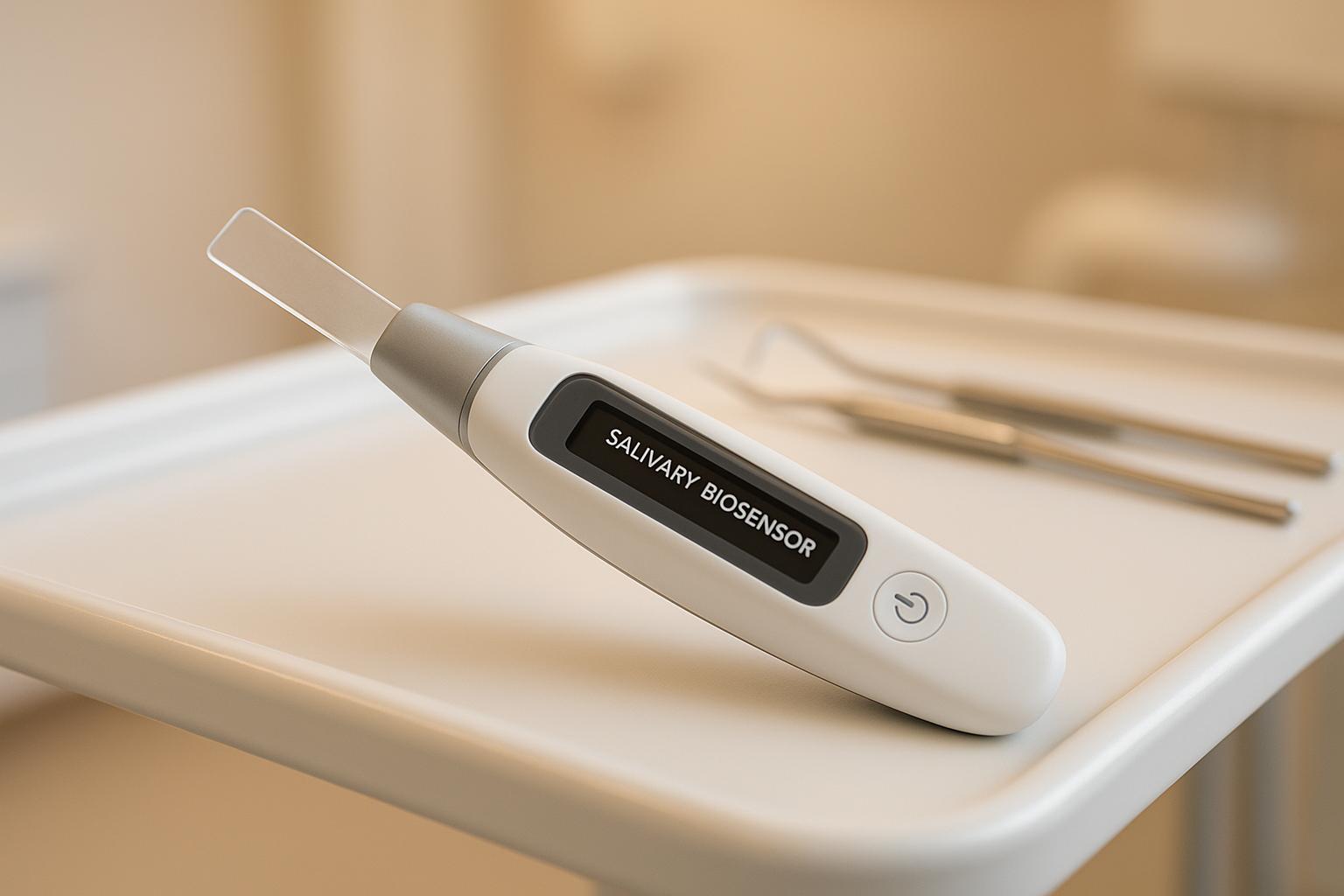
Advances in salivary biosensors are changing how gum disease is detected and managed. These devices use saliva to monitor biological markers linked to periodontal health, offering a painless and real-time alternative to traditional methods like X-rays or probing. By identifying key markers such as MMP-8 (linked to tissue breakdown) and IL-1β (an indicator of inflammation), they allow early detection of gum disease, even before symptoms appear.
Wearable biosensors take this a step further, enabling continuous monitoring and instant feedback. They can alert patients and dentists to changes in oral health, supporting early intervention. With features like wireless data transmission and AI analysis, these tools are especially helpful for people in remote areas or those needing tailored care. Challenges include accuracy issues, development costs, and regulatory hurdles, but ongoing research is improving their reliability.
Key takeaways:
- Salivary biomarkers like MMP-8 and IL-1β detect gum disease early.
- Wearable biosensors provide continuous tracking and AI-driven insights.
- Benefits include early intervention, fewer clinic visits, and personalised care.
- Challenges include calibration needs, data privacy concerns, and high costs.
This technology is transforming dental care in Australia by shifting focus from reactive treatments to early prevention, promising better outcomes for patients.
Beyond Bacteria The Next Frontier in Salivary Testing
Technology Developments in Wearable Salivary Biosensors
Recent advancements in materials, sensor technology, and computational tools have led to devices capable of reliable, continuous monitoring within the challenging environment of the mouth. These improvements form the backbone of the sensor innovations explored below.
Electrochemical and MIP-Based Sensors
Electrochemical biosensors are a popular choice for salivary monitoring due to their ability to detect biomarkers with high sensitivity. They work by converting interactions between biomarkers and electrode surfaces into electrical signals. Ongoing miniaturisation has significantly improved their ability to identify biomarkers at very low concentrations.
Molecularly Imprinted Polymer (MIP)-based sensors take a different approach by using specially designed polymers that bind selectively to specific biomarkers. These sensors create binding sites that mirror the target molecules’ shape and chemical properties, enhancing their selectivity and stability. Designed to perform consistently in the dynamic conditions of saliva, they hold promise for long-term use. Such advancements are particularly valuable for the early detection of periodontal issues through precise biomarker identification.
Flexible and Biocompatible Sensor Materials
Emerging materials are making sensors more flexible and suitable for the contours of the mouth. For example, graphene-based composites combine excellent electrical conductivity with the flexibility needed to conform to oral surfaces. Hydrogel-based sensors are also being explored for their compatibility with the mouth’s moist environment. Additionally, surface treatments are being developed to minimise immune responses and reduce protein build-up, ensuring the sensors maintain their performance over time. These innovations make wearable biosensors even more effective for early periodontal detection.
Integration of AI and Deep Learning
Artificial intelligence is transforming how data from wearable biosensors is analysed. AI models can process complex signals to detect subtle early changes associated with periodontal health. These systems enable predictive analytics, helping to forecast potential problems based on trends in the data. On-device processing reduces response times, while personalisation algorithms adapt to individual biomarker patterns, improving the accuracy of alerts. These advancements are setting the stage for more effective clinical applications, which will be explored in the sections ahead.
Key Salivary Biomarkers and Their Clinical Use
Thanks to advancements in wearable biosensors, salivary biomarkers are now playing a bigger role in bridging technology and clinical periodontal care. These devices offer a non-invasive way to monitor oral health by detecting key indicators of inflammation and tissue breakdown. This means clinicians can assess and address periodontal health more efficiently.
Commonly Monitored Biomarkers
Matrix Metalloproteinase-8 (MMP-8):
MMP-8 is a key player in breaking down collagen during gum inflammation. Its presence in saliva can signal early tissue damage, allowing for quicker intervention.
Interleukin-1β (IL-1β):
This inflammatory cytokine often increases in response to bacterial challenges in the mouth. Elevated levels in saliva point to heightened inflammatory activity in the gums.
C-reactive Protein (CRP):
Traditionally measured in blood, CRP can also be detected in saliva, where it’s linked to periodontal inflammation. It provides insight into both local gum health and overall inflammatory responses.
Lactate Dehydrogenase (LDH):
LDH is an enzyme released when tissue is damaged. Higher levels in saliva can indicate the extent of cellular injury in the gums.
Prostaglandin E2 (PGE2):
PGE2 plays a role in inflammation regulation. Monitoring its levels in saliva can reveal the body’s response to periodontal pathogens and help track treatment progress.
Volatile Sulphur Compounds:
Produced by anaerobic bacteria in periodontal pockets, these compounds are associated with bacterial activity and bad breath. Their detection offers insight into the microbial environment tied to gum disease.
Evidence Supporting Biomarker Use
Research continues to highlight the value of salivary biomarkers alongside traditional periodontal assessments. For instance, studies confirm that measuring MMP-8 and IL-1β can aid in early detection of periodontal disease and track treatment effectiveness. Using multiple biomarkers together enhances diagnostic precision, paving the way for more tailored and effective periodontal care in clinical settings.
sbb-itb-2be92ed
Benefits and Limitations of Wearable Salivary Biosensors
Wearable salivary biosensors are transforming the way periodontal health is monitored. They offer exciting possibilities for patient care but also come with challenges that need to be addressed for widespread adoption.
Benefits of Wearable Biosensors
Non-invasive and Comfortable Monitoring
These biosensors analyse saliva, a naturally produced fluid, removing the need for uncomfortable procedures like periodontal probing or blood tests. This non-invasive approach makes the experience far more patient-friendly.
Real-time Monitoring for Better Engagement
With continuous tracking of biomarkers throughout the day, these devices ensure no critical changes go unnoticed. Their ease of use encourages patients to stay engaged with their oral health, making it as simple as checking their phone.
Early Detection of Periodontal Issues
By identifying elevated biomarkers before symptoms appear, wearable biosensors enable early interventions. This proactive approach means treatments can be less invasive and more effective.
Cost Savings Over Time
Although the upfront cost may be high, these devices can help avoid expensive treatments for advanced periodontal disease. Plus, remote monitoring reduces the need for frequent in-person check-ups, particularly for patients with stable conditions.
Limitations and Challenges
While the potential is clear, several hurdles remain that could slow down the adoption of wearable salivary biosensors.
Accuracy and Stability Issues
Environmental factors like temperature, humidity, and the natural variability in saliva composition can affect the accuracy of these sensors. Many devices also need regular calibration, which can be inconvenient for daily use.
False Positives Due to Cross-reactivity
Saliva contains hundreds of compounds, and sometimes these can interfere with the sensors, leading to false positives. This can complicate diagnosis and treatment planning.
High Development Costs
The advanced technology required for these devices makes them expensive to develop and manufacture. For Australian dental practices and patients, these costs could pose a barrier to access.
Limited Testing in Clinical Settings
Most wearable biosensors have been tested in controlled research environments. However, real-world dental practices often reveal practical issues that weren’t apparent during development.
Regulatory and Standardisation Hurdles
In Australia, the Therapeutic Goods Administration (TGA) has strict requirements for medical devices. Since wearable biosensors are relatively new, regulatory pathways are still evolving, which could delay their availability.
Data Privacy and Security Risks
These devices generate large amounts of sensitive health data. Ensuring this information is securely stored and transmitted, while still accessible to healthcare providers, poses ongoing challenges.
Comparison Table: Benefits vs. Limitations
| Benefits | Limitations |
|---|---|
| Non-invasive and comfortable | Accuracy affected by external factors |
| Real-time, continuous monitoring | Cross-reactivity risks false positives |
| Encourages patient engagement | High development and production costs |
| Enables early disease detection | Limited real-world clinical validation |
| Potential long-term cost savings | Regulatory approval delays |
| Reduces routine clinic visits | Data privacy and security concerns |
| Provides objective biomarker data | Requires regular calibration and maintenance |
As wearable salivary biosensors continue to develop, addressing these challenges will be key to unlocking their full potential in periodontal care.
Future Directions and Clinical Applications
With advancements in sensor technology and clinical biomarker research, wearable biosensors are becoming more integrated into everyday dental care across Australia. These innovations are set to transform periodontal care, offering more personalised monitoring and evidence-based management.
Emerging Trends in Sensor Development
Collaboration Across Disciplines
Progress in salivary biosensors is being driven by partnerships between engineers, materials scientists, and dental experts. These collaborations are improving sensor accuracy, stability, and overall functionality.
Smaller, Smarter Sensors
The trend towards miniaturisation is leading to discreet sensors that can be embedded in everyday oral appliances like mouthguards and retainers. This makes continuous monitoring more convenient and less obtrusive for patients.
Seamless Digital Integration
Future sensors are being designed to connect directly with digital health platforms. This connectivity could enable automatic updates to electronic health records, giving dental practitioners instant access to patient data and improving clinical decision-making.
Advances in Sensor Materials
New biocompatible materials are being developed to counteract the effects of saliva’s natural enzymes on sensor performance. These materials aim to reduce the need for frequent recalibration, enabling more reliable and long-term monitoring.
Personalised Care and Early Intervention
Customised Treatment Plans
Continuous monitoring allows dental professionals to identify individual biomarker patterns, tailoring treatments to each patient’s specific periodontal risks. Predictive analytics can further support early intervention, potentially preventing more serious issues.
Empowering Patients with Real-time Data
Real-time feedback from biosensors gives patients immediate insights into how their daily habits – like brushing or dietary choices – impact their oral health. This encourages a proactive approach to maintaining periodontal health.
Risk-based Monitoring
With a steady flow of data, dental professionals can categorise patients by risk levels. High-risk patients might benefit from more frequent check-ups, while those with stable conditions could require fewer visits, optimising resources and care schedules.
Integration with Comprehensive Dental Care
Wearable biosensors are poised to complement traditional dental treatments by providing continuous data between appointments. This integration enhances overall care and supports timely interventions.
Better Treatment Planning
Access to ongoing data about a patient’s periodontal health can improve treatment strategies. For example, during orthodontic procedures or after dental implants, biosensors can monitor healing and guide clinical decisions. Australian practices such as Complete Smiles Bella Vista (Complete Smiles Bella Vista) are already incorporating such technologies to strengthen evidence-based care.
Proactive Preventive Care
By detecting potential issues before symptoms appear, biosensors align with preventive care principles. Early identification of risks can help practitioners implement measures to avoid more invasive treatments down the line.
Educating and Engaging Patients
The visual data generated by biosensors can be a powerful educational tool. It helps patients see the direct impact of their oral hygiene habits, motivating them to take a more active role in their care.
Flexible Appointment Scheduling
Continuous monitoring opens the door to more dynamic scheduling. Instead of fixed intervals, appointments could be tailored to the patient’s current needs, ensuring timely interventions while avoiding unnecessary visits.
Conclusion
Wearable salivary biosensors are revolutionising periodontal care by offering continuous monitoring of oral health for both Australian dental professionals and patients. Building on recent technological developments, these devices provide real-time insights into salivary biomarkers, offering a clearer picture of gum health and transforming how periodontal disease is detected and managed.
This non-invasive and cost-efficient solution, enhanced by AI, empowers better oral hygiene decisions. It also enables timely and targeted interventions, helping to address issues before they escalate. This shift from reactive to proactive care aligns seamlessly with Australia’s focus on preventive healthcare.
However, challenges remain. Standardising biomarker reference ranges for Australia’s diverse population and ensuring sensor stability in the complex oral environment are key hurdles. Researchers are actively working on these issues, exploring advanced materials and refining calibration techniques to improve reliability.
The future of periodontal care in Australia is set to become more personalised and data-driven. As these biosensors evolve and see broader adoption, they hold the potential to significantly reduce cases of periodontal disease. Early detection and continuous monitoring will lead to better treatment outcomes, making this technology an invaluable addition to dental practices focused on evidence-based care.
FAQs
What makes salivary biosensors a promising tool for detecting gum disease?
Salivary biosensors are a cutting-edge, non-invasive method for spotting gum disease. By detecting specific biomarkers in saliva, like MMP-8, these devices provide a quicker and more sensitive option compared to traditional approaches such as visual checks or lab tests.
What makes these biosensors stand out is their ability to offer real-time monitoring. They can pick up early signs of periodontal problems, which could lead to better treatment results. That said, there are still hurdles to overcome, including the risk of sample contamination and the technical complexity of the devices, to ensure they deliver consistent accuracy and dependability.
What challenges need to be addressed for wearable salivary biosensors to become widely used in periodontal care?
Wearable salivary biosensors show great potential for advancing periodontal care, but there are a few hurdles to clear before they can become mainstream. A key challenge lies in the complex makeup of saliva. It’s a mix of proteins, bacteria, and other substances, all of which can interfere with how accurately these sensors work. On top of that, pinpointing and studying specific biomarkers, like salivary extracellular vesicles (EVs), isn’t easy. These biomarkers are not only scarce but also influenced by the ever-changing composition of saliva.
Another significant obstacle is ensuring the durability and consistent performance of these sensors over time. Saliva is a dynamic and reactive environment, and prolonged exposure can wear down the sensor materials, making it tough to maintain reliable, real-time monitoring. Tackling these technical and biological challenges is essential to fully realise what salivary biosensors can bring to periodontal care.
How do wearable salivary biosensors improve personalised dental care and early detection of gum disease?
Wearable salivary biosensors are changing the game in personalised dental care by offering real-time, non-invasive tracking of key biomarkers like MMP-8 and glucose, which are linked to gum disease. These devices allow for earlier detection of periodontal problems, giving dentists the ability to design treatment plans that are customised to each patient’s needs.
With continuous monitoring, these biosensors not only help catch issues before they escalate but also contribute to maintaining better oral health over the long term. This cutting-edge technology ensures timely interventions, making dental care more precise and effective.
Related Blog Posts
- How Wearables Help Prevent Dental Issues
- Periodontal Pocket Depth: Measurement Techniques
- Salivary Tests for Early Detection of Gum Disease
- AI in Dentistry: Predicting Periodontal Disease
Important Notice: Any surgical or invasive procedure carries risks. Before proceeding, you should seek a second opinion from an appropriately qualified health practitioner.
Individual results may vary. The information provided in this article is for educational purposes only and does not constitute medical advice.
Checkout Related Blogs




Get in touch with us
For more information, call us now to start feeling better. Or fill the form below to make appointment
The Latest News from Complete Smiles
How to Clean Clear Plastic Retainers
Checklist for Choosing Wearable Dental Devices
Checklist for Choosing Cloud AI Platforms in Dentistry

Complete Smiles Bella VistaAccepts All Major Health Funds, Including





