





Minimally Invasive Veneers: Eco Benefits

Minimally invasive veneers are reshaping dental care by offering a low-waste, enamel-preserving alternative to conventional veneers. These ultra-thin ceramic shells require little to no enamel removal, reducing waste and supporting better tooth health. Unlike traditional options, they often don’t need anaesthesia or temporary restorations, cutting down on clinical materials and emissions from multiple visits. With a longer lifespan and advanced digital manufacturing techniques, they reduce resource use and environmental impact.
Key Points:
- Tooth Preservation: Requires minimal (0.2–0.5 mm) or no enamel removal.
- Longevity: Average lifespan of ~10.28 years vs ~9.32 years for traditional veneers.
- Lower Waste: No temporary restorations; fewer replacements needed.
- Advanced Technology: Digital design and 3D printing reduce material waste.
Minimally invasive veneers combine durability with a reduced carbon footprint, making them a smart choice for patients and the planet alike.
Environmental Problems with Conventional Veneers
Excessive Enamel Removal
Conventional veneers often demand the removal of a considerable amount of healthy tooth structure. The typical preparation depth of 0.5 mm to 1.0 mm frequently surpasses the natural enamel thickness at the gingival third, which is only about 0.3 mm to 0.4 mm [1][6][4]. This process exposes the dentin irreversibly and sacrifices healthy tissue permanently.
"Tooth preparations for CVs required 3%–30% of tooth structure by weight and one-quarter to one-half the amount of tooth reduction of conventional complete-coverage crowns." – Edelhoff and Sorensen [1]
When veneers bond to exposed dentin instead of enamel, they become more susceptible to issues like chipping, fractures, and debonding. Clinical trials have reported failure rates ranging from 14% to 33%, largely due to the excessive removal of tissue and poor occlusal conditions [3][4]. Each failure leads to replacement, which not only consumes more materials but also generates additional waste.
High Material Waste and Resource Consumption
The environmental impact of conventional veneers extends beyond enamel loss, with significant material waste being a notable concern. Temporary restorations, often made from resin, are discarded shortly after use while waiting for permanent veneers to be fabricated [3][7]. Once disposed of, these interim materials contribute to dental waste, which can release greenhouse gases and other pollutants when incinerated or sent to landfills [2].
Conventional veneers also have a shorter average lifespan – 9.32 years compared to 10.28 years for minimally invasive options [3]. This means they need to be replaced more frequently, requiring additional ceramic materials, bonding agents, and single-use clinical supplies. Their thicker design (ranging from 0.3 mm to 1.0 mm, compared to 0.2 mm to 0.5 mm for minimally invasive veneers [3]) further increases the material consumption per restoration. Add to this the resource-heavy procedures, often involving multiple appointments and anaesthesia, and it becomes clear that conventional veneers leave a considerable environmental footprint.
Porcelain Veneer alternative with NO GRINDING and LESS COST called Bioclear Veneers, watch how!
Eco Benefits of Minimally Invasive Veneers
Minimally invasive veneers stand out as a more sustainable alternative to conventional veneers, addressing some of the environmental challenges associated with traditional dental treatments.
Preservation of Natural Tooth Structure
One of the key benefits of minimally invasive veneers is their ability to conserve more of the natural tooth structure. These procedures require only a small reduction in enamel – approximately 0.1 mm at the cervical, 0.2–0.5 mm mid-tooth, and 0.7–1.0 mm at the incisal edge – significantly less than conventional crowns [1][6].
"The recommended superficial preparation within the enamel and adhesive luting facilitates restoration with minimal loss of healthy tooth structure." – Burçin Akoğlu Vanlıoğlu, Department of Prosthetic Dentistry, University of Marmara [1]
By preserving enamel, these treatments reduce the need for extensive dental interventions over time. Some minimally invasive veneers are even reversible, maintaining the tooth’s natural integrity and leaving room for future treatment options [1][7]. This approach not only supports oral health but also lessens the environmental impact by cutting down on the use of dental materials and clinical resources.
Use of Non-Toxic, Biocompatible Materials
Minimally invasive veneers are crafted from materials that align with eco-conscious principles. Feldspathic porcelain, primarily composed of silicon dioxide and alumina, can be made as thin as 0.2–0.3 mm while still offering excellent translucency [1][4]. Similarly, lithium disilicate glass-ceramics provide exceptional strength due to their high crystalline content, ensuring durability while using less material.
"MPVs have a strong biocompatibility with dental substrates, which coincides with their propensity to collect little bacterial plaque and encourage better oral hygiene." – Abbasi Begum Meer Rownaq Ali, Department of Prosthodontics, Riyadh Elm University [3]
These materials are not only biocompatible and non-toxic but also resist bacterial plaque build-up, promoting better long-term oral health. The ultra-thin design of minimally invasive veneers (0.2–0.5 mm compared to the 0.3–1.0 mm of conventional veneers) further reduces material consumption, making them a more sustainable choice for dental restorations.
Durability and Waste Reduction
The impressive durability of minimally invasive veneers adds another layer of environmental benefit. A nine-year study of 186 porcelain veneers across 35 patients revealed a 100% survival rate for no-prep or minimally invasive veneers, compared to just 9.67% for conventional veneers [3]. Additionally, the average success rate for minimally invasive veneers was found to be 10.28 years, slightly higher than the 9.32 years for traditional options [3].
With lifespans often ranging from 10 to 15 years [3][4][5][7], these veneers reduce the need for frequent replacements. Fewer replacements mean less waste and a lower carbon footprint from the manufacturing and disposal processes. This extended longevity makes minimally invasive veneers a practical choice for reducing waste and conserving resources, aligning with sustainable dental practices.
sbb-itb-2be92ed
Technologies Supporting Eco-Friendly Practices
The eco-conscious appeal of minimally invasive veneers gets a boost from advancements in digital technologies. These innovations not only improve precision but also cut down on waste, aligning with sustainable practices.
Digital Design and 3D Printing
Digital workflows have revolutionised how veneers are designed and made, replacing traditional methods that often generate significant waste. Intraoral scanning has eliminated the need for conventional impressions, which relied on disposable trays and silicone materials that typically ended up in landfill. Tools like iTero® 3D scanning create detailed virtual models of teeth, offering a cleaner, more sustainable alternative to older techniques [8][10].
With computer-aided design (CAD) software, processes like "digital waxing" have replaced manual wax-ups, reducing the use of laboratory materials and consumables [8][11]. This approach allows patients to preview and approve the final design before any physical work begins, cutting down on errors and the need for do-overs, which can be resource-intensive.
Additive manufacturing, or 3D printing, builds veneers layer by layer, using only the material needed. This is a stark contrast to subtractive milling, which carves veneers from solid blocks and produces a lot of waste [8][9]. A notable example is the "First Fit" system, introduced by researchers Ye, Jiang, et al. in April 2023. This system uses 3D-printed guides and specialised tools to measure and control enamel reduction with high precision, ensuring only the necessary amount of tooth structure is removed [7]. These digital workflows achieve micron-level accuracy, reducing fitting errors and the need for material-heavy remakes [8].
Such advancements make manufacturing processes not only more efficient but also more sustainable.
Efficient Manufacturing Processes
Modern manufacturing techniques have significantly improved material use and reduced energy consumption. With CAD/CAM technology, veneers are milled from flawless ceramic blocks, ensuring a precise fit that minimises waste and reduces the need for extensive adjustments during placement.
"The streamlined 100% digital 3D printed porcelain veneers workflow is more environmentally friendly than traditional veneer manufacturing, lower carbon footprint and less waste compared to conventional fabrication methods." – ORA Dental Studio [12]
In-office manufacturing systems, like CEREC, can create veneers in a single visit. This reduces the carbon emissions associated with multiple appointments and the transportation of materials to and from external laboratories. These advancements mark a step forward in combining efficiency with eco-consciousness.
Comparing Environmental Impacts: Conventional vs Minimally Invasive Veneers
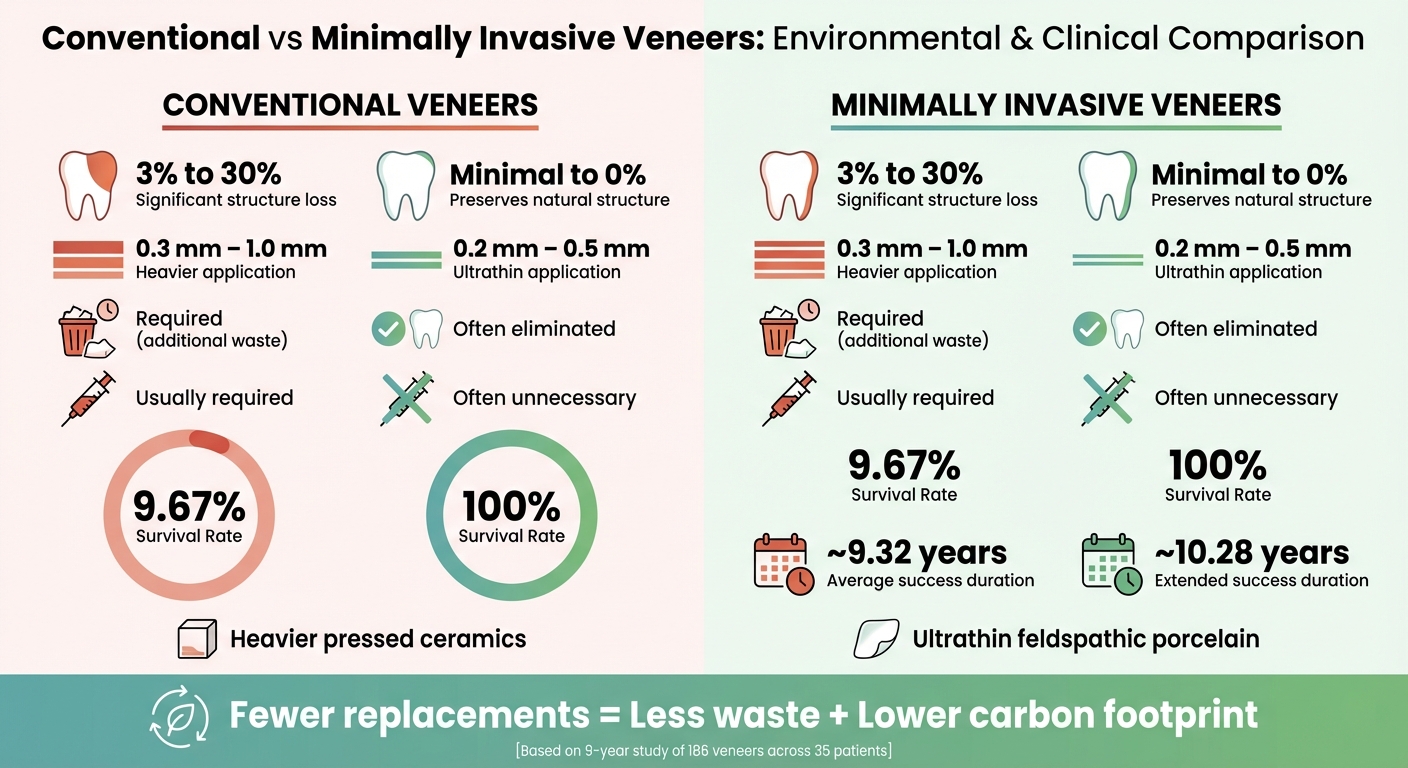
Conventional vs Minimally Invasive Veneers: Environmental Impact Comparison
When it comes to veneers, the environmental impact is often overlooked. Yet, comparing conventional and minimally invasive veneers reveals some striking differences. Conventional veneers typically require the removal of 3% to 30% of the tooth structure[1], generating waste that needs proper disposal. On the other hand, minimally invasive veneers preserve nearly all the natural enamel, significantly reducing waste from the outset.
A nine-year study involving 186 veneers across 35 patients found a 100% survival rate for minimally invasive veneers compared to just 9.67% for conventional ones. This translates to a longer average success period (10.28 years vs 9.32 years)[3]. Fewer replacements mean less material use and waste generation over time. Additionally, conventional veneers often require temporary plastic resin restorations, disposable syringes and needles for anaesthesia, and several clinical visits. Minimally invasive options can often skip these steps[3], cutting down on resource use and emissions associated with multiple appointments.
The table below highlights these differences.
Comparison Table: Conventional vs Minimally Invasive Veneers
| Feature | Conventional Veneers | Minimally Invasive Veneers |
|---|---|---|
| Tooth Structure Removal | 3% to 30%[1] | Minimal to 0%[3] |
| Veneer Thickness | 0.3 mm – 1.0 mm[3] | 0.2 mm – 0.5 mm[3] |
| Temporary Restorations | Required (additional waste) | Often eliminated[3] |
| Anaesthesia | Usually required | Often unnecessary[3] |
| 9-Year Survival Rate | 9.67%[3] | 100%[3] |
| Mean Success Period | ~9.32 years[3] | ~10.28 years[3] |
| Primary Material | Heavier pressed ceramics | Ultrathin feldspathic porcelain[3] |
Conclusion
Minimally invasive veneers are a smart choice for improving oral health while being mindful of the planet. By removing just 0.2–0.5 mm of tooth structure, these veneers help preserve enamel and generate less waste[3]. Plus, with a 100% nine-year survival rate, they prove that opting for a conservative approach doesn’t mean compromising on durability[3].
These veneers also cut down on temporary restorations, anaesthesia, and appointments, which makes a real difference in reducing dentistry’s carbon footprint. In Australia, transport emissions make up around 65% of the dental sector’s carbon output, so fewer trips to the dentist mean a meaningful reduction in environmental impact[2]. It’s clear that adopting such techniques is a step towards more sustainable dental care.
"Dentistry as a profession should integrate sustainable development goals into daily practice and support a shift to a green economy in the pursuit of healthy lives and well-being for all through all stages of life." – Australian Dental Association[2]
Thanks to advancements in digital tools and manufacturing, these eco-conscious benefits are now more accessible than ever. If you’re considering cosmetic dental options, discussing minimally invasive techniques with your dentist could be a great move. These methods not only align with the push for greener healthcare but also deliver lasting results.
No matter what type of veneers you choose, maintaining excellent oral hygiene is essential for their longevity. By prioritising conservative treatments, you’re contributing to a more sustainable and responsible approach to dental care.
FAQs
How do minimally invasive veneers help protect your natural teeth?
Minimally invasive veneers are crafted to keep your natural teeth intact, requiring minimal or no removal of healthy enamel. These veneers bond directly to the tooth’s surface, preserving the enamel’s structure while improving the look of your smile.
Since this method avoids extensive tooth preparation, it helps safeguard the natural structure of your teeth. Plus, it reduces waste, making it a more environmentally conscious choice. This technique balances oral health with a focus on sustainability.
How are minimally invasive veneers better for the environment?
Minimally invasive veneers are often seen as a more eco-conscious option because they preserve a larger portion of the natural tooth structure. This method naturally results in less material waste during the procedure.
By focusing on conserving natural teeth and using fewer resources, this approach supports sustainable dental practices. It’s an appealing option for individuals looking to balance cosmetic enhancements with environmentally mindful choices, all while promoting long-term oral health.
What materials are used in minimally invasive veneers, and how do they ensure durability?
Minimally invasive veneers are usually made from porcelain or ceramic, both celebrated for their strength and long-lasting nature. Porcelain stands out for its resistance to wear, chipping, and staining, making it a preferred option for those seeking veneers that endure over time.
These materials are designed to closely resemble the natural look of teeth while preserving as much of the original tooth structure as possible during preparation. This method not only achieves a durable and visually appealing finish but also reduces material waste, aligning with efforts to conserve resources.
Related Blog Posts
- Energy-Efficient Dental Materials: Overview
- Future of Cosmetic Dentistry: Green Materials
- Carbon Footprint of Traditional vs. Digital Dentistry
- Digital Smile Design with Porcelain Veneers
Important Notice: Any surgical or invasive procedure carries risks. Before proceeding, you should seek a second opinion from an appropriately qualified health practitioner.
Individual results may vary. The information provided in this article is for educational purposes only and does not constitute medical advice.
Checkout Related Blogs




Get in touch with us
For more information, call us now to start feeling better. Or fill the form below to make appointment
The Latest News from Complete Smiles
How to Clean Clear Plastic Retainers
Checklist for Choosing Wearable Dental Devices
Checklist for Choosing Cloud AI Platforms in Dentistry
Complete Smiles Bella VistaAccepts All Major Health Funds, Including





