





Guide to Sustainable Dental Waste Management

Dental clinics generate various waste types, from everyday office items to high-risk clinical and hazardous materials. Proper waste management is critical for safety, compliance, and reducing harm to the planet. Here’s a quick breakdown:
- Types of Waste:
- General (e.g., paper, cardboard)
- Non-infectious (e.g., uncontaminated gloves, masks)
- Clinical (e.g., sharps, blood-soaked materials)
- Hazardous (e.g., amalgam, mercury, chemicals)
- Key Steps:
- Segregation: Use colour-coded bins for each waste type.
- Treatment: Clinical waste must be sterilised or incinerated. Hazardous waste requires specialised disposal.
- Recycling: Items like amalgam, X-rays, and precious metals can be recycled safely.
- Regulations: In Australia, strict laws like Victoria’s Environment Protection Act 2017 ensure waste is handled responsibly. Clinics must use licensed services for collection and disposal.
- Reducing Waste:
- Switch to reusable items (e.g., metal trays).
- Conduct regular audits to minimise unnecessary waste.
- Use tools like amalgam separators to prevent mercury pollution.
Effective waste management not only ensures compliance but also cuts costs and supports a healthier future.
Australian Regulations for Dental Waste Management
National and State Regulations
In Australia, managing dental waste operates under a dual framework. The Dental Board of Australia oversees professional standards, while state and territory authorities handle clinical waste regulations. For instance, in Victoria, the EPA enforces the Environment Protection Act 2017 and related regulations, classifying clinical waste as "reportable priority waste" under Schedule 5 [6]. Meanwhile, New South Wales adheres to NSW Health‘s guidelines for clinical waste management [7].
Dental practices hold legal accountability for their waste. According to EPA Victoria, practices must ensure that only authorised treatment facilities are used. This includes verifying the credentials of both waste transporters and treatment facilities [6].
Additionally, regulations impose an environmental duty on anyone handling reportable priority waste [6]. This means practices must explore safer disposal methods and treat waste – such as through incineration or autoclaving – to eliminate hazards. In Victoria, practices storing up to 40m³ of biomedical waste must obtain an A21 registration for temporary storage [6].
These frameworks also underpin the mandatory colour coding and labelling systems that are vital for safe and effective waste management.
Colour Coding and Labelling Standards
Colour coding systems play a critical role in ensuring proper waste segregation. They help prevent cross-contamination, safeguard staff, and minimise environmental risks. Each waste category is assigned a specific container colour, paired with clear labelling to identify the contents and associated hazards.
Victoria’s IWRG612.1 guidance outlines clinical waste definitions, responsibilities, and detailed colour coding requirements [8]. To comply, dental practices must train their staff in these protocols. Failing to properly segregate or label waste increases risks, such as needle-stick injuries or the spread of infectious diseases [6].
Types of Dental Waste and Segregation Methods
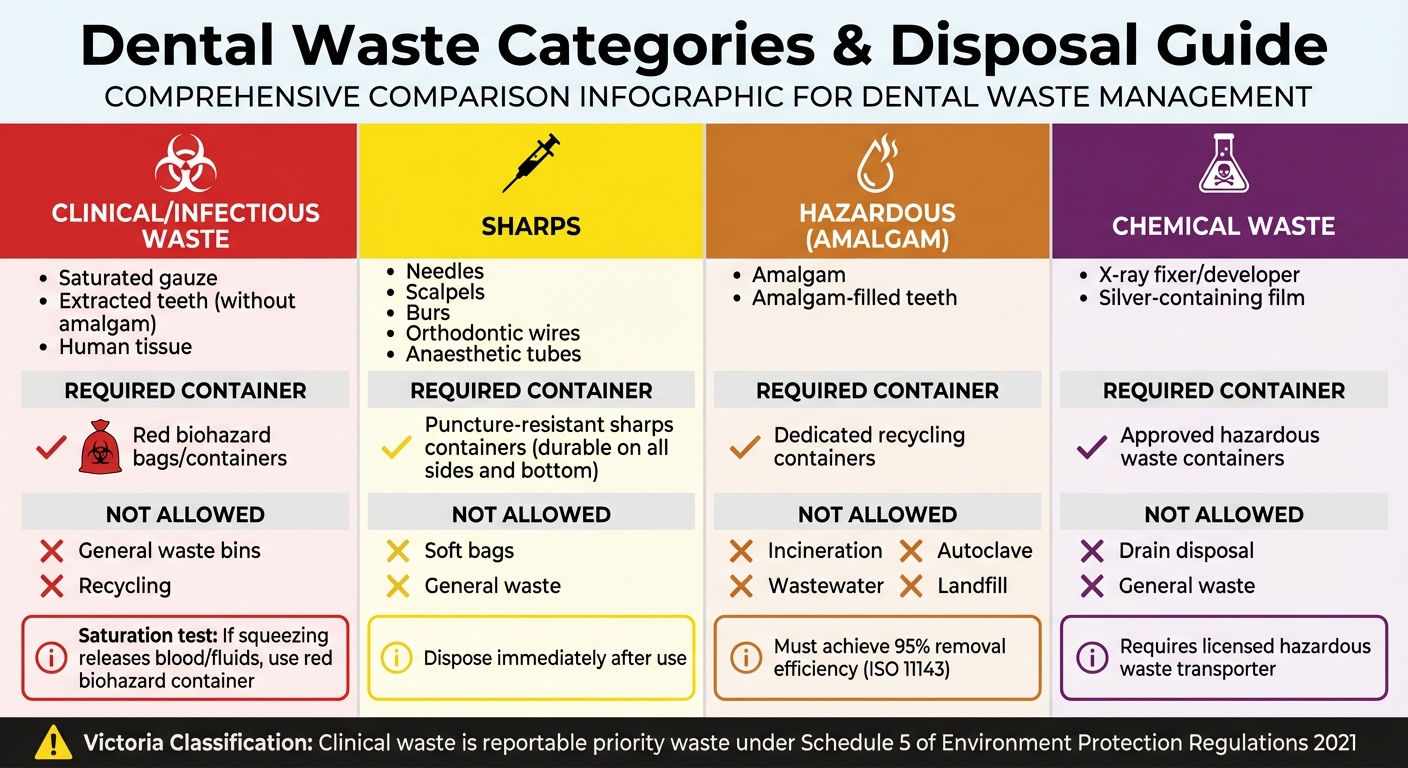
Dental Waste Categories and Proper Disposal Methods Guide
Dental practices produce several types of waste, each requiring careful handling to meet regulatory standards and safeguard the environment.
Clinical and Anatomical Waste
Clinical waste primarily includes materials that may carry infectious risks, such as those contaminated with blood, body fluids, or human tissue. In Victoria, this waste is classified as reportable priority waste under Schedule 5 of the Environment Protection Regulations 2021 [6]. The Environment Protection Authority (EPA) defines it as:
"Clinical waste is waste generated in a clinical or similar setting. It can cause disease or injury and can be offensive to the community." [6]
Within this category, high-risk items like gauze or cotton soaked in blood are labelled as specific sanitary/infectious waste. A simple "saturation test" determines this: if squeezing the material releases blood or fluids, it belongs in red biohazard bags or containers [9].
On the other hand, uncontaminated items such as gloves, masks, and bibs are considered non-specific sanitary waste, which helps reduce costs and plastic usage [5]. Switching to reusable items, like autoclavable gowns and shoe covers, can further cut down on plastic waste [5].
Sharps and Infectious Waste
Sharps are another critical category and must be handled with precision. These include needles, scalpels, orthodontic wires, burs, and anaesthetic tubes. They should be disposed of immediately in puncture-resistant, leak-proof containers with secure lids [9]. These containers must be durable on all sides and the bottom to prevent punctures. For efficiency, disposable ejectors should be separated into their plastic and metal components before disposal [5].
Amalgam, Mercury, and Hazardous Waste
Hazardous waste poses significant environmental challenges, especially dental amalgam. Amalgam must not be discharged into wastewater, landfills, or treated via incineration or autoclaving, as these processes can release mercury into the environment [9]. Kevin Webber of TriHaz Solutions cautions:
"Small missteps in waste handling can cause large problems for your practice, resulting in regulatory violations and fines, or even lawsuits." [9]
Amalgam-containing materials require specialised recycling containers. Extracted teeth with amalgam fillings must also be segregated and not included in waste streams destined for incineration or autoclaving [9]. Similarly, X-ray chemicals, such as fixer and developer solutions containing silver, must be stored in approved containers for collection by licensed hazardous waste transporters. In some cases, old X-ray films are donated to organisations like the Red Cross for silver recovery [3].
Cytotoxic waste is another highly dangerous category, as even small amounts can harm or destroy cells [6]. This waste must undergo specialised high-temperature incineration.
| Waste Category | Examples | Required Container | Not Allowed |
|---|---|---|---|
| Clinical/Infectious | Saturated gauze, extracted teeth (without amalgam), human tissue | Red biohazard bags/containers | General waste bins, recycling |
| Sharps | Needles, scalpels, burs, orthodontic wires | Puncture-resistant sharps containers | Soft bags, general waste |
| Hazardous (Amalgam) | Amalgam, amalgam-filled teeth | Dedicated recycling containers | Incineration, autoclave, wastewater, landfill |
| Chemical | X-ray fixer/developer, silver-containing film | Approved hazardous waste containers | Drain disposal, general waste |
Collection, Treatment, and Disposal Methods
Common Disposal Methods
Once waste is properly segregated, the next step is to treat it to ensure safe disposal. Clinical waste, in particular, must undergo treatment processes like incineration or autoclaving. According to EPA Victoria:
"Clinical and related industrial waste must be treated before final disposal – for example, by incineration (burning) or autoclave (sterilising). This is to make the waste non-hazardous and inoffensive." [6]
Incineration destroys hazardous waste by burning it at high temperatures, while autoclaving uses steam to sterilise it. Both methods meet regulatory requirements, but incineration tends to have a greater environmental impact [3][6]. Importantly, treated waste should only be sent to facilities that hold the proper permissions [6].
Once treatment is complete, practices can shift focus to recycling initiatives and improving collection systems.
Recycling Processes and Amalgam Separators
Recycling dental materials plays a crucial role in reducing environmental damage. One key tool is the amalgam separator, which captures mercury particles from wastewater before discharge. These devices must comply with ISO 11143 standards and demonstrate at least 95% removal efficiency [10]. To ensure they function effectively, inspect separators monthly and replace retaining cartridges when they reach capacity [10].
In addition to amalgam, dental practices can recycle other materials such as precious metals from crowns and bridges, lead foil from X-ray packets, and old X-ray films [3]. However, it’s important to avoid using oxidising or acidic cleaners like bleach, chlorine, or peroxide to flush dental unit water lines, as these can dissolve solid mercury. Instead, use cleaners with a pH level between 6 and 8 [10].
Effective recycling efforts are further supported by selecting appropriate collection services that align with sustainable waste management practices.
Comparison of Collection Services
Choosing the right licensed waste collection service depends on the specific needs of your practice. Providers must be authorised to handle various waste types, including clinical, sharps, cytotoxic, and amalgam waste [3][11]. With transport contributing around 65% of dentistry’s carbon emissions, opting for local services can help reduce environmental impact [1].
When evaluating collection services, consider several factors, such as bin sizes (commonly 120L or 240L), collection frequency (weekly or fortnightly), and whether the provider offers reusable containment systems like Sharpsmart to minimise single-use plastics [11]. Look for providers that offer end-to-end waste management, covering collection, treatment, and disposal in compliance with regulations. Regular waste audits can also help identify areas to increase recycling and cut disposal costs [2].
sbb-itb-2be92ed
Reducing Waste in Dental Practices
Recycling and Waste Reduction
Minimising waste starts with proper segregation and treatment, but the next step is reducing waste at its source. One key area of focus is separating clinical waste from general waste to avoid unnecessary and costly incineration, which is also harmful to the environment [3].
In non-clinical spaces, like staff rooms, setting up separate bins for paper, mixed recyclables, and organic waste can make a big difference. Conducting a waste audit can help spot items such as tuna tins or takeaway containers that might be ending up in general waste instead of being recycled. To cut down on expired product waste, try implementing a "first-expiry, first-out" system alongside monthly audits. Bulk ordering is another smart approach – it not only reduces the frequency of deliveries, which lowers freight costs, but it also helps shrink your carbon footprint [4].
In clinical areas, consider switching out single-use items for reusable, steam-sterilisable alternatives like metal impression trays and matrix retainers [3]. Evaluate whether plastic barriers are truly necessary for surfaces that can be effectively cleaned with disinfectant wipes. For areas that do require barriers, using cut-to-size options can help minimise waste. Paper towels used for hand drying or cleaning with biodegradable detergents can be disposed of in green waste bins if they aren’t visibly soiled [3].
Specialised recycling programs, such as those offered by TerraCycle, can handle items like toothbrushes, toothpaste tubes, and even PPE, although these programs may charge a collection fee [3]. Additionally, precious metals from crowns, bridges, and lead foil can be sent to specialised refineries for recycling [3].
These efforts to recycle and reduce waste work hand in hand with the use of specialised devices designed to minimise hazardous waste, which will be discussed next.
Voluntary Use of Amalgam Separators
Amalgam separators are an essential tool for capturing mercury particles from dental wastewater, preventing mercury pollution. To be effective, these devices should meet ISO 11143 standards and achieve at least 95% removal efficiency. Regular maintenance, including monthly inspections and timely cartridge replacements, ensures they function at their best [10]. Dental practices are encouraged to phase down the use of amalgam in line with the Minamata Convention on Mercury and to recycle amalgam scrap through specialised recyclers [3][4].
Staff Training and Education
Reducing waste isn’t just about having the right processes in place – it also depends on a well-informed, engaged team.
"Sustainable practice must be embedded within existing policies and procedures to ensure its longevity. This requires careful thought and planning to ensure buy‑in from the dental team and support from management." – Australian Dental Association [1]
Clear documentation of stock and waste management processes helps maintain consistency across the team [4]. For further education, the FDI World Dental Federation offers a three-hour MOOC on Sustainability in Dentistry, which can guide dental teams in adopting environmentally responsible practices [4].
Colour-coded bins are a practical way to streamline waste disposal in clinical and sterilisation areas, making the process more efficient and hygienic [3]. Management can set the tone by encouraging sustainable habits, such as rinsing recyclables in staff areas and using reusable coffee cups [2]. Regular audits can highlight areas where waste disposal is being mishandled, providing opportunities for targeted staff training and improvement [2].
Conclusion
Managing dental waste sustainably requires strict adherence to guidelines and a genuine commitment to reducing environmental impact. Dental practices must carefully classify and separate waste into clinical, sharps, and hazardous categories to avoid cross-contamination and ensure proper treatment [12][6]. In Victoria, clinical waste is considered a reportable priority waste, which comes with stringent handling and transport requirements [6]. To stay compliant, waste must be managed exclusively by authorised companies [12][6].
Sustainability isn’t just about meeting regulations – it can also streamline operations. For example, conducting monthly stock audits and placing bulk orders can cut down on waste and lower freight expenses [3][4]. Installing amalgam separators is another practical step, capturing mercury particles before they enter wastewater systems and aligning with the Minamata Convention on Mercury’s goals [1][4]. These measures not only reduce waste but also foster a more eco-conscious workplace culture.
Achieving long-term sustainability means weaving it into the fabric of everyday operations. As the Australian Dental Association highlights:
"Dentistry as a profession should integrate sustainable development goals into daily practice and support a shift to a green economy in the pursuit of healthy lives and well-being for all through all stages of life." [1]
Regular audits, staff training, and clear documentation are key to embedding these practices into daily workflows [1][2].
Additionally, addressing transport emissions can significantly boost sustainability efforts. Reducing delivery frequency and opting for reusable items can help cut the sector’s 65% transport-related carbon emissions [1]. By combining regulatory compliance with practical waste management strategies and fostering a culture of sustainability, dental practices can protect both public health and the environment.
FAQs
How do amalgam separators benefit dental practices and the environment?
Amalgam separators are essential in cutting down mercury pollution. They work by capturing at least 95% of amalgam waste before it reaches wastewater systems. This prevents harmful substances from entering the environment and supports eco-friendly dental practices that adhere to Australia’s environmental regulations.
Utilising amalgam separators shows that dental practices are serious about protecting the environment. It reflects a commitment to responsible waste management and helps safeguard local ecosystems.
What steps can dental clinics take to comply with waste management regulations in Australia?
Dental clinics across Australia are bound by stringent regulations to manage clinical and hazardous waste responsibly. This means properly classifying items like contaminated sharps, blood-soaked materials, and other infectious substances, ensuring they are handled and disposed of according to legal standards. Such waste must be sent exclusively to authorised facilities for treatment, such as incineration or sterilisation, to reduce risks to both public health and the environment.
To maintain compliance, clinics need to focus on waste segregation at the source, partner with licensed waste transporters, and keep thorough records of all disposal activities. Regular staff training on infection control and waste management protocols is equally important, ensuring day-to-day operations align with Australian laws and environmental guidelines. By following these measures, dental clinics can meet their legal responsibilities while contributing to safer and more environmentally conscious waste management practices.
How can dental practices reduce waste and adopt sustainable practices?
Reducing dental waste and supporting sustainability doesn’t have to be complicated. One of the first steps is to sort waste correctly. This means separating general, non-infectious, infectious, and hazardous waste, ensuring materials like metals, amalgam, and x-ray films are either disposed of or recycled responsibly. Incorporating recycling programs and switching to biodegradable options, like bamboo toothbrushes, can also help cut down on environmental impact.
Dental practices can also limit their use of disposable items. For instance, using sterilisable metal instruments where possible and carefully managing inventory can prevent unnecessary waste. Choosing eco-friendly supplies and encouraging suppliers to adopt greener practices can make a noticeable difference. Proper training for staff on waste management and sustainability is key to making these efforts successful. These steps not only reduce the environmental footprint of dental practices but also align with Australian regulations.
Related Blog Posts
- ISO Standards for Dental Materials
- Reducing Dental Waste: Key Solutions
- Future of Cosmetic Dentistry: Green Materials
- Australian Rules for Dental Waste Disposal
Important Notice: Any surgical or invasive procedure carries risks. Before proceeding, you should seek a second opinion from an appropriately qualified health practitioner.
Individual results may vary. The information provided in this article is for educational purposes only and does not constitute medical advice.
Checkout Related Blogs




Get in touch with us
For more information, call us now to start feeling better. Or fill the form below to make appointment
The Latest News from Complete Smiles
How to Clean Clear Plastic Retainers
Checklist for Choosing Wearable Dental Devices
Checklist for Choosing Cloud AI Platforms in Dentistry

Complete Smiles Bella VistaAccepts All Major Health Funds, Including





