





AI vs. Traditional Oral Health Risk Assessment
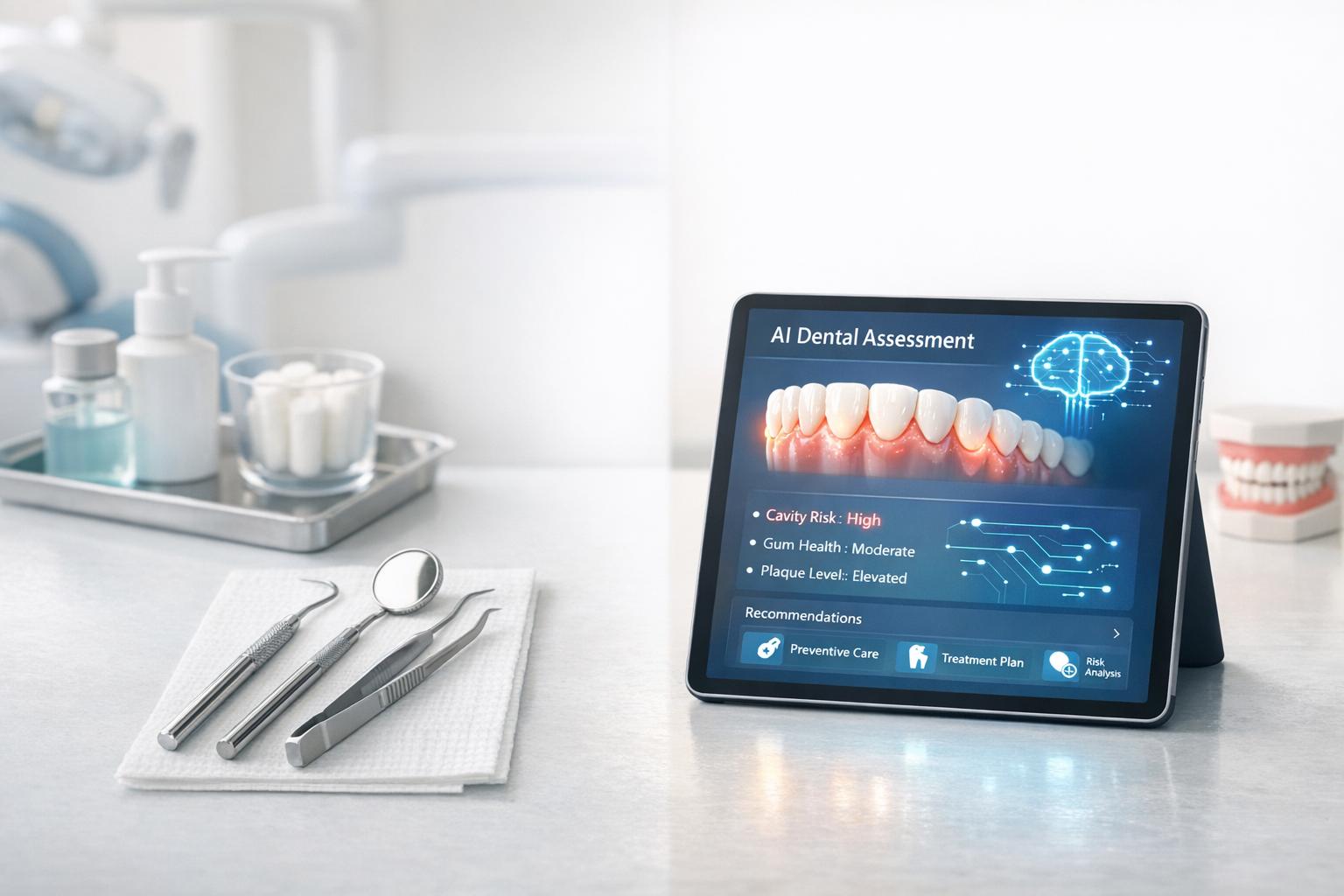
AI is changing how dentists assess oral health risks by offering data-driven precision, while traditional methods rely on hands-on expertise and clinician judgement. Here’s the key takeaway: AI excels in speed, consistency, and identifying subtle issues in radiographs, but it can’t replace the personal care and nuanced understanding dentists provide. Both approaches have strengths and challenges, and combining them can improve patient outcomes.
Key Points:
- AI Advantages:
- Analyses large datasets (e.g., radiographs, clinical notes).
- Higher accuracy for detecting conditions like cavities (up to 93%).
- Reduces variability in assessments.
- Speeds up processes like insurance checks.
- Traditional Methods:
- Relies on manual techniques (probing, visual exams).
- Provides direct patient interaction and tactile feedback.
- Accessible in areas without advanced tech.
- Can miss early signs of disease due to subjectivity and fatigue.
Comparison Table:
| Aspect | AI-Based | Traditional |
|---|---|---|
| Accuracy | High (82%–95%) | Variable, depends on skill |
| Speed | Fast | Time-intensive |
| Consistency | High | Subjective |
| Cost | High upfront investment | Low |
| Accessibility | Limited by tech availability | Widely available |
AI offers promising tools but must be supervised by qualified dentists to ensure safe and effective care. The future lies in blending both methods for better oral health outcomes in Australia.
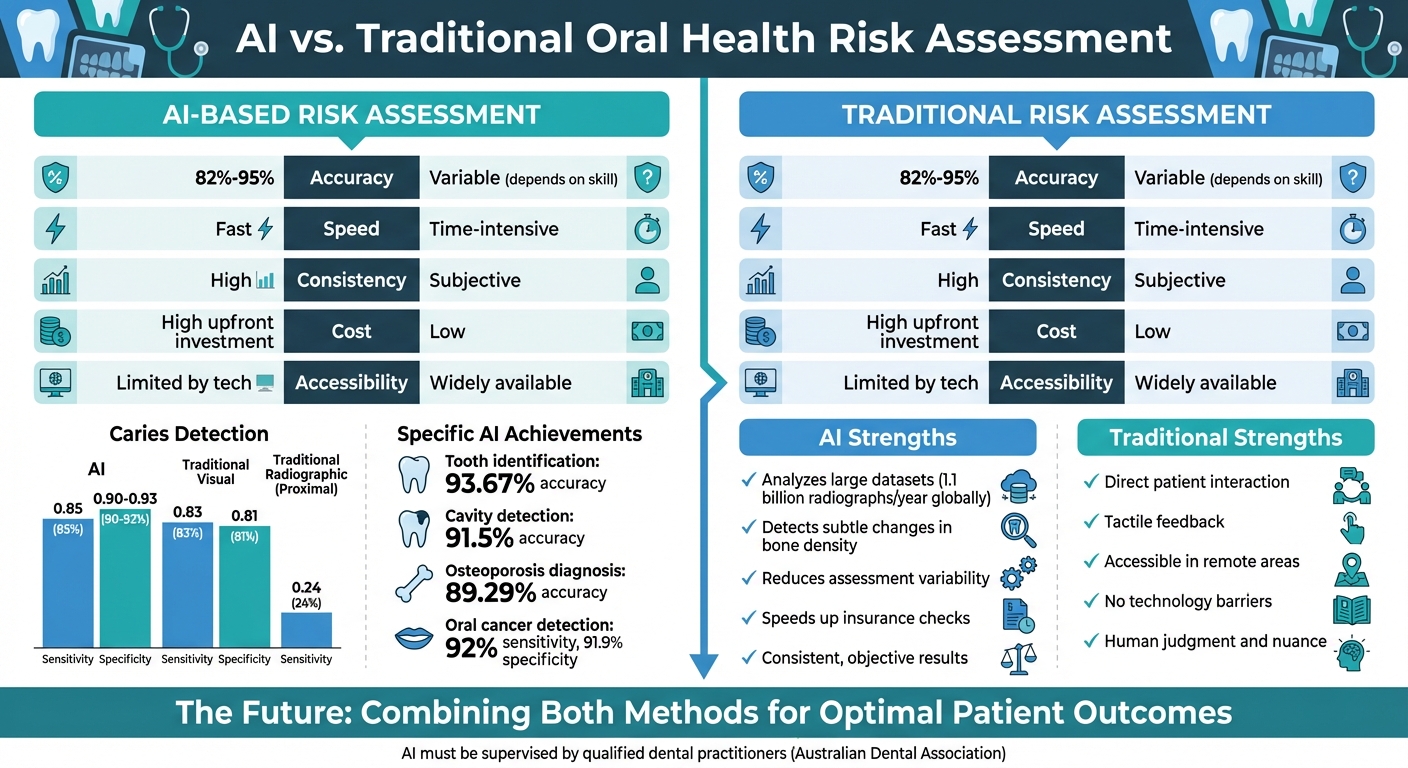
AI vs Traditional Oral Health Risk Assessment: Accuracy, Speed, and Cost Comparison
Same X ray, 50 different diagnoses Why dental AI matters
Traditional Oral Health Risk Assessment Methods
Traditional methods for assessing oral health risks rely on well-established manual techniques. One of the most widely used practices is manual periodontal probing, which involves a thorough examination of six specific sites around each tooth to measure clinical attachment levels and detect signs of inflammation. This remains a cornerstone of dental care [12]. In addition, dentists utilise visual inspections, patient questionnaires, and X-rays to evaluate disease indicators like bleeding during probing, bone loss, and risk factors such as smoking habits and medical history [10][11][12].
Key Features of Traditional Methods
The effectiveness of these traditional assessments heavily depends on the clinician’s skill and experience. To standardise evaluations, practitioners often use scoring systems such as:
- DMFT/DMFS (Decayed, Missing, and Filled Teeth or Surfaces) to track dental caries.
- Basic Periodontal Examination (BPE) for periodontal screening.
- International Caries Detection and Assessment System (ICDAS) for classifying caries.
- Basic Erosive Wear Examination (BEWE) for monitoring tooth wear [11].
These tools offer structured ways to document oral health, but their accuracy relies on the precision and consistency of the clinician conducting the assessment.
Challenges in Traditional Approaches
One major limitation of traditional methods is their subjectivity. Differences in clinician techniques and the potential for observational fatigue can lead to inconsistent results [6][10][13]. Studies have highlighted a lack of agreement among practitioners when assigning risk levels to identical patient cases, which raises concerns about reliability [10]. For example, self-reported screening questionnaires have shown a sensitivity of just 0.28 in predicting moderate to severe periodontitis, indicating significant room for improvement [13].
Another challenge is detecting oral health issues early. Subtle changes in bone density or tissue structure often go unnoticed with conventional tools, and minor radiographic anomalies may be overlooked by practitioners [2][6]. Additionally, the DMFT index, though effective in some cases, can become less useful in adult populations as it reaches a saturation point [11].
Time constraints and the complexity of integrating multiple risk factors further complicate manual assessments [10]. Despite the fact that 11% to 15% of the population is at high risk for periodontal disease, traditional methods often focus narrowly on the severity of existing conditions, potentially ignoring other critical risk indicators [10]. These challenges highlight the need for more objective and consistent approaches, paving the way for advancements like AI-based solutions.
AI-Based Oral Health Risk Assessment
Artificial intelligence is reshaping how dental professionals evaluate oral health risks by analysing vast amounts of patient data. Traditional methods often rely on a clinician’s judgment, but AI systems take things further by processing multiple data sources at once. These include radiographs, 3D scans, periodontal probing depths, and even text-based notes from electronic dental records [7]. This blended approach creates a detailed risk profile, capturing subtle variations in disease severity rather than just offering a simple "yes or no" diagnosis [1]. It’s a game-changer for understanding how AI operates within modern dentistry.
How AI Works in Dentistry
AI employs advanced machine learning techniques to detect patterns in dental data that might go unnoticed by the human eye. For example, Convolutional Neural Networks (CNNs) dissect radiographic images down to the pixel level, allowing for precise identification of conditions like cavities or bone loss [7]. With around 1.1 billion dental radiographs produced globally each year, the data available for training these systems is immense [7].
Natural Language Processing (NLP) also plays a crucial role by extracting valuable insights from clinical notes. This technology can identify treatment trends and track disease progression over time – details that might be missed in traditional assessments [7]. Notably, in 2025, Overjet’s FDA-cleared AI platform demonstrated its capabilities by analysing data from 343,297 patients. By combining radiographic and periodontal information with a weighted cost function, it delivered consistent and reliable scoring [1].
Benefits of AI in Risk Assessment
AI’s diagnostic accuracy is impressive, with success rates across dental specialties ranging from 82% to 95%. It boasts a sensitivity of 0.85 and a specificity of 0.93 [8]. In specific tasks, AI has achieved 93.67% accuracy in identifying and numbering teeth, 91.5% accuracy in detecting cavities, and 89.29% accuracy in diagnosing osteoporosis [9]. These consistent, data-driven results eliminate much of the variability seen in human interpretation [2].
Another significant advantage is speed. AI can process complex datasets quickly while maintaining high levels of precision. For instance, it can detect minute changes in radiographs – such as early signs of bone density loss or tissue damage – that might escape even the most trained human eye [2]. However, the Australian Dental Association stresses that AI should serve as a tool to support, not replace, clinical judgment [3]. Dentists must still verify AI findings against the broader clinical context, ensuring the technology complements rather than overrides their expertise.
Comparing AI and Traditional Methods
When you put AI side by side with traditional methods, the differences in performance are hard to ignore. AI systems handle data with precision, cutting out much of the human variability that can affect reliability [15][16]. This sets the stage for a closer look at how they compare in terms of diagnostic accuracy and workflow efficiency.
Accuracy and Reliability Comparison
The numbers don’t lie – AI often outperforms traditional methods in accuracy. For instance, AI algorithms used to detect dental caries show a pooled sensitivity of 0.85 and specificity between 0.90 and 0.93. By comparison, traditional visual examinations reach a sensitivity of 0.83 and specificity of 0.81 [15][8]. The gap becomes even more pronounced with radiographic detection. Traditional methods for spotting occlusal caries have a sensitivity as low as 0.35, and for proximal caries, it plummets to just 0.24 [15]. This means traditional X-ray interpretations can miss many early-stage cavities, which AI systems are much better at catching.
| Method | Condition | Sensitivity | Specificity |
|---|---|---|---|
| AI (CNN/ML) | Dental Caries (General) | 0.85 [15] | 0.90 [15] |
| Traditional Visual | Caries Diagnosis | 0.83 [15] | 0.81 [15] |
| Traditional Radiographic | Proximal Caries | 0.24 [15] | 0.97 [15] |
| AI (Overjet) | Calculus Detection | 0.85 [1] | 0.85 [1] |
| AI (Overjet) | Periapical Radiolucency | 0.91 [1] | 0.91 [1] |
In 2025, Overjet’s FDA-cleared platform analysed data from 343,297 patients across 2,558 U.S. dental practices. The results showed that AI-derived scores were highly effective at predicting treatment costs, outperforming traditional tools like the Marcus et al. Oral Health Status Index [1].
"Caries diagnosis using AI is accurate and its use in clinical practice is justified" – Arzani S. et al., PLOS One [15].
Time Efficiency and Workflow Integration
AI also stands out when it comes to saving time. Traditional assessments can be time-consuming, especially during patient appointments. In Australia, a typical new patient visit lasts about 60 minutes [4], with clinicians manually recording findings and interpreting radiographs. This process is not only lengthy but also prone to observational fatigue [1][2].
AI simplifies and speeds up these tasks. Routine detection, like identifying caries or bone levels in radiographs, happens automatically, allowing dentists to focus more on patient care. For example, insurance eligibility checks that once took several minutes now take just seconds [17]. AI-powered practice management systems also save dental offices countless hours each month with features like automated recalls, digital forms, and faster claims processing [17].
Another key advantage is consistency. Traditional methods often yield subjective results that can vary between different practitioners – or even the same practitioner on different days [2]. AI, on the other hand, delivers consistent and objective assessments by picking up on subtle, pixel-level changes that human eyes might overlook [2]. That said, the Australian Dental Association reminds us of the importance of balancing AI insights with clinical expertise:
"A decision to action an AI system’s result should only be made by a Dental Practitioner taking into account a patient’s clinical presentation, including history, examination and relevant tests" [3].
sbb-itb-2be92ed
Strengths and Limitations of Each Approach
Both AI and traditional methods offer distinct benefits, but they also come with practical challenges that influence how they can be applied in Australian dental practices.
Strengths of Traditional Methods
Traditional dental assessments provide a level of personal care and trust that aligns well with Australian practices, particularly those focused on long-term patient relationships and conservative treatment philosophies [4].
One of the key advantages of traditional methods is their ability to deliver highly accurate diagnoses through direct patient care [5]. Dentists can consider a patient’s complete clinical profile – medical history, physical exams, and tactile feedback – offering insights that AI systems cannot replicate. This comprehensive approach allows practitioners to detect subtle issues that might be overlooked in data-driven evaluations.
Traditional methods also shine in terms of accessibility. They are particularly valuable for vulnerable groups such as elderly Australians, individuals with limited digital skills, or those living in remote areas where technology infrastructure may be lacking [5]. Unlike AI systems, which often require specialised equipment, reliable internet connections, and technical know-how, traditional dental care can be delivered in almost any setting without additional costs or technological barriers [5][14].
Another major strength is the clarity of professional oversight. Dentists remain directly accountable for patient care, ensuring adherence to ethical standards without the "black box" challenges associated with AI systems [3]. This transparency fosters trust and supports ethical, patient-focused care.
While traditional methods excel in many areas, AI-based approaches face hurdles that limit their practicality in dental practices.
Limitations of AI-Based Methods
AI systems in dentistry encounter several obstacles that complicate their widespread adoption in Australian practices:
- High upfront costs for AI technology can deter smaller practices from investing in these systems [5][14].
- Training challenges add another layer of complexity. Dental professionals and their teams need time to become proficient with new systems, and patients may also require guidance to use remote monitoring devices effectively [5]. This is further complicated by the digital divide, where differences in digital literacy and socio-economic status can prevent disadvantaged communities from accessing AI-driven care [5]. As Professor Colman McGrath from the University of Hong Kong points out:
"Digital technology can exacerbate and reinforce pre-existing social health disparities" [5].
- AI accuracy tends to decline in real-world applications. While AI may perform well in controlled environments, its effectiveness can drop due to variations in equipment, patient demographics, or image quality [14][2]. For example, AI models designed to diagnose periodontal disease from intraoral photos have shown accuracy rates as low as 47% [5], which falls short of the reliability needed for clinical decision-making.
- Governance and liability issues remain a major concern. Without proper oversight, predictive AI systems could lead to misdiagnoses, unnecessary procedures, or financial inefficiencies [3]. The Australian Dental Association has emphasised this point:
"Any application of an AI system in dental clinical care must be supervised and managed by a Dental Practitioner and not be actioned autonomously by patients" [3].
Accountability questions persist, particularly in cases where AI-generated recommendations result in patient harm or unwarranted treatments [5][2]. These unresolved issues highlight the need for careful integration of AI into existing dental care frameworks.
Future of Dental Practice in Australia
Improved Patient Outcomes
AI is transforming dental care in Australia by identifying risks earlier and removing barriers to treatment. With its ability to deliver consistent, data-driven insights, AI is enhancing risk assessment in ways that were previously unimaginable. For instance, AI models can now detect plaque and gingivitis with accuracy rates as high as 99%, alongside sensitivities and specificities ranging between 92% and 94% [5]. This technology allows dental professionals to monitor long-term changes in a patient’s oral health, paving the way for more proactive and effective care.
When it comes to oral squamous cell carcinoma (OSCC), AI is proving to be a game-changer. With a sensitivity of 92% and a specificity of 91.9%, AI is improving early detection rates, which can elevate survival outcomes from below 30% after metastasis to an impressive 75% to 90% [2]. For Australians living in rural and remote areas, AI-powered teledentistry and remote monitoring tools offer significant benefits, such as reducing travel costs and minimising disruptions to work schedules [5].
Value-based care models are also seeing the advantages of AI. By providing objective measurements of disease severity and predicting treatment needs, these systems support clearer communication between dentists and their patients [1]. However, the integration of these advancements must align with Australia’s stringent regulatory standards to ensure both safety and effectiveness.
Integration with Australian Dental Practices
While the potential of AI in dentistry is immense, its successful adoption hinges on navigating Australia’s regulatory framework. AI systems must adhere to the guidelines set out by the Australian Dental Association (ADA) and the Dental Board of Australia. Supervision by a qualified practitioner is non-negotiable, as the ADA highlights:
"A decision to action an AI system’s result should only be made by a Dental Practitioner taking into account a patient’s clinical presentation, including history, examination and relevant tests" [3].
Additionally, AI systems must comply with the Office of the Australian Information Commissioner (OAIC) rules on data privacy. This means patient data must be collected with proper consent, securely stored, and used solely for its intended purposes [3]. Dental practices adopting AI are encouraged to establish independent governance structures to oversee system performance, ensuring alignment with ethical and healthcare standards. This is particularly important as the industry shifts toward practice consolidation and the rise of dental support organisations (DSOs) [3].
Generative AI tools, while useful for administrative tasks, require careful oversight. Practitioners must verify all outputs before they are finalised to ensure accuracy and reliability [3]. Furthermore, it’s crucial to educate patients about the limitations of using generative AI for self-diagnosis or treatment planning. Emphasising that AI serves as a supplementary tool rather than a replacement for clinical expertise is key [3].
Finally, addressing the digital divide is vital to ensure that AI benefits all Australians equally. Factors like digital literacy, internet access, and socio-economic challenges can prevent vulnerable groups – such as elderly individuals and those living in remote areas – from accessing AI-driven dental care [5]. Investments in digital literacy programs and infrastructure will be critical to avoid deepening existing oral health disparities and to make AI-driven advancements accessible to everyone.
Conclusion
When comparing AI with traditional methods for assessing oral health risks, it’s clear that their strengths complement each other. Traditional approaches rely on decades of clinical experience, human judgment, and a nuanced understanding of each patient’s unique needs. On the other hand, AI brings objectivity, the ability to process vast amounts of data, and a knack for spotting subtle changes that might go unnoticed by even seasoned practitioners.
For instance, AI-assisted systems have demonstrated impressive accuracy, diagnosing oral squamous cell carcinoma with 92% sensitivity and 91.9% specificity [2]. Similarly, AI models used for detecting conditions like caries and calculus show sensitivity and specificity ranging between 74% and 94% [1]. However, as highlighted by the Australian Dental Association:
"A decision to action an AI system’s result should only be made by a Dental Practitioner taking into account a patient’s clinical presentation, including history, examination and relevant tests" [3].
This reinforces the idea that AI is a supportive tool, not a standalone solution. While it can address the subjective aspects of traditional assessments, practitioner oversight remains essential.
Looking ahead, the integration of AI with traditional methods could redefine oral healthcare in Australia. AI has the potential to analyse the staggering 1.1 billion dental radiographs produced globally each year [7], spotting patterns and risks with remarkable precision. However, these insights must be carefully interpreted by dental professionals, who can consider the broader context of a patient’s health, lifestyle, and treatment objectives.
For this integration to succeed, it’s vital to uphold strict regulations, protect patient data, and ensure ongoing professional training. When used responsibly, AI can help make timely care more accessible, support value-driven treatment models, and improve oral health outcomes across diverse communities. By embracing AI as a tool that enhances – not replaces – clinical expertise, the future of dentistry can combine the best of human judgment and technological innovation.
FAQs
How does AI enhance the accuracy of oral health risk assessments compared to traditional methods?
AI has transformed oral health risk assessments by leveraging advanced machine learning to process large volumes of clinical and imaging data. This technology achieves sensitivity rates of about 91–94% and specificity rates ranging from 88–99%. These figures are a stark improvement compared to the 24–36% sensitivity commonly associated with traditional visual examinations.
By cutting diagnostic errors by as much as 37%, AI equips dentists with a more reliable and efficient way to detect potential issues early. This not only enhances treatment accuracy but also promotes better overall oral health care outcomes.
What challenges does AI face in dental health assessments?
While AI holds promise for improving dental care, several hurdles are slowing its adoption in Australian practices. One major issue is that many AI systems are trained on datasets that don’t fully reflect the diverse characteristics of Australian patients. This can result in biases and lower accuracy when applied in real-world settings. On top of that, factors like image quality, differences in equipment, and how patients are positioned can all affect how well AI performs.
Regulatory and ethical concerns add another layer of complexity. The Australian Dental Association stresses the importance of maintaining patient safety, protecting data privacy, and securing informed consent when using AI tools. Without proper oversight from clinicians, there’s a risk of errors or even data breaches. Compounding this issue is the lack of transparent validation for many AI products, making it hard for dental professionals to gauge their reliability.
Practical challenges also play a role. High licensing fees, the need for staff training, and the requirement for ongoing monitoring make implementing AI a daunting task. Dental practices, including those offering a wide range of services like Complete Smiles Bella Vista, must navigate these obstacles carefully. AI should be seen as a tool to complement professional judgement, not replace it.
How can AI and traditional methods work together to improve dental care?
AI and traditional dental practices can work together to improve patient care by merging advanced data analysis with hands-on clinical expertise. For instance, AI can quickly evaluate dental X-rays, assess probing depths, and calculate risk scores to flag potential problems early on. This helps dentists concentrate on high-risk areas during examinations and customise treatment plans, taking into account a patient’s medical history and lifestyle habits.
By blending AI’s precision and speed with the human judgement and personalised care of dentists, patients benefit from earlier interventions, more accurate diagnoses, and streamlined appointments. This combination not only enhances oral health outcomes but also upholds patient safety and aligns with the high standards of Australian dental care.
Related Blog Posts
- AI in Dentistry: Predicting Periodontal Disease
- How AI Improves Remote Dental Care
- AI in Oral Cancer Detection: How It Works
- AI vs Radiographs: Caries Detection Accuracy
Important Notice: Any surgical or invasive procedure carries risks. Before proceeding, you should seek a second opinion from an appropriately qualified health practitioner.
Individual results may vary. The information provided in this article is for educational purposes only and does not constitute medical advice.
Checkout Related Blogs




Get in touch with us
For more information, call us now to start feeling better. Or fill the form below to make appointment
The Latest News from Complete Smiles
How to Clean Clear Plastic Retainers
Checklist for Choosing Wearable Dental Devices
Checklist for Choosing Cloud AI Platforms in Dentistry

Complete Smiles Bella VistaAccepts All Major Health Funds, Including





