





Top 5 Ethical Risks of AI in Dentistry
AI is reshaping dentistry, but it comes with ethical risks that must be addressed. These risks include algorithmic bias, data privacy concerns, lack of transparency, unclear accountability, and overreliance on AI systems. Here’s a quick breakdown:
- Algorithmic Bias: AI trained on limited or non-diverse datasets may fail to provide accurate diagnoses for all patient groups, potentially leading to unequal care.
- Data Privacy and Security: AI systems require large amounts of sensitive patient data, making them attractive targets for cyberattacks and raising concerns about consent and misuse.
- Lack of Transparency: Many AI tools function as "black boxes", making it difficult for dentists to understand or validate how decisions are made.
- Accountability and Liability: Practitioners remain legally responsible for AI-driven errors, creating a challenging dynamic when relying on AI recommendations.
- Overreliance: Dependence on AI could erode clinical reasoning skills, with risks of automation and anchoring bias influencing decision-making.
While AI can assist with diagnostics and efficiency, its integration into dental care requires vigilance to ensure ethical and safe practices. Dentists must combine AI insights with their expertise, prioritising patient trust, data protection, and informed decision-making.
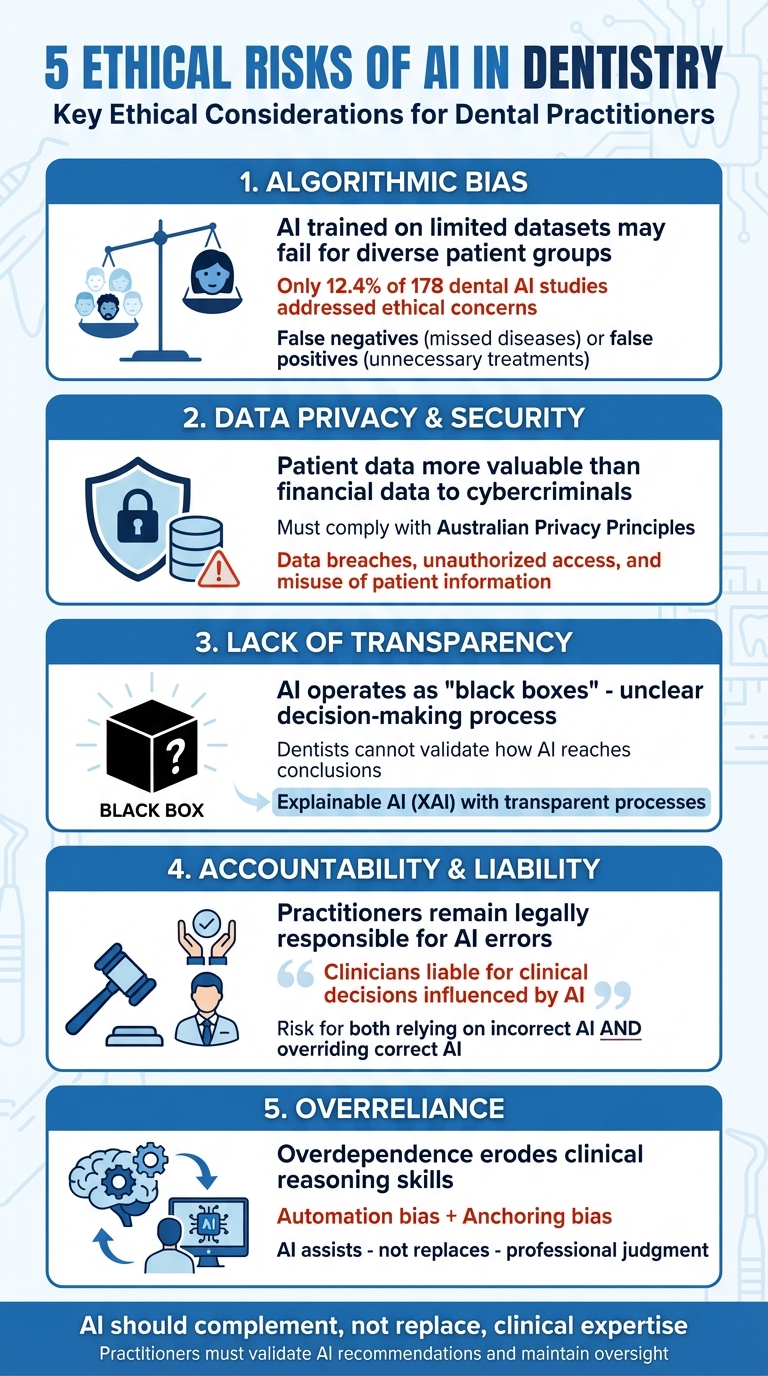
5 Ethical Risks of AI in Dentistry: Quick Reference Guide
The Future of Dentistry: AI, Ethical Practices, and Global Standards with Dr. Kianor Shah
1. Algorithmic Bias
AI systems rely heavily on the data they are trained on, and if this data lacks diversity, the results can end up being skewed. For instance, when dental AI tools are developed using data primarily from high-income countries, they risk underperforming for patients from varied ethnic and socio-economic backgrounds. This geographical limitation in training data means that diagnostic models that work well for one population might not be effective for another.
This kind of bias can result in serious consequences, such as false negatives (where dental diseases are missed) or false positives (leading to unnecessary treatments) [6]. A notable example comes from dermatology AI, where systems trained on datasets with only 5–10% Black patients showed approximately 50% lower accuracy for Black patients compared to white patients [7]. This highlights a similar issue in dentistry, where anatomical differences can significantly affect AI predictions [8].
"Lack of diversity in engineering and biomedical teams can replicate unconscious bias and power imbalances." – Natalia Norori et al. [7]
A scoping review focused on AI-driven caries detection identified lack of diversity as a key ethical concern [6]. Alarmingly, out of 178 dental AI studies, only 12.4% addressed ethical considerations such as equity or privacy [4], underscoring how often these biases are overlooked during development.
To address these risks, Australian dental practitioners can take several practical steps. First, they should ensure that AI tools are trained on diverse datasets [1][6]. Additionally, AI should be used as a supplementary tool, always combined with clinical expertise and judgement [1][3]. Finally, regular audits of AI performance are crucial to detect and prevent any inadvertent discrimination against patients [1].
2. Data Privacy and Security
AI systems in dentistry rely heavily on extensive datasets, including patient records, diagnostic images, and treatment histories. This wealth of sensitive health information is highly valuable to cybercriminals – often more so than financial data – making dental practices that utilise AI appealing targets for hackers [7, 18]. The risk isn’t just about data breaches; concentrated datasets can also open the door to more sophisticated cyberattacks.
In addition to breaches, there’s a risk that AI models could be exploited to reveal sensitive training data or re-identify anonymised records [10]. Another concern is the potential misuse of patient data. Information initially collected for clinical purposes might be repurposed to train AI models without the patient’s knowledge or consent, which could breach the Australian Privacy Principles [5, 17].
"The vast amounts of data collected and stored by generative AI may increase the risks related to data breaches… through unauthorised access to the training dataset or through attacks designed to make a model regurgitate its training dataset."
– Office of the Australian Information Commissioner (OAIC) [10]
Australian dental practices must adhere to the Privacy Act 1988 and the 13 Australian Privacy Principles, which regulate how personal information is collected, stored, and shared [5, 18]. Under these guidelines, diagnostic images like X-rays and 3D scans are classified as sensitive information, requiring explicit patient consent and stringent safeguards [7, 17]. The Dental Board of Australia reinforces this responsibility, stating:
"Regardless of what technology is used to advance healthcare, the practitioner remains responsible for delivering safe and quality care and for ensuring their own practice meets the professional obligations set out in their Code of Conduct." [3]
To meet these obligations, dental practices must implement robust measures. These include conducting Privacy Impact Assessments, using encrypted servers with multi-factor authentication (MFA), and obtaining specific patient consent for AI-related data use [7, 17, 18]. Regular audits, staff cybersecurity training, and choosing AI vendors based in Australia can further strengthen data protection efforts [11].
3. Lack of Transparency
Many AI systems used in dental diagnostics operate like "black boxes." Dentists input data, such as an X-ray, and receive a diagnosis – but they’re left in the dark about how the AI arrived at that conclusion, even when the system is developed by leading experts [12].
This lack of clarity poses serious challenges for clinical validation. For instance, when AI flags potential issues like cavities or oral cancer, dentists have no way to confirm whether the AI correctly prioritised the relevant clinical features. A striking example comes from a study where an AI misdiagnosed COVID-19 because it relied on annotated markers instead of actual lung features [12].
"Deep learning… has been associated with the ‘black box effect’ – a phenomenon where the internal decision-making processes of the models are not easily understandable to humans."
– Nature [6]
This lack of transparency also complicates accountability. If an AI provides an incorrect diagnosis, it becomes difficult to determine who – or what – is at fault [6]. The Australian Dental Association has stressed that "the extent of the contribution of an AI system in dental clinical decision making should be clearly recognised and understood by Dental Practitioners and patients" [2]. Without insight into how an AI reaches its conclusions, dental practitioners cannot ensure patients provide informed consent or confidently apply their professional judgement to verify the AI’s findings.
The way forward lies in Explainable AI (XAI) – a type of system designed to make its decision-making process more transparent. For example, researchers are working on techniques like saliency maps, which highlight specific radiographic features that influenced the AI’s decision [6]. The Dental Board of Australia also reminds practitioners that "practitioners must apply human judgement to any output of AI" [3]. This underscores the importance of pairing transparent AI tools with clinical oversight to ensure accurate and reliable decision-making.
sbb-itb-2be92ed
4. Accountability and Liability
When an AI diagnostic error occurs, the legal responsibility falls squarely on the shoulders of the dental practitioner. According to the Dental Board of Australia:
"Regardless of what technology is used to advance healthcare, the practitioner remains responsible for delivering safe and quality care and for ensuring their own practice meets the professional obligations set out in their Code of Conduct" [3].
This principle underscores the legal complexities surrounding AI use in dental care.
Practitioners face a challenging liability paradox: they risk legal consequences both for relying on an incorrect AI recommendation and for overriding a correct one [14]. Len D’Cruz, Head of BDA Indemnity, summarises this dilemma:
"Clinicians remain liable for clinical decisions influenced by AI" [13].
Even though AI systems can achieve over 97% accuracy in detecting dental caries from radiographs [14], the current legal framework places the entire burden of responsibility on healthcare providers. AI is legally classified as a "clinical support system", not an autonomous decision-maker [14][15]. This means that practitioners must retain ultimate authority over diagnoses and treatment plans while being prepared to justify any deviations from AI recommendations. To mitigate risks, experts suggest maintaining a standardised record of AI overrides, documenting the reasons behind challenging an AI diagnosis [14].
This level of accountability could discourage practitioners from adopting AI tools due to the associated legal risks. Dr. M. G. Mathew from Christian Dental College highlights this concern:
"A major flaw in current legal frameworks is that full responsibility for AI-related errors falls on clinicians, discouraging AI adoption due to legal risks" [14].
Some professional organisations are now advocating for a shift towards a "shared liability model", where manufacturers of AI systems would share responsibility for the accuracy of their products [2]. This could lead to a fairer distribution of accountability and potentially encourage broader acceptance of AI in clinical practice.
The Australian Dental Association advises practitioners to ensure any AI system they use is "fit for purpose." Dentists are expected to understand the system’s limitations, critically evaluate its outputs, and integrate these insights with a patient’s clinical presentation, including their history, examination, and relevant tests [2][3]. These liability concerns echo broader ethical debates about the role of AI in healthcare.
5. Overreliance and Reduced Human Oversight
AI-powered diagnostics bring undeniable benefits, but they also pose a risk to the clinical reasoning skills of dental professionals. A. F. Luai from the Centre of Population Oral Health and Clinical Prevention Studies highlights this concern:
"Overreliance on AI outputs could undermine independent clinical reasoning among students and dentists, raising questions about competency development" [16].
This overdependence goes beyond issues like bias and data security, introducing challenges to clinical autonomy. Two cognitive biases often emerge when AI systems are overused: automation bias, where clinicians accept AI decisions without sufficient scrutiny, and anchoring bias, where early AI suggestions disproportionately shape clinical evaluations [16]. These biases are particularly likely to surface during high-stress situations, such as periods of heavy workload or fatigue [3]. Alarmingly, researchers have identified 45 ethical concerns tied to AI in dentistry, with overreliance standing out as one of the most critical [17].
Regulators emphasise that AI should only serve as a supportive tool, leaving full clinical judgement and responsibility in the hands of dental practitioners [3][2].
Overreliance also threatens the precautionary principle – a hallmark of human clinical practice. Dentists often err on the side of caution, especially when diagnosing serious conditions like oral cancer, considering the potential consequences of a misdiagnosis. In contrast, AI systems prioritise statistical accuracy over clinical caution. Even minor data corruption, such as 4% adversarial noise, can lead an AI to misclassify lesions [17].
TDIC Risk Management underscores this balance:
"AI is a tool to assist – not replace – their professional judgment" [9].
To preserve clinical integrity, practitioners should continue to perform manual diagnostic checks, seek input from colleagues, and treat AI as an advisory resource rather than a decision-maker [3]. This approach ensures that human oversight remains at the forefront of patient care.
Conclusion
AI holds promise for transforming dentistry, but it brings ethical challenges that demand attention from practitioners, regulators, and technology developers. Issues like algorithmic bias, data breaches, lack of transparency, ambiguous accountability, and overreliance on AI cannot be ignored. A systematic scoping review of 178 studies revealed that only 12.4% (22 studies) addressed ethical concerns related to AI in dentistry [4], highlighting a significant gap in research and awareness. Without proper oversight, AI risks amplifying health disparities, exposing sensitive data, and undermining clinical decision-making. Addressing these gaps is essential for the ethical integration of AI into dental practice.
The Dental Board of Australia clearly states:
"Regardless of what technology is used to advance healthcare, the practitioner remains responsible for delivering safe and quality care and for ensuring their own practice meets the professional obligations set out in their Code of Conduct" [3].
This underscores the principle that AI should complement, not replace, clinical judgement. Dentists must validate AI recommendations, inform patients about its role, and implement robust data protection measures, such as multi-factor authentication, encrypted storage, and obtaining active patient consent [5].
When used responsibly, AI can enhance diagnostic accuracy and improve workflow efficiency. In Australia, clinics like Complete Smiles Bella Vista demonstrate how advanced technology, combined with personalised care, can elevate patient outcomes. By blending AI insights with clinical expertise, practitioners can offer tailored treatments while preserving the essential doctor–patient connection.
Dr. Marcus Engelschalk captures this balance perfectly: "The principle of ‘man and machine’ and not ‘man against machine’ should be the top priority" [18]. With strong regulations, clear communication, and vigilant oversight by clinicians, AI can enhance dental care without compromising the ethical principles that underpin the profession. As dentistry evolves, maintaining this balance will be key to ensuring AI serves as a tool for progress, not a source of ethical dilemmas.
FAQs
How can dentists address bias in AI systems used in dental care?
Dentists can take steps to reduce bias in AI systems by making sure the data used to train these tools represents Australia’s diverse population. This means including records from people of various ages, ethnic backgrounds, socioeconomic statuses, and geographic locations, particularly those from rural and remote areas. Regular audits of AI outputs can help spot and address any disparities early, ensuring fair and accurate performance across all groups.
Transparency and clinician oversight play a key role in using AI responsibly. Dentists must remain fully accountable for diagnostic decisions, clearly document how AI recommendations are applied, and openly communicate the role of AI in patient care. Cross-checking AI outputs with established clinical standards and staying up to date on AI ethics through professional development are also essential steps to ensure the technology is used safely and fairly.
By following these practices, dental clinics can embrace AI’s capabilities while upholding ethical, evidence-based care for Australians from all walks of life.
How can patient data privacy be protected when using AI in dental care?
Protecting patient data privacy when incorporating AI into dentistry requires a thorough strategy that aligns with Australian regulations and practices. Dental clinics must adhere to the Privacy Act 1988 and the Australian Privacy Principles (APPs). This means obtaining informed consent before collecting personal health data, ensuring it is used solely for its intended purpose, and storing it securely. Key measures like encrypting data, enforcing strict access controls, and keeping detailed audit trails are vital for safeguarding sensitive information.
To reduce potential risks, clinics should embrace data-minimisation – using only the information necessary for AI systems to function effectively. When sharing data with third-party providers, binding agreements must ensure compliance with APP standards. Regular security audits, ongoing staff training, and clear protocols for managing breaches further strengthen data protection efforts.
It’s also crucial to monitor AI algorithms for biases or unintended data leaks, as these can undermine trust. Clinics such as Complete Smiles Bella Vista can embed these safeguards into their daily operations, ensuring AI not only improves patient care but also upholds confidentiality and ethical practices.
What impact can overreliance on AI have on a dentist’s clinical skills?
Overreliance on AI in dentistry poses the risk of eroding essential clinical skills. When dentists lean too much on AI for diagnosing or treatment planning, they may gradually lose the habit of critically evaluating radiographs or manually assessing clinical findings. This reliance can weaken their ability to make independent decisions or identify rare cases that AI systems might not be equipped to handle.
The Australian Dental Association emphasises that AI should support clinical judgement rather than replace it. Relying too heavily on technology can jeopardise patient care, especially if the AI makes mistakes or struggles with unfamiliar data. To preserve and sharpen their clinical expertise, dentists should prioritise hands-on assessments, engage in reflective practice, and participate in peer reviews. AI works best as a complementary tool, enhancing both efficiency and accuracy without overshadowing human expertise.
Related Blog Posts
- AI vs. Traditional Methods: Impacted Teeth Detection
- Real-Time AI in Dental Imaging: What to Know
- AI in Dentistry: Predicting Periodontal Disease
- AI vs. Traditional Oral Health Risk Assessment
Important Notice: Any surgical or invasive procedure carries risks. Before proceeding, you should seek a second opinion from an appropriately qualified health practitioner.
Individual results may vary. The information provided in this article is for educational purposes only and does not constitute medical advice.
Checkout Related Blogs




Get in touch with us
For more information, call us now to start feeling better. Or fill the form below to make appointment
The Latest News from Complete Smiles
How to Clean Clear Plastic Retainers
Checklist for Choosing Wearable Dental Devices
Checklist for Choosing Cloud AI Platforms in Dentistry

Complete Smiles Bella VistaAccepts All Major Health Funds, Including





